



Avoiding Customs Fees on Craft Supplies: Understand the Costs
The country shown as the shipping point doesn’t necessarily determine the customs duty. For U.S. imports, tariff rates depend on a product’s country of origin, not the country it ships from. A sound approach to avoiding customs fees on craft supplies starts with understanding that difference and knowing that duty is only one possible import charge.
It is easy to focus on the item price and shipping, then be surprised by a separate bill at delivery. Depending on the destination and shipping terms, the total may also include import taxes or brokerage charges. This guide explains what each charge means, how shipping origin differs from where an item was made, and how to estimate landed cost before ordering. That way, you can make a more informed decision about craft supplies from abroad and reduce surprises at delivery.
Key Takeaways
- Separate customs duty, import tax, and courier brokerage charges to understand what may make up a delivery bill.
- Learn how Canada’s mailed-goods and gift exemptions work, and why a purchase doesn’t automatically qualify as a gift.
- Distinguish where a parcel ships from where its contents were made, since the difference can affect U.S. tariff treatment.
- Compare an international order’s full landed cost with a local option, not just the listed item price.
- Explore how leathercraft bundles, leather, hardware, and tools can support your next project.
1. What Is A Customs Duty?
Customs duty is a government charge assessed on some imported goods when they cross a border. It is separate from sales tax and courier brokerage, so a parcel can incur several charges. In Canada, duty rates vary by imported item, and the Department of Finance Canada establishes the rates. Most goods imported into Canada may also incur GST and PST, or HST in some provinces and territories.
For goods mailed to Canada, value affects whether an exemption applies. A mailed item worth CAN$20 or less is exempt from duty and tax under the Postal Imports Remission Order, subject to listed exclusions. A mailed item worth more than CAN$20 is subject to applicable duty, GST or HST, and any PST on its full value. The CAN$20 exemption doesn’t apply to goods ordered through a Canadian post office box or intermediary.
Shipment origin can also change the amount due. In June, China- or Hong Kong-origin items sent through the international postal network were subject to a tax of either 54% of their value or a flat $100 per postal item. In early May, the tax on those postal items was as high as 120% of their value. These figures describe different periods, not a single rate to apply to every order.
Shipping terms clarify who pays charges at delivery. With delivered duty paid (DDP), the shipper covers duties. With delivered duty unpaid (DDU), or “tax unpaid” shipping, the recipient is likely to owe duties, brokerage charges, and other fees. The CBSA Duty and Tax Estimator provides an estimate, not a final bill.
Legal ways to reduce customs costs include using an exemption only when the shipment genuinely qualifies and understanding its origin and shipping terms before ordering. Never undervalue or mislabel goods to lower charges. For most commercial goods entering the United States, importers or their agents must file an electronic or paper entry for release, followed by an entry summary, according to U.S. Customs and Border Protection. Accurate product descriptions and values support these required documents.
Undervaluing or mislabeling an item can lead to customs enforcement and reassessment. The consequences depend on the rules governing the shipment and the circumstances. Use the actual value and an accurate description, rather than declaring a purchase as a gift.
2. Gift exemption for mailed items worth CAN$60 or less
Canada’s mailed-gift exemption applies to qualifying gifts worth CAN$60 or less. The gift must come personally from a friend or relative, with a card or other notice identifying it as a gift. If its value exceeds CAN$60, applicable duty and taxes apply to the amount above CAN$60. This exemption cannot be combined with the CAN$20 exemption for most mailed items.
A purchase doesn’t become a gift because a seller labels it that way. The mailed-gift exemption excludes tobacco, alcoholic beverages, advertising material, and items sent by a business. Falsely asking a seller to declare purchased craft supplies as a gift to avoid customs charges is customs fraud. The separate CAN$20 exemption also has limits: it doesn’t apply to goods ordered through a Canadian post office box or a Canadian intermediary, and listed exclusions may apply.
For returning U.S. residents, some qualifying unaccompanied purchases may receive personal exemptions based on where they come from. Qualifying purchases from an insular possession may receive a duty-free exemption up to $1,600. Qualifying purchases from a Caribbean Basin Initiative or Andean country may receive an exemption up to $800. For qualifying goods from these origins, up to an additional $1,000 is dutiable at a flat 3% rate.
To use the described procedure, qualifying purchases from an insular possession or Caribbean Basin Initiative country must arrive within 30 days and be sent directly to the United States. Unaccompanied purchases shipped to the United States must be listed on CBP Form 255, with a separate form for each package or container. A craft supply may qualify for duty-free treatment under a U.S. trade agreement if it meets that agreement’s origin requirements; being a craft supply alone doesn’t establish eligibility. U.S. customs duties depend on the product’s tariff classification, country of origin, and applicable rate.
The U.S. de minimis exemption also changed. It ended on May 2 for packages from China and Hong Kong. An executive order suspended the exemption for shipments from all countries beginning August 29. These changes mean an order’s value alone doesn’t establish duty-free treatment; origin and the rules applying when goods arrive matter.
3. Import sales tax and courier brokerage charges
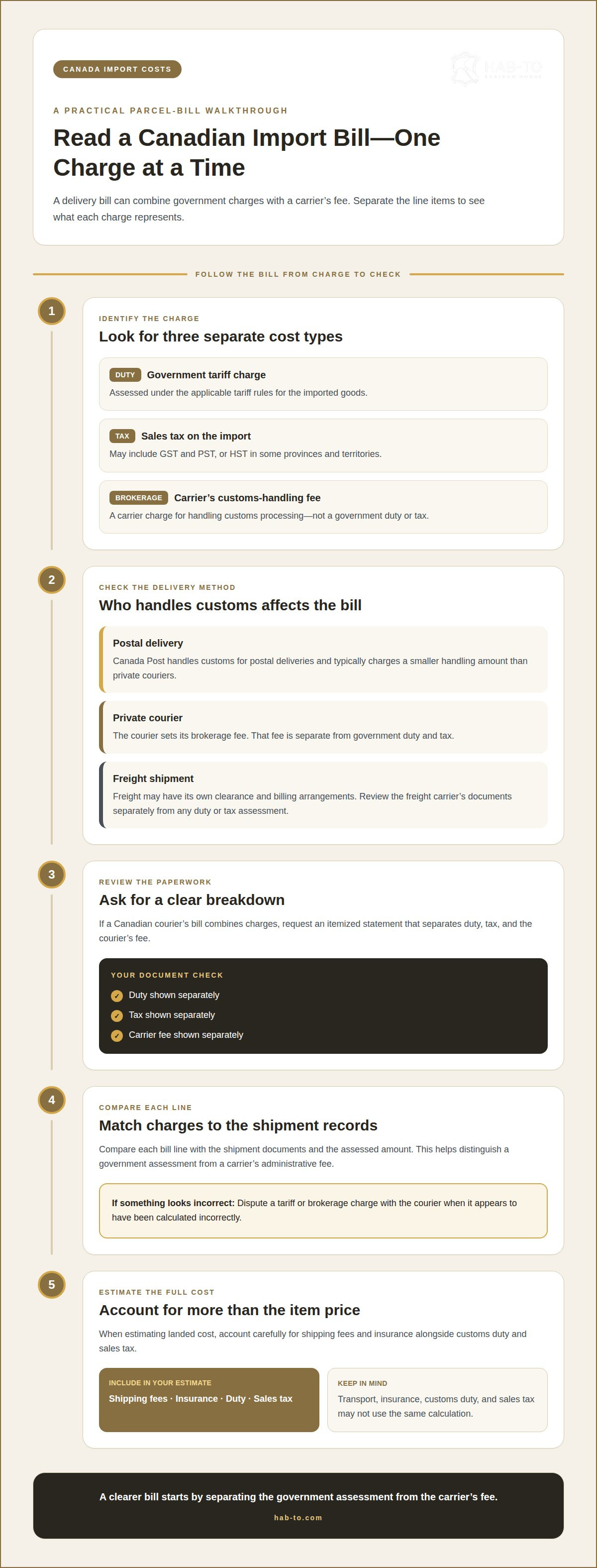
At the Canadian border, an imported parcel can incur customs duty, sales tax, and brokerage as separate charges. Duty is assessed under applicable tariff rules. Sales tax may include GST and PST, or HST in some provinces and territories. Brokerage is the carrier’s charge for handling customs processing. Separating these items makes a delivery bill easier to understand.
The shipping method affects who handles customs and how charges appear. Canada Post handles customs for postal deliveries and typically charges a smaller handling amount than private couriers. A courier’s brokerage fee is set by that courier, not the government. Freight shipments may have their own clearance and billing arrangements, so review the freight carrier’s documents separately from any duty or tax assessment.
Check the paperwork before paying. If a Canadian courier’s bill combines charges, request an itemized statement that separates duty, tax, and the courier’s fee. Compare each line with the shipment documents and assessed amount. If the courier appears to have calculated tariff or brokerage charges incorrectly, dispute the charge with that courier. This helps distinguish a government assessment from a carrier’s administrative fee.
Account carefully for shipping fees and insurance when estimating landed cost. Do not assume transport, insurance, customs duty, and sales tax use the same calculation base. Customs valuation and tax rules depend on the destination, while brokerage remains a separate carrier charge. List the item value, shipping, insurance, assessed duty, tax, and brokerage separately when estimating the total cost of craft supplies.
For example, a parcel shipped by Canada Post and one handled by a private courier may face the same kinds of border charges, but their handling fees can differ. A freight invoice may also separate transportation from customs processing. Carrier paperwork can show whether an amount is duty, tax, or a service fee. Review those categories before deciding whether a bill needs clarification or a dispute.
To compare shipping methods, identify who manages customs, what the carrier charges for handling, and whether payment is due before or at delivery. The goods’ import status determines whether applicable duty or tax is assessed; the delivery method does not turn a carrier fee into government duty. For accurate budgeting, add each documented charge once and keep brokerage separate from the item’s listed price.
4. Shipment origin versus country of manufacture
The country a parcel ships from is not necessarily where its contents were made. A craft supply may leave a warehouse in Germany after being manufactured in China. For U.S. imports, tariff rates depend on the product’s country of origin, not its shipping country. Knowing where an item was made helps you understand which tariff treatment may apply when avoiding customs fees on craft supplies legally.
It was made in China but shipped to the United States from Germany. Germany was the dispatch point; China was the manufacturing origin relevant to tariff treatment. A European shipping address alone does not establish that an item receives treatment based on European origin.
Keep these details separate when estimating an international order. The shipping point is where the seller dispatches the parcel; the country of manufacture is where the product was made. A marketplace warehouse, postal processing centre, or seller’s dispatch location may differ from the manufacturing country. Do not use the parcel’s departure country as a substitute for the product’s origin.
Before comparing craft supplies, note the listed manufacturing country and shipping country separately. If a product page says an item was made in China and ships from Germany, record both facts. Then consider the destination country’s tariff rules and the item’s classification. These details, rather than the route alone, help explain why similar supplies may receive different customs treatment.
For Canadian buyers, stock already held in Canada presents a different consideration. Buying from Canadian-held stock avoids a new border crossing for that order, and therefore avoids import duty and brokerage on that shipment. This differs from buying an imported item that has already crossed into Canada. The key question is whether that particular order crosses the border again.
When reviewing a listing, ask where the item was made, where it will ship from, and where it is being delivered. For a U.S. order, the China-made, Germany-shipped ukulele illustrates why origin matters for tariff rates. For a Canadian order, Canadian-held stock means no new import crossing for that shipment. Separating these details supports lawful, informed decisions about avoiding customs fees on craft supplies.
5. Comparing the full landed cost with local prices
An international listing’s item price is only one part of the buying decision. Compare the total payable amount with the local price for an equivalent supply, matching the quantity, material, and stated specifications. When assessing ways to avoid customs fees on craft supplies, this comparison shows whether an apparent saving remains after delivery and import charges.
Build a simple worksheet for each order. Record the item amount and shipping separately, then add each charge shown in the carrier’s documents. Keep customs duty, GST or HST, any PST, and courier brokerage as distinct entries. The result is the shipment’s documented landed cost, not a guess based on the product listing alone.
- Item amount and quantity being ordered
- International shipping and any separately listed insurance
- Customs duty assessed for the shipment
- Applicable GST, HST, or PST
- Courier brokerage or postal handling charge
Use the same currency for both totals. If an international listing and the local price use different currencies, convert the order total consistently before comparing. Keep the conversion record with the listing and shipping details. This makes the calculation transparent without treating currency conversion as a customs charge.
Next, compare like with like. A local supply and an imported one should match in material, usable quantity, and relevant specifications. For leathercraft, check the stated leather type and thickness instead of comparing different cuts or grades. For tools, compare the same tool type and included components. A lower listed price may not save money if the imported option does not suit the project.
Delivery terms also affect when charges appear. With delivered duty paid shipping, the shipper covers duties; with tax-unpaid terms, the recipient is likely to owe duties, brokerage, and other fees. Add each charge only once. If a carrier invoice already includes a fee in its total, do not enter it again as a separate amount.
Finally, compare the local total with the full imported total, not just the checkout subtotal. A Canadian-held item avoids a new border crossing for that order, while a new international shipment may bring duty, tax, and handling charges. Understanding these costs is a practical part of avoiding customs fees on craft supplies: it helps distinguish legitimate charges from costs you may avoid by choosing a different source or shipping arrangement.
Hab-To Leather House: Crafting Bundles
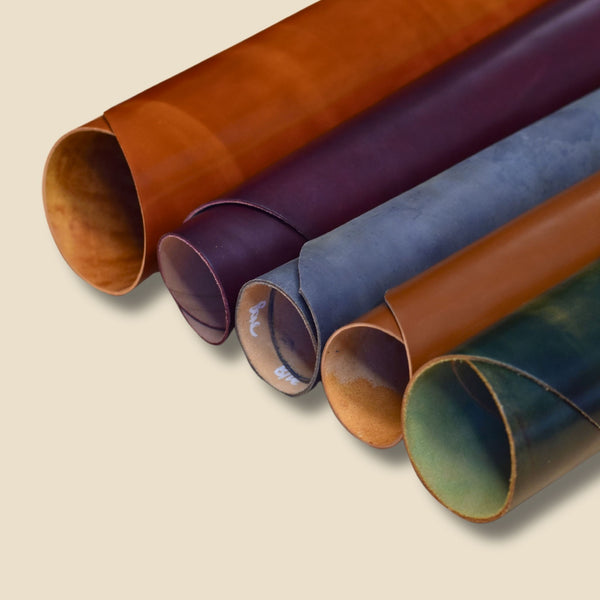
Hab-To Leather House offers Crafting Bundles, Vegetable Tanned Leather, Leather Hardware, and Leatherworking Tools for leathercraft projects. These materials can be a practical next step when you’re ready to plan a project and select supplies suited to the work. They don’t change customs rules or remove charges on an international shipment, so use the landed-cost comparison above when weighing order options.
A Crafting Bundle may help bring project supplies together when you’re starting a new piece or building your leathercraft practice. Browse the starter bundles to see an option for beginning a project. For a specific build, first consider the materials and tools the work requires, then compare the complete cost of any order crossing a border with local alternatives.
Vegetable Tanned Leather is relevant when the material itself is central to your project. Choosing leather suited to the work lets you focus on the craft, while keeping in mind that a parcel’s dispatch country does not guarantee its customs treatment. The country of manufacture and shipping terms remain separate details in any import-cost estimate.
Leather Hardware can support projects that require suitable components alongside the leather. Leatherworking Tools may help when your work calls for dedicated tools rather than materials alone. These offerings are useful to consider as part of a complete project plan: identify what the design needs, then account for each item’s purchase and delivery costs.
For example, when planning a leathercraft project, list the leather, hardware, and tools you need, then compare the order’s full landed cost with local prices. A bundle may suit a project that benefits from a grouped selection; individual materials or tools may better fit a specific requirement. The right choice depends on the project, not an assumption that every imported parcel will avoid duty, tax, or brokerage.
Careful planning matters. Match materials and tools to the work, and keep customs charges distinct from product costs when comparing options. If you’d like to discuss your leathercraft needs, contact Hab-To Leather House.
Frequently Asked Questions
What Is A Customs Duty?
Customs duty is a tariff assessed on imported goods, with treatment shaped by product classification and country of origin. A leatherworking tool and a piece of leather are not automatically treated alike, even when purchased together. In the United States, the importer of record is legally responsible for the shipment’s duties. That responsibility is separate from any courier brokerage or sales tax charge shown on a delivery bill.
What can you do if you get a customs bill?
Start by separating duty, tax, and carrier charges on the bill. For a Canadian courier bill, request an itemized statement showing each amount separately. If you believe the courier calculated its tariff or brokerage charge incorrectly, dispute that charge with the courier. For a suspected customs overcharge in Canada, request a refund or adjustment from the CBSA within its published time limit. Keep the bill and purchase documents together.
When do U.S. customs duties apply to imported craft supplies?
U.S. customs duties may apply when craft supplies enter the country, according to their classification, country of origin, value, and applicable exemptions. The shipping country alone does not determine tariff treatment. For most commercial goods, importers or their agents must file an entry to obtain release, followed by an entry summary, according to U.S. Customs and Border Protection. The importer of record remains legally responsible for duties.
What are the current U.S. de minimis rules and duty-free thresholds for craft supplies?
The U.S. de minimis exemption ended on May 2 for packages from China and Hong Kong. An executive order suspended the exemption for shipments from all countries beginning August 29. The former treatment for shipments under $800 applied before the exemption change described here, so it shouldn’t be assumed to apply now. Certain traveler exemptions have separate conditions and aren’t general thresholds for ordinary online craft-supply orders.
What HTS codes and duty rates apply to common craft supplies?
There is no single HTS code or duty rate for every craft supply. Classification depends on the imported product, so a leather hide, metal hardware component, and hand tool should not be assigned one assumed code simply because they support the same project. The applicable rate also depends on country of origin. Accurate product descriptions and origin details help distinguish items that may receive different tariff treatment.
How can U.S. buyers estimate customs fees before ordering craft supplies?
To estimate a U.S. shipment, identify each product’s description, country of origin, declared value, and likely tariff classification. Then account for applicable duty and keep carrier charges separate from the tariff estimate. Do not use the CBSA Duty and Tax Estimator for a U.S. import; it estimates Canadian duty and tax. For most commercial goods, entry filing and an entry summary are also part of the U.S. import process, according to U.S. Customs and Border Protection.
Project Materials
Once you’ve compared import costs, browse leathercraft starter bundles for grouped project supplies, or explore leather bundles when choosing material for your next make.
Disclaimer
All our blog articles are made for information purposes only we dont take responsability for any content from third parties.