Diamond Chisel vs French Style Chisel: Which Leather Stitching Tool Should You Choose?
The chisel that looks more refined in a product photo may not be the best fit for your first leather project. With the diamond chisel vs French style chisel choice, the difference isn’t just the tool’s name: hole shape and stitching technique can change the finished look and feel.
If product descriptions seem inconsistent, or you’re unsure how a row of teeth will translate into a stitch line, start by comparing the actual tooth shape and intended use. Diamond chisels typically make distinct diamond-shaped holes for a pronounced slant, while French style tools create a finer slit associated with a cleaner, more understated line. The final result also depends on your leather, thread, and sewing technique.
This guide compares common hole shapes and stitch appearances, explains how each style can suit different projects and workflows, and shows you how to test both tools on scrap leather before working on a finished piece. A side-by-side sample helps you judge the result for yourself and practise a repeatable technique.
Key Takeaways
- Tool names can vary between makers, so compare how each chisel marks or pierces leather rather than relying on the label alone.
- See how the diamond chisel vs French style chisel can shape the look of a hand-stitched seam.
- Match your choice to the project, the stitch character you prefer, and the way you like to work.
- Test both tools on scrap leather with the same thread and sewing technique. Compare alignment, sewing ease, and repeatability.
- Use your test stitches to choose tools and project essentials with greater confidence.
Diamond Chisel vs French Style Chisel: What Do the Names Mean?
In leatherwork, a diamond chisel usually refers to a multi-tooth tool that makes a row of angled, diamond-like stitching holes. A French style chisel commonly makes narrower, slanted slits. The labels aren’t used consistently by every maker, though, so treat them as a starting point, not a guarantee of a particular tooth shape or stitch result.
Both tools prepare leather for hand stitching. They aren’t needles: a chisel marks or pierces the leather, while a hand-sewing needle carries thread through the prepared holes. Some tools sold as French style pricking irons are intended to mark stitch positions for later piercing with an awl. Others can pierce through the leather themselves. Check the tool’s design and intended use, not just its name. This overview of stitching tools can help clarify how an awl differs from a chisel.
What leatherworkers usually mean by a diamond chisel
The teeth on a typical diamond chisel are arranged to leave angled, diamond-like openings. Set in a row, they create a line of prepared holes, with the distance between teeth helping determine how close together the stitches sit. The result is often associated with a visible slant, but that look isn’t automatic. Leather thickness, tool handling, and sewing technique all play a part.
What leatherworkers usually mean by a French style chisel
French style tools are commonly associated with fine, slanted slits rather than broader diamond-shaped openings. The term can overlap with pricking iron, a name traditionally used for tools that mark stitch locations rather than pierce fully through the leather. Makers use these labels differently, and tooth geometry varies, so don’t assume every French style tool produces the same slit or requires the same technique.
Here’s the practical distinction to keep in mind as you compare the diamond chisel vs French style chisel:
- Diamond style: typically leaves a more open, diamond-like hole.
- French style: commonly leaves a finer, angled slit.
- Either style: the final seam depends on the tool, leather, thread, and how you sew.
Product photos can show the general profile, but they can’t guarantee an identical stitch line across different makers or techniques. For a closer look at leathercraft equipment, browse the leatherworking tools collection. Next, we’ll look at how hole direction and sewing technique influence the seam you see.
How Chisel Shape and Stitching Technique Affect the Finished Seam
A prepared hole gives the thread a path, but it doesn’t dictate every detail of the finished seam. A diamond-shaped opening commonly encourages a more noticeable slant, while the narrow slit associated with a French style tool can create a finer-looking stitch line. These are tendencies, not promises. The tool’s geometry, the leather, and the way you sew work together: hole angle guides the thread, while needle path, tension, and consistency determine how that guidance appears on the surface.
How prepared holes influence stitch appearance
Look at the direction of the holes as well as their shape. If the openings lean consistently, the thread may follow that line and form a visible slant. Pulling one stitch tighter than another, changing how the needles cross, or piercing holes with an awl at a different angle can alter the pattern. For a fair comparison, keep your sewing method and tension as consistent as possible.
Common tendency | What may vary
Diamond chisel: Often leaves more open, diamond-like holes and a pronounced slant. | Tooth geometry, hole spacing, leather, and sewing technique affect the final seam.
French style chisel: Often leaves a finer, angled slit and a more understated line. | Tool design and whether holes are punched or marked for an awl can change the result.
Why leather and thread matter too
Leather thickness and firmness affect how clearly the holes show and how easily you can pass the needles through them. A hole that looks crisp in one piece of leather may appear less defined in another. Thread size matters as well: choose thread that suits the scale of your project and the holes, then keep your pull even so the thread doesn’t overwhelm the prepared line or sit loosely in the seam. For material options, browse the leather collection.
That’s why the diamond chisel vs French style chisel comparison is best judged by sewing a sample, not by looking at tool names alone. Make a short test seam, then inspect the slant, spacing, and consistency from both sides. If you’re gathering essentials for the test, explore the stitching bundles for a practical place to start.
Diamond vs French Style Chisel: Which Suits Your Project?
Choose by the seam you want to see, the space you have to stitch, and the method you can repeat comfortably. A diamond chisel may suit you if you like a pronounced stitch angle. A French style chisel may appeal if you prefer a finer-looking line. Neither is automatically better for every maker or project. What matters is how the prepared holes work with your design and stitching routine.
Choose based on the seam you want
Consider the character of the piece. On a cardholder, a neat, consistent stitch line can be a prominent detail because the seam sits close to the eye. A bag or belt may call for a different visual rhythm, depending on its proportions and your preferred finish. These are design considerations, not strict rules: either style can be used for many hand-stitched projects.
Look at actual stitched samples rather than relying on labels or product photos. Compare the slant, spacing, and overall line on both sides of the leather. Don’t judge durability by chisel style alone. The finished seam also depends on the leather, thread, stitch consistency, and how the piece is used.
Your priority | What to examine
A pronounced stitch angle | Whether a diamond chisel’s sample line gives you the look you want.
A finer-looking seam | Whether a French style tool’s sample creates the visual rhythm you prefer.
Stitching a small or curved area | How easily you can control the tool and keep the holes aligned on that shape.
Working along a longer, straight seam | Whether the spacing and handling feel consistent over a longer run.
Choose based on comfort and repeatability
A tool should feel manageable in your hands. Notice whether you can position it confidently, maintain even spacing, and follow a curve or edge without losing your rhythm. A small cardholder and a long belt seam make different demands on your attention, but project size alone doesn’t dictate the right chisel. Your control and preferred workflow matter just as much.
Choose the style whose results you can reproduce, not just the one that looks appealing in a single sample. If you’re gathering tools and other stitching essentials, browse the stitching bundles. Let the samples guide you. In the next section, you can put both styles through a practical test before committing to your project.
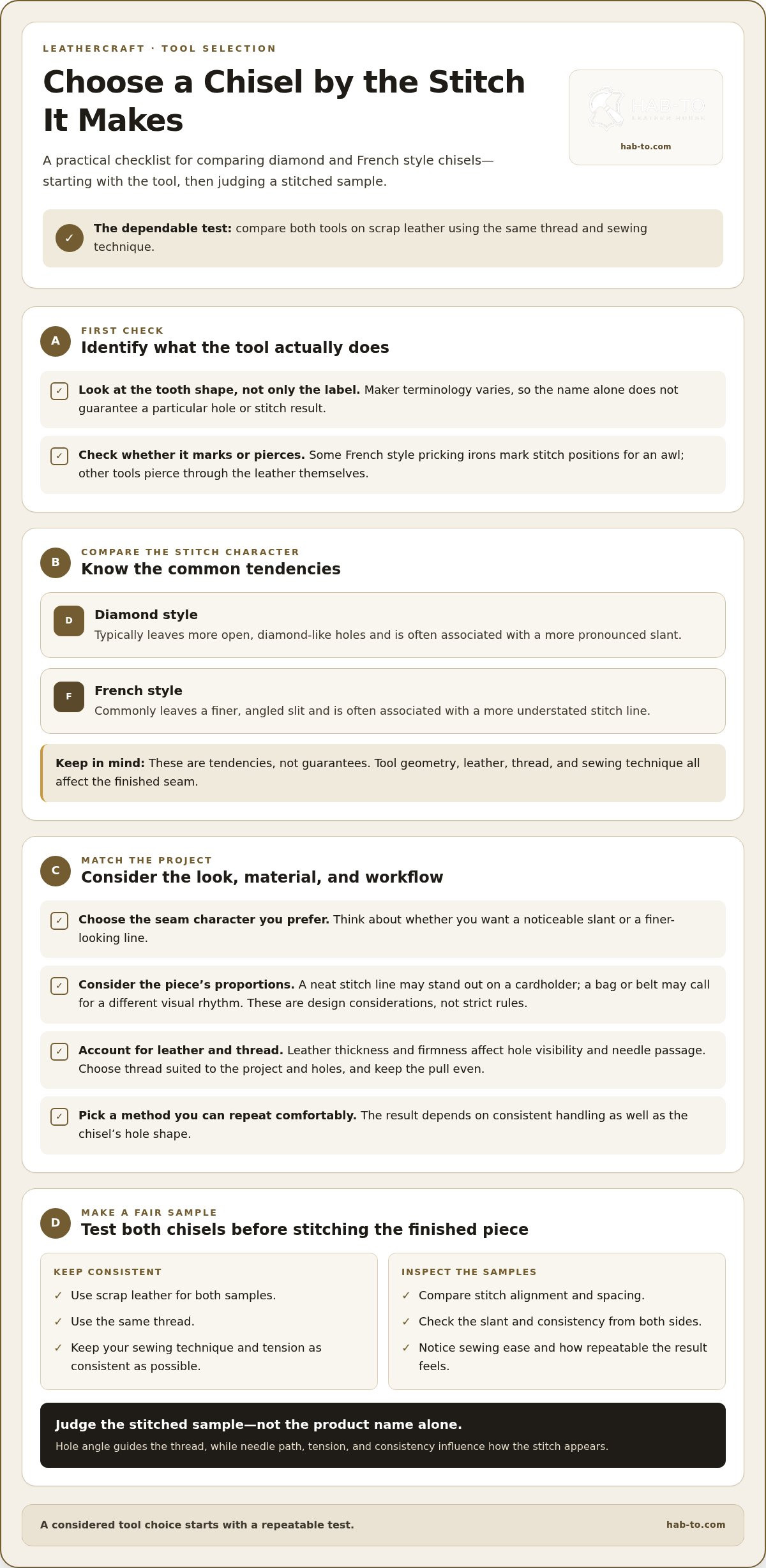
How to Test Both Chisels Before Stitching Your Project
A short side-by-side sample can tell you more than a product photo. It lets you judge the hole line, finished stitches, and how each tool feels in your hands before you work on your project piece. Scrap testing also helps prevent avoidable holes or marks on leather intended for a finished item.
What you will need for a fair comparison
- A diamond chisel and a French style chisel
- Scrap leather from the same hide, with similar thickness and firmness
- The same stitching thread and hand-sewing needles for both samples
- A ruler and a marking tool for laying out equal stitch lines
Use tools suited to your method. Hab-To Leather House offers leatherworking tools and stitching bundles to help you gather project essentials. If one chisel is intended to mark stitch positions rather than pierce through the leather, prepare those holes with your usual awl technique. Keep that distinction in mind so you compare each tool as it is designed to be used.
A simple side-by-side test
- Cut two similar scraps. Keep the leather type and thickness as alike as possible, so the material doesn’t become the main difference.
- Mark equal-length stitch lines. Use the ruler to keep both lines straight and choose comparable spacing for each tool. Follow each tool’s tooth spacing rather than forcing the same number of holes into different layouts.
- Prepare the holes consistently. Hold each tool steadily and use the same approach across its line. If you need an awl for one method, use a consistent angle and technique for every hole in that sample.
- Sew both lines the same way. Use the same thread and needles, and keep your stitching sequence and tension as consistent as you can.
- Compare the results. Under the same lighting, inspect hole alignment, stitch slant, spacing, and the appearance of both sides. Notice how easily the needles pass through, how comfortable each tool feels, and whether you can repeat the result without drifting.
For a useful comparison, record what you notice rather than choosing based on one attractive stitch. The diamond chisel vs French style chisel decision becomes clearer when you can see which sample suits your project and which method you can handle consistently.
Ready to gather your stitching essentials? Browse the stitching bundles and use your sample results to guide what you need.
Choose Your Chisel with Confidence and Gather Your Stitching Essentials
There’s no universal winner in the diamond chisel vs French style chisel choice. A diamond chisel may suit you if you like a more pronounced stitch angle; a French style chisel may fit your preference for a finer-looking line. Your best guide is the sample you’ve stitched yourself, using the leather and technique you plan to use for the project.
A quick decision checklist for your next project
Before settling on a tool, work through these questions:
- What stitch character do you want? Decide whether you prefer a visible slant or a more understated line.
- What leather will you use? Consider how its thickness and firmness affect the holes and the feel of sewing.
- How large or detailed is the project? Think about the seam length, curves, and the space available for positioning the tool.
- Which technique feels natural? Consider whether you prefer a tool that pierces the holes or a marking approach followed by an awl.
- Can you repeat the result? Choose the tool that gives you consistent alignment and a seam you’re happy to reproduce.
Product labels can be useful, but they don’t guarantee identical tooth shapes across makers. Look for clear views of the teeth or compare physical samples when possible. Then make a small practice sample in similar leather before stitching your finished piece. This simple test can save you from committing to a seam you don’t like.
Stitching essentials for your next project
If you’re bringing together tools and materials for hand stitching, explore the stitching bundles as a practical starting point. Use your sample results to guide what you need for the project.
Take your time choosing. A stitch line is a visible part of the work, and the right tool is the one that suits your preferred look and feels steady in your hands. Start with your test, then gather what you need for the next piece.
Choose the Chisel That Fits Your Next Project
There’s no universal winner in the diamond chisel vs French style chisel comparison. The right choice is the one that gives you the stitch character you want and feels comfortable to use consistently. Tool labels offer a starting point, but tooth shape and sewing technique affect the result, so a sample stitched in similar leather is the best way to judge.
Compare the holes and finished seam, then consider how easy each tool feels to position and handle. Your preferred look, project, leather, and stitching routine all matter. Practising before working on your finished piece can help you choose with confidence.
Hab-To Leather House supplies leathercraft materials, tools, and stitching essentials for makers of all sizes, with no minimum order requirements. Explore the leatherworking tools and stitching bundles to prepare for your next project.
Stitching essentials for your next project
Explore leathercraft bundles as a practical starting point for gathering project essentials.
Trust the sample, follow your eye, and enjoy the steady satisfaction of a seam that feels right for your work.
Frequently Asked Questions
What is the difference between a diamond chisel and a French style chisel?
The names generally describe different tool styles or hole patterns, but leatherworking terminology varies between makers. A diamond chisel commonly leaves a diamond-like opening, while a French style tool is often associated with a narrower, angled slit. Both prepare leather for hand stitching. Compare the actual tooth shape, spacing, and stitched samples rather than relying on the label alone. The finished seam also depends on the leather, thread, and sewing technique.
Which chisel makes a slanted saddle stitch?
Neither chisel guarantees a particular slant on its own. Tool geometry can influence the direction and appearance of the stitches, but needle path, thread tension, and how you handle the leather matter too. To see how a tool behaves, make a sample with the same thread and sewing method you plan to use for your project. Judge the result you observe rather than assuming every chisel of that style creates an identical stitch.
Can I use a diamond chisel on thick leather?
It depends on the specific tool, its stated use, the leather, and your project. Don’t force a chisel through leather if it doesn’t cut cleanly or feels difficult to control. Follow the tool maker’s guidance and practise on an offcut from the same leather before working on your piece. For a fair test, keep your spacing and technique consistent instead of judging the tool by one hole.
Is a French style chisel better than a diamond chisel for beginners?
Neither style is automatically better for every beginner. Your choice depends on the stitch appearance you prefer, how confidently you can handle the tool, and the projects you want to make. Since tool names can vary, look closely at the teeth and compare actual stitched samples. A short practice test on scrap leather gives you a more useful guide than a universal ranking or a product label alone.
Are French style chisels and French pricking irons the same thing?
The terms overlap in leathercraft, but they aren’t always used consistently. Traditionally, a pricking iron may mark stitch positions for later piercing with an awl, while a stitching chisel is generally described as making the holes. Individual tools and maker descriptions can differ. Before using one, check its construction and the maker’s product information to understand whether it marks the leather or is intended to pierce through it.
What do I need to test diamond and French style chisels?
Use both tools, comparable scrap leather, a ruler, suitable needles, and the same thread for each sample. Mark equal stitch lines, prepare the holes consistently, and sew using the same technique and tension. Then compare the hole pattern, alignment, seam appearance, ease of sewing, and how repeatable the result feels. A small test lets you assess the tools before experimenting on leather intended for a finished project.
Do diamond and French style chisels use the same spacing?
Spacing depends on the individual tool, not just its style name. Check each chisel’s stated spacing, and don’t assume tools are comparable because their labels sound similar. When testing, keep the leather and sewing method consistent, but record the spacing used for each sample. That gives you a clearer basis for comparing the stitch line and deciding whether the tool’s layout suits your project design.
Disclaimer
All our blog articles are made for information purposes only we dont take responsability for any content from third parties.