

Mastering the Glass Edge: How to Burnish Leather Edges with Tokonole (2026 Guide)
Most crafters spend years chasing a mirror-like finish, only to end up with edges that look hairy, unfinished, or eventually peel away. It's incredibly frustrating when you've poured hours into a project only for the final detail to let you down. You want that smooth, professional "glass" look that defines high-end leatherwork, but achieving it often feels like a trade secret. Mastering the art of burnishing leather edges with Tokonole is about more than just rubbing a wooden slicker; it's about understanding the relationship between the leather fibers and the finish. At Hab-To Leather House, we've spent 160 years perfecting these details, and we know that the right technique makes all the difference.
You're likely here because you want a finish that doesn't just look good today but stays beautiful for years. This 2026 guide will teach you the exact professional techniques to achieve a durable, glossy edge using this industry-favorite agent. We'll walk through the specific sanding steps, explain why high-quality vegetable-tanned leather is the only choice for a true burnish, and show you how to master the friction-based chemistry that creates a permanent seal. Get ready to transform your projects from handmade to world-class with a few expert adjustments to your workflow.
Key Takeaways
- Discover why Tokonole's unique water-based formula provides a superior, non-toxic alternative to traditional gum tragacanth for a lasting shine.
- Learn the precise sanding and preparation sequence essential for burnishing leather edges with Tokonole to achieve a flawless, mirror-like result.
- Identify the professional tools and curated bundles needed to transition from a "hairy" edge to a smooth, compressed surface.
- Master advanced application methods specifically tailored for high-end vegetable-tanned leathers like Shell Cordovan and dense Italian hides.
- Gain insights from 160 years of family expertise on how to maintain edge durability and prevent common issues like peeling or fading.
What is Leather Edge Burnishing and Why Choose Tokonole?
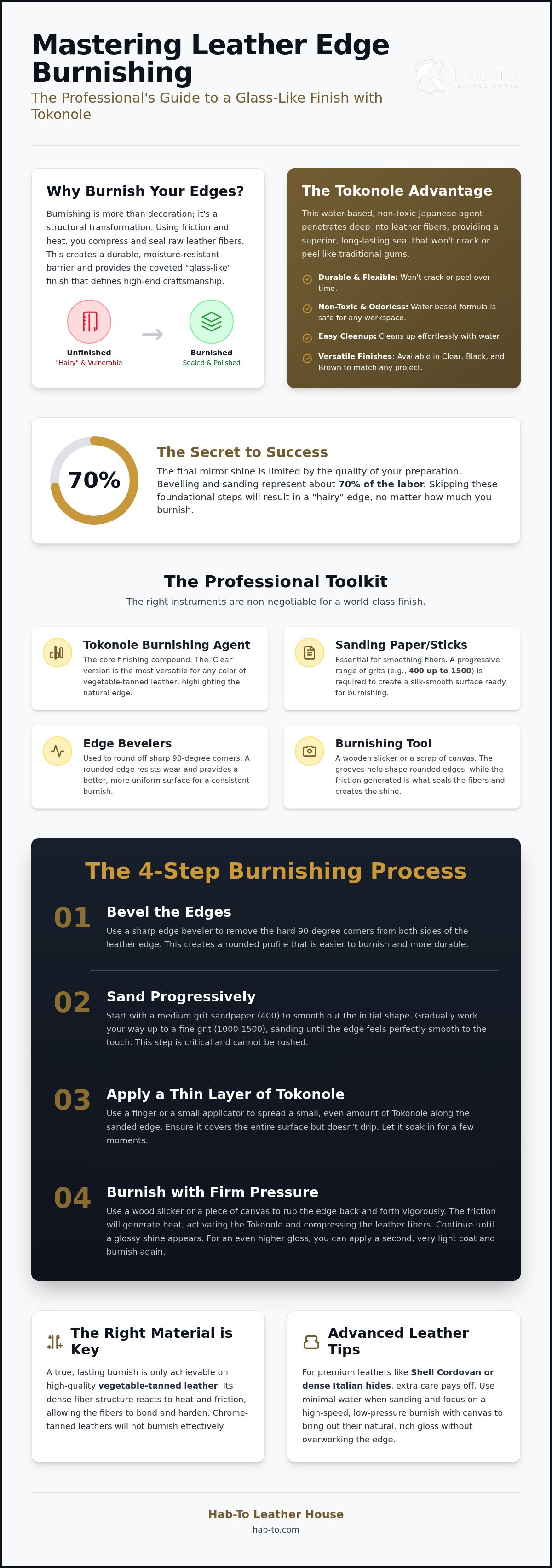
Burnishing isn't just a decorative step; it's a structural transformation of the material. At its core, burnishing is the process of compressing leather fibers through heat and friction to create a sealed, glossy edge. When you apply pressure and movement to the raw edge of a hide, the fibers mat together and the heat melts natural or applied waxes into the gaps. This creates a barrier that protects against moisture and wear while giving your project that coveted "glass" look. It's the hallmark of a crafter who respects the material enough to finish it properly.
Why do we swear by Tokonole at Hab-To Leather House? This water-based, non-toxic Japanese burnishing agent has completely changed the game for modern crafters. Unlike heavy synthetic paints that sit on the surface, burnishing leather edges with Tokonole allows the natural beauty of the hide to shine through. The secret lies in its chemistry. It contains natural waxes that penetrate deep into the fibers, providing a long-lasting seal that won't crack or peel over time. For us, choosing Tokonole aligns perfectly with our philosophy of sustainable, non-synthetic crafting. We believe in materials that age gracefully alongside the leather itself.
Tokonole vs. Traditional Burnishing Agents
For decades, gum tragacanth was the standard in workshops. However, it's quickly becoming obsolete. Gum trag can be temperamental, often leaving a sticky residue or peeling off months later. Tokonole offers a much more reliable experience. Because it's water-based, cleanup is effortless and there are no harsh fumes to deal with in a small workspace. You can choose between Clear, Black, or Brown finishes depending on your project's aesthetic. Clear is our favorite for showing off the natural layers of a multi-layer edge, while Black and Brown provide a deep, professional tint that integrates into the hide.
The Role of Vegetable-Tanned Leather
You can't achieve a professional burnish on just any material. Chrome-tanned leather, which we don't stock, simply fails to burnish properly because its fibers are too loose and chemically altered. To get that mirror shine, you must use high-quality vegetable tanned leather. The tannins used in the traditional tanning process react specifically to the heat of friction, allowing the fibers to bond and harden. The denser the leather, the better the result. When you're burnishing leather edges with Tokonole on a dense hide, the agent acts as a lubricant and sealant, turning a rough cut into a smooth, permanent edge that feels like polished stone.
The Professional Toolkit: What You Will Need
A mirror finish starts long before you open a jar of burnishing agent. Achieving a glass-like finish when burnishing leather edges with Tokonole requires more than just a steady hand. It demands a specific set of instruments designed to prepare the fibers for the agent. Most beginners assume the cream does all the work. In reality, your final shine is limited by the quality of your preparation. Using high-quality leatherworking tools ensures that your cuts are clean and your bevels are consistent. Without a smooth foundation, even the best burnishing agent will only highlight the imperfections in your work.
Most guides gloss over the preparation phase. We believe that sanding and bevelling represent about 70% of the labor. If you skip these steps, you'll likely end up with a "hairy" edge regardless of how much friction you apply. Success in burnishing leather edges with Tokonole is built on a foundation of progressive sanding and sharp tools. It's the difference between a project that looks handmade and one that looks world-class.
Essential Tools and Materials List
To get a professional result, you need a specific sequence of materials. Each tool plays a role in how the fibers react to the burnishing process. Don't underestimate the power of a simple canvas scrap compared to a wooden slicker.
- Tokonole Burnishing Agent: The Clear version is the most versatile choice for any workshop. It works beautifully on all colors of vegetable-tanned leather.
- Edge Bevelers: These are essential for rounding off sharp corners. A rounded edge resists wear much better than a square one and provides a better surface for burnishing.
- Sanding sticks or paper: You'll need a range of grits. Start with 400 for initial shaping and work your way up to 1500 for a silk-smooth surface.
- Burnishing tool: A traditional wood slicker is excellent for generating heat on thicker hides. For a high-speed polish on delicate items, a scrap of heavy canvas cloth is often superior.
Why Bundles Save Time and Money
Choosing individual tools can be overwhelming. Our Tokonole Bundles bridge the gap between hobbyist efforts and professional results. These kits include the exact grits and agents we use in our own Amsterdam warehouse. For projects involving very thin or soft leathers, we often include Texon reinforcement. This material provides the internal stiffness needed to prevent the edge from collapsing under the pressure of the slicker. If you want to avoid the guesswork, our curated bundles for finishing provide everything you need to start finishing edges like a pro.
How to Burnish Leather with Tokonole: A Step-by-Step Guide
You've gathered your tools and selected your hide. Now comes the part where craft becomes art. The process of burnishing leather edges with Tokonole is a rhythmic, sensory experience that rewards patience over brute force. If you rush, the results will show it. If you follow the sequence, you'll achieve a finish that looks like it was dipped in liquid glass. Let's walk through the exact steps we use in our Amsterdam workshop to ensure every edge meets our family's 160-year standard of quality.
Step 1: Edge Preparation and Bevelling
Bevelling is the most skipped but vital step because it defines the structural profile of your edge. Without removing the sharp 90-degree corners, your edge will eventually mushroom over and lose its shape. Use a sharp beveler from your leatherworking tools kit to take a thin, consistent strip off both the top and bottom corners. This creates a rounded surface that is much easier to compress. Once bevelled, start sanding. Always sand in one direction to avoid fraying fibers; going back and forth creates a fuzzy surface that Tokonole can't fully tame. Start with a 400 grit and move up to 600 until the edge feels like a single, solid piece of material.
Step 2: Applying Tokonole and Burnishing
When it's time to apply the agent, remember the "less is more" rule. Use a finger or a small spatula to apply a thin, even layer of Tokonole to the edge. You don't want it dripping down the sides of your project. Waiting for the "tacky" stage is the secret to a great finish. Timing is everything because wet Tokonole just slides around, while tacky Tokonole grips the wood to create the necessary friction. Once it feels slightly sticky, place the edge in the appropriate groove of your wood slicker. Rub quickly but gently. Use the wood slicker grooves without applying too much pressure; it's the speed and heat that seal the fibers, not the weight of your arm.
Step 3: Secondary Sanding and Re-application
Many beginners stop after the first burnish, but the pros know there's one more level of refinement. After your first round, you might notice a few tiny fibers still standing up. Sand the edge again, but this time use a high-grit paper like 800 or 1000. This knocks down any remaining imperfections without destroying the seal you've just built. Apply a second micro-layer of Tokonole, just enough to dampen the surface. For the final touch, ditch the wood slicker and use a scrap of heavy canvas cloth. Rub the edge vigorously with the canvas to generate intense heat. This final buffing creates that signature "glass" look and a durable, professional shine that lasts for years.
Advanced Techniques for Premium Leathers
Every hide has its own personality. You'll quickly find that a standard vegetable-tanned shoulder behaves differently than a high-end Italian shell. When you're burnishing leather edges with Tokonole, the density and oil content of your base material dictate your speed, pressure, and the amount of agent required. Mastering these nuances is what separates a hobbyist from a true artisan. We've spent decades handling the world's finest skins in Amsterdam, and we've learned that you must adjust your technique to respect the tannage.
Some leathers are thirsty and drink up the agent. Others are so dense they barely let it penetrate. If you treat every project the same, you'll struggle with inconsistent results. Success in burnishing leather edges with Tokonole comes from observing how the fibers react under your slicker and knowing when to push and when to pull back.
Burnishing Shell Cordovan and Dense Vacchetta
Working with Maryam Shell Cordovan is a unique experience. This material is famous for its incredible density and high oil content. Because the fibers are so tightly packed, you actually need very little Tokonole. If you apply too much, it won't soak in; it will just sit on the surface and create a cloudy, smeary mess. The goal with Cordovan is to achieve a "seamless" edge where the individual layers of a wallet disappear into a single, solid block of color.
- Friction over product: Maryam leathers respond better to high-speed friction than to heavy coats of agent.
- Canvas is king: For these dense hides, a scrap of heavy canvas is often superior to a wood slicker. It generates heat faster without the risk of crushing the grain.
- Light touch: Use light pressure. Let the heat of the friction melt the oils and Tokonole together to create that permanent seal.
Handling Open-Grain and Napped Leathers
Texture adds character, but it also adds difficulty. Badalassi Pueblo is a perfect example. Its unique, scuffed surface is beautiful, but the open grain can easily "wick" the Tokonole onto the face of the leather. This leaves dark, permanent spots that ruin the aesthetic. When working with Pueblo, use a precision applicator or a very dry finger. Apply the agent only to the edge and wait for it to become tacky before you even think about touching it with a tool.
Don't forget the flesh side. If you're making an unlined bag or wallet, you can use Tokonole to flatten the loose fibers on the back of the hide. This creates a smooth, professional feel similar to a lining without adding any extra weight or thickness. It's an expert trick that gives your work a high-end, finished look from every angle. Just spread a thin layer across the back and use a glass slicker or a smooth bottle to press the fibers down until they're sealed.
Elevating Your Craft: Mike’s Expert Tips for Longevity
After 160 years in the leather trade, our family has seen every mistake in the book. I often tell my students that the final 5% of the project is what defines the artisan. Burnishing leather edges with Tokonole is a skill that requires a conversation with the material. You can't force a shine; you have to coax it out through a balance of chemistry and physics. If you're finding that your edges aren't meeting your expectations, it's usually down to a few common pitfalls that are easy to fix once you know what to look for.
Troubleshooting: Why is My Edge Not Shiny?
The most frequent issue I see is the "too much product" trap. Beginners often think that more cream equals more shine. In reality, excess Tokonole creates a gummy, dull surface that never quite hardens. You only need enough to dampen the fibers. If the edge looks white or milky while you're rubbing, you've used too much. Wipe it off, sand lightly, and start again with a smaller amount.
Another factor is the confusion between pressure and speed. Friction generates the heat required to melt the waxes and bond the fibers. If you press too hard, you'll distort the edge or cause it to mushroom. Focus on rapid, light strokes. Finally, keep an eye on your environment. High humidity in your workshop can significantly extend drying times. If the agent is still too wet, the fibers won't compress; they'll just slide around. Wait for that tacky stage before you pick up your slicker.
Next Steps in Your Leather Journey
Don't let your materials fail you before you even start. Store your Tokonole in a cool, dark place and always ensure the lid is tight. Since it's a water-based product, it's sensitive to temperature. If it freezes during a cold winter, the emulsion will break and the product will lose its effectiveness. Always remember that the quality of your leather is the absolute ceiling of your finish. You can't achieve a glass edge on poor-quality hides, which is why we only stock leathers that we know will respond beautifully to a burnish.
If you're ready to deepen your knowledge, I invite you to join a Hab-To Masterclass. There's no substitute for hands-on guidance from a heritage leather supplier who understands every nuance of the hide. We're here to support your growth as a maker, providing the tools and expertise you need to create pieces that last a lifetime.
Transform Your Craft with Every Edge
Achieving a glass-like finish is a milestone in every crafter's journey. It represents a commitment to detail and a deep respect for the raw material. You now understand that a mirror shine isn't a secret; it's a process. Success comes from meticulous preparation, progressive sanding, and using the right friction-based chemistry. By mastering the art of burnishing leather edges with Tokonole, you ensure your projects don't just look professional today but remain durable for decades.
At Hab-To, we've spent over 160 years refining these techniques. We believe in providing tools that we use ourselves. Our selection is non-toxic, eco-friendly, and trusted by professional artisans across Europe. Whether you're working with dense Shell Cordovan or textured Pueblo, the principles of heat and patience remain the same. It's time to stop settling for "good enough" and start creating edges that reflect your true skill level.
We can't wait to see the incredible pieces you create. Keep practicing, keep refining, and remember that every project is an opportunity to perfect your craft.
Frequently Asked Questions
Is Tokonole better than water for burnishing leather edges?
Yes, Tokonole is significantly better than water because it contains natural waxes and binding agents. While water only temporarily softens fibers, burnishing leather edges with Tokonole creates a permanent, structural seal. The agent penetrates the hide and hardens under friction, preventing the edge from fraying or becoming "hairy" again. It's the difference between a temporary dampening and a professional, long-lasting finish that resists moisture and daily wear.
Can I use Tokonole on chrome-tanned leather?
No, Tokonole isn't suitable for chrome-tanned leather. The chemical tanning process for chrome hides results in loose, spongy fibers that don't react to heat and friction the way vegetable-tanned leather does. If you try to burnish chrome-tan, the edge will likely just become messy or mushroom out without ever achieving a shine. For a successful edge, always stick to high-quality vegetable-tanned hides like those in our Amsterdam warehouse.
Do I need to sand my leather edges before using Tokonole?
Yes, sanding is the most critical preparation step for a mirror-like finish. You can't burnish away a rough cut or uneven surface. By sanding with progressive grits from 400 up to 1500, you create a perfectly smooth foundation for the agent to work its magic. When you're burnishing leather edges with Tokonole, the agent seals the surface you've already perfected. Skipping the sanding phase will always result in a dull, uneven edge.
How long does it take for Tokonole to dry?
Tokonole dries relatively quickly, typically reaching the ideal "tacky" stage within one to two minutes. This tackiness is essential because it provides the grip needed for your slicker to generate heat. A full cure usually takes between 15 and 30 minutes, though this varies based on the humidity in your workshop. Don't rush the process; let the agent settle into the fibers before you apply your final buffing with a canvas cloth.
Will Tokonole change the colour of my leather edges?
The Clear version of Tokonole won't change the base color of your leather, though the heat from burnishing naturally darkens edges slightly. This darkening is a result of the fibers compressing and the natural oils rising to the surface. If you want a specific tint, use the Black or Brown versions. These provide a deep, integrated color that won't peel or flake away like traditional edge paints often do over time.
What is the best tool to use with Tokonole for a glass finish?
The best tool depends on the stage of your finish, but a traditional wood slicker is the standard for generating initial heat. The grooves help compress the edge into a rounded profile. However, if you want that signature glass finish, we recommend a final buff with a scrap of heavy canvas. The high-speed friction from the canvas generates intense heat that polishes the waxes in the Tokonole to a brilliant, durable shine.
Can I use Tokonole on the flesh side of the leather?
Yes, using Tokonole on the flesh side is a professional secret for finishing unlined projects. It's an excellent way to flatten loose, fuzzy fibers on the back of the hide, giving it a smooth and lined feel without the extra weight of a second layer. Simply apply a thin coat and use a glass slicker or a smooth bottle to press the fibers down. It's a hallmark of high-end craftsmanship that adds immediate value.
What happens if Tokonole freezes during shipping?
If Tokonole freezes during shipping, the emulsion will break, making the product unusable. You'll notice it becomes chunky or watery and won't blend back together even after shaking. Since it's a water-based product, it's very sensitive to extreme cold. We recommend ordering during milder months or ensuring someone is home to receive the package immediately. At Hab-To, we take great care in our shipping, but nature can sometimes be unpredictable.
Disclaimer
All our blog articles are made for information purposes only we dont take responsability for any content from third parties.