3mm Veg Tan Leather for Sale: How to Choose the Right Hide
A 3mm hide can be the wrong choice, even when your project calls for strong, substantial leather. What matters is how its firmness and construction work with the finished piece, not thickness alone. If you’re searching for 3mm veg tan leather for sale, listings can be difficult to compare when they don’t clearly describe the cut, temper, or measurement.
It makes sense to focus on thickness when you want a sturdy result. But a measurement by itself won’t tell you how the leather will bend, feel, or suit your pattern. Matching the material to the build can help you avoid ordering more than you need or choosing leather that feels too firm for the job.
This guide explains how to assess 3mm vegetable-tanned leather for your project and what to check in a listing, including stated thickness, temper, cut type, and available quantity. Hab-To Leather House sells vegetable-tanned leather by the dm², panel, or shoulder, with no minimum order requirement. That gives you options beyond buying a whole hide. You’ll also find a checklist for assessing a sample and deciding whether a listing gives enough detail to make an informed choice.
Key Takeaways
- 3mm describes thickness, not whether leather suits your project. Temper and construction matter too.
- Consider how folds, lining, and overlapping pieces will affect the finished item’s bulk.
- When comparing 3mm veg tan leather for sale, check each listing’s stated thickness, firmness, cut format, and product details.
- Use a pre-purchase checklist to match the leather’s specifications and available quantity to your pattern.
- Compare the construction, temper, thickness, cut, and required amount before choosing a hide or smaller cut.
3Mm Veg Tan Leather for Sale: What the Thickness Tells You
3mm describes a leather’s stated thickness, not whether it will suit your project. Temper, construction, and the finish you plan to create also affect how a piece handles. A thick panel that bends easily can behave quite differently from one that feels firm and board-like, even if both have similar listed measurements.
Vegetable tanning describes the process used to tan a hide, not its thickness or firmness. For a concise overview of the vegetable tanning process, see the section on vegetable tanning in this leather-tanning reference.
What does 3mm leather mean in a product listing?
It means the seller describes the leather as approximately 3mm thick, but don’t assume every area of a hide has an identical measurement. Natural material can vary, and a listing may give one nominal measurement or a range. Read the product details to see what is stated. If the measurement method or tolerance isn’t explained, ask the seller how thickness is measured and what variation to expect before buying.
This check matters when comparing 3mm veg tan leather for sale across different listings. For example, Hab-To lists a Badalassi Pueblo product with a 2.2–4mm range. That range doesn’t confirm an exact 3mm option, so check the current listing details and available cut before deciding. You can also browse the cow-hide selection, then review individual product specifications rather than relying on the collection label alone.
How does thickness differ from temper?
Temper is the leather’s feel and resistance to bending. It describes whether the material feels supple, firm, or stiff in your hands. Thickness is a measurement; temper describes how the leather handles. As a result, two leathers of similar thickness can fold, curve, and hold their shape differently.
Start with your pattern and how you plan to finish the piece. Will the leather need to bend around an edge, hold a defined shape, or take an additional layer? Those choices affect what will feel manageable at the workbench. Check the product description for details about firmness or flexibility, and ask for guidance if they’re unclear. A thickness measurement is useful only when the leather’s working behaviour suits the build.
How 3mm Vegetable-Tanned Leather Behaves in a Finished Project
Consider the whole construction, not just the main panel. A single layer may sit neatly, while that same leather can become bulky where it’s folded, lined, overlapped, or joined at a seam. Edges that look clean on a flat pattern can form thick ridges where several layers meet.
Thickness and construction work together: judge the leather by how it will behave in the assembled piece, not by its measurement alone. A firm component designed to hold a shape has different demands from a section that needs to curve comfortably against the body or move with repeated use. The Leather & Hide Council of America offers broader background on the leather industry, while your pattern and intended use should guide your material choice.
Which projects may benefit from thicker veg-tan leather?
A belt, sheath, or other structured project may need leather with enough body to support its design. That doesn’t mean every belt or sheath should use 3mm leather. Width, reinforcement, hardware, intended flexibility, and the number of layers all affect the choice. Compare your pattern and construction with the options in leather for belts, and check each listing’s specifications rather than choosing by category alone.
For a rigid component, a thicker piece may help create the substantial feel you want. If your project has both structured and flexible sections, consider whether they need different materials or construction. The right choice depends on the finished design, not a universal thickness rule.
When could 3mm be too thick for the design?
Thickness can become a drawback at tight curves, narrow folds, small closures, and comfort-sensitive edges. Add a lining or another layer, and the finished section becomes bulkier. That extra material may make a fold harder to form, a seam awkward to close, or an edge uncomfortable against the wearer.
Skiving, which thins leather locally, may help reduce bulk at a fold or joined edge. Changing a seam or the way pieces overlap can also affect the result. Both options depend on your skills, tools, and pattern, so test the construction before committing to a larger cut if you’re unsure.
When searching for 3mm veg tan leather for sale, use a paper mock-up or small sample to check how the layers meet and how the piece bends. If you’re still weighing materials and tools for a project, browse the leathercraft bundles to explore available supplies.
Compare 3mm Veg-Tan Leather Listings by Cut, Temper, and Use
Start with your pattern, not the tannery name. Note the area you need, whether the pieces must come from one continuous section, and how flexible the finished project should be. Then compare cut, temper, stated thickness, and product details. A leather’s name can help identify its tannery or style, but it doesn’t replace checking the specifications of the individual listing.
| Project need | Temper to consider | Cut format to compare | Listing details to verify |
|---|---|---|---|
| One small pattern or test piece | Match firmness to the shape and handling required | Per-dm² purchase, if offered | Quantity, dimensions or selection method, thickness |
| Several pieces from a planned layout | Check that the leather suits any bends or structured areas | Panel, if available | Usable area, shape, grain and surface details |
| Larger or multiple projects | Consider the balance of body and flexibility | Shoulder, if available | Cut size, variation, listed thickness and current availability |
Should you buy a panel, shoulder, or larger cut?
Choose a format based on your pattern layout, number of projects, and expected cutting waste. A panel can suit a planned group of pieces, while a shoulder may offer a larger area for laying out patterns. A per-dm² purchase describes quantity by area, so check how the seller supplies and selects that material. Hab-To sells vegetable-tanned leather by dm², panel, or shoulder, but not every format is available for every listing. Browse the vegetable-tanned leather listings and check the options on the specific product page.
How do firmness and grain affect your choice?
Ask whether the project needs to hold a defined shape, form around a curve, or move comfortably. Check the product description for details about temper, grain, and surface. If a detail that matters to your pattern is unclear, ask for guidance before ordering. For example, Hab-To lists Badalassi Pueblo leather in a 2.2–4mm range. That range doesn’t confirm an exact 3mm piece or current stock, so verify the live product details before treating it as a match.
Use this comparison to narrow your options, not to rank them. For a search like 3mm veg tan leather for sale, the strongest candidate is the listing that fits your construction, required cut, and quantity, with enough detail to make an informed choice.
What to Check Before Buying 3mm Veg-Tan Leather Online
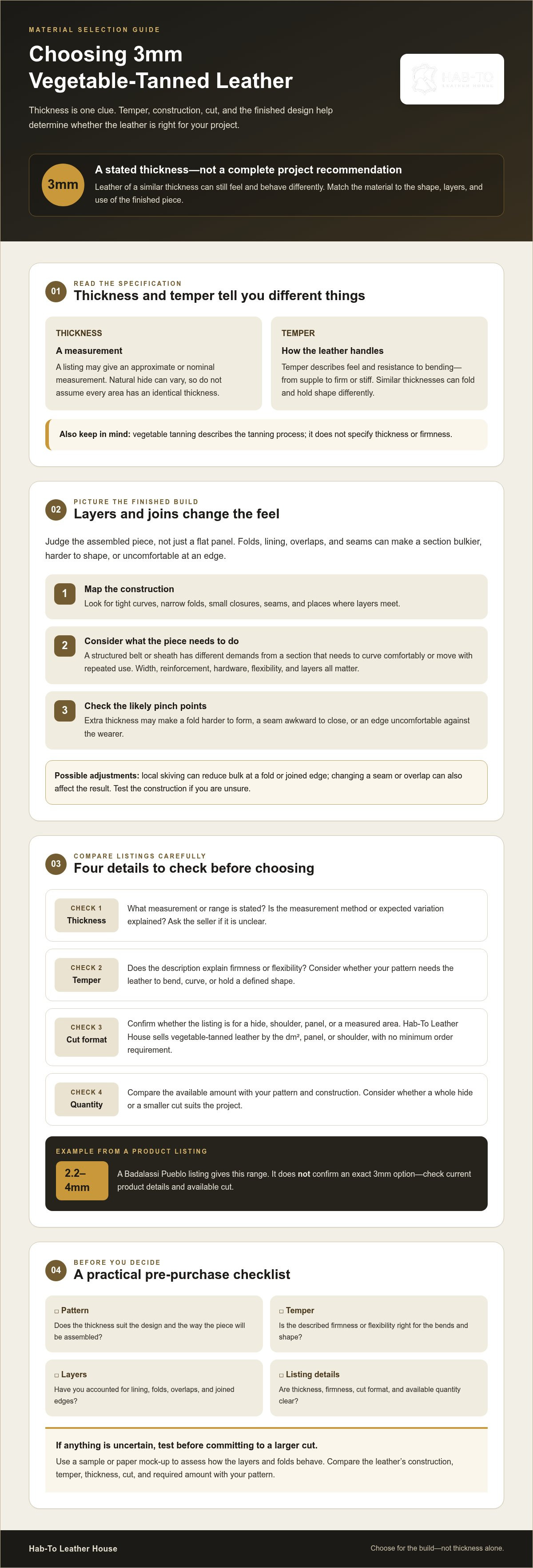
A useful listing should help you decide whether the leather fits your pattern, not just confirm its thickness. Before buying, compare the product details with your construction plan and the amount of material you’ll use. If you’re searching for 3mm veg tan leather for sale, work through this checklist before checkout.
What should a 3mm leather listing tell you?
Look for a stated thickness or range, the leather type, available cut format, and photographs that show the material clearly. A general category label won’t confirm a particular colour, surface character, firmness, or current availability. If the measurement method, tolerance, or temper isn’t clear, ask the seller before ordering.
How much leather should you order for a project?
Lay out your pattern pieces before choosing a quantity. Account for their orientation, the space between pieces, areas you may want to avoid, and reasonable cutting waste. An area estimate can’t guarantee an exact yield from a natural hide. Use the seller’s stated area or cut dimensions to judge whether the format can accommodate your layout.
If you’re testing a design, a smaller suitable cut can help you assess how the leather handles without committing to more material than the project needs. Hab-To sells vegetable-tanned leather by dm², panel, or shoulder, but available formats vary by listing, so check the current product details.
Before checkout, confirm the listed thickness, temper, cut, and quantity, then make sure they fit your pattern and finished design.
- 1. Verify thickness. Check whether the listing gives one measurement or a range. Ask about measurement details if they’re unclear.
- 2. Confirm the material. Read the leather type and product description. Don’t rely on a broad category name to infer the exact surface or feel.
- 3. Check the cut. Confirm whether the product is sold by area, as a panel, or as a shoulder, and review the dimensions or selection method provided.
- 4. Review the photos and details. Use images as a guide, but don’t assume they show the exact piece you’ll receive unless the listing says so.
- 5. Match quantity to your layout. Arrange pattern pieces and allow for orientation and cutting waste before choosing an amount.
Find the Right Veg-Tan Leather and Get Help Choosing
Make the choice in order: start with how your project is constructed, decide how much firmness or flexibility it needs, then check the listed thickness, available cut, and quantity. This keeps a measurement from overshadowing how the finished piece must work. Before ordering, confirm the current product details rather than assuming a named leather or broad category is available in a particular thickness.
How can a maker choose without buying a whole hide?
A whole hide may be more material than a single project calls for. Hab-To Leather House has no minimum order requirement, and vegetable-tanned leather is sold by dm², panel, or shoulder. Compare the available format and stated area with your pattern layout and the number of pieces you plan to make. Cut options vary by listing, so check the product details before choosing.
If you’re searching for 3mm veg tan leather for sale, a smaller quantity can be a practical way to test a design or see how a particular leather handles before committing to more. The right amount still depends on your pattern, layout, and cutting waste.
What can you do if the right thickness is uncertain?
Ask the seller to clarify the listed thickness, measurement range, firmness, cut options, and current availability if any of these details are unclear. Mike offers a free one-to-one video consultation to help you discuss how the material may fit your project before choosing. Bring your pattern, construction notes, and questions about how the leather needs to bend or hold its shape.
Good sourcing is part of good craft. Confirm the specifications, match the cut and quantity to your build, and ask for guidance when the listing doesn’t answer a project-specific question.
Need tools or materials for your leathercraft project? Explore leathercraft bundles, and check each bundle’s contents and current details to see whether it suits your needs.
Choose Leather That Fits the Way You’ll Build
The best 3mm veg tan leather for sale isn’t simply the listing with the closest thickness match. Start with how your project is constructed, then weigh the leather’s temper, cut, and quantity against your pattern. Check the current product details before ordering, especially if a listing gives a thickness range.
You don’t have to commit to a whole hide to find the right fit. Hab-To Leather House offers vegetable-tanned leather by dm², panel, or shoulder, with no minimum order requirement. The company brings over 160 years of family leather experience, and Mike offers free one-to-one video consultations if you’d like to talk through your project and material choice.
Match the material to your design, then explore leathercraft bundles for tools and supplies to support your project.
Frequently Asked Questions
Is 3mm veg-tan leather suitable for belts?
Yes, 3mm veg-tan leather may suit some belt designs, but thickness alone can’t determine fit. Consider the belt’s construction, intended firmness, buckle attachment, and finishing. A folded or layered buckle end will build differently from a simpler single-layer design. Check your pattern and the specific listing for thickness, temper, and dimensions. If any detail is unclear, ask the seller for guidance before choosing.
Can I use 3mm vegetable-tanned leather for a sheath?
Yes, it may work for some sheath designs, depending on the pattern, retention method, and structure you want. The leather’s firmness and the way the sheath is assembled both affect the finished result. Test your pattern and consider how the material will form around the item it holds. Before buying, confirm the listing’s stated thickness and available cut. Not every sheath design calls for 3mm leather.
How much leather do I need for a project?
The amount depends on your pattern dimensions, number of pieces, layout, and cutting waste. Arrange your pattern pieces before ordering, allowing room for their orientation and any areas you choose to avoid. Use the seller’s stated area or cut dimensions rather than relying on a generic yield estimate. Hab-To offers leather by dm², panel, or shoulder, but check each listing to confirm the available format and details.
What is the difference between leather thickness and temper?
Thickness is the leather’s measured depth; temper describes its feel and resistance to bending. Two leathers with similar stated thickness can handle differently during cutting, shaping, or assembly. One may bend more readily, while another feels firmer. Check the product description for information about firmness and flexibility. If the listing doesn’t specify temper, ask the seller before buying so you can compare the material with your project’s needs.
Can I buy a small amount of veg-tan leather instead of a whole hide?
Yes, depending on the supplier and the formats offered on a particular listing. Hab-To sells vegetable-tanned leather by dm², panel, or shoulder and has no minimum order requirement. The available format can vary, so review the current product details before ordering. Match the amount to your pattern and planned project quantity, and confirm the listed area or dimensions to judge whether the cut will work.
How can I tell whether an online 3mm leather listing is right for my project?
Check the stated thickness or range, leather type, cut format, product photographs, and available dimensions. Compare those details with your pattern and construction, not just the listing’s use of “3mm.” If you’re searching for 3mm veg tan leather for sale, confirm that the exact product details and availability are current. Ask the seller about measurement or firmness if either is unclear before placing your order.
Disclaimer
All our blog articles are made for information purposes only we dont take responsability for any content from third parties.