Gum Tragacanth vs Tokonole for Leather Edges: Which Should You Use?
If you’re weighing gum tragacanth vs tokonole for edges, start with the finish you want and the leather you’re using. Gum tragacanth tends to leave a more natural, low-sheen look, while Tokonole is often chosen for a smoother, glossier finish. These are useful starting points, not guarantees: your leather and technique affect the result.
If you’ve struggled to get consistent edges, or don’t want to experiment on a finished piece, the choice can feel bigger than it should. Tokonole is often considered approachable for beginners, while gum tragacanth may suit makers who prefer a more traditional-looking finish. Neither product is the right choice for every project.
In this guide, you’ll learn how the two edge agents differ, how to compare them on matching scraps, and what to look for in the result. A careful test helps you choose with more confidence before committing good leather to a finish.
Key Takeaways
- There’s no universal winner in the gum tragacanth vs tokonole for edges comparison. The right choice depends on your leather, workflow, and preferred finish.
- Start with a clean, evenly prepared edge so your comparison is useful.
- Check each product’s maker instructions before applying it, and note how the sample looks and feels.
- Test both products on matching leather scraps, using the same preparation and burnishing approach where the instructions allow.
- A beveler and burnisher can help you build a basic edge-finishing setup. Technique matters alongside product choice.
Gum tragacanth vs Tokonole for leather edges: what each product does
Comparing gum tragacanth and Tokonole makes sense when you’re choosing an edge finish, but there isn’t one answer for every piece of leather. Edge burnishing refines and smooths the exposed fibers along a cut edge. The result depends on the product, the leather, and the preparation and technique you use.
In the gum tragacanth vs tokonole for edges comparison, think of both as products used during edge finishing, not as substitutes for careful preparation. Leather type and firmness, the condition of the edge, the product’s maker instructions, and the look you want can all affect your experience. A sample on matching scrap is a sensible first step, especially with unfamiliar leather or a new product.
What does gum tragacanth do on a leather edge?
Gum tragacanth is used in leathercraft as an edge-slicking and burnishing compound, including on vegetable-tanned leather. The Tragacanth overview describes this leatherworking use. Follow the instructions for the specific product you’re using rather than assuming every formulation behaves the same. Before applying it to a project, try it on scrap from the same leather and assess the result using your planned edge preparation and burnishing approach.
What is Tokonole used for in leathercraft?
Tokonole is an edge-finishing option used by leatherworkers who want to burnish leather edges. It’s available from Hab-To Leather House, including through its Tokonole Bundles. This section focuses on edge work. Using a product on a leather’s flesh side is a separate task, so don’t assume the instructions are the same. Check the product’s own guidance before use, then test it on a matching offcut.
In simple terms, edge burnishing refines and smooths the exposed fibers of a leather edge. Getting a consistent finish takes attention to the leather and the work leading up to burnishing. A soft piece of vegetable-tanned leather may respond differently from a firmer one, so don’t assume a result on one scrap will transfer unchanged to another hide.
For a useful comparison, prepare matching scraps in the same way and follow each product’s instructions. Observe the appearance and feel rather than relying on a general claim about which product is best. This lets you choose a method for your leather and preferred finish before working on the project piece.
How gum tragacanth and Tokonole interact with leather edges
Before judging gum tragacanth against Tokonole, look closely at the edge itself. A finishing product can’t correct a cut that is uneven, poorly aligned, or rough in places. Consistent preparation gives you a fairer basis for comparing products and helps you identify whether differences come from the agent or from the edge beneath it.
Leather can vary from piece to piece. A soft vegetable-tanned hide and a firmer one may respond differently to the same preparation and working method. That doesn’t establish that one product is more compatible or effective. It means the leather, its condition, and your technique are all part of what you’re evaluating.
Why edge preparation matters before applying either product
Start with an edge that’s trimmed and aligned as evenly as your project allows. Check for steps where layers meet and for spots that feel rough or uneven. These inconsistencies can remain visible after burnishing, making it harder to assess the finish. Prepare each test piece in the same way, and follow the chosen product’s maker guidance rather than assuming a particular grit, moisture level, or tool setting.
The general process is straightforward: prepare the edge, apply the selected agent according to its instructions, then work the edge with your chosen burnishing method. Keep the process consistent across samples where the instructions allow. Don’t assume gum tragacanth and Tokonole have the same formula, application requirements, or compatibility with every leather. Check product-specific guidance before relying on it.
What to observe as the edge is worked
Pay attention to the edge as you work. Does the surface look consistent along its length? Do the fibers appear controlled, or are rough areas still visible? How does the finish look once you’ve completed your planned method? These observations are more useful than deciding based on the product name alone.
A fair comparison keeps leather preparation, application guidance, and burnishing method consistent while changing only the product being tested. Use comparable scraps, then record what you used and noticed. A simple note can include:
- Leather type and whether the sample was soft or firm.
- How you prepared the edge.
- Which product and maker instructions you followed.
- The burnishing method and the finished sample’s appearance.
This record helps you interpret the result before using the method on a project piece. If you’re gathering supplies for a Tokonole test, browse the available Tokonole bundles alongside your leather and tools.
Gum tragacanth vs Tokonole: compare them with a fair test
A useful comparison doesn’t start with a winner. It starts with your leather and the finish you want. For gum tragacanth vs tokonole for edges, maker instructions explain how each product is intended to be used, while a controlled sample helps you see what happens on your own project leather. Keep those sources of information separate: instructions are product guidance, and the test piece shows what you observed.
Use this comparison checklist for each product:
- Product guidance: What does the maker say about edge use, application, and any steps to follow? Note anything you need to verify rather than filling gaps with assumptions.
- Workflow: Record the preparation, tools, and burnishing method you used. Follow each product’s own instructions, even if the process differs between samples.
- Desired finish: Decide what you’re aiming for, such as a particular level of smoothness or appearance. Treat this as your preference, not a promise about what either product will produce.
- Observed result: Describe the sample’s surface consistency, visible fibers, and appearance. Keep these as observations, not general performance claims.
This approach avoids turning a personal test into a universal ranking. A result on one piece of leather may not predict how another piece will behave.
Which edge agent should you try first?
Start with the product whose verified guidance fits your workflow and intended finish. Consider the leather you’ll use and whether you can follow the instructions consistently. If you’re testing Tokonole, Hab-To’s Tokonole Bundles are one option to explore. A matching scrap offers better project-specific guidance than a blanket recommendation.
How to make an apples-to-apples comparison
Cut matching scraps from the project leather. Prepare them to the same edge shape and surface condition, then use the same tools and technique where the product instructions allow. Change only the product being tested. If the directions call for different steps, follow them and note the difference instead of forcing both products into an identical process.
Compare samples after the same interval only if both makers’ guidance supports that timing. Otherwise, follow each product’s instructions and record when you assessed the result. A short note with the leather, preparation, product, method, and observations makes the comparison easier to repeat and helps you choose based on evidence from your own work.
How to test gum tragacanth or Tokonole on a leather edge
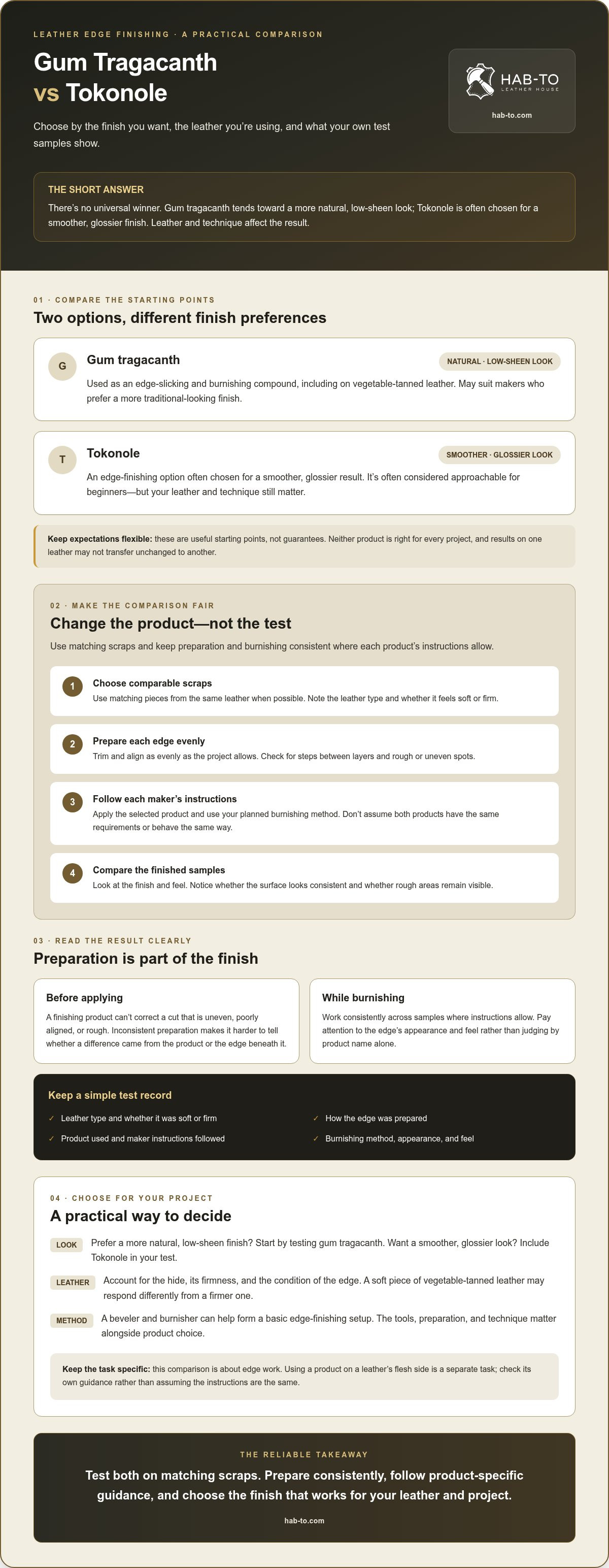
A small, controlled test lets you compare an edge finish without experimenting on the project itself. Use scraps that match the leather you plan to work with, and change only the edge agent where the maker’s instructions allow. This makes your observations more useful and helps separate product differences from variations in preparation or technique.
What you will need for a controlled edge test
- Matching leather offcuts from your project leather. If you need to choose project material, browse the vegetable-tanned leather selection.
- Gum tragacanth or Tokonole. If comparing both, have each product and its maker instructions ready. This list does not imply that Hab-To supplies gum tragacanth.
- An edge beveler, if appropriate for your project and the edge you’re preparing.
- A burnisher and any other tools required by the product instructions. Explore the leatherworking tools collection for relevant tools.
- A note or worksheet to record your preparation, method, and observations.
If you’re assembling a Tokonole test setup, the Tokonole Bundles collection is a relevant place to explore. Choose tools and materials that suit your leather and project.
A simple test sequence and troubleshooting checks
Keep the process deliberate. Follow the maker’s directions for each product, including any instructions about application or when to assess the result. Don’t assume the two agents use identical steps.
- Prepare comparable samples. Use matching scraps and prepare their edges to the same shape and surface condition.
- Apply one product per sample. Follow its own verified instructions, then use the burnishing method planned for the project.
- Record what you see. Note the product, leather, preparation, tools, method, and finished appearance. Separate direct observations from claims made in product guidance.
- Repeat only to investigate a difference. If samples look inconsistent, first check whether the edges were prepared or worked differently. Correct the process before drawing conclusions about the product.
For example, if one sample looks less even, check for differences in edge alignment or tool handling before attributing the result to the agent. A repeat test can help once you’ve identified a process difference to control. There’s no need to keep repeating the same test without changing or clarifying a factor.
Explore Tokonole Bundles.
Choose an edge-finishing method that suits your leathercraft project
Let your test samples guide the finish you choose for the actual piece. Note which result best suits the project’s look and whether the steps fit your workflow. Treat a result as specific to the leather and method you tested, not a guarantee for every hide.
A quick decision checklist for your next project
- What finish are you aiming for? Keep your preferred appearance in mind, and check whether the product’s maker guidance supports its intended use on an edge.
- Does the test match your project? Consider the leather’s type and firmness, and how closely the sample reflects the piece you’ll make.
- Can you repeat the method? Choose a process you can carry out consistently with the tools you have.
- Which sample suits the project? Base your choice on what you observed rather than a general ranking of gum tragacanth or Tokonole.
Preparation and handling remain part of the result. If neither sample looks right, revisit your edge preparation or working method before settling on a product.
Build a small, useful edge-finishing setup
Keep your setup focused: the project leather, the edge agent you’ve selected, and tools that suit the edge. An edge beveler may be useful for your particular work, and a burnisher is another tool to consider. Follow the product’s instructions and check that any bundle you choose contains items that fit your needs.
Hab-To offers Tokonole Bundles as part of its curated bundle range. They may be a practical starting point for makers exploring a Tokonole setup. Gum tragacanth is not presented here as a Hab-To product.
Tokonole Bundles
Explore the collection and review its contents to see whether it suits your edge-finishing setup.
Explore Tokonole Bundles.
Choose your edge finish with confidence
The right answer to gum tragacanth vs tokonole for edges depends on your leather, the finish you want, and the instructions for the product you choose. Neither is a universal winner. A small test on matching scrap gives you project-specific evidence before you commit to finishing the actual piece.
Keep your comparison fair: prepare the samples consistently, follow each product’s guidance, and note what you observe. A considered edge comes from the whole process, not product choice alone.
Hab-To supports makers with leathercraft supplies and more than 160 years of family leather expertise. Its offerings include vegetable-tanned leather, tools, and curated Tokonole Bundles. If you’re unsure which leather or supplies suit your project, Hab-To also offers free one-to-one video consultations with Mike.
Take your time with the sample, trust what you learn from your own leather, and enjoy the care that goes into a well-finished edge.
Frequently Asked Questions
Is gum tragacanth better than Tokonole for leather edges?
Neither is automatically better for every leather edge. In the gum tragacanth vs tokonole for edges comparison, your leather, preferred appearance, and working method all matter. Check the maker’s directions, then test the products on matching scraps prepared in the same way. A sample that gives you a consistent result on your project leather is a more useful guide than a general ranking.
Can you use gum tragacanth and Tokonole on the same leather edge?
Don’t apply them in sequence to the same edge unless the product makers’ instructions support that use. Combining products could make it difficult to tell which one affected the finish, and their interaction shouldn’t be assumed. For a clear comparison, use separate matching scraps, with one edge agent on each. Follow each product’s guidance and assess the results separately before deciding whether either suits your project.
What is the difference between gum tragacanth and Tokonole?
Both are used in leathercraft for edge finishing, but they are distinct products with their own maker guidance. Gum tragacanth is used as an edge-slicking and burnishing compound, while Tokonole is another option for burnishing leather edges. Makers may report differences in finish and workflow, but these can depend on the leather and technique. Check product descriptions and test samples rather than assuming a result will be the same across hides.
How do you test gum tragacanth against Tokonole?
Use matching offcuts from the leather intended for your project. Prepare both edges in the same way, then apply each product according to its own instructions. Keep tools and burnishing technique consistent where the directions allow, and record the leather, preparation, method, and what you observe. Compare samples only at a point supported by the product guidance. If the results differ, check for process differences before drawing conclusions.
Can Tokonole be used on all types of leather edges?
Don’t assume Tokonole is suitable for every leather edge. Leather type, condition, and construction can affect the result, and product compatibility should be confirmed through the maker’s guidance. Test it on a scrap that matches your project before treating a finished piece. If your leather differs in firmness or surface from the test material, make a new sample rather than relying on results from another hide.
Do you need an edge beveler before burnishing leather?
No, an edge beveler isn’t automatically required for every burnishing project. Whether it suits your work depends on the leather, edge shape, and finish you want. The priority is a clean, consistently prepared edge, using tools appropriate to the project. If you’re unsure whether to bevel, try the planned preparation on a matching offcut first. That lets you inspect the edge and finish before working on the project piece.
What should you do if a burnished leather edge looks uneven?
Check the edge preparation and your technique before blaming the finishing product. Look for uneven trimming, misaligned layers, or sections that were worked differently. Compare the rough-looking area with a smoother part of the same edge, then test a correction on scrap if possible. For a repeat test, change one factor at a time and follow the product instructions. Record what you adjusted and whether the sample became more consistent.
Disclaimer
All our blog articles are made for information purposes only we dont take responsability for any content from third parties.