


Maker's Mark: How It Shows Leather Craft and Authenticity
A maker’s mark is a small emblem, name, or symbol stamped onto an item to identify its maker. On leather, it connects a finished piece to the hands and skill behind it. The pride in signing your maker’s mark comes from making that connection part of the work.
A mark can do more than identify who made a piece. It can support authentication and shape perceptions of value, while reflecting the care and choices behind the craft. But a mark alone doesn’t tell the whole story.
In this guide, you’ll learn what a maker’s mark is, how to incorporate identifying details into leather designs, and what a mark can and can’t say about authenticity and value. We’ll also look at how a signature becomes part of the making process: a quiet statement that the work is finished and someone stands behind it.
Key Takeaways
- Understand how a maker’s mark identifies its maker and why it should be distinct from a legal signature.
- Learn how marks can support authentication and influence perceived value without serving as proof on their own.
- Explore ways to incorporate identifying details into a design while respecting the material and the finished piece.
- See how a maker’s mark can express care, authorship, and the point at which a craftsperson considers the work complete.
- Get a clear overview of why legal requirements for marks can depend on where and how handmade goods are sold.
Authenticating marks and perceived value
A maker’s mark can connect a leather piece to its creator, but it isn’t proof of authenticity by itself. A stamp, initials, or monogram is more useful when it matches other evidence, such as the maker’s documented work, construction choices, and records of the piece’s history. Treat the mark as one clue, not a verdict.
An artist’s signature can help protect creative work from copycats, and an authenticating mark can add perceived value. A monogram offers a compact way to identify a maker, especially when a full name would disrupt a design. Its value as evidence depends on consistency: a mark that appears across a maker’s documented work is more informative than an isolated impression with no supporting context.
The story of a drawing attributed to Albrecht Dürer shows why attribution matters. This example concerns art, not leather pricing, but it illustrates how attribution can influence perceived value. A name or mark alone doesn’t establish authorship.
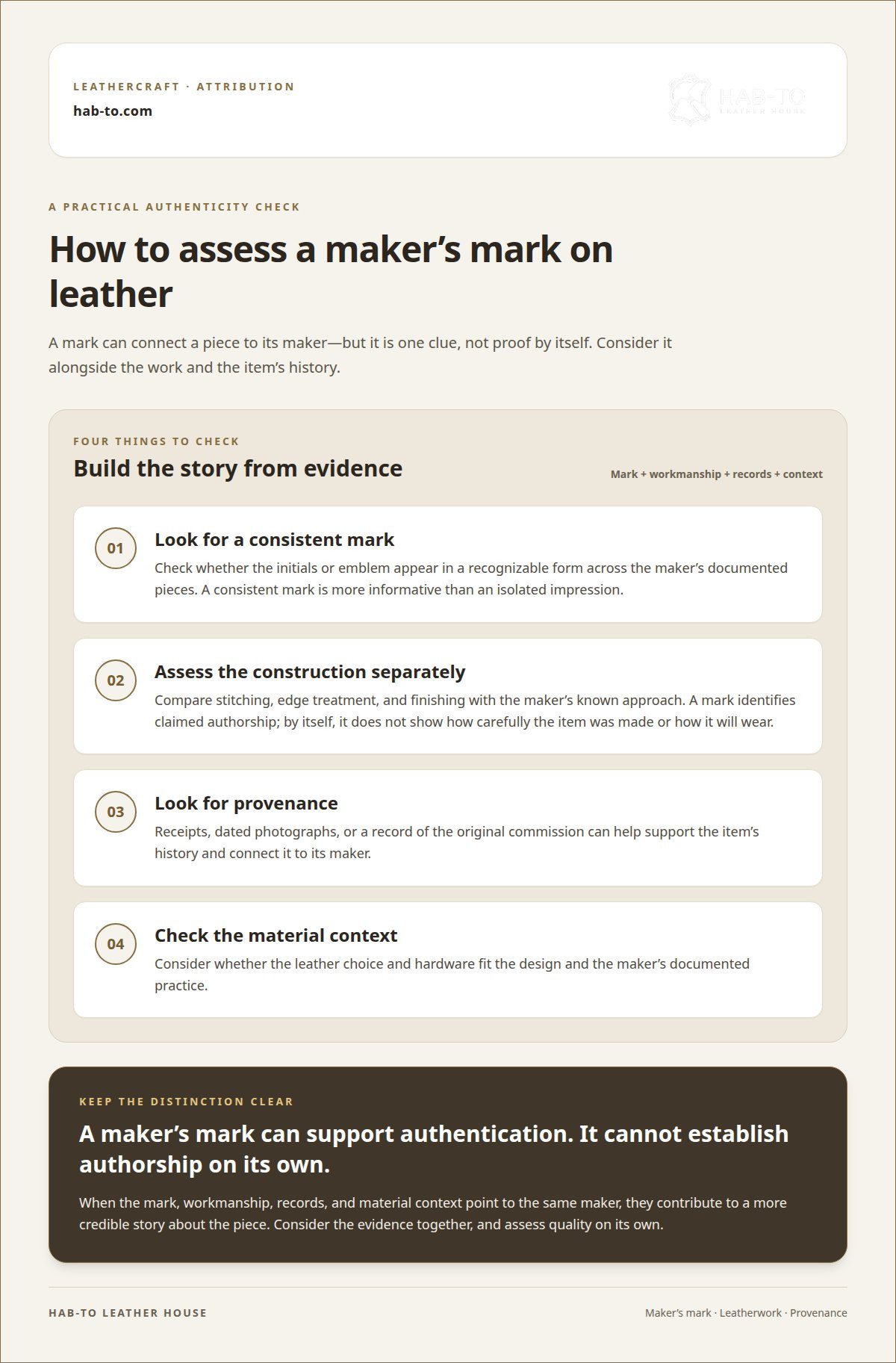
For a leather item, authentication is stronger when several details fit together. Useful evidence can include:
- A consistent mark: The maker’s initials or emblem appear in a recognizable form across documented pieces.
- Construction details: Stitching, edge treatment, and finishing align with the maker’s known approach.
- Provenance: Receipts, dated photographs, or a record of the original commission support the item’s history.
- Material context: Leather choice and hardware correspond with the design and the maker’s documented practice.
This also explains the difference between authentication and quality assurance. A mark can identify who claims authorship; on its own, it can’t show how carefully an item was made or how it will wear. For example, a clearly stamped monogram may sit beside uneven stitching. Assess the workmanship separately, then consider whether the mark and supporting records make sense together.
Copying another maker’s mark can mislead buyers, weaken trust, and falsely suggest authorship or approval. Use a mark you have permission to use, and never present another maker’s emblem as your own.
For the craftsperson, the pride in signing your maker’s mark comes with responsibility. A thoughtful mark identifies its maker without claiming to prove more than it can. When a recognizable monogram, sound construction, and clear records point to the same maker, the mark contributes to a more credible story about the piece.
What is a Maker's Mark?
A maker’s mark is an identifying name, emblem, or symbol placed on an object by its maker. On leather, it might be a small stamped device, initials, or a distinctive monogram. Its purpose is attribution: it connects the object with the person or workshop responsible for making it.
Choosing a mark begins with a practical question: can you recognize and reproduce it consistently? A simple emblem may remain clear when stamped on a small leather panel, while a detailed design can lose definition. Sketch several options, test their legibility at the intended size, and choose one that feels personal without copying another maker’s identity.
A maker’s mark should also differ from a legal signature. For security, it’s advisable to make an artist’s mark distinct from their legal signature. For instance, a craftsperson might use a compact symbol or selected initials rather than signing a full legal name. That distinction lets the mark serve as a public identifier without making it a direct substitute for a private signature.
- Keep it recognizable: Use shapes or letters that remain distinct when reduced.
- Make it repeatable: Choose a design that can be applied consistently.
- Make it your own: Avoid another maker’s mark or a confusingly similar design.
The name Maker’s Mark also belongs to a bourbon brand, so context matters. A distillery visit or barrel experience can illustrate how a brand identity differs from an individual craft signature: one identifies a product brand, while the other identifies the maker of a particular object. A barrel marking and a leather stamp may both identify something, but they don’t mean the same thing.
The history of Maker’s Mark includes specific people and milestones. Margie Samuels was the first woman directly involved with a distillery and was inducted into the Kentucky Bourbon Hall of Fame. Bill Samuels, Sr. tested bourbon mashbills by baking bread, evaluating recipes without distilling and aging them. These examples show how people and documented work can shape a brand’s history. A mark alone, however, doesn’t establish when an object or business began.
For leatherwork, make the mark part of a considered design rather than an afterthought. A leathercraft bundle can support a project where material, tools, and a maker’s chosen detail come together.
Integrating identifying details into product design
A maker’s mark works best when it belongs in the design rather than competing with it. On a leather wallet, for example, a small emblem inside a pocket can identify the maker without interrupting the exterior. A bag might carry its mark on a discreet interior panel, while a belt could use a carefully placed stamp near its end. Placement affects how the detail is seen and how it relates to the object.
Consider the mark alongside the item’s shape, use, and material. A broad, simple symbol may suit a firm leather panel; fine lines can become harder to read when compressed into a small impression. Before choosing a final position, sketch the item and mark together. Decide whether the mark should be prominent, discovered only when the piece is handled, or repeated as a small design element.
Stamping is one option, but identifying details can also be integrated through a label, etching, carving, weaving, embroidery, or dyeing. Each method has a different visual character. A carved motif becomes part of the leather’s surface, while an embroidered detail adds thread and texture. A label can carry a name or symbol separately. Match the method to the design rather than treating every mark as a stamp.
- Choose the location: Try an interior panel, pocket, strap, or other area that suits the item.
- Test the scale: Make sure the design remains legible at its intended size.
- Match the technique: Consider stamping, carving, stitching, or another method that fits the material.
- Review the whole piece: Check whether the mark supports the design without distracting from function.
What you will need
- A maker’s mark stamp, mallet, leather, and scrap leather for testing.
Brand design offers a related lesson. A bottle label and a leather maker’s mark both place identity on an object, but serve different purposes. Margie Samuels is associated with Maker’s Mark’s history; that connection can prompt discussion of brand identity without assuming she designed particular bottle features. Keep attribution precise. A person’s role in a brand’s story should not be confused with authorship of every visual element.
For ideas on artist signatures, John Castagno has curated more than 17 books of artist signatures. These references can help makers study how names and monograms vary in form, but a leather mark still needs to suit its own scale and technique. Look for principles such as clarity and distinctiveness, then create an original design instead of copying an existing signature.
If stamping or carving is part of your plan, explore leatherworking tools that can support the project. The final detail should feel considered from the first sketch to the finished piece.
Maker's marks and craftsmanship
A maker’s mark connects an object with the person or workshop that made it. On leather, its placement and finish can reflect the same care as the seams, edges, and hardware.
Materials and Products That Carry Marks
Maker’s marks appear on materials such as leather, wood, metal, pottery, and textiles, and on products including bags, saddles, furniture, and tools. A mark gives an object an identifying detail that remains after the making is complete. On a leather bag, for example, a small stamp inside a pocket can identify its maker without changing the outer design. An engraved name on a metal tool can serve a similar purpose.
Tools and Marking Methods
Stamping, engraving, carving, weaving, embroidery, dyeing, and signing can all add identifying details to a product. Leather stamps and a mallet create an impression; an engraving tool cuts a design into a surface, while a pen can add a handwritten signature to a label. The method matters because it affects legibility, texture, and how the mark sits beside the object’s other details.
Craftsmanship shows in the relationship between the mark and the work around it. Consider a leather wallet with neatly aligned stitching and a cleanly finished edge. A crooked or crowded stamp can distract from those details, while careful placement can feel intentional. The mark need not be large to carry meaning. Its scale, clarity, and position all contribute to the piece’s visual balance.
One useful way to assess a mark is to look at the whole object, not just the name or symbol. Ask whether its placement suits the item’s use, whether the impression is clear, and whether it competes with functional features. On a watch strap, for instance, a mark near the buckle may be less intrusive than one across the visible center. Leatherworking tools can support careful making, but the maker’s judgment guides the final placement.
Marks have a longer history than contemporary branding. The comparison with marketplace seals on products in the first century shows how identifying marks can connect an object with its maker or origin. Forms and meanings vary across materials and periods, so a leather stamp today shouldn’t be treated as identical to an older seal. The shared idea is deliberate identification.
A famous work of art offers another useful distinction. Edgar Degas’s Dancers Practicing at the Barre dates to 1877, but a work’s title and date are different details from a maker’s mark. A mark identifies authorship; other records and features provide context. In leathercraft, keep those roles clear. A signature can close the making process, but it doesn’t replace the evidence of sound construction.
In practice, let the mark follow the object’s design. A saddle, wallet, and small case each offer different surfaces and constraints. A maker’s mark feels integrated when its technique suits the material and its placement respects the piece’s function. That final detail can make authorship visible without speaking louder than the craft itself.
What are the legal rules for using a maker’s mark on handmade goods?
There isn’t one universal rule for every maker’s mark or handmade product. The relevant considerations depend on where goods are sold, what the mark communicates, and the product category. A symbol identifying a leatherworker raises different questions from a stamp that suggests a material certification or official inspection. Keep the mark’s purpose clear, and avoid presenting a personal identifier as evidence of a claim it doesn’t support.
Start by distinguishing a personal maker’s mark from a brand name, certification, or quality claim. For example, initials stamped inside a handmade wallet identify the maker. A phrase such as “certified leather” communicates something different: buyers may read it as a claim about the material. Use wording and symbols that accurately describe the work, materials, and maker. The distinction matters because a decorative detail can convey more than authorship.
Another consideration is whether the design belongs to you or someone else. A copied emblem, business name, or distinctive logo can create confusion about who made or endorsed an item. Before adopting a design, consider its similarity to marks already used in your market. Keep dated sketches and design files to document how your symbol developed, along with versions showing how the final design differs from earlier ideas.
- Identify the mark’s purpose: Separate maker identification from claims about materials, origin, or approval.
- Use an original design: Avoid another maker’s name, emblem, or logo.
- Describe products accurately: Match labels and sales descriptions to the item’s actual construction and materials.
- Keep records: Save design drafts, product photographs, and sales records that connect the mark to your work.
Product type also matters. A maker’s stamp on a leather cardholder differs from a mark on an item whose material, origin, or safety characteristics are regulated. Jewelry, children’s products, and goods making environmental claims can raise additional labeling questions. Don’t assume a decorative stamp satisfies a separate requirement tied to the product or its claims. Keep descriptions specific to what the product actually is.
Where a mark appears can affect how buyers understand it. A small signature inside a bag reads differently from a large “official” seal on its exterior. Pair the symbol with plain-language descriptions in listings, packaging, or invoices. For instance, state that a wallet was handmade by the named maker rather than suggesting a third-party body approved it. Clear wording keeps the intended meaning consistent across the product and its sales materials.
Keep the same mark consistent across the item and its records. A dated photograph of a stamped piece, a matching invoice, and a saved design file can help explain the connection between maker and object. As you organize supplies for a handmade project, leathercraft bundles can bring materials and tools together, while your own records document the mark’s use. Documentation supports clarity, but it doesn’t replace applicable legal requirements.
Artisans can create an original symbol that clearly identifies them as the maker, while avoiding designs that could be confused with another maker’s mark. Keep dated sketches, design files, product photographs, and sales records to document the mark’s development and use.
Hab-To Leather House
At Hab-To Leather House, I help makers bring a personal mark into a leather project with carefully chosen materials and practical supplies. Whether you’re planning a stamped wallet, a carved detail on a bag, or a signature on a small accessory, your choice of leather and tools affects how the mark fits the finished design.
Explore leatherworking tools for the techniques your project calls for, or consider vegetable-tanned leather and crafting bundles as you plan the piece. Thoughtful materials and preparation let your mark feel like part of the craft, not an afterthought.
Have a question about materials or tools for your maker’s mark? Contact Hab-To Leather House.
Make Your Next Piece Your Own
Your next leather project is a chance to make authorship part of the design from the first sketch. Decide what you want the mark to communicate, then let that choice guide its size, placement, and finish. The pride in signing your maker’s mark grows when the detail feels true to the thought and skill behind the work.
As you plan, choose materials and tools that suit your design. Hab-To Leather House offers vegetable-tanned leather, leather hardware, and leatherworking tools. Explore the crafting bundles to bring useful project supplies together as you prepare your next piece.
Keep exploring the craft with related reading on authenticating a maker’s mark, integrating identifying details into a design, and choosing a mark that reflects your workmanship. Each offers another way to make your next project more personal.
Keep creating, keep learning, and let your next piece carry a signature that feels unmistakably your own.
Frequently Asked Questions
What does “the pride in signing your maker’s mark” mean?
It describes the satisfaction of putting your identity on work you made and accepting responsibility for its finish. For a leatherworker, adding a mark to a completed cardholder can make authorship feel tangible. The pride in signing your maker’s mark isn’t just about recognition; it can also represent the patience, decisions, and practiced skills invested in that particular piece.
What is a maker’s mark, and what is its history?
A maker’s mark is a symbol, name, or other identifying device associated with the person or workshop that made an object. Its history spans many crafts: a potter might press a device into clay, while a metalworker could use a punch on a tool. Styles and meanings vary by place, period, and trade, so a mark needs context to tell its story.
How does a maker’s mark differ from a trademark, hallmark, or signature?
A maker’s mark identifies a maker or workshop on an object. A trademark identifies a business or product source in commerce, while a hallmark is associated with precious-metal goods. A signature is usually a person’s handwritten name or personal sign. These terms can overlap in everyday use, but their purposes differ; legal meanings also depend on the product and jurisdiction.
How can buyers identify and verify an artisan’s maker’s mark?
Start with the maker’s portfolio or product records, then compare the mark’s shape, spelling, and placement with examples connected to that artisan. For a custom leather piece, a dated order confirmation or design correspondence can help connect the item to its maker. Consider the construction and materials as well. A stamp can be copied, so don’t treat it as standalone proof of authorship.
Disclaimer
All our blog articles are made for information purposes only we dont take responsability for any content from third parties.