

Best Leather for Watch Straps: Master Artisan Guide for 2026
Hi, I'm Mike. After twenty-five years at the workbench, I can tell you a blunt truth: the finest mechanical timepiece feels unwearable on a stiff, cracking band that irritates your wrist. You already know the frustration of deciphering vague marketing terms like 'genuine leather' only to end up with cardboard-like rigidity and sweat-stained linings within a few months. Finding the best leather for watch straps isn't about chasing buzzwords. It demands choosing authentic, dense-fiber vegetable-tanned hides that breathe naturally and mold comfortably to your skin.
In this master artisan guide, I will show you exactly which materials stand up to daily wrist wear. You will discover why world-class vegetable-tanned hides like Maryam Shell Cordovan, Badalassi Carlo Pueblo, and skin-friendly Olivenleder deliver superior comfort, moisture tolerance, and rich patina. We will also explore essential bench specifications, from precise layer thicknesses and temper balance to sweat-resistant lining choices. Here is everything you need to build or commission an heirloom-grade custom watch strap.
Key Takeaways
- Discover why dense-fiber vegetable-tanned hides like Shell Cordovan, Pueblo, and Olivenleder represent the best leather for watch straps, resisting sweat without cracking.
- Learn the exact skiving thicknesses and temper specifications required to prevent wrist stiffness while maintaining dimensional stability.
- Master clean edge finishing and bonding techniques using workshop essentials like Tokonole and non-toxic Ecostick adhesives.
- Eliminate costly full-hide scrap waste by sourcing zero-minimum-order panels and curated crafting bundles for your bespoke strap builds.
Evaluating Watch Strap Leather: The Four Essential Performance Criteria
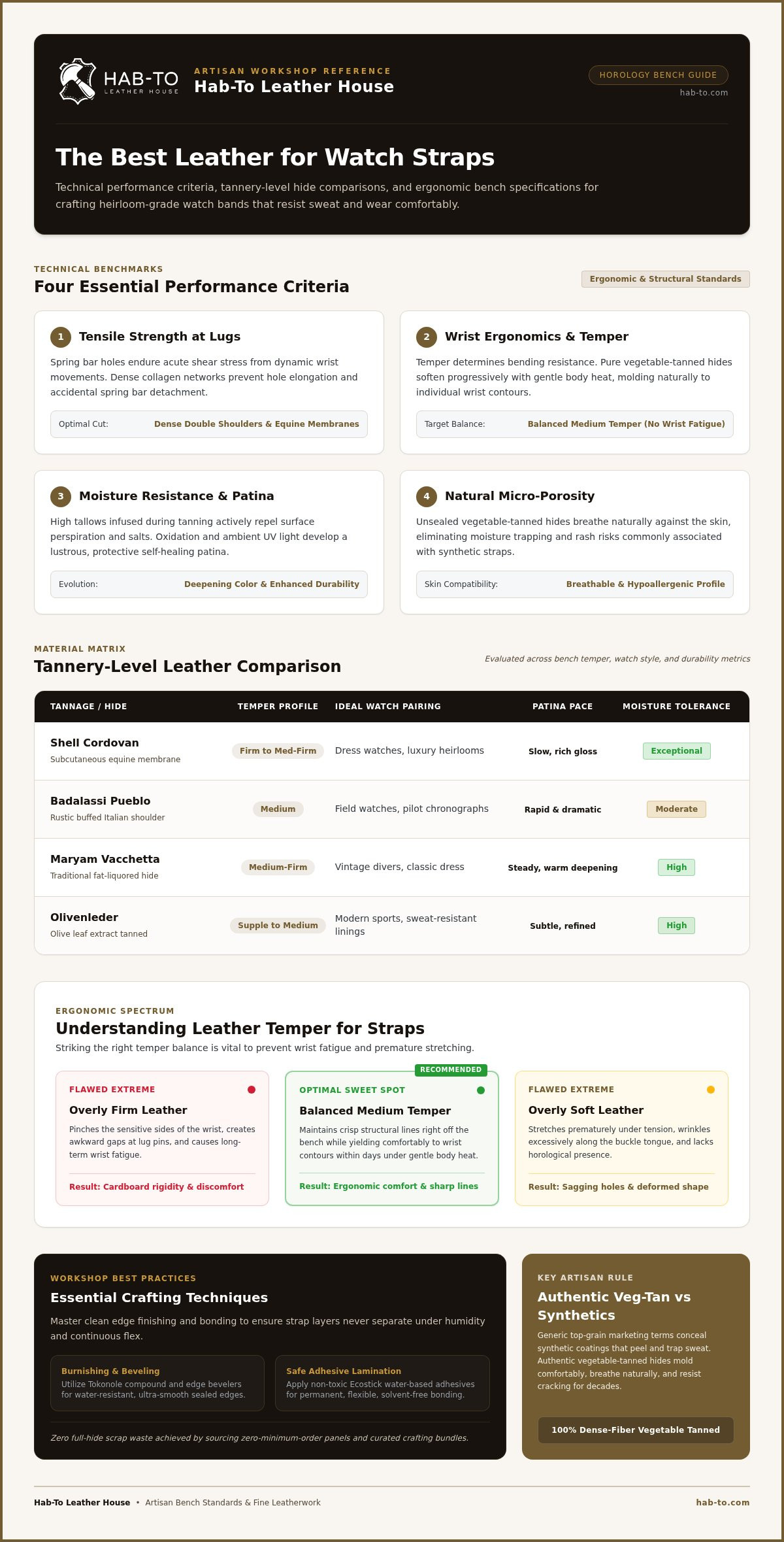
A wristwatch band endures far more abuse than a wallet or tote bag. It faces constant body oils, acidic sweat, torsional twisting, and unending friction against desk surfaces. Mass-market retail brands often claim that any top-grain cut is sufficient for daily wear, but selecting the best leather for watch straps requires a much stricter technical evaluation. In watchmaking ergonomics, temper defines a hide's relative firmness and resistance to bending, while tensile strength measures its structural capacity to resist stretching or tearing under continuous dynamic loads. Pure vegetable-tanned hides provide natural micro-porosity, allowing the material to breathe against your skin and eliminating the rash risks frequently caused by synthetic or chrome-tanned bands.
Tensile Strength and Fiber Density at Lug Pin Points
Spring bar holes bear the brunt of daily wrist motion. Every time you flex your wrist, the strap's folded lug loop experiences acute shear stress. Loose, spongy hides like bovine belly stretch rapidly under this tension, causing pin holes to deform and risking accidental spring bar detachment. You must use cuts with tight, interwoven collagen networks. Dense double shoulders or specialized equine membranes, such as authentic shell cordovan leather, keep their dimensional shape indefinitely. They lock your spring bars securely in place without elongating over years of continuous wear.
Wrist Ergonomics: Temper, Suppleness, and Break-in Time
Leather temper ranges on a spectrum from soft to extra-firm. Striking the right balance is vital for everyday comfort:
- Overly firm leather: Pinches the sensitive sides of your wrist, gaps awkwardly at the lugs, and causes fatigue.
- Overly soft leather: Stretches prematurely, wrinkles along the buckle tongue, and lacks structural presence.
- Balanced medium temper: Offers clean structural lines right off the bench while yielding comfortably to your wrist contours.
Natural plant tannins behave differently than synthetic coatings. When exposed to gentle body heat, genuine vegetable tanned leather softens progressively, molding to your individual wrist shape within days.
Moisture Resistance and the Patina Evolution of Veg-Tan
Perspiration introduces moisture, salts, and fatty acids directly to the grain. While synthetic plastics trap perspiration and eventually peel, unsealed vegetable hides absorb natural wrist oils to create a self-healing barrier. The high concentrations of natural tallows infused during the tanning process actively repel surface moisture droplets. Over months of wear, oxidation and ambient UV light transform the surface, deepening its color and developing a lustrous, protective patina that synthetic bands simply cannot match.
The Best Leathers for Watch Straps: A Tannery-Level Comparison
Artisanal watchmakers look past generic marketing labels to evaluate hides by tannery heritage, fiber density, and surface treatment. Selecting the best leather for watch straps comes down to matching the hide's temper and finish to the character of your timepiece. Understanding hide anatomy, particularly vegetable tanning and corium structure, clarifies why certified Italian artisan tanneries produce material with such exceptional tensile strength and flexibility. The table below details how four premier vegetable tannages compare at the workbench:
| Tannage | Temper | Ideal Watch Style | Patina Pace | Moisture Tolerance |
|---|---|---|---|---|
| Shell Cordovan | Firm to Medium-Firm | Dress watches, luxury heirlooms | Slow, rich gloss | Exceptional |
| Badalassi Pueblo | Medium | Field watches, pilot chronographs | Rapid and dramatic | Moderate |
| Maryam Vacchetta | Medium-Firm | Vintage divers, classic dress | Steady, warm deepening | High |
| Olivenleder | Supple to Medium | Everyday modern sports, skin linings | Subtle, refined | High |
Shell Cordovan: The Undisputed Gold Standard of Horology
Unlike standard bovine hides, shell cordovan comes from a specialized subcutaneous fibrous flat muscle beneath equine rump hides. Because it lacks a porous hair-follicle grain layer, it cannot develop traditional creasing or micro-wrinkles when folded around a watchcase. Hot-stuffed with deep liquored fats, Maryam Shell Cordovan sheds perspiration droplets effortlessly. It remains the ultimate choice for heirloom dress watches that demand an enduring, mirror-like gloss.
Badalassi Carlo Pueblo: Rustic Texture with Rapid Patina
Produced by the Badalassi Carlo tannery in Tuscany, Pueblo features a distinctive stone-buffed finish with circular, rustic micro-scratches. As you handle the strap, wrist friction and skin oils quickly smooth the velvety surface into a deep, glossy patina. Its balanced medium temper makes Badalassi Carlo Pueblo leather remarkably forgiving to prick and saddle-stitch, pairing naturally with pilot watches and rugged military field pieces.
Tuscan Vacchetta and Olivenleder: Classic Suppleness and Eco-Tanning
Traditional Tuscan vacchetta represents centuries of Italian tanning culture. Infused with natural tallows, Maryam Vacchetta delivers a smooth surface and supple hand-feel that ages gracefully. For makers seeking an eco-conscious alternative, Olivenleder utilizes olive-leaf tanning extracts. This hypoallergenic, chromium-free tannage breathes cleanly against bare skin, performing brilliantly as both exterior strap faces and sweat-resistant under-linings.
You don't need to purchase massive, expensive commercial sides to craft with these elite hides. Exploring our curated leather bundles lets you work directly with certified Italian panels sized specifically for precision strap builds.
Anatomy of a Durable Watch Strap: Thickness, Skiving, and Linings
Even the finest material fails if its structural geometry is flawed. Even when sourcing the best leather for watch straps, single-layer unlined builds often stretch out around the buckle prong holes within a year. Crafting a comfortable, multi-year strap requires a laminated architecture that pairs an exterior hide with a stabilizing core and a breathable backing.
Precision Splitting and Feather-Edge Skiving Techniques
Achieving structural balance comes down to strict millimeter targets. The exterior face leather should be split to roughly 1.0mm to 1.2mm, while your inner lining leather sits at 0.6mm to 0.8mm. This pairing produces a finished flat strap thickness between 2.0mm and 2.5mm, which easily slides through standard buckles. Use a sharp French edger or Japanese skiving knife to execute a delicate feather skive along the lug fold. Tapering the thickness down to 0.5mm around the spring bar prevents bulky bunching against the watch lugs.
Selecting Hypoallergenic, Sweat-Resistant Lining Leathers
Direct skin contact subjects the inner strap face to continuous moisture and warmth. Synthetic foam linings or heavily coated plastics trap perspiration, degrading thread fibers and causing dermatitis. Pure vegetable hides sourced to strict audited tannery standards provide naturally hypoallergenic properties. Excellent lining options include:
- Vegetable-Tanned Calf: Extremely smooth, fine grain that resists sweat accumulation.
- Vegetable Goat: Naturally dense grain with supple flex and superior abrasion resistance.
- Fine Sheep Nappa: Ultra-soft hand-feel that eliminates break-in stiffness instantly.
Internal Reinforcements and Keeper Construction
Preventing longitudinal stretch across the sizing holes demands an ultra-thin non-stretch core. Laminating micro-thin synthetic reinforcers like Texon reinforcement between your face and lining leathers stops elongation entirely without adding bulk. For your keepers, skive individual strips down to a razor-thin 0.6mm. A clean, precisely proportioned 0.6mm fixed keeper combined with a floating keeper secures the strap tail neatly, shielding its burnished edges against friction every time you take the watch off.
What You Will Need: Essential Tools and Supplies for Watch Strap Crafting
Pairing high-grade hides with improper bench equipment results in frayed edges, crooked stitch lines, and uneven seams. Crafting high-end watch bands is an exercise in micro-leathercraft where fractions of a millimeter matter. While choosing the best leather for watch straps gives you superior tensile strength and comfort, turning those cuts into a durable finished band requires specialized blades, clean alignment tools, and safe workshop adhesives.
Core Workshop Materials and Tooling Checklist
Precision execution demands a focused bench setup. Gather these fundamental tools before making your initial cuts:
- Cutting and Skiving: A razor-sharp Japanese skiving knife or French edger to thin lug folds cleanly without dragging the grain.
- Stitching Irons: Fine-pitch French pricking irons (2.7mm to 3.38mm spacing) for creating refined, compact horological stitch patterns.
- Punches and Guides: A polymer mallet, steel cork-backed ruler, and dedicated 1.5mm to 2.0mm micro oval punches for clean buckle tongue slots.
- Assembly: Lin cable or waxed braided polyester thread paired with dull harness needles for traditional saddle stitching.
Adhesives and Edge Finishing Compounds
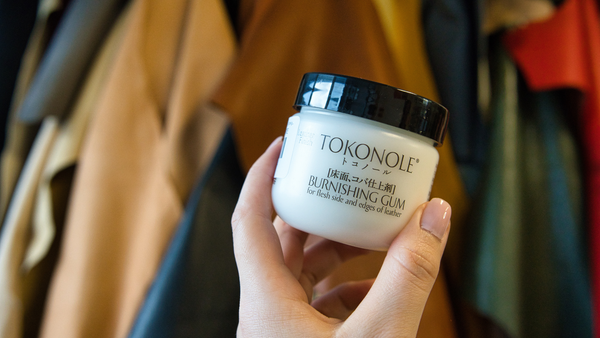
Standard solvent contact cements release toxic fumes and can dry into brittle glue lines that crack during repeated flexing. Using solvent-free, water-based Ecostick 1804 leather glue gives you a strong, permanent bond that remains supple across the wrist. For raw perimeter edges, avoid heavy plastic paints that crack under tension. Instead, bevel your edges lightly and apply Tokonole gum with a wooden or canvas slicker. Tokonole binds loose collagen fibers into a water-resistant, glassy edge. You can find pre-matched combinations of gums, applicators, and burnishers in our specialist Tokonole bundles.
Selecting Solid Hardware for Heirloom Builds
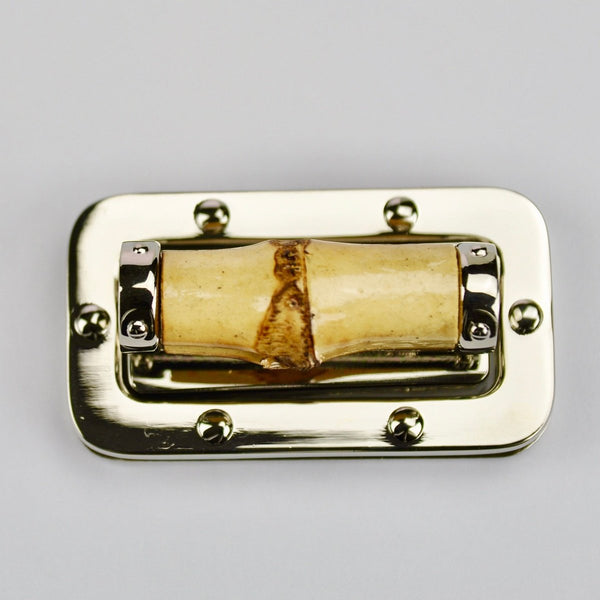
Hardware quality must mirror the integrity of your leather. Always pair your straps with buckles machined from 316L stainless steel, solid brass, or gunmetal finishes to prevent flaking and corrosion. Screw-in thumbnail buckles provide exceptional security for thick utility straps, whereas slim spring-bar pin buckles suit classic dress profiles. For standard case sizing, ensure your buckle matches your lug taper: common combinations include 20mm tapering to 16mm, or 22mm tapering to 18mm.
Curated Leather and Tool Bundles: Build Bespoke Straps Without Waste
Traditional leather merchants operate on industrial models designed for upholstery or footwear factories. They require you to purchase whole hides measuring twenty square feet or more just to access world-renowned Italian tanneries. For independent makers crafting slender bands, this creates hundreds of euros in dead inventory and rolls of unused scrap. Sourcing the best leather for watch straps shouldn't demand running a commercial warehouse. Buying precut panels alongside matched consumables allows you to build custom, heirloom-grade straps efficiently while keeping workshop waste at zero.
The No-MOQ Advantage for Artisans and Watch Enthusiasts
Precision strap making requires very little square footage per build. A standard two-piece strap needs only an 80mm buckle piece and a 120mm tail. With a strict zero minimum order quantity policy, you can purchase single, hand-selected panels or compact shoulders tailored precisely to small-goods horology. This accessibility lets you experiment freely across Maryam Shell Cordovan, Badalassi Carlo Pueblo, and Tuscan vacchetta without stockpiling massive hides. Artisans nationwide benefit from swift 24 to 48-hour order fulfillment, keeping projects moving from initial inspiration directly to the bench.
Curated Contextual Product Block: Your Watch Strap Workshop
Starting a new strap build requires seamless compatibility between your materials and chemistry. Matching our rustic Badalassi Carlo Pueblo panels with water-based Ecostick adhesives ensures your laminated layers cure flexible without breathing noxious fumes. Complete the build using Japanese edge tools and Tokonole gum to burnish your edges to a smooth, friction-free gloss. If you are uncertain about exact splitting gauges or matching lining weights to specific lug profiles, book a free video consultation to review hide temper and thickness before cutting your first panel.
Ready to assemble your horological bench setup? Build with authentic materials via our curated leathercraft bundles.
Recommended Reading and Next Steps for Makers
Continue expanding your bench knowledge with these artisan workshop resources:
- 160 Years of Leathercraft Heritage: What Family Tradition Means for Your Craft
- A Crafter's Guide to Essential Leather Hardware and Buckles
- Buying Leather Online: The Professional Artisan's Guide to Sourcing Certified Hides
- Professional Leatherworking Masterclasses: From Hand Stitching to Edge Finishing
Crafting Timepiece Straps That Endure Generations
Selecting the best leather for watch straps is about honoring the mechanical artistry on your wrist with materials that mature gracefully. True horological durability comes down to tight collagen fibers, measured skiving tolerances, and pure vegetable tanning that breathes comfortably against your skin. Drawing on over 160 years of family leatherworking heritage dating back to 1857, our benchmark remains uncompromising: 100% certified vegetable-tanned leathers, zero synthetic fillers, and zero harsh tanning chemicals.
With our zero minimum order policy and reliable 24 to 48-hour fulfillment nationwide, you don't need commercial warehouse space or bulk hide commitments to build bespoke bands. Sourcing single panels of world-class Italian hides gives you total creative freedom right at your bench. You simply need authentic materials, sharp hand tools, and the patience to execute every stitch with care.
Take pride in your benchwork. The character and patina you cultivate today will tell an enduring story for decades to come.
Frequently Asked Questions
Can I use chrome-tanned leather to make a watch strap?
No, you should avoid chrome-tanned leather for watch straps worn directly against the skin. Chrome tanning relies on harsh mineral salts that can trigger contact rashes and skin irritation during hot, humid days. These chemical finishes also block proper edge burnishing and trap sweat against thread fibers, causing early stitching failure. Pure vegetable-tanned hides remain breathable, hypoallergenic, and far healthier for prolonged daily contact.
What is the ideal leather thickness for a handmade watch strap?
The ideal finished thickness for a flat dress watch strap ranges strictly between 2.0mm and 2.5mm. For a classic lined build, skive your exterior face leather down to 1.0mm-1.2mm and split your inner lining leather to 0.6mm-0.8mm. Around the lug folds, feather skive the material down to 0.5mm. This prevents bulky bunching at the spring bars while letting the band glide smoothly through standard buckles.
Why is Shell Cordovan considered the best leather for luxury watch straps?
Shell Cordovan represents the best leather for watch straps on luxury dress watches because its non-porous equine membrane never develops micro-creases or surface wrinkles. Taken from the dense flat muscle layer beneath horsehide, it features exceptional fiber density that resists stretching around spring bar holes. Heavily infused with liquored fats and waxes, it naturally sheds perspiration droplets while maintaining an enduring, mirror-like gloss.
How do I protect vegetable-tanned leather watch straps from sweat and rain?
You can protect vegetable-tanned straps by burnishing their raw edges with Tokonole and treating the grain with natural beeswax or olive-oil-based balms. Because vegetable tanning preserves the hide's natural cellular structure, periodic conditioning replenishes depleted lipids and repels incidental water droplets. Avoid submerging the band in water. If it gets damp from rain, wipe it clean with a soft microfiber cloth and let it dry naturally away from direct heat.
Do I need to buy an entire hide just to make a few watch straps?
No, you do not need to buy an entire hide to craft bespoke watch bands. Traditional merchants often enforce heavy minimum orders, but you can purchase individual precut panels and single shoulders with zero minimum order requirements. This allows hobbyists and micro-brands to access world-renowned tanneries like Conceria Maryam and Badalassi Carlo in small quantities, eliminating hide scrap waste while keeping project costs under control.
What is the best glue for laminating watch strap linings and keepers?
Water-based, solvent-free adhesives like Ecostick 1804 provide the best bond for laminating watch strap assemblies. Unlike aggressive solvent contact cements that dry into stiff, brittle films, water-based glues remain permanently flexible under continuous wrist articulation. They produce no toxic workshop fumes, emit zero odor against the skin, and hold skived lining edges tightly without creeping or separating when exposed to daily body heat.
How long does a vegetable-tanned leather watch strap typically last?
A properly constructed vegetable-tanned watch strap typically lasts between three and ten years with basic maintenance. Selecting the best leather for watch straps and pairing it with a non-stretch core prevents elongation around pin holes. Because dense plant-tanned hides absorb natural wrist oils rather than degrading like synthetic plastics, the leather grows stronger, softer, and darker with age instead of cracking or peeling across the surface.
Which leather temper is most comfortable for small or sensitive wrists?
A balanced medium-soft temper provides the highest level of comfort for small or sensitive wrists. Heavy, extra-firm leathers create painful pressure points along the wrist bones and fail to wrap naturally around smaller circumferences. Tallow-rich vacchetta or olive-leaf-tanned Olivenleder offers supple initial flex while preserving sufficient tensile firmness along stitch lines. These materials mold to your arm within days under gentle body warmth, eliminating break-in fatigue completely.
Disclaimer
All our blog articles are made for information purposes only we dont take responsability for any content from third parties.