What Is Waxed Linen Thread? The Artisan’s Guide to Traditional Stitching
A single stitch is the difference between a piece of gear that lasts a lifetime and one that fails before the patina even sets. In my 25 years at the workbench, I've seen how the wrong materials can cheapen even the finest hides. Many makers ask, what is waxed linen thread, and why does it remain the gold standard for traditional leathercraft? You've likely felt the frustration of synthetic threads that fray or knots that slip during a saddle stitch. It is disheartening when a plastic look clashes with your high-quality vegetable-tanned leather. These are common hurdles for those moving from hobbyist work to professional results.
I'm here to help you bridge that gap and respect the heritage of our craft. With 64 percent of global consumers now preferring natural textiles, choosing linen is about meeting a modern standard for quality and sustainability. This guide will show you how waxed linen transforms your projects into heirloom pieces. We'll cover everything from tactile benefits to choosing the correct weight for your needles. You'll learn how to achieve professional-looking stitches that lock into place and age as beautifully as the leather itself. It's time to elevate your stitching from a simple fastener to a structural work of art.
Key Takeaways
- Understand what is waxed linen thread and why its natural flax fibers and wax coating make it the superior choice for traditional hand-stitching.
- Learn why the matte finish of linen creates a high-end look on vegetable-tanned leather that shiny synthetic polyester simply cannot match.
- Discover how linen thread respects the structure of premium hides like Pueblo or Shell Cordovan without cutting into the leather fibers over time.
- Master essential hand-stitching techniques, including the "four times the seam" rule for calculating thread length and matching needle sizes.
- See how curated stitching bundles and a no-minimum-order policy help you achieve heirloom quality for your specific projects without unnecessary waste.
The Soul of the Stitch: Defining Waxed Linen Thread
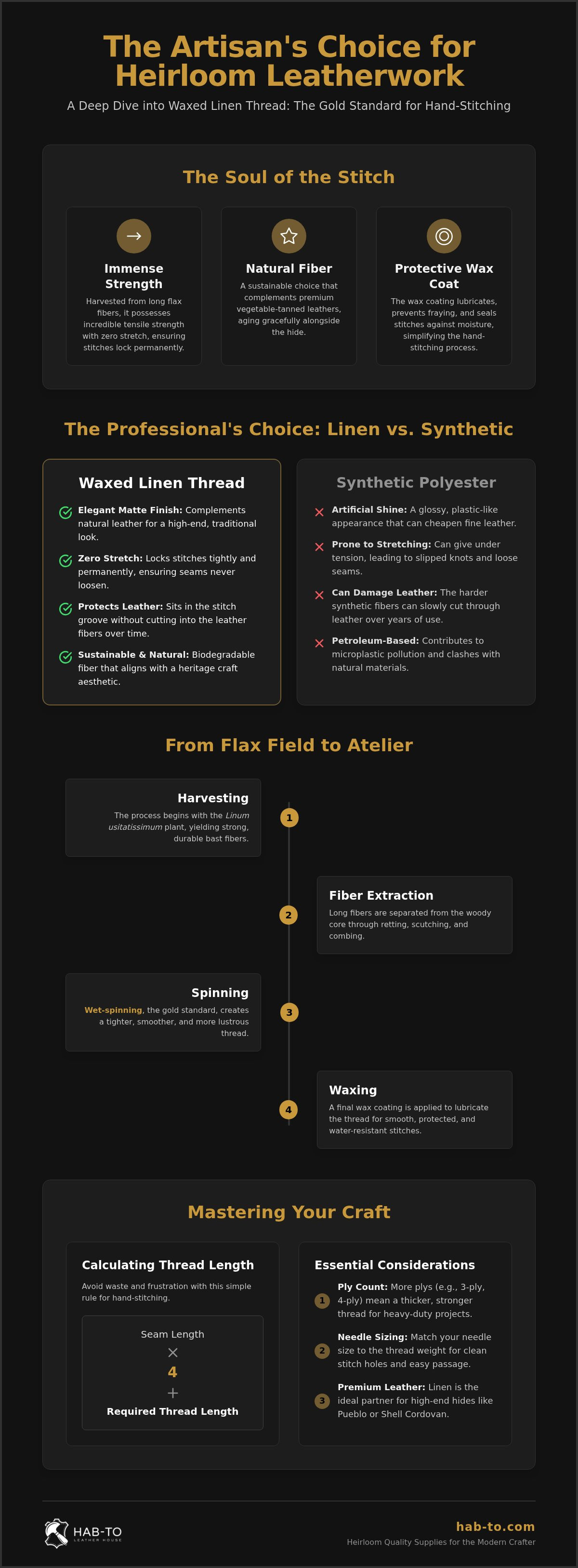
What is waxed linen thread, and why does it hold such a revered place in my workshop? At its core, it's a natural fiber harvested from the flax plant, twisted for immense strength, and coated in a protective layer of wax. In my 25 years of leatherworking, I've learned that a project isn't truly finished until it's hand-stitched with natural thread. It's the soul of the piece. This Linen textile has been the backbone of traditional saddlery for centuries, creating a bond that synthetic alternatives simply can't replicate.
To see how this traditional material behaves in practice, watch this helpful video:
The wax coating is non-negotiable for hand-stitching. It isn't just for aesthetics or shine. The wax reduces friction as the thread passes through the leather, preventing the fibers from fraying over the course of a long seam. It also seals the stitch, protecting the inner core from moisture and rot. Without it, hand-stitching becomes a struggle of tangles and weakened seams. Waxed linen is more than just a fastener; it's a structural component that breathes with the leather.
The Anatomy of a High-Quality Thread
When you look at a spool, you'll see terms like 3-ply or 4-ply. This refers to the number of individual flax strands twisted together. More plys generally mean a thicker, stronger thread for heavy-duty projects. Linen's superpower is its zero stretch. Unlike polyester, which can give under tension, linen stays exactly where you pull it. This ensures your saddle stitch remains tight for decades. The wax coating further binds these plys, creating a smooth, round profile that sits beautifully in the stitch groove.
A Heritage Material for Modern Crafters
When you understand what is waxed linen thread, you begin to see why it has defined luxury goods for generations. It represents a commitment to materials that age with grace. In a world increasingly concerned with microplastics, flax-based fibers offer a sustainable path forward. Recent EU regulations, like the 2026 ban on destroying unsold textiles, highlight a global shift toward durable, circular materials. Choosing linen aligns your craft with this future. It is the natural partner for premium vegetable-tanned hides like Pueblo leather or Shell Cordovan.
This dedication to quality is woven into our Hab-To heritage. My family has spent 160 years selecting materials that respect the craft. I believe in buying only what you need to create something beautiful, which is why we offer our premium supplies with no minimum order quantities. It's about supporting your journey, whether you're making one watch strap or a full set of luggage.
From Flax Fields to the Atelier: How It Is Made
The journey of a premium thread begins in the soil with the blue-flowered Linum usitatissimum. This plant yields a bast fiber that is significantly stronger and more durable than cotton. After harvesting, the flax stalks undergo retting and scutching to separate the long, golden fibers from the woody core. For those wondering what is waxed linen thread at a structural level, it is cellulose at its most resilient. These long fibers are then combed and prepared for spinning into the thread you hold at your workbench.
The spinning method is where quality truly diverges. Wet-spinning is the gold standard for high-end leathercraft. In this process, the fibers pass through warm water to soften the natural pectin, allowing for a tighter, smoother twist. This results in a lustrous thread that resists pilling. Dry-spinning is a faster, less expensive alternative that often leaves the thread feeling coarser and more prone to fuzzing. I've found that understanding what is waxed linen thread and how it is spun helps you appreciate why luxury houses never settle for the dry-spun varieties.
The Waxing Process: Why It Matters
Coating the spun flax in wax is a critical step for the hand-stitcher. The wax acts as a vital lubricant. It allows the thread to glide through the tight holes made by your stitching irons without creating heat or friction. This is exactly why I consider this material essential for our stitching bundles. Beyond lubrication, the wax provides a "locking" effect. As you pull each stitch tight, the wax creates enough friction to hold the tension in place while you prepare your next needle pass. This ensures your seams remain consistent from the first stitch to the last.
Natural vs. Synthetic Coatings
Artisans generally choose between natural beeswax and synthetic paraffin-based coatings. Beeswax is the traditional favorite because it has a unique "grippy" feel. It holds a knot exceptionally well, which is a major advantage during complex saddle stitching. Synthetic coatings are often smoother and perform better in high-heat environments where natural wax might soften too much. This versatility is why linen remains a staple traditional bookbinding thread as well. If your thread ever feels a bit dry for a specific project, you can easily refresh it by pulling it through a fresh block of wax.
Matching the right thread grade to your leather is an art in itself. Whether you are stitching a robust harness or a delicate wallet, the material's integrity defines the final result. If you are looking for the right foundation for your next project, our leather bundles offer the premium quality needed to practice these traditional methods.
Linen vs. Synthetic: Why Traditionalists Choose Natural Fibers
Choosing your thread is more than a technical decision; it's a choice of philosophy. While polyester and nylon are common in mass production, they often feel like a compromise in the bespoke world. When people ask what is waxed linen thread in the context of high-end work, they're usually looking for that specific matte finish. Synthetic threads have a tell-tale plastic shine. On a piece of rugged, character-rich hide, that shimmer can make a handcrafted item look "cheap" or industrial. Linen, by contrast, possesses an organic depth that complements the grain rather than competing with it.
Durability is often misunderstood in this debate. Polyester is technically stronger in a straight pull, but it behaves like a plastic wire. Over decades, synthetic thread can actually saw through the softer fibers of your leather as the piece flexes. Linen is a textile. It is firm, yet it yields just enough to respect the structure of the hide. If a seam ever needs a repair, linen is a dream to work with. You don't have to deal with melted plastic blobs. You simply unpick the natural fibers and restitch, preserving the integrity of the original holes.
The "Grip" and the "Lay"
Linen thread has a unique way of sitting flat against the leather surface. Because it has no "memory" like plastic-based threads, it doesn't try to spring back or uncoil after you've pulled it tight. It bites into the leather and stays there. This creates a low-profile seam that is less prone to abrasion. This refined "lay" is a hallmark of premium leather handbags, where every millimeter of stitch height matters for the final silhouette. Understanding what is waxed linen thread allows you to see why synthetic options often feel out of place on a high-end commission.
Sustainability and the Environment
In my workshop, I prioritize materials that age with the earth, not against it. Linen is entirely biodegradable. It is the ethical partner for your vegetable-tanned leather. Market data shows that 64 percent of global consumers now prefer natural textiles, and as a maker, your material choices should reflect that shift. You don't need a lighter to finish a linen seam. Instead of melting the ends into a hard plastic bead, you can use traditional tucking and gluing methods. This avoids the risk of scorching your leather and keeps the entire project free of microplastics. It's a cleaner, more honest way to build gear that lasts a lifetime.
Master the Thread: Practical Tips for Hand-Stitching
After years of teaching workshops, I've found that the best materials only shine when paired with the right technique. Understanding what is waxed linen thread is the first step, but mastering it requires a bit of math and a steady hand. Before you cut your first length, you need to calculate exactly how much you'll need. A reliable rule of thumb is the "four times the seam" rule. Measure the length of the area you intend to stitch and multiply it by four. This gives you enough thread to accommodate the thickness of the leather and leave a comfortable tail for your needles.
Choosing your needle is just as important as the thread itself. You want a harness needle that allows the thread to pass through the eye without excessive force, yet isn't so large that it widens the holes made by your irons. When you begin your saddle stitch, I recommend "casting" your stitch. This involves looping the thread over the needle in a specific direction as you pass through the hole. It locks the waxed fibers in place and creates that beautiful, slanted aesthetic that defines high-end leatherwork. To finish the seam, skip the lighter. Instead of melting the ends, back-stitch for two or three holes and tuck the ends between the layers of leather with a drop of glue. This traditional approach maintains the heirloom quality of your piece.
What You Will Need
To get the best results with traditional stitching, you'll need a few essential items from my personal toolkit:
- Waxed linen thread: Choose a weight that matches your project scale. You can find high-quality options in our stitching bundles.
- Harness needles: I prefer John James needles for their consistent taper and smooth eyes.
- Pricking irons: Use a set of professional leatherworking tools to ensure your hole spacing is perfectly consistent.
- Stitching pony: This tool acts as a third hand, holding your work steady so you can focus on even tension.
Explore our professional stitching bundles
Common Mistakes to Avoid
Even experienced makers can stumble when switching to natural fibers. One frequent error is using thread that is too thick for your stitch spacing. If you're stitching at 9 or 10 stitches per inch (SPI), a heavy 4-ply thread will look crowded and messy. Always test your thread and iron combination on a scrap piece first. Another mistake is pulling too hard. While linen is strong, snapping the natural fibers is possible if you're too aggressive. Finally, don't forget to "warm" the thread. Pulling the length through your fingers a few times softens the wax, making it more pliable and easier to pull through the leather. This small step makes a world of difference in your stitching rhythm.
Elevating Your Craft with Hab-To Stitching Supplies
I believe that the quality of your work is a direct reflection of the materials you choose to respect. In my workshop, I personally curate every spool of thread and every tool we offer. I don't just sell these items; I use them daily. When you truly understand what is waxed linen thread, you realize it is the heartbeat of a traditional project. My goal is to ensure you have access to the same professional-grade fibers used by the world's most prestigious tanneries. We don't believe in barriers to entry, which is why we maintain a strict no minimum order quantity policy. Whether you're a seasoned professional or a curious beginner, you can buy exactly what you need for a single project without waste.
Choosing the right combination of thread and leather can feel overwhelming. To solve this, I've developed our stitching bundles. These kits take the guesswork out of your first project by pairing the correct thread weights with the right needles. If you want to dive deeper into the heritage of these methods, I invite you to join our community through our masterclasses. We share the techniques passed down through 160 years of my family's leather expertise, helping you move from simple assembly to true artisan craftsmanship.
The Hab-To Difference
We pride ourselves on being more than just a warehouse. If you're struggling to decide on the right thickness for a specific commission, you can book a free video consultation with me. We can talk thread weights and leather pairings in real-time. Once you've made your choice, we ensure fast shipping from our base in Amsterdam to crafters across the globe. Our sourcing process is uncompromising. We only partner with suppliers who share our focus on sustainability and quality. This ensures that when you ask what is waxed linen thread from Hab-To, the answer is always the finest flax fiber available.
Start Your Traditional Stitching Journey
If you're ready to see the difference for yourself, I have a specific recommendation. Pair our waxed linen thread with Badalassi Pueblo leather. The rustic, matte texture of this hide is the perfect companion for the natural look of linen. It creates a finished piece that feels authentic and looks intentional. For a complete entry into the craft, check out our starter bundles. They include everything you need to begin your journey with confidence. Don't forget to sign up for our newsletter. I send out regular "Expert Friend" tips to help you refine your technique and stay inspired at the workbench.
Elevate Your Craft with Timeless Materials
Choosing the right materials is the first step toward creating something that outlives its maker. We have explored what is waxed linen thread and why its unique grip, zero stretch, and matte finish make it the only choice for heritage-quality leatherwork. Unlike synthetics that age poorly and can damage your hides, natural linen respects the leather and develops its own character over time. It is a choice that honors both the history of the craft and the modern push for sustainable, circular materials.
At Hab-To, we bring over 160 years of family leather expertise to your workbench. I personally select every thread to ensure it meets the standards of professional artisans across Europe. Because we don't have minimum order quantities, you can start small and focus on perfection without the burden of excess stock. Your journey from hobbyist to master artisan starts with the very first stitch.
It is time to put these traditional methods into practice. I can't wait to see how you use these premium supplies to transform your next project into a true heirloom. Keep crafting with passion and precision.
Frequently Asked Questions
Is waxed linen thread stronger than polyester?
Waxed linen has a lower tensile strength than polyester in a straight pull, but it is superior for the structural integrity of leather. Polyester is essentially a plastic wire that can saw through vegetable-tanned hides over time. Linen is a textile that yields slightly, respecting the leather's fibers. For hand-stitching, the strength of the thread is less critical than its ability to protect the leather from internal abrasion.
Does waxed linen thread rot over time?
Linen can rot if exposed to constant moisture, but the wax coating acts as a powerful preservative. The wax seals the flax fibers, preventing water from penetrating the core of the thread. As long as you keep your finished goods in a dry environment and maintain the leather, your stitching will last for decades. This is why traditional saddlery from the last century still remains intact today.
What size waxed linen thread should I use for a wallet?
For a standard wallet, I recommend a thread diameter between 0.4mm and 0.6mm. If you are stitching at 9 or 10 stitches per inch (SPI), a finer thread like Lin Câblé 632 provides a refined, high-end look. For a more rugged aesthetic on thicker leather, a 0.6mm thread is a better fit. Always match your thread weight to your pricking irons to ensure the seam looks balanced.
Can I wax my own linen thread at home?
You can certainly wax your own thread at home by pulling raw linen through a block of natural beeswax. This allows you to control the amount of "grip" on the thread. However, professional pre-waxed threads are often wet-spun and waxed under tension, which provides a much more consistent coating. If you find a spool is too dry for your project, a quick pass through a fresh beeswax block is a common artisan trick.
How do I finish the ends of waxed linen thread without melting it?
To finish a seam without a lighter, you should back-stitch for two or three holes and then tuck the ends between the leather layers. Use a tiny drop of specialized leather glue, like Ecostick, to secure the final tail inside the seam. This traditional method avoids the hard, melted plastic beads associated with synthetic threads. It leaves your project with a clean, professional finish that respects the natural materials.
Will the wax on the thread stain my leather?
Natural beeswax generally won't stain your leather, though it may leave a slight residue on very light-colored hides if applied too heavily. Most high-quality threads use a stable wax that stays within the fibers. If you notice a residue, you can usually buff it away with a soft cloth. When people ask what is waxed linen thread, they're often surprised to learn the wax actually helps condition and seal the stitch hole.
Why is my linen thread fraying while I stitch?
Fraying usually happens because of excessive friction or a lack of wax. If your needle holes are too small for your thread diameter, the leather will strip the wax and damage the fibers with every pass. To prevent this, ensure your thread is properly lubricated and that you're using high-quality harness needles. Warming the thread between your fingers before you start helps the wax penetrate and protect the flax strands.
Can I use waxed linen thread in a sewing machine?
You shouldn't use waxed linen thread in a sewing machine. The wax will quickly build up on the tension discs, needle, and bobbin case, causing the machine to jam or skip stitches. This material is specifically designed for the slower, more deliberate pace of hand-stitching. If you're looking for a machine-compatible option, you'll need to look for un-waxed or bonded threads that won't leave a sticky residue in your internal equipment.
Disclaimer
All our blog articles are made for information purposes only we dont take responsability for any content from third parties.