Premium Vegetable Tanned Leather: The Ultimate Artisan’s Sourcing Guide (2026)
Your craftsmanship is only as good as the hide on your workbench. You've likely felt the frustration of ordering a "premium" skin only to realize it's a plastic-coated imitation that won't take a burnish or develop a soul. Truly world-class vegitable tanned leather is different; it's a natural material that breathes, ages, and tells a unique story through its character. It's the only choice for makers who refuse to make concessions on quality.
As someone whose family has lived and breathed this trade since 1857, I know the headache of being forced to buy a massive hide when you only need a small panel. You shouldn't have to navigate customs delays or settle for inferior alternatives just to avoid bulk requirements. Here at Hab-To Leather House, we show you how to source authentic Italian hides from legendary tanneries without those traditional hurdles.
We'll explore how to choose the right leather weight for your specific project and how to identify the hallmarks of a professional-grade patina. From the rustic texture of Pueblo to the mirror-like glow of Shell Cordovan, you're about to discover how to bring a 160-year-old tradition of excellence to your own workshop.
Key Takeaways
- Understand the unique "living" quality of plant-based tannins and how they create a superior, long-lasting patina compared to mass-produced alternatives.
- Learn to recognize authentic Italian craftsmanship through the Tuscan Vegetable Tanning Consortium certification and iconic producers like Conceria Maryam.
- Master the technical art of matching hide thickness to your project by understanding the conversion between millimeters and ounces for vegitable tanned leather.
- Access premium materials like Pueblo and Shell Cordovan without the burden of bulk purchases through our specialized no-minimum-order sourcing.
- Identify the exact tools and preparation techniques needed to achieve professional-grade results when tooling or finishing your leather projects.
What is Vegetable Tanned Leather and Why Does It Define Quality?
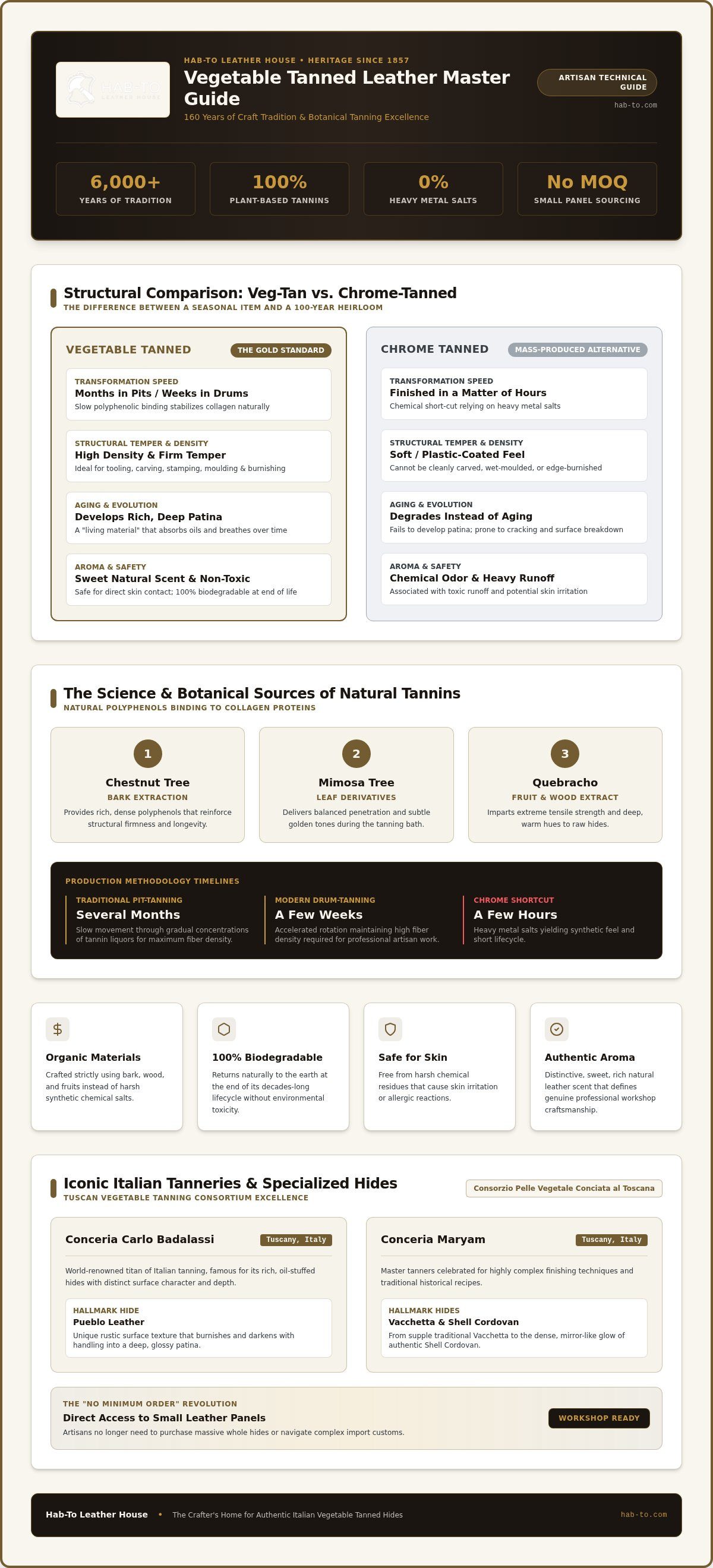
True quality isn't found in a laboratory. It's found in the bark of a chestnut tree, the leaves of a mimosa, and the fruit of the quebracho. This 6,000-year-old tradition is what we call vegetable tanned leather. It's a process that respects the material. It honors the animal and the earth. Unlike mass-produced alternatives, this method relies on natural tannins to transform raw hides into something extraordinary.
We call it a "living material" for a reason. It breathes. It evolves. Every time you touch a finished piece, the oils from your hands interact with the fibers. Over time, it develops a rich, deep patina that can't be faked. At Hab-To Leather House, we refuse to stock chrome-tanned hides. We believe in materials that get better with age, not ones that fall apart. Our 160-year history is built on this single, unyielding principle.
Our commitment to sustainability isn't a marketing trend. It's our heritage. Choosing plant-based methods means avoiding the toxic runoff associated with heavy metals. It's a choice for the environment and for the craftsman who handles the leather every day.
- Organic materials: Uses bark, wood, and fruits instead of harsh salts.
- Biodegradable: Returns to the earth naturally at the end of its long life.
- Safe for skin: No chemicals to cause irritation or allergic reactions.
- Authentic aroma: That classic, sweet leather scent that defines a professional workshop.
The Science of Plant-Based Tannins
The vegetable tanning process is a masterclass in patience. Tannins are naturally occurring polyphenols. They bind to the collagen proteins in the hide and stabilize them. This prevents decay and creates a structure that's incredibly dense. Traditional pit-tanning can take several months. The hides move slowly through various concentrations of tannin liquors. While modern drum-tanning speeds this up to a few weeks, it still maintains the high fiber density required for professional work. This slow transformation ensures the leather doesn't just look good; it stays strong for decades.
Durability vs. Chrome Tanned Alternatives
Chrome tanning is the industry's shortcut. It uses heavy metal salts to finish hides in a matter of hours. The result is a leather that feels like plastic and smells like chemicals. Vegetable tanned leather is the polar opposite. It's the gold standard for artisans because of its structural superiority. If you want to carve, stamp, or mould your project, you need the firm temper that only plant-based tanning provides. It's the difference between a product that lasts a season and an heirloom that lasts a century. For those just starting their journey, choosing the right material is the first step toward professional results. You can find our full range of authentic hides in our professional artisan's guide to sourcing hides.
Sourcing World-Class Hides: The Iconic Italian Tanneries
Sourcing world-class hides often feels like an exclusive club. For years, the finest Italian tanneries only dealt with high-volume manufacturers. At Hab-To, we've spent decades breaking down those barriers. We believe every artisan deserves access to the same quality as the luxury fashion houses. Our focus remains on the heart of Italy, specifically the Tuscan region, where the art of vegitable tanned leather has been perfected over centuries of tradition.
The Consorzio Pelle Vegetale Conciata al Toscana certification is the mark of a true masterpiece. This group of tanneries adheres to strict traditional standards. They use only natural tannins and sustainable practices. When you see that iconic handprint logo, you know you're working with a material that has a soul. This certification isn't just a label; it's a promise that the leather was produced with respect for the craft and the environment.
Conceria Carlo Badalassi and Conceria Maryam are the titans of this industry. Badalassi is legendary for its rich, oil-stuffed hides, while Maryam has mastered the complex art of Vaccheta and Shell Cordovan. We've built deep, personal relationships with these families. This allows us to offer a "No MOQ" revolution. You can now buy small panels of these world-renowned leathers for your specific project without the burden of buying a whole hide. It's about making professional excellence accessible to everyone.
Spotlight on Pueblo Leather
Pueblo is unlike any other hide. It has a unique scuffed texture that feels rustic and raw to the touch. Don't let the initial matte appearance fool you. As you work the material and use the finished piece, the surface smoothens into a beautiful, deep glow. The color depth of Italian Pueblo is unmatched, aging with a character that tells the story of its user. For wallets, bags, and small accessories that need immediate personality, Badalassi Pueblo Leather is the gold standard.
The King of Leathers: Shell Cordovan
If Pueblo is the rebel, Shell Cordovan is the royalty. Maryam Shell Cordovan is sought after for its incredible density and mirror-like finish. It doesn't crease; it ripples. This unique characteristic makes it the ultimate choice for high-end watchstraps and bespoke wallets. You can dive deeper into why this material is so special in our guide on Shell Cordovan: The Ultimate Guide to the King of Leathers. For those ready to start their next masterpiece, we offer Maryam Shell Cordovan Premium Italian Leather in sizes that fit your workshop needs perfectly.
Finding the right combination of premium leather and hardware can be daunting for any project. To help you get started without the guesswork, consider exploring one of our carefully curated leather bundles.
Choosing the Right Leather Weight for Your Project
Selecting the wrong thickness is a costly mistake. It can turn a sleek wallet into a bulky brick or a sturdy bag into a sagging mess. In my years at the workbench, I've learned that understanding weight is just as important as choosing the hide itself. Most European tanneries measure in millimeters, while US based crafters often use ounces. The rule of thumb is simple: 1 ounce is approximately 0.4mm. If you're looking for a 4oz hide, you need a 1.6mm thickness.
But thickness is only half the story. You must also consider the "temper." This refers to the leather's stiffness or flexibility. A firm temper vegitable tanned leather provides the structural integrity needed for standing bags. A soft or medium temper is better suited for items that need to fold or wrap. Because we offer a "No MOQ" policy, you can source smaller panels or shoulders to prototype your designs. This allows you to test how a specific weight reacts to your pattern before committing to a larger project.
Leather for Small Goods (1.0mm - 1.5mm)
Small leather goods require a delicate balance. You need a material thin enough to fold without cracking, yet strong enough to hold a stitch. For wallets, watchstraps, and premium linings, 1.0mm to 1.5mm is the sweet spot. I highly recommend Maryam Vaccheta for these projects. It's incredibly supple but retains enough strength to last for years. If your design requires even thinner sections, such as T pockets, you'll need to master the art of skiving. Thinning the edges ensures your finished piece remains refined and professional.
Leather for Belts and Heavy Gear (3.5mm+)
When it comes to load bearing gear, fiber density is everything. Belts, knife sheaths, and equestrian equipment demand a thickness of 3.5mm or more. This is where Harness and Bridal leather truly shine. These hides are stuffed with extra oils and waxes to withstand the elements and heavy use. The tight grain prevents the leather from stretching over time, ensuring your belt stays the same size for a lifetime. For those moving from small goods into larger constructions, check out our Artisan’s Guide to Premium Leather for Handbags to see how weight impacts bag design.
Working with Vegetable Tanned Leather: Tools and Techniques
Working with vegitable tanned leather is a sensory dialogue between the artisan and the hide. It requires a different mindset than synthetic or chrome-tanned materials. Because the grain remains "open" and natural, it accepts moisture and pressure in a way that allows for permanent, beautiful modification. This is why it's the only choice for traditional tooling and stamping. When you case the leather with a bit of water, you're softening the fibers to accept the steel's mark. Once it dries, that impression is locked in for a lifetime.
Bonding your project is another area where quality matters. Traditional solvent-based glues are harsh on the lungs and the environment. In our workshop, we've moved exclusively to water-based adhesives. They offer a professional, permanent bond without the chemical smell. It's about respecting the material and the person working it. Choosing the right glue ensures your seams stay tight as the leather ages and develops its character.
What You Will Need: The Finishing Kit
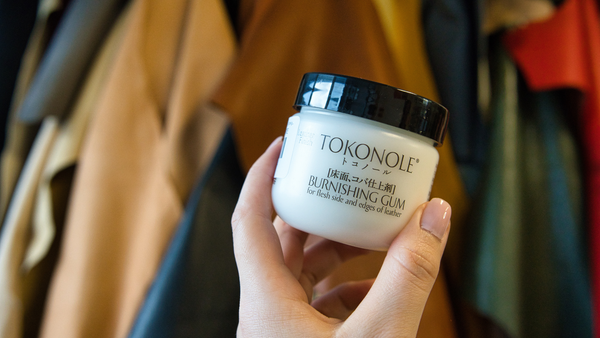
- Tokonole Burnishing Cream: The industry standard for achieving a smooth, sealed, and glossy edge.
- Wood Slicker: A simple but essential tool used to create the friction necessary for a professional burnish.
- Edge Bevelers: These are used to remove the sharp corner of the leather, creating a rounded profile that's easier to finish.
- Ecostick 1804 Leather Glue: A high-performance, water-based adhesive that provides a professional bond without toxic fumes.
- Stitching Essentials: High-quality pricking irons and waxed thread are vital for creating the iconic saddle stitch that defines handmade luxury.
The Art of the Perfect Edge
A raw, fuzzy edge is the mark of an amateur. A glass-like, burnished edge is the signature of a master. Vegitable tanned leather is unique because its dense collagen structure can be compressed and polished through friction. This process, known as burnishing, uses a cream like Tokonole to bind the loose fibers together. You apply a small amount to the beveled edge, let it get slightly tacky, and then use your wood slicker with rapid, light strokes. The heat generated by the friction "melts" the natural tannins and waxes, creating a hard seal that protects the edge from moisture and wear.
While some modern makers prefer edge paint, burnishing honors the natural beauty of the hide. It allows the edge to age and patina alongside the rest of the piece. This creates a cohesive look that only improves over time. If you're looking to take your decorative work further, check out The Artisan’s Guide to Leather Stamping Tools to see how to add professional depth to your designs.
Why Hab-To Leather House is the Crafter's Home
Hab-To isn't just a store. It's a legacy. Our family business was founded in 1857, and we've lived through the evolution of this trade for over 160 years. When you shop with us, you're talking to people who understand the grit and the glory of the workbench. Mike, our lead expert, brings over 25 years of hands-on experience to every selection. We don't just sell hides. We curate the foundation for your next heirloom. Our commitment to exclusively stocking vegitable tanned leather ensures that your work remains authentic, sustainable, and professional.
We've seen too many talented crafters sidelined by massive minimum order requirements. You shouldn't have to buy a whole side of premium Italian leather just to make a single watchstrap or wallet. Our "No Minimum Order" promise changed that. We source world-renowned hides from the Tuscan consortium and break them down into accessible panels. This allows you to work with the best materials in the world regardless of your project size or budget. We handle the logistics and the customs so you can focus on the craft.
Personalized Support for Your Journey
We believe in education before the sale. If you're unsure which hide weight fits your pattern, you can book a free 1-on-1 video consultation with Mike. It's a chance to get expert eyes on your specific project needs. For those looking to sharpen their technique, our Leathercraft Masterclasses provide deep dives into professional construction. You aren't just a customer here. You're part of a community that values tradition over mass production. We're here to help you navigate every stitch and burnish.
Get Started with a Curated Bundle
Starting a new project can be overwhelming. The sheer variety of tools and hides often leads to analysis paralysis. Our Crafting Bundles are designed to eliminate the guesswork. We've paired the right weights of vegitable tanned leather with the exact tools and adhesives needed to finish them. The Leathercraft Master Bundle is a perfect example. It includes everything from premium Italian hides to professional-grade Ecostick glue. These kits save you money and ensure your first project is as confident as your last.
Building Your Legacy with the Finest Hides
Choosing the right hide is the difference between a project that fades and one that thrives. We've explored how the dense, natural fibers of vegitable tanned leather provide the structural integrity needed for professional stamping, moulding, and burnishing. By understanding the nuances of leather weight and temper, you can now match your material to your specific vision with total confidence. It's about respecting the material as much as the process.
You don't need a massive warehouse or a corporate budget to work with world-class Italian leather. Our 160 years of family expertise and direct sourcing from legendary Tuscan tanneries mean you get authentic quality without the burden of minimum order requirements. We've removed the traditional barriers so you can focus on what truly matters; the quiet, rewarding rhythm of the craft itself.
Your journey at the workbench is a lifelong pursuit of excellence. We're honored to be your partner in that process. Grab your tools, pick your panel, and start creating something that will last for generations.
Frequently Asked Questions
What is the difference between vegetable tanned and chrome tanned leather?
Vegetable tanning uses organic plant tannins like tree bark and fruit to stabilize the hide, while chrome tanning relies on heavy metal salts. The result is a material that is biodegradable and develops a rich patina over time. Because the process takes months rather than hours, it results in a higher fiber density. This makes it the superior choice for traditional techniques like stamping, carving, and burnishing.
Does vegetable tanned leather water-stain easily?
Yes, unfinished hides are porous and will absorb moisture, which can leave permanent marks on the surface. While many crafters appreciate these marks as part of the material's unique story, you can protect your project with natural finishes. Applying a leather cream or wax creates a protective barrier. It is best to wipe away any spills immediately with a dry cloth to prevent moisture from penetrating deep into the fibers.
Why is vegetable tanned leather more expensive than other types?
The cost reflects the significant time and skill involved in a process that takes up to several months to complete. Unlike chrome tanning, which is a fast, chemical-heavy industrial method, this traditional approach relies on natural extracts and slow-acting tanning pits. This transformation results in a more durable material with superior structural integrity. You are investing in a premium product that is designed to last for generations.
Can I buy just a small piece of Italian leather at Hab-To?
Absolutely, we specialize in a "No MOQ" policy that allows you to buy small panels or shoulders for your specific projects. You don't have to purchase a whole hide to access world-class Italian leather from legendary tanneries like Conceria Maryam. This approach makes premium materials accessible for small items like watchstraps or wallets. We handle the bulk sourcing so you can buy only the amount you actually need.
How do I care for my vegetable tanned leather project?
Regular conditioning with plant-based products is the best way to maintain suppleness and prevent the grain from cracking. We recommend using specialized leather food or olive-oil based care ranges every few months. Avoid using harsh detergents or synthetic sprays that can clog the natural pores of the hide. A gentle buffing with a soft brush helps distribute natural oils and enhances the glow of the developing patina.
Is vegetable tanned leather 'vegan' or just plant-based?
It is a plant-based tanning process, but the base material is still genuine animal hide. The term "vegetable" refers to the tannins used in the tanning liquors, such as chestnut bark and mimosa. It should not be confused with synthetic "vegan" leathers, which are often made from petroleum-based plastics. This is a natural, biodegradable byproduct that avoids the toxic chemicals found in both chrome-tanned and synthetic alternatives.
What is the best weight of leather for making a belt?
A thickness between 3.5mm and 4.0mm is ideal for creating a durable, load-bearing belt that won't stretch. This weight provides the necessary rigidity to support hardware and maintain its shape over decades of use. Using a high-density vegitable tanned leather like Harness or Bridal ensures the finished piece remains functional for a lifetime. For heavy-duty utility belts or equestrian gear, you might even consider going slightly thicker for maximum strength.
How long does it take for vegetable tanned leather to develop a patina?
You will usually see the first signs of change within a few weeks of regular use and handling. The speed of the transformation depends on exposure to sunlight, natural oils from your hands, and daily friction. A project made from vegitable tanned leather will continue to darken and develop a unique sheen over several months. This evolution is a natural process that turns a simple object into a personalized heirloom.
Disclaimer
All our blog articles are made for information purposes only we dont take responsability for any content from third parties.