

Guide to Vegetable Tanned Leather: Quality and Benefits
The most expensive material in your workshop isn't the premium hide you just bought. It's the wasted leather sitting in the corner because a wholesaler forced you to buy a full skin for a small project. True craftsmanship shouldn't be gated by minimum order requirements. Quality matters. Tradition counts. When you choose vegetable tanned leather, you aren't just buying a surface. You're investing in a centuries-old legacy that rewards your patience with a lifetime of character.
We know the frustration of navigating "genuine leather" marketing that masks inferior quality. You want materials that age gracefully and tools that feel like an extension of your hand. This guide explores why vegetable tanned leather remains the undisputed gold standard for artisans who refuse to make concessions. You'll discover the chemistry behind the tanning process, the magic of the patina, and the essential toolset needed to master this material. From sourcing small panels of elite Italian hides to finishing edges like a professional, we'll show you how to elevate your craft without the usual industry hurdles.
Key Takeaways
- Learn why vegetable tanned leather is a living material that develops a unique patina over time through natural oxidation and use.
- Discover how to select the perfect hide for your project by comparing the textures of premium Pueblo leather and Shell Cordovan.
- Understand the science behind the patina process and how sunlight and hand oils transform your leatherwork into a one-of-a-kind heirloom.
- Master professional edge finishing techniques using essential supplies like Tokonole and Ecostick glue.
- Access elite hides from tanneries like Conceria Maryam without any minimum order requirements, allowing you to buy exactly what you need.
What is Vegetable Tanned Leather? The Artisan's Choice
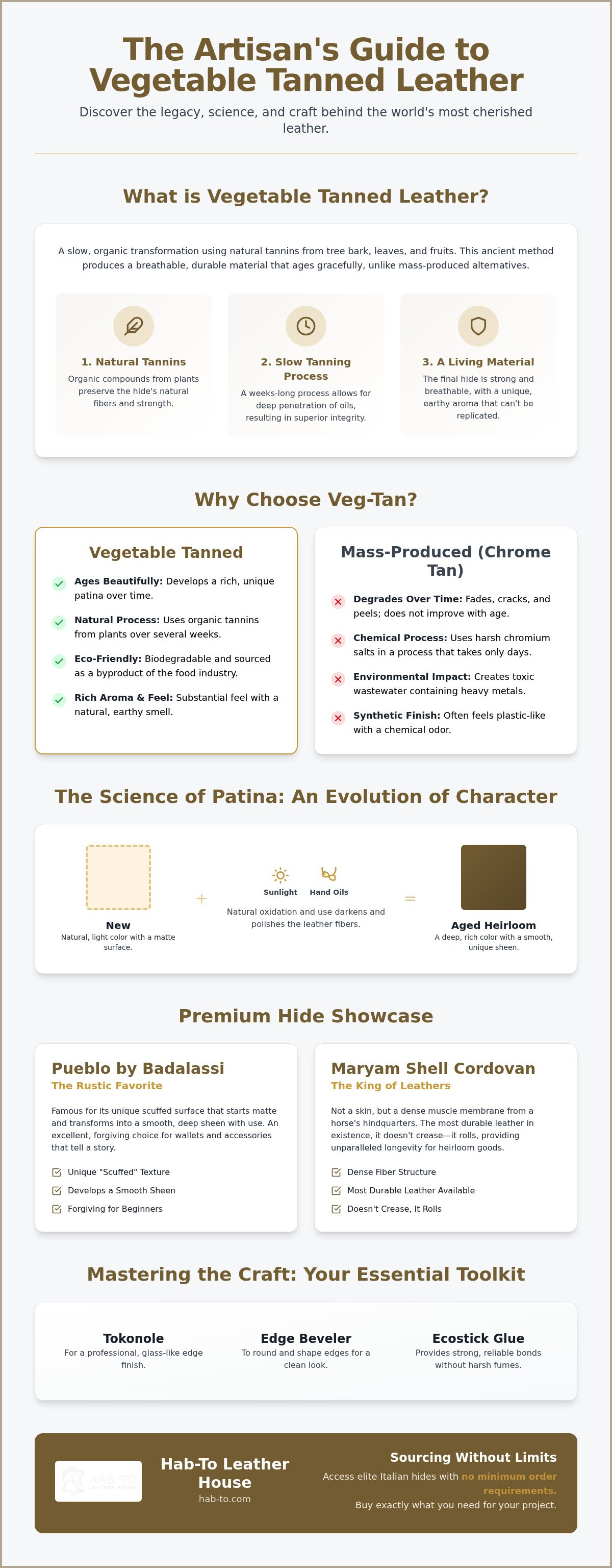
At its core, vegetable tanned leather is the result of a slow, organic transformation. Unlike mass-produced alternatives that rely on harsh chemicals, this method uses natural tannins derived from tree bark, leaves, and fruits. This ancient vegetable tanning process can take several weeks or even months to complete. The result is a hide that feels substantial, smells like wood and earth, and possesses a structural integrity that synthetic materials simply cannot replicate. It's a living material. Because the fibers aren't sealed under a plastic-like coating, the leather remains breathable and continues to evolve long after it leaves the tannery.
Our philosophy at Hab-To is simple: we don't make concessions. We exclusively stock vegetable tanned leather because it respects the artisan and the end-user alike. When you work with a hide like Badalassi Pueblo, you're handling a material that's been treated with the same reverence for quality that we've maintained for generations. We avoid synthetics because they lack soul. They don't age; they only degrade. Veg-tan, however, grows more beautiful with every touch.
The History and Heritage of Veg-Tan
The roots of this craft stretch back thousands of years. While the world has sped up, the best Italian tanneries have stayed the course. They've refined ancient techniques into a modern standard of excellence that remains unmatched. This respect for tradition is personal for us. Hab-To was founded in 1857, and that 160-year legacy informs every hide we select. Our owner, Mike, brings over 25 years of personal expertise to the table. He understands that traditional methods outperform industrial shortcuts for several reasons:
- Natural tannins preserve the original hide structure and strength.
- Slow tanning times allow for deeper penetration of oils and waxes.
- Traditional recipes produce a unique, earthy aroma that chemicals can't mimic.
You can feel that difference in the density and the "snap" of a premium Italian hide.
Sustainability and the Environment
True luxury shouldn't come at the cost of the planet. Plant-based tanning agents are inherently eco-friendly. Because the process avoids heavy metals, the leather is essentially biodegradable at the end of its very long life. We're proud to be direct partners with the Consorcio Pelle Vegetal Toscano. This organization represents the gold standard for ethical leather production in Tuscany. They ensure that every hide is a byproduct of the food industry and that tanneries adhere to strict environmental regulations. When you source from our collection, you're supporting a circular economy that values transparency and craftsmanship over mindless volume.
Comparing Premium Hides: Pueblo, Vaccheta, and Shell Cordovan
Selecting the right vegetable tanned leather depends entirely on the soul of your project. Every tannery uses a proprietary blend of fats, waxes, and natural liquors to achieve a specific density and hand-feel. For a structured tote, you might require a 2.0mm shoulder. For a delicate watch strap, a 1.2mm panel is far more appropriate. Sourcing from certified Italian tanneries ensures you receive hides that meet the strict standards of the Consorcio Pelle Vegetal Toscano. We provide small panels and shoulders specifically so you can test these premium textures without the burden of a full hide purchase.
Weight selection is a critical decision framework for any artisan. A 1.0mm to 1.5mm weight is ideal for linings and card slots. Hides between 2.0mm and 2.5mm provide the rigidity needed for belts or unlined bags. If you aren't sure which temper fits your design, exploring our leather bundles is a great way to handle different weights before committing to a larger order.
Pueblo by Badalassi: The Rustic Favorite
Badalassi Pueblo Leather is famous for its unique scuffed surface. It starts with a matte, almost rustic texture that feels slightly rough to the touch. As you use it, the oils from your hands buff the surface. It transforms into a smooth, deep sheen with incredible depth of color. This character makes it the perfect choice for wallets, journals, and small accessories that need to tell a story. It's a forgiving leather for beginners because its natural texture hides minor tool slips.
Maryam Shell Cordovan: The King of Leathers
Shell Cordovan isn't technically skin; it's a specific muscle membrane found in the hindquarters of a horse. This dense fiber structure makes it the most durable leather in existence. Unlike standard hides, it doesn't crease; it ripples. This unique property prevents the unsightly cracking often seen in lower-quality materials. For a deeper dive into why this material sits at the top of the leather hierarchy, check out our Shell Cordovan: The Ultimate Guide. It remains the undisputed choice for luxury footwear and heirloom-grade small goods.
Olivenleder and Jesse: The New Sustainable Frontier
The Jesse Collection represents a significant shift in 2026 crafting trends. Instead of traditional tree barks, this leather uses a tanning agent derived from olive tree leaves, a byproduct of the olive oil industry. This "Olivenleder" method produces a leather that is exceptionally soft and hypoallergenic. It's an ideal choice for eco-conscious crafters who want to combine modern ecological innovations with the timeless quality of traditional Italian tanning.
The Science of the Patina: Why Your Leather Evolves
A patina is the ultimate signature of vegetable tanned leather. It's not just a change in appearance; it's a slow-motion chemical reaction. When the natural tannins within the hide are exposed to sunlight and oxygen, they undergo oxidation. This process is strikingly similar to how your skin tans in the sun. Over time, these tannins darken, shifting from pale creams to deep, honeyed ambers. At the same time, the hide absorbs the natural oils from your hands. These lipids penetrate the fiber structure, softening the leather from within and giving it a supple, buttery hand-feel that mass-produced materials can't mimic.
There's a distinct difference between a healthy patina and a dirty product. A true patina has depth and a subtle glow. It's a translucent layer of character that still allows the natural grain to show through. Grime, on the other hand, looks flat and opaque. After two years of daily use, a high-quality hide like Maryam Vaccheta will look entirely different than it did on day one. It will have shifted from a stiff, uniform surface to a piece with unique wear patterns that tell the story of its owner.
Factors That Influence Patina
Sunlight is the primary driver. If you leave a natural translucent leather on a windowsill for a week, you'll see a visible change in tone without even touching it. Friction and heat also play vital roles. The heat generated by the friction of sliding a wallet into a pocket helps burnish the surface, creating a natural polish. The starting point matters too. Natural "Crust" leathers, which haven't been dyed or heavily finished, offer the most dramatic evolution. They act as a blank canvas for your daily life.
Preserving the Evolution
One of the biggest mistakes we see is over-conditioning. If you saturate the leather with heavy waxes too early, you clog the pores and stall the natural oxidation process. It's like putting a plastic wrap over a living thing. For subtle maintenance that respects the hide's journey, we recommend products from the Olivenleder collection. These olive-oil-based treatments provide hydration without creating a heavy barrier. Mike always shares one crucial tip during our masterclasses: less is more. High-quality vegetable tanned leather already contains most of the oils it needs. Trust the material and let time do the heavy lifting.
Mastering the Craft: Tools and Edge Finishing
Vegetable tanned leather is uniquely responsive to the artisan's touch. Unlike chrome-tanned options that are sealed with synthetic topcoats, its open fiber structure allows for deep compression and molding. This makes it the only viable choice for traditional tooling, carving, and stamping. When you apply pressure or heat to the surface, the leather holds that shape with remarkable clarity. It's also the only material that achieves a glass-like edge through friction alone. The natural tannins act as a binding agent when heated, allowing the fibers to fuse into a smooth, solid unit.
Beginners often face "tool fatigue" by trying to buy every gadget at once. We always recommend a more curated approach. High-quality results depend on the foundation. Using a standard household adhesive might save a few Euros today, but it will inevitably fail as the leather flexes over time. Professional-grade adhesives ensure your bond is as durable as the hide itself. Achieving a high-end look also requires attention to the geometry of your project. Edge beveling is the critical bridge between an amateur "cut" look and a professional, rounded finish.
What You Will Need: The Perfect Edge Finish
To achieve a professional result, you need a kit that works in harmony with the natural properties of the hide. We suggest the following essentials:
- Tokonole: The gold standard for burnishing that provides a smooth, durable finish.
- Edge Bevelers: Essential for removing the sharp 90-degree corners of your leather panels.
- Glass Slicker: A tool used to generate the specific heat and friction required to seal the fibers.
- Ecostick 1804: A solvent-free, water-based glue that offers a permanent, flexible bond without toxic fumes.
Starting with a Master Bundle approach is the most efficient way to ensure your tools match your materials. It eliminates the trial and error that often discourages new crafters.
Step-by-Step Burnishing Technique
Success in burnishing is about patience and rhythm. First, sand your edges starting with 400 grit and moving to 800. The surface must be perfectly flush before you proceed. Second, apply a very thin layer of Tokonole using your finger or a small spatula. You want to hydrate the fibers, not soak them. Third, use your wood or glass slicker. Fast, light strokes are better than heavy pressure. You're trying to generate heat, not crush the leather. For a deeper dive into this process, read our guide on Professional Edge Finishing with Tokonole.
Sourcing Without Limits: The Hab-To Difference
Most high-end Italian tanneries speak only one language: volume. For the independent artisan or the hobbyist, this often creates an impossible barrier. Professional wholesalers typically demand massive minimum orders that force you to buy more than you need. We've changed that. At Hab-To, we've removed the hurdles between elite tanneries and your workbench. We operate with a strict No Minimum Order (No MOQ) policy. You shouldn't have to buy a full hide when you only need a small panel for a watch strap or a few square decimeters for a card holder.
Efficiency is the backbone of our service. When a custom commission arrives, you don't have time to wait weeks for shipping. We've optimized our logistics to ensure a 24-48 hour delivery speed for our customers. This allows you to keep your own inventory lean while knowing that the world's finest vegetable tanned leather is always within reach. Our goal is to be the bridge that connects traditional craftsmanship with modern accessibility.
The Expert in Your Pocket
Buying leather online can feel like a gamble. You can't feel the temper or see the grain through a standard product photo. To reduce that anxiety, you can book a Free Video Consultation with Mike. With over 25 years of personal expertise, Mike can show you specific hides in real-time and help you choose the right weight for your design. If you're looking to sharpen your technical skills, our masterclasses start at 65 Euro in our Amsterdam showroom. These sessions offer a deep dive into the "Leather Art Experience," providing the kind of mentorship that an anonymous corporate checkout can't provide.
Your One-Stop Shop for Leathercraft
A project is only as good as its weakest component. To ensure consistent quality, you can combine your leather purchase with premium hardware and specialized tools in a single order. Sourcing everything from one reliable partner saves time and shipping costs. Because we are based in the EU, our European customers enjoy a seamless experience with no customs surprises or unexpected import duties. We aren't just selling a commodity. We're providing a complete educational and material ecosystem for those who take vegetable tanned leather seriously.
Explore our full collection of Vegetable Tanned Leather
Begin Your Legacy with Premium Italian Hides
Choosing the right material is the first step toward creating an heirloom. You now understand why vegetable tanned leather stands alone in its ability to age, breathe, and evolve. By selecting certified Italian hides and mastering the tools required for a professional finish, you're honoring a tradition that spans centuries. At Hab-To, we've spent over 160 years refining our expertise to support your journey. Whether you need a single panel for a watch strap or a full shoulder for a luxury bag, we provide access to the same premium materials used by elite fashion houses. Don't let minimum order requirements stifle your creativity. If you're unsure which hide fits your next project, Mike is available for free 1-on-1 video consultations to help you decide.
Your workshop deserves materials that reward your hard work with a lifetime of character. We're here to help you build something that lasts. We can't wait to see the unique patina your next project develops.
Frequently Asked Questions
Is vegetable tanned leather actually better than chrome-tanned leather?
Vegetable tanned leather is the superior choice for artisans who value tradition and longevity. While other methods use heavy metals, this process relies on natural plant extracts. It is the only material that develops a rich patina and allows for professional edge burnishing. It is more durable and holds its shape better over decades. If you want a material that tells a story and respects the environment, veg-tan is the undisputed standard.
How do I know if I'm buying real Italian vegetable tanned leather?
Authentic Italian hides are usually accompanied by a certificate from the Consorcio Pelle Vegetal Toscano. This guarantee confirms the leather was tanned in Tuscany using century-old recipes. You will notice a distinct, woody aroma that chemicals cannot replicate. We only stock certified leathers from world-class tanneries like Conceria Maryam and Badalassi. This ensures you are getting genuine quality that supports traditional craftsmanship rather than mass-produced industrial alternatives.
Does vegetable tanned leather water-spot easily?
Open-pore leathers do absorb moisture, which can cause temporary or permanent spotting. This is a natural characteristic of high-quality, unfinished hides. Many crafters embrace these marks as part of the unique patina. If you prefer a more uniform look, you can protect the surface with a light application of Olivenleder leather food. This provides a subtle barrier against light splashes while still allowing the leather to breathe and evolve naturally over time.
What is the best weight of leather for making a bifold wallet?
We recommend using a mix of weights to achieve the perfect balance for a wallet. Use 1.0mm to 1.2mm for the interior pockets to prevent the wallet from becoming too thick once it is folded. For the exterior shell, a weight of 1.4mm to 1.6mm offers the necessary protection and structure. This combination ensures the wallet remains durable but stays slim enough for a pocket. You can find these specific weights in our Pueblo and Vaccheta collections.
Why do I need to use Tokonole for my edges?
Tokonole is a specialized burnishing gum that penetrates the leather fibers to create a permanent bond. Unlike simple waxes, it does not just coat the surface. It works with the natural tannins in vegetable tanned leather to fuse the edges into a smooth, glossy finish. When you use it with a wood slicker, the friction generates heat that seals the edge. It is the most reliable way to achieve a professional, fray-resistant look.
Can I buy just a small piece of Shell Cordovan at Hab-To?
Yes, you can buy exactly what you need without any minimum order requirements. We offer Shell Cordovan from Conceria Maryam in small panels and by the square decimeter. This makes it affordable for artisans working on small-scale projects like watch straps or card holders. You don't have to invest in a full shell to experience the world's most durable leather. We believe premium materials should be accessible to every crafter regardless of project size.
How should I store my leather hides to prevent damage?
The best way to store your hides is flat or loosely rolled in a dark, temperate environment. Direct sunlight will cause the color to shift prematurely due to oxidation. Avoid folding the leather, as this creates permanent creases in the grain. If you roll your hides, keep the grain side facing inward to prevent accidental scratches. Use a breathable fabric cover instead of plastic to ensure air circulation and prevent any moisture buildup on the surface.
Is vegetable tanned leather considered sustainable?
Vegetable tanning is widely recognized as the most sustainable tanning method available today. It uses renewable plant extracts instead of toxic heavy metals. The hides are sourced as a byproduct of the meat industry, ensuring nothing goes to waste. Because the process is organic, the leather is biodegradable at the end of its life. Our direct partnership with the Tuscan consortium ensures that every hide meets the highest ethical and environmental standards in the global industry.
Disclaimer
All our blog articles are made for information purposes only we dont take responsability for any content from third parties.