

Mastering Leather Hardware: The Artisan Guide to Solid Brass and Quality Finishes
Your choice of a buckle or D-ring is the difference between a legacy piece and a project destined for the landfill. You spend hours selecting the perfect Maryam or Pueblo leather, only to watch cheap leather hardware chip and rust within a year. It is a common frustration for artisans who want their work to last. You deserve materials that match your dedication to the craft. I believe that the "jewelry" of your project should be as high-end as the hide itself.
I understand the struggle of finding reliable components that do not require massive minimum order quantities. In this guide, I will show you how to select and install the highest quality solid brass to ensure your projects last a lifetime. We will explore the technical standards of metal finishing, the benefits of solid brass over zinc alloys, and how to source pieces that develop a beautiful patina alongside your leather. You will learn how to match finishes across different components for a truly professional look. By the end, you will have the expertise to achieve results that honor the tradition of fine craftsmanship.
Key Takeaways
- Learn why solid brass is the gold standard for longevity and how its natural patina complements vegetable-tanned leathers.
- Discover the simple visual and physical cues to distinguish premium leather hardware from cheap zinc alloy alternatives.
- Master the selection process for belts and bags, ensuring you choose the right buckle style and load-bearing D-rings for every design.
- Identify the essential tools and techniques needed to set hardware professionally without scratching the finish.
- Find out how to access luxury-grade components with no minimum order quantities, making professional quality available for any project size.
The Essential Role of Premium Leather Hardware in Your Craft
Hardware is the soul of your leatherwork. You shouldn't pair a premium Maryam Vaccheta leather with a buckle that feels like plastic. The physical weight of your leather hardware tells a story of quality before the customer even touches the hide. It defines the visual tier of your work. High-quality components ensure that the metal ages at the same rate as the leather, creating a cohesive heirloom. If the metal looks shiny and new while the leather develops a deep character, the project feels disjointed and unfinished.
Choosing the wrong metal is the quickest way to ruin a project. Cheap plating eventually chips away, exposing a dull, grey core that can permanently stain your leather. For professional artisans, this is a significant business risk. Your resale value depends on the promise of durability. If a strap snap fails on a bag made of Badalassi Pueblo leather, the entire piece is viewed as a failure. Premium hardware justifies a premium price tag and builds long-term trust with your clients.
Hardware as the "Jewelry" of Leatherworking
Think of your buckles and rivets as the jewelry of your craft. A finish like Old Gold adds warmth and a vintage feel to a traditional bridle leather belt. Gun Metal offers a sleek, modern edge. It's about intentional balance. You don't want a dainty, thin clasp on a heavy-duty tote. Matching the "heaviness" of your leather hardware to the physical weight of your hide creates a sense of professional design. It transforms a simple strip of leather into a luxury item through contrast and texture.
The Longevity Factor: Why Hardware Fails
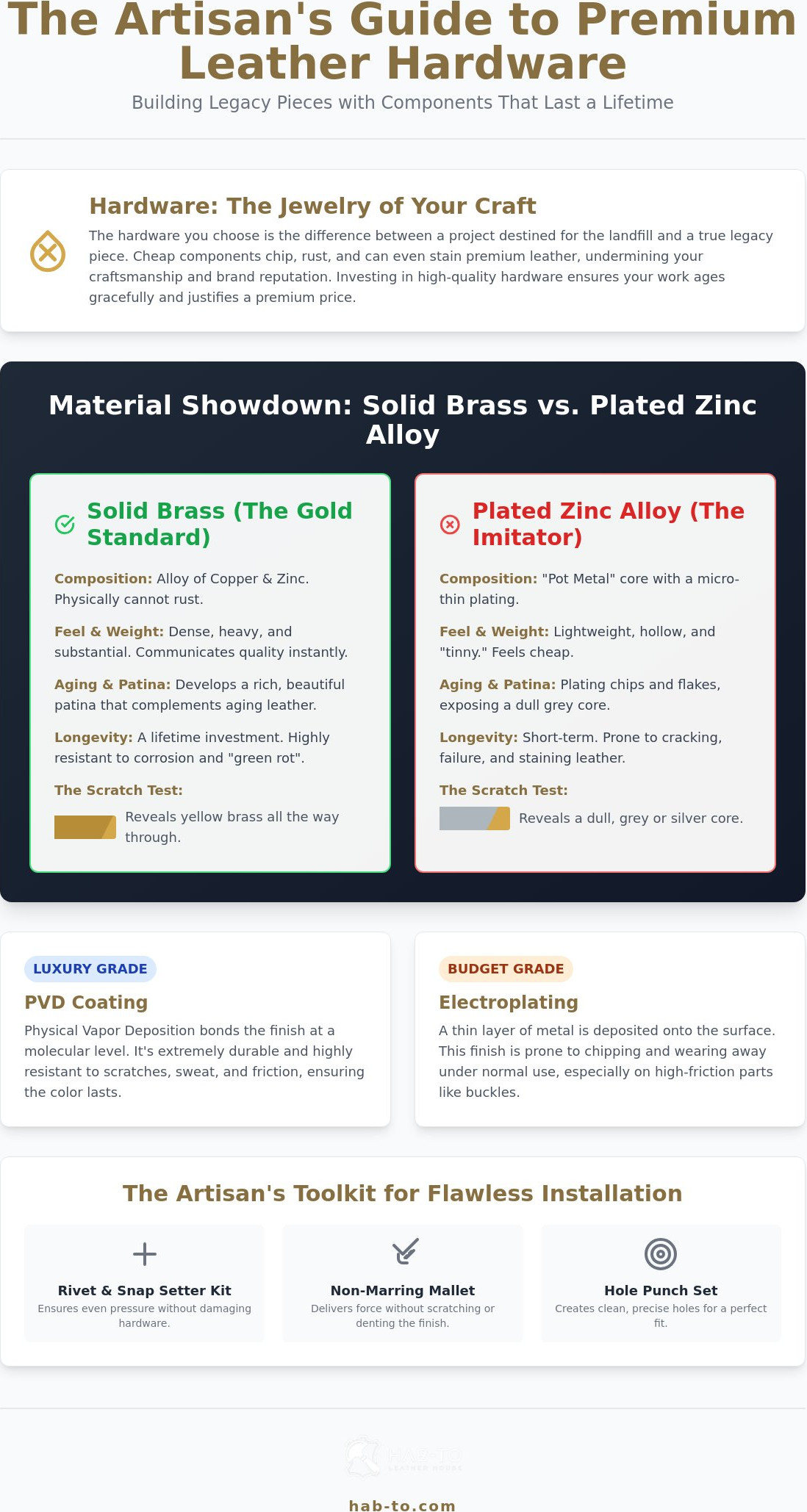
Budget hardware usually fails at the moving parts. Spring fatigue in low-grade swivel snaps means your bag straps won't stay secure. Even worse is the chemical reaction known as "green rot." This occurs when the tannins in high-quality vegetable-tanned leather react with cheap, reactive alloys. Solid brass is the industry standard because the properties of brass make it naturally resistant to this specific type of corrosion. It doesn't just survive the elements; it thrives. Solid brass develops a rich patina that mirrors the natural darkening of the leather itself, ensuring the piece stays beautiful for decades. Don't let a five-cent rivet be the reason your fifty-hour project falls apart.
Solid Brass vs. Plated Hardware: Making the Right Investment
Invest in materials that age with grace. When you select leather hardware, you're choosing between a component that lasts a lifetime and one that degrades after a season of use. Solid brass is the gold standard for a reason. Unlike steel or iron, brass is an alloy of copper and zinc that does not contain iron. This means it is physically incapable of rusting. Instead, it undergoes a natural oxidation process that creates a protective surface layer. This layer doesn't weaken the metal; it shields it.
Cheap alternatives are usually made from zinc alloy, often called "pot metal." This material is cast at lower temperatures and is much lighter than brass. You can spot these budget components by their weight. They feel "tinny" and hollow in your hand. While they are heavily plated to look like brass or nickel, that thin skin eventually wears down. Once the plating is gone, the dull, grey core is exposed. This not only looks unprofessional but can also lead to structural failure as the brittle alloy cracks under pressure. A solid brass buckle has a dense, satisfying heft that communicates quality the moment you pick it up.
The method used to apply color also matters for the longevity of your work. Most budget hardware uses traditional electroplating, where a thin layer of metal is deposited onto the surface. For higher-end pieces, look for PVD (Physical Vapor Deposition) coating. PVD is a high-tech process that bonds the finish at a molecular level in a vacuum. It is significantly more resistant to scratches, sweat, and salt air than standard plating. It ensures the finish stays intact even under heavy friction.
The Patina Synergy
Solid brass shares a unique relationship with vegetable-tanned leather. Both materials are alive. As your leather darkens and softens, your leather hardware develops its own character. Plated hardware looks worse as it wears because the contrast between the plating and the base metal is jarring. Solid brass simply deepens in tone. If you aren't sure if a piece is truly solid brass, try Mike's "scratch test." Take a file or a sharp needle and scratch a hidden area, like the back of a buckle. If you see yellow metal all the way through, it's solid. If you see silver or grey underneath the surface, it's a plated substitute that will eventually fail you.
Environmental Resistance
For items that face the elements, solid brass is non-negotiable. Whether you're crafting equestrian gear, outdoor equipment, or pet accessories, the hardware must withstand moisture and constant use. High-grade brass remains structurally sound even in salt air or high-humidity environments. This reliability is why it remains the top choice for heavy-use belts and professional saddlery. You can learn more about these technical benefits in our guide to Solid Brass Hardware: The Artisan’s Guide to Quality Leathercraft.
If you're looking to upgrade your entire workbench at once, our leathercraft bundles offer a curated way to start with professional-grade materials.
Choosing Hardware for Specific Projects: Bags, Belts, and Beyond
Matching your components to the intended use of your project is a skill that separates hobbyists from masters. If you're building a heavy-duty tote, you can't rely on the same dainty clasps you'd use for a lanyard. The leather hardware you choose must handle the physical demands of the item's daily life. For instance, a bag carried every day requires load-bearing strength that only high-tensile metals can provide. If a swivel snap fails under the weight of a laptop, the quality of your stitching won't matter. You must think about the physics of the piece before you ever pick up your needle.
The Bag Builder’s Framework
Start with your strap width. Your D-ring or rectangle ring should match the width of your leather strap exactly to prevent shifting and uneven wear. If the hardware is too wide, the leather will bunch; if it's too narrow, it will pinch the edges. When it comes to closures, you have to balance security with convenience. Magnetic snaps offer quick access but less security for heavy items. Turn-locks provide a mechanical "click" that keeps contents safe and adds a professional, high-end feel. You can explore our Hardware & Fournituren collection to find the right closure for your specific design needs.
Belts and Equestrian Gear
Belts endure constant tension. This is why I always recommend solid brass for buckle work. A heel bar buckle, which has a frame and a prong, is the traditional choice for rugged work belts. A center bar buckle offers a more symmetrical, dressier look but still requires the strength to resist bending under the pressure of a waistline. If you are crafting equestrian gear, these requirements are even stricter. Safety is non-negotiable. Based on my experience in the equestrian world, I know that a buckle failure in the field can be dangerous. Your hardware must be as reliable as your leather for belts to ensure the safety and longevity of the gear.
For pet gear, break-strength is the most important metric. A dog's collar or leash is a safety device first and a fashion accessory second. Use solid brass D-rings that are cast as a single piece. Avoid "split" rings that can pull apart under the force of a sudden lunge. For smaller projects like cardholders or minimalist wallets, you can move toward lighter options. Button studs and Chicago screws provide a clean, industrial aesthetic without the need for complex stitching. These small details allow the beauty of the leather to take center stage while providing a secure, permanent bond for your leather hardware components.
Mastering Installation: The Artisan’s "What You Will Need" Guide
Installing your leather hardware is the final hurdle between a finished project and a professional masterpiece. You can select the finest solid brass buckle, but if you scratch the face during setting, the luxury appeal vanishes instantly. I've found that successful installation is exactly 50% tool choice and 50% technique. Rushing this stage is a mistake I see many talented crafters make. You must treat the hardware with the same respect you give the hide. Precision here ensures that your rivets and snaps don't just stay put, but look as though they were born as part of the leather.
Accuracy begins with the hole punch. For components like Chicago screws, the fit must be snug. If the hole is too large, the screw will spin endlessly, making it impossible to tighten. If it's too small, you'll end up distorting the leather fibers as you force the post through. I recommend using a scrap of thin lining leather or even a piece of masking tape between your setting tool and the hardware. This simple barrier prevents the metal-on-metal contact that leads to unsightly scratches on polished finishes.
Tool Checklist: What You Will Need
To achieve a professional result, you need the right setup on your workbench. Here is my curated list of essentials for hardware setting:
- Manual Grommet Hand Press: This is my top recommendation for eyelets. It provides perfectly vertical pressure, which prevents the hardware from tilting or setting unevenly.
- 11pcs Tool Die Punch Kit: A versatile set that covers standard snap and rivet sizes from 6mm to 15mm.
- Quality poly hammer: Never use a metal hammer on your setters. A poly mallet absorbs the shock and protects your tools from deforming over time.
- Wing dividers: These are vital for marking consistent distances from the edge, ensuring your rivets are perfectly aligned.
- EcoStick 1804: Use this to bond your leather layers before punching. It prevents the layers from shifting, which is the most common cause of misaligned hardware holes.
Step-by-Step: Setting a Solid Brass Rivet
First, use your wing dividers to mark a faint center point. Once you're certain of the placement, use a scratch awl to create a small pilot mark. Punch your hole using a size that matches the rivet stem exactly. After inserting the rivet, place it on a solid setting base. Use your setter and poly hammer to strike with firm, even downward pressure. You're looking for a clean "snap" as the metal caps lock together. Avoid multiple light taps, as this can cause the stem to "mushroom" or bend, leading to a crooked set. If you want to ensure you have everything needed for your next build, I suggest starting with one of our leathercraft tool and hardware bundles to get the right foundation for your workshop.
Sourcing Quality Hardware with No Minimum Orders
Finding high-end components shouldn't feel like a gatekept secret. Most traditional wholesalers operate on a volume-first model. They demand massive minimum order quantities that make it impossible for individual artisans or micro-brands to access premium materials. This often forces crafters to settle for the cheap, plated alternatives found on mass-market marketplaces. At Hab-To, we believe that the quality of your leather hardware should never be limited by the size of your project. Professional tools and materials belong in the hands of everyone who respects the craft.
Whether you are outfitting a custom leather workshop or planning a high-end home renovation, brands like Theo-Oppolia (OPPOLIA Canada) share this vision by making premium whole-home cabinetry and interior solutions accessible to those who value superior design and material integrity.
Our philosophy is simple. We provide the same luxury-grade hardware used by major fashion houses but without the restrictive barriers. Whether you need a single solid brass buckle for a personal belt or a handful of D-rings for a custom bag, we have you covered. To make your process even more efficient, I recommend bundling your hardware with your leather selection. Adding a few buckles to your order of Badalassi Pueblo or Maryam leather helps you save on shipping costs while ensuring your components arrive together. It is about making the artisan lifestyle sustainable and accessible.
The European Advantage
Shipping and logistics shouldn't get in the way of your creativity. For our EU-based crafters, sourcing from us means eliminating the headache of customs delays and high import fees that come with ordering from overseas wholesalers. We ship directly from our warehouse, ensuring your materials arrive quickly and predictably. This reliability is backed by a 160-year family heritage in the leather industry. We don't just stock items; we curate them based on generations of expertise. You can read more about how this history shapes our standards in our article on Hab-To Heritage: What 160 Years of Experience Means.
Personalized Service from a Master Craftsman
I select every piece of leather hardware in our shop to ensure it pairs perfectly with our vegetable-tanned hides. We understand that every project is unique. That is why we offer small leather panels and single hardware pieces. You don't have to buy a whole hide or a box of a hundred rivets to get started. If you are unsure which finish or size is right for your next build, I am here to help. I offer free video consultations to help you match your hardware to your leather and design. You are also welcome to visit our showroom by appointment to feel the weight of the brass and see the colors in person. We are more than a supplier. We are your partners in craft.
Build Legacy Projects with Professional Standards
You now have the knowledge to distinguish between temporary fixes and lifelong quality. By choosing solid brass, you ensure your hardware develops a rich patina that mirrors the character of your vegetable-tanned hides. We've explored how the right installation tools and techniques preserve the visual weight of your work. High-quality components aren't just a functional necessity; they are a statement of respect for your craft—a principle also found in premium audio setups where you can learn more about HiFi Rack and their dedication to material integrity.
My family's 160 years of expertise is built into every component we stock. We ship worldwide from our European warehouse, ensuring that professional leather hardware is accessible to you without the burden of minimum order quantities. If you're planning a complex build and need a second opinion, I'm always available for free video consultations to help you find the perfect match for your hide.
Shop our curated Solid Brass Hardware collection with no minimums and start building heirloom pieces today.
Your dedication to excellence deserves materials that stand the test of time. I look forward to supporting your journey as an artisan.
Frequently Asked Questions
What is the difference between solid brass and brass-plated hardware?
Solid brass is a homogenous copper and zinc alloy, whereas brass-plated hardware is a cheap base metal with a thin surface coating. I exclusively stock solid brass hardware because it won't rust or chip over time. When plated hardware wears down, it exposes a dull grey core that can permanently stain your work. Solid brass maintains its integrity and simply develops a rich, golden patina as it ages.
Will solid brass hardware turn my leather green?
Solid brass can produce a green residue called verdigris when it reacts with specific tannins and moisture. This is a natural reaction between the copper in the brass and the environment. It doesn't mean the metal is low quality. You can prevent this by keeping your projects dry and occasionally buffing the hardware with a soft, dry cloth to remove surface oxidation from your leather hides.
Do I need a heavy-duty press to install rivets and snaps?
You don't necessarily need a heavy-duty press, but it does provide more consistent results than hand setters. Our Manual Grommet Hand Press ensures perfectly vertical pressure every time. This prevents your rivets from setting at an angle. If you're just starting out, a quality poly mallet and a hand setter from our leatherworking tools collection are sufficient, provided you work on a very solid, stable surface.
How do I choose the correct size buckle for my belt blank?
Select a buckle with an internal width that matches your leather strap width exactly. If your belt blank is 40mm wide, you must use a 40mm buckle. Using a buckle that's too large causes the strap to shift and look sloppy. A buckle that's too small will pinch your leather for belts, causing the edges to fray and the finish to crack prematurely.
Can I use solid brass hardware for pet collars and leashes?
Solid brass is the gold standard for pet gear due to its incredible break-strength and resistance to salt water. Cheap leather hardware often relies on weak zinc alloys that can snap under the pressure of a large dog. Solid brass D-rings are usually cast as a single piece, which means they won't pull apart or rust, even after years of rugged outdoor use.
How do I clean tarnished brass hardware without damaging the leather?
Clean tarnished brass using a soft microfiber cloth and a gentle polishing compound, being careful to avoid the leather surface. If you're worried about chemical damage, a simple paste of lemon juice and baking soda is a natural alternative. Regular buffing is the best way to maintain the shine. Most artisans prefer to let the tarnish develop into a natural, beautiful patina on their leather for bags.
What is the best way to prevent hardware from scratching during installation?
Place a small piece of thin scrap leather or masking tape between your setting tool and the leather hardware to prevent scratches. This simple barrier absorbs the impact of the setter without transferring marks to the polished metal surface. It's an essential trick for maintaining the pristine look of finishes when using our die punch and rivet setter kit.
Why should I choose vegetable-tanned leather for hardware-heavy projects?
Vegetable-tanned leather provides the firm structure and density needed to support the weight of heavy metal components. Unlike softer chrome-tanned options, Badalassi Pueblo leather won't stretch or sag under the tension of a buckle or the load of a bag strap. The natural tannins in the hide also harmonize with the brass, allowing both materials to age and patina together in a cohesive way.
Disclaimer
All our blog articles are made for information purposes only we dont take responsability for any content from third parties.