

The Satisfaction of a Perfectly Stitched Line: Mastering the Art of the Saddle Stitch
Have you ever spent hours carefully cutting and assembling a piece only to have a single wonky stitch ruin the entire aesthetic? It’s a frustration every artisan knows well. You’ve likely felt the sting of inconsistent tension or the confusion of choosing the wrong needle size for a heavy Vegetable Tanned Leather. There is nothing quite like the satisfaction of a perfectly stitched line to transform a simple project into a piece of heirloom art. It isn’t just about the visual appeal. It’s about the integrity and durability of the craft itself.
I understand that achieving that elusive, professional slant can feel like a constant battle against your materials. That’s why I’m going to share the meditative techniques and professional Leatherworking Tools required to elevate your work. We’ll explore how the relationship between leather temper and stitch quality dictates your results. By the end of this guide, you’ll know how to find a calm, productive rhythm in your workshop while producing results that rival the finest Italian ateliers. Let’s look at how to turn your frustration into a signature mark of quality.
Key Takeaways
- Master the traditional saddle stitch to create seams that are significantly stronger and more durable than any machine-sewn alternative.
- Learn how to use professional tools like wing dividers to mark consistent paths and select the ideal SPI for a balanced aesthetic.
- Discover how choosing premium materials and the correct thread weight leads to the satisfaction of a perfectly stitched line in every project.
- Identify the technical causes behind the "zig-zag" effect to ensure your stitch lines look flawless on both the front and back of the leather.
- Leverage expert sourcing tips to find high-end Italian and vegetable-tanned leathers with no minimum order requirements.
Why We Crave the Satisfaction of a Perfectly Stitched Line
There is a specific kind of peace that settles over a workshop when the only sound is the rhythmic punch and pull of a needle through hide. It’s more than just a task. It’s a meditative practice. Human brains are naturally wired to find comfort in symmetry and repetition. When you achieve the satisfaction of a perfectly stitched line, you aren't just finishing a seam. You’re creating a visual rhythm that signals quality, patience, and care. This sense of "flow" is what keeps artisans returning to their benches night after night.
To help you visualize the technique and find your own rhythm, watch this tutorial on improving your hand-stitching speed and quality:
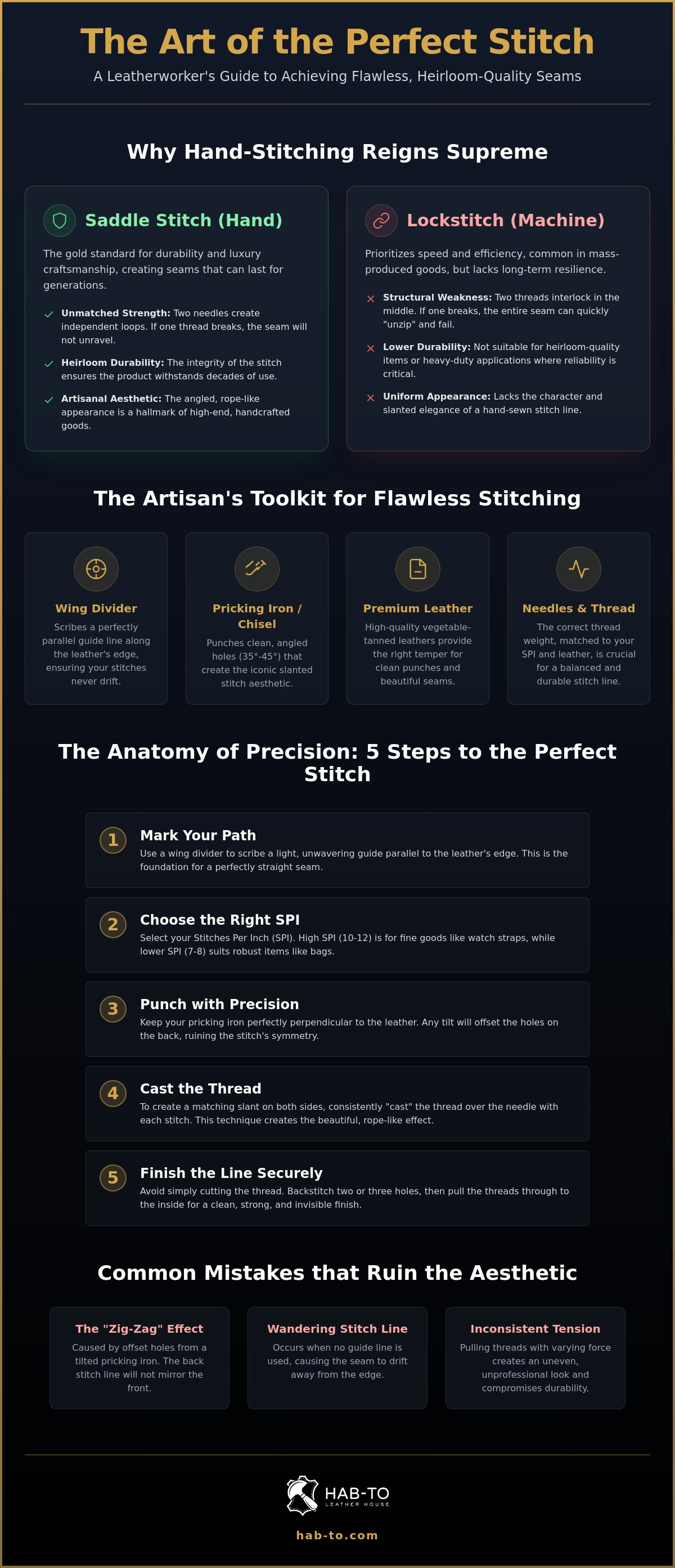
While machines prioritize speed, the traditional Saddle stitch prioritizes integrity. In this method, two needles pass through the same hole from opposite sides. This creates a series of independent loops. If one thread happens to fray or break over decades of use, the rest of the line stays secure. It won't unravel like a cheap garment. This structural superiority is why hand-stitching remains the gold standard for high-end Vegetable Tanned Leather goods.
The Aesthetic of the Slant
The iconic artisan look is defined by the slant. This angled appearance isn't an accident. It's the result of using high-quality Leatherworking Tools like pricking irons or stitching chisels. These tools pierce the leather at a specific degree, usually between 35 and 45 degrees. Consistency is everything here. If your iron tilts even slightly, the slant changes, breaking the visual harmony. A master crafter ensures the thread "lays" perfectly in these grooves, creating a clean, rope-like texture that catches the light beautifully.
Hand-Stitching vs. Machine Stitching
Most commercial leather goods use a lockstitch made by a machine. It's fast, but it’s the weak link in leathercraft. A lockstitch relies on two threads catching each other in the middle of the leather. If the thread breaks, the whole seam can unzip. For heirloom-quality materials like Badalassi Pueblo Leather, a machine stitch simply doesn't do the material justice. Top-tier luxury brands still use hand-stitching for their most exclusive collections because they know it's the only way to guarantee a lifetime of durability. It's a commitment to quality over convenience.
The Anatomy of Precision: How to Achieve the Perfect Stitch
Achieving the satisfaction of a perfectly stitched line starts long before the first needle enters the hide. It is a process of disciplined preparation. If your layout is sloppy, your stitching will never look professional, regardless of your hand speed. Precision is built layer by layer, starting with a clear path and ending with a secure, invisible finish.
- Step 1: Marking your path. Use a wing divider to scribe a light crease parallel to the edge of your leather. This provides an unwavering guide for your pricking iron. Without this line, your stitches will inevitably drift.
- Step 2: Choosing the right SPI. Stitches Per Inch (SPI) dictates the "visual weight" of your project. A fine watch strap might require 10 or 12 SPI, while a heavy tote looks best with 7 or 8 SPI. Match your thread thickness to this scale for a balanced look.
- Step 3: The art of the punch. When using your pricking iron, keep the tool perfectly perpendicular to the leather. If you lean even slightly, the holes on the back will be offset, ruining the symmetry of your work.
- Step 4: Casting the thread. To ensure the slant matches on both sides, you must "cast" the thread over the needle during the stitch. This technique is detailed extensively in classic resources like The Art of Hand Sewing Leather, which remains a foundational text for artisans.
- Step 5: Finishing the line. Don't just cut and burn. Backstitch two or three holes, then pull the threads through to the inside or between layers. Tapering your thread ends ensures the transition is seamless and the knot is hidden.
If you're ready to start your journey with the right equipment, explore our curated stitching bundles to get everything you need in one go.
Mastering Stitch Tension
Consistency in tension is what separates hobbyists from masters. If you pull too hard, the leather will pucker and distort. Pull too soft, and you'll see unsightly gaps between the thread and the hole. You need to develop muscle memory so every pull has identical force. Using a stitching pony is essential here. It holds your project securely, freeing both hands to maintain a steady, repeatable rhythm. This focus on "feel" eventually leads to the satisfaction of a perfectly stitched line that looks like it was laid by a machine but possesses the soul of handwork.
Geometric Consistency
Corners are the ultimate test of an artisan's skill. You must plan your SPI so a stitch lands exactly at the corner point. If the spacing is off, the turn will look cramped or stretched. Remember that the diamond shape of the hole dictates your needle entry. The exit point of the needle defines the back-side aesthetic, so always check your alignment from both angles before pulling tight. This attention to geometry ensures your work looks as beautiful from the back as it does from the front.
What You Will Need: The Artisan’s Toolkit for Flawless Stitching
Achieving the satisfaction of a perfectly stitched line requires a synergy between your physical technique and the specific properties of your materials. At Hab-To Leather House, we curate our inventory to ensure every item supports this high-precision work. Your toolkit isn't just a collection of metal and thread. It is the foundation of your legacy. If your tools are blunt or your leather is too soft, even the most disciplined hand will struggle to produce a professional result.
Thread selection is often the most debated choice among makers. Waxed linen provides a matte, historic finish often seen in museum-level leather conservation. However, for items facing daily friction, braided polyester is the modern standard for its rot-resistance and tension strength. You must pair this with blunt harness needles. Sharp needles are for fabric; in leathercraft, a sharp point will accidentally pierce the leather fibers or your previous stitches, creating unsightly "hairy" lines that ruin the visual flow of your seam.
What You Will Need
- Premium Thread: Choose between traditional linen or high-tenacity braided polyester.
- Blunt Harness Needles: Essential for protecting your leather fibers and existing stitches.
- Edge Bevelers: Available in our leatherworking tools collection, these are vital for removing sharp corners before you begin your stitch line.
- Burnishing Agent: Use Tokonole to seal the edges, providing a clean, professional frame for your stitching.
- Comprehensive Kits: Our stitching bundles contain the pricking irons and thread needed to start your project with confidence.
The Best Leathers for Stitch Definition
Not every hide is suitable for high-precision hand-stitching. The firm temper of Badalassi Pueblo Leather is a favorite for its ability to hold a crisp hole shape without distortion under tension. For luxury accessories, Maryam Vaccheta offers a rich oil content that allows the thread to seat beautifully and securely into the grain.
If you are focused on smaller goods like wallets, Virgilio Pueblo provides the perfect thickness for multi-layer construction without adding unnecessary bulk. Choosing these high-end vegetable-tanned hides ensures that the satisfaction of a perfectly stitched line remains the focal point of your craft, as the firm fibers prevent the holes from stretching over time.
Common Mistakes That Ruin the Stitched Aesthetic
Even the most patient artisan encounters hurdles. It’s part of the craft. But nothing disrupts the satisfaction of a perfectly stitched line quite like a messy back-side. You might have a pristine row on the front, only to flip the project over and find a chaotic, wandering path. This is a common frustration, but it is entirely avoidable with the right technique and attention to detail.
The dreaded "Zig-Zag" effect occurs when your needle entry isn't identical for every hole. If you don't maintain a consistent angle or fail to "cast" the thread as we discussed in the anatomy of the stitch, the back will look jagged. Precision is discipline. Quality is patience. Excellence is a choice you make with every single puncture.
Misaligned holes are often blamed on leather thickness. I disagree. Most of the time, it’s a lack of perpendicular force. You need a steady hand and a heavy mallet. If your pricking iron tilts even a fraction of a degree, the exit hole on the back of the panel will be offset. This ruins the symmetry. Always ensure your workspace is at the correct height so you can look directly down at your tool before striking.
Thread fraying often happens when you use a sharp needle that accidentally pierces the thread fibers mid-stitch. Use blunt harness needles instead. Skipped stitches are usually a sign of losing your rhythm. If you're tired, put the needles down. A single missed loop can compromise the entire seam's integrity and ruin the visual flow you’ve worked so hard to build.
Troubleshooting Tension Issues
Identifying "puckering" early is vital. If the leather starts to gather or ripple, you’re pulling too hard. The thread should sit flush against the grain, not crush it. If you find a loose stitch, don't unpick the whole line. Use a scratch awl to carefully redistribute the tension through the next few holes. To prevent layers from shifting before you even pick up an iron, use Ecostick 1804 Leather Glue. It creates a secure bond that keeps your holes perfectly aligned during the punch.
Needle and Thread Mismatches
Choosing a thread that’s too thick is a common error. It chokes the hole and hides the beautiful slant of your iron. Follow the "Goldilocks" rule: your thread should be thick enough to be strong, but thin enough to let the diamond shape of the hole remain visible. To avoid slipping, properly "lock" your thread onto the needle by piercing the thread itself twice before you start. This simple step ensures the satisfaction of a perfectly stitched line remains uninterrupted from start to finish.
If you're tired of guessing which tools work together, check out our curated leathercraft bundles to ensure a perfect match every time.
Elevating Your Craft with Hab-To Leather House: From Beginner to Master Artisan
Choosing a source for your materials is a decision that shapes the very soul of your work. At Hab-To Leather House, we don't just supply hide and hardware. We offer a partnership rooted in a 160 year family legacy of leather expertise. When you reach out to us, you aren't talking to a warehouse clerk. You’re connecting with Mike and a team of mentors who understand the weight of every mallet strike. We've seen how the right material choice can be the difference between a project that frustrates and one that delivers the satisfaction of a perfectly stitched line.
One of our core principles is removing the barriers that separate hobbyists from master-level materials. We maintain no minimum order quantities, meaning you can access the same world-class leathers used by heritage fashion houses for a single wallet or watch strap. This flexibility allows you to experiment with premium hides like shell cordovan or harness leather without the burden of bulk purchasing. It ensures that the satisfaction of a perfectly stitched line is achievable for every project, regardless of its size or scope.
Sustainability isn't a trend for us; it is a commitment to the craft’s future. We exclusively source vegetable-tanned leather because it is the only choice for an artisan who values both durability and environmental ethics. These hides are tanned using natural tannins, creating a firm, breathable canvas that ages with a unique story. By choosing these materials from Hab-To Leather House, you are ensuring your work remains an heirloom rather than a disposable commodity. We believe the time you spend at the bench deserves the finest foundation possible.
Beyond the leather, we've built a community to support your growth through every stage of your journey. Whether you’re listening to our podcast or attending a session, we’re here to share the nuances of the trade that often go unspoken. We want to help you find that perfect rhythm where technique and material meet.
Deepen Your Skills
- Join a Hab-To Leather House Masterclass to learn traditional techniques in a hands-on, expert environment.
- Book a Free Video Consultation with Mike to discuss your project’s specific technical needs.
- Explore our About Page to discover the heritage and values behind every hide we select.
Your Next Project Starts Here
- Browse our full Leather Collection to find the perfect temper and finish for your next design.
- Check out our Starter Bundles if you’re ready to begin your journey with the right foundation.
- Follow us on Instagram for daily inspiration and highlights from our global community of crafters.
Bring Your Vision to Life with Every Stitch
Mastering the saddle stitch is a transformative milestone for any leatherworker. It moves you from simply joining pieces to creating heirloom art. You've learned that precision starts with marking a clean path and choosing a thread that respects the leather's temper. By avoiding common tension mistakes and perpendicularity errors, you ensure your work stands the test of time. Every puncture and pull is an opportunity to refine your skill and find your rhythm at the bench.
At Hab-To, we back your journey with 160 years of family leather expertise. We believe in quality without barriers. That's why we offer exclusively sustainable vegetable-tanned leather with no minimum order quantity. You get exactly what you need to achieve the satisfaction of a perfectly stitched line without unnecessary waste. Whether you're working on a fine watch strap or a rugged tote, the right foundation makes all the difference.
Start your journey toward the perfect stitch with our curated Stitching Bundles.
Your bench is waiting. It's time to turn these techniques into your next signature piece. We're honored to be part of your crafting story and can't wait to see the results of your dedication.
Frequently Asked Questions
How do I keep my stitch line perfectly straight?
Use a wing divider to scribe a light guide line parallel to the edge of your leather. This provides a visual track that prevents your hand from drifting during the punch. Without this layout step, even a steady hand will eventually wander. Using high-quality passers and wing dividers ensures your spacing is mathematically consistent. Always punch your holes from the grain side to keep the most visible line as clean as possible.
What is the best thread for hand-stitching vegetable-tanned leather?
Braided polyester thread is generally the best choice for modern leathercraft. It is incredibly durable and won't rot over time like some natural fibers. While waxed linen offers a traditional look, polyester handles the high tension of a saddle stitch much better. Matching your thread weight to your SPI is vital for achieving the satisfaction of a perfectly stitched line. A thread that's too thick will look clunky; one that's too thin will look weak.
Why do my stitches look different on the back than on the front?
This usually happens because your pricking iron wasn't perfectly perpendicular during the punch. Even a slight tilt causes the exit hole on the flesh side to be offset. This ruins the symmetry of the back line. Additionally, if you don't "cast" the thread consistently during the stitch, the slant will vary. Mastering these small movements is the secret to a professional finish that looks flawless from every angle.
How much thread do I need for a saddle stitch?
You should measure out roughly three and a half to four times the length of the seam you're stitching. For thicker leathers or tighter stitch spacing, you might need even more. It’s always better to have a little extra than to run out three holes before the end. If you’re using our stitching bundles, you'll have plenty of high-quality thread to practice with until you find your preferred measuring rhythm.
Can I use a regular sewing needle for leathercraft?
No, regular sewing needles are too sharp and will damage the leather fibers or pierce your thread mid-stitch. You need blunt-tipped harness needles. These are designed to glide through pre-punched holes made by your leatherworking tools. A sharp needle will often catch on the thread already in the hole, leading to fraying and knots. Using the correct needle size for your thread weight is essential for a smooth experience.
What happens if I run out of thread in the middle of a stitch line?
You can seamlessly restart by overlapping your new thread with the last two or three existing stitches. This backstitching method secures the old thread and anchors the new one. When done carefully, the transition is almost invisible. It’s a common fix, but it requires steady tension to ensure the doubled-up holes don't look bulky. Pull the thread ends between the leather layers and trim them closely for a clean restart.
Is hand-stitching really stronger than a sewing machine?
Yes, the saddle stitch is structurally superior to the machine lockstitch. In a saddle stitch, two independent threads pass through every hole. If one thread breaks, the other still holds the seam together. A machine stitch relies on two threads looping around each other in the middle. If a machine thread snaps, the whole line can unravel. This durability is why we recommend hand-stitching for heirloom-quality vegetable tanned leather.
How do I choose the right SPI (stitches per inch) for a wallet?
For most wallets, a range of 8 to 10 SPI provides the best balance of strength and elegance. Smaller items like cardholders look refined with tighter spacing and thinner thread. Larger bags often use 6 or 7 SPI for a more rugged aesthetic. Choosing the right SPI is a key part of finding the satisfaction of a perfectly stitched line. It ensures the scale of your stitching matches the scale of your design perfectly.
Disclaimer
All our blog articles are made for information purposes only we dont take responsability for any content from third parties.