

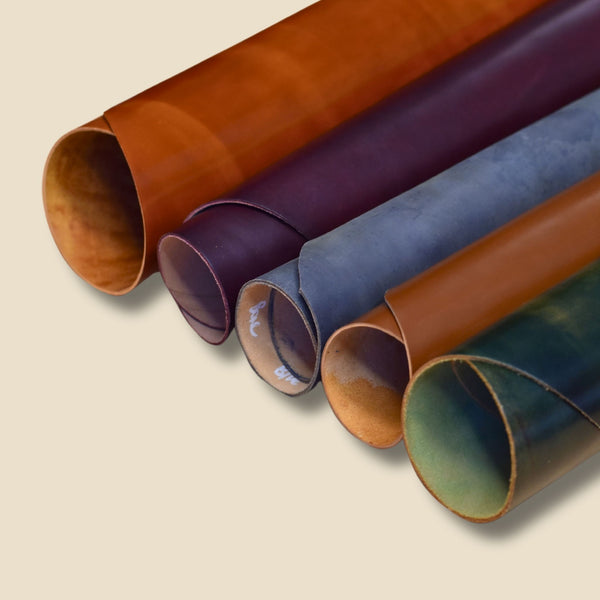
The Ultimate Guide to Leather Bag Hardware: Sourcing and Selection for Artisans
You can spend forty hours hand-stitching a bag from the finest Shell Cordovan, but if the plating on your buckle peels within a month, your masterpiece is effectively ruined. It's a common heartbreak for artisans. You invest in premium hides only to be let down by subpar leather bag hardware that looks like jewelry in the shop but performs like a toy in the real world. I've seen it happen too often. Hardware isn't just an accessory; it's the structural skeleton of your craft. If the skeleton is weak, the whole body fails.
I understand the frustration of finding professional components without being forced into massive minimum orders. You want your D-rings and buckles to age with the same grace as your vegetable-tanned leather. This guide will show you how to choose between solid brass and zinc alloy, how to perfectly match hardware sizes to your strap widths, and where to source Italian-grade finishes that respect your work. We'll give you the confidence to select materials that ensure your bags look professional and last for decades.
Key Takeaways
- Learn why solid brass is the professional standard for high-end accessories compared to common zinc alloy alternatives.
- Master the "golden rule" of inner diameter to ensure your straps and leather bag hardware fit perfectly every time.
- Discover the essential tools and techniques needed to install rivets and snaps without damaging your leather's finish.
- Understand how to scale hardware weight to leather thickness to prevent unappealing hardware sag in your designs.
- Find out how to source premium Italian components with no minimum order requirements, perfect for small-scale artisans and hobbyists.
The Structural Role of Leather Bag Hardware in Craftsmanship
Think of your bag as an architectural feat. The leather is the beautiful facade, but the hardware is the steel beam holding the entire structure together. Many makers view closures and rings as simple jewelry for their projects. This is a mistake. In reality, your leather bag hardware is the primary stress point of any accessory. It's the anchor for every strap and the pivot for every opening. If these points fail, the entire bag becomes useless, regardless of how perfect your saddle stitching might be.
Cheap components are the number one cause of failure in handmade goods. When a swivel hook snaps or a buckle pin shears off under the weight of a laptop, the artisan's reputation suffers. There's also a deep relationship between hardware longevity and the natural aging of vegetable-tanned leather. High-quality hides like those from Conceria Maryam develop a rich patina over decades. If you pair such leather with hardware that flakes or rusts within a year, you create a visual and functional mismatch. Understanding Handbag hardware history shows us that the most iconic designs survived because their metal components were built to last as long as the skins they were attached to.
To better understand the variety of components available and how they function, watch this helpful video:
Load-Bearing vs. Decorative Components
Not all hardware is created equal. You must identify critical stress points before you start cutting your leather. Swivel hooks, D-rings, and handle fasteners are load-bearing. They require superior tensile strength and solid construction. On the other hand, you can prioritize aesthetics for decorative buckles, studs, or stoppers. I always recommend weight-testing your leather bag hardware for larger projects like totes or backpacks. A D-ring that looks fine on a clutch might bend out of shape when supporting a heavy weekender bag. Choosing the right weight ensures your project stays artisanal rather than looking homemade.
The Heritage Perspective: 160 Years of Quality
At Hab-To, our 160 years of family experience informs every piece of hardware we source. We've seen how the industry has shifted, and we refuse to compromise on the materials that support your craft. We exclusively pair our Italian hardware with sustainable hides like Badalassi Pueblo leather or Maryam Vacchetta. This synergy is vital for a professional result. The right hardware protects the leather from premature tearing by ensuring that movement is smooth and friction is minimized at every attachment point. When you use professional-grade components from our hardware collection, you're investing in the future of your work.
Decoding Materials: Solid Brass vs. Plated Zinc Hardware
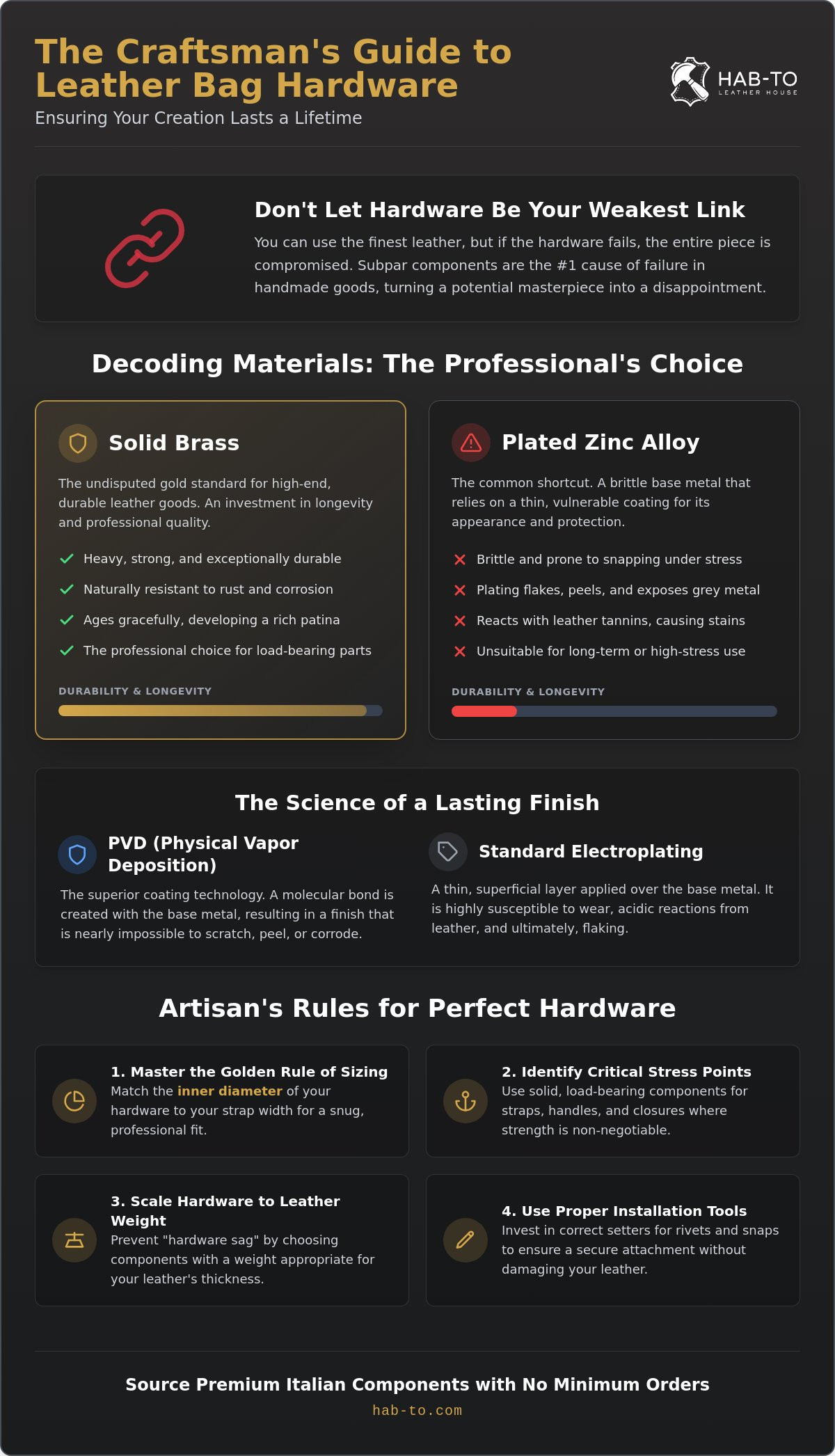
Choosing the right base metal is where most beginners trip up. You see a shiny buckle that looks like gold, but what's underneath determines if your bag lasts two years or twenty. Solid brass remains the undisputed gold standard for professional leather bag hardware. It's heavy, durable, and naturally resistant to corrosion. While European brass prices rose by 34.13% in early 2026, the investment remains vital for anyone serious about their craft. Brass doesn't just sit on the leather; it lives with it.
This demand for durability is shared by the maritime industry, where metal components must withstand constant exposure to the elements. For artisans who appreciate the engineering behind high-quality marine-grade fittings, Nautic Haven offers a selection of yacht and boat accessories that exemplify this standard of resilience and longevity.
Zinc alloy, often called Zamak, is the industry's most common shortcut. It's a brittle material that relies entirely on a thin layer of electroplating for its appearance. This leads to the "Plating Problem." The tannins in high-quality vegetable-tanned leather are acidic. Over time, they can actually eat through cheap plating, causing the hardware to flake and expose a dull, grey base metal. This reaction often leaves permanent dark stains on your leather. If you want to avoid this, look for PVD (Physical Vapor Deposition) coatings. In 2026, PVD is the superior choice over traditional electroplating because it creates a molecular bond that's nearly impossible to scratch or peel.
Comparing Hardware Finishes
Your choice of finish sets the entire mood of your design. Gold and silver remain timeless classics for luxury handbags. Interestingly, 2026 has seen a massive revival in silver-toned hardware, offering a sharp contrast against darker leathers. For a modern or industrial aesthetic, nickel and gun metal provide a sleek, understated look. If you're working with rustic materials like Pueblo or Vacchetta leathers, I always recommend Old Gold. It has a muted, pre-patinated warmth that matches the earthy tones of traditional vegetable-tanned hides perfectly.
The Hab-To Bamboo Collection
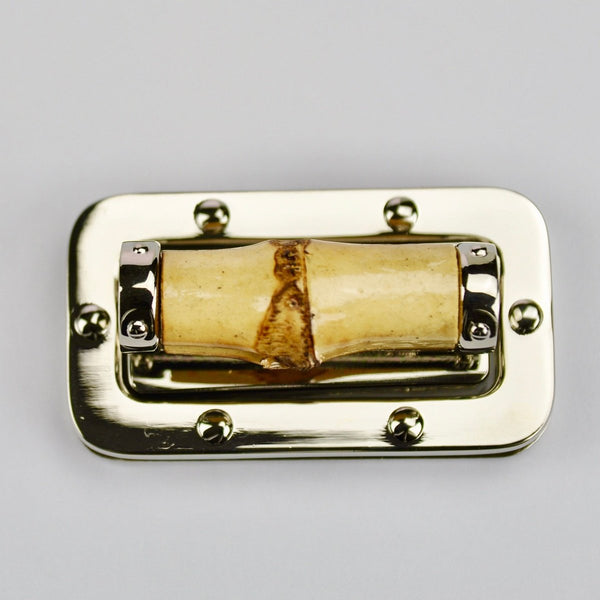
Sometimes a standard D-ring isn't enough to capture your vision. The current "jewelry-inspired" trend in leathercraft means hardware is now a primary design element rather than just a functional necessity. Our exclusive Bamboo collection offers a textured, organic aesthetic that adds a signature designer feel to even the simplest bag patterns. These pieces transform a functional strap attachment into a focal point. You can explore these unique finishes and more in our Hardware & Fournituren collection to find the perfect match for your next project.
If you're just starting out and want to ensure all your materials and tools work in harmony, you might find our curated crafting bundles a helpful way to get everything you need in one go.
Selecting the Right Components for Your Bag Design
Designing a custom bag is an exercise in proportions. If you've ever finished a project only to realize the strap looks squeezed into the buckle, you've missed the "golden rule." When selecting leather bag hardware, you must always match your strap width to the inner diameter of the component. A 20mm strap requires a 20mm D-ring. It sounds simple, but even a 1mm discrepancy can cause the leather to bunch or the hardware to rattle, instantly devaluing your work.
You also need to consider the weight of the metal against the thickness of your hide. Heavy solid brass on a thin lining leather will cause "hardware sag," where the material stretches and droops under the weight of the component itself. To prevent this, structural reinforcement is your best friend. I always recommend using Texon behind your attachment points. This stiffening material provides the necessary support for heavy hardware without adding unnecessary bulk to your seams.
Choosing closures is another critical decision. Magnetic locks offer modern convenience for quick access, making them ideal for casual flap bags. However, if you're building something that carries weight or requires extra security, a turn-lock is the superior choice. The mechanical engagement of a turn-lock ensures the bag stays closed even when full, providing that satisfying clink that customers associate with high-end craftsmanship.
Hardware for Specific Bag Types
- The Everyday Tote: These bags take a beating. Prioritize durable D-rings and reinforced rivets at every handle junction to ensure the straps don't pull through the leather over time.
- The Professional Briefcase: This is where you pull out the heavy hitters. Use solid brass buckles and professional Doctor Bag Brackets to give the bag its iconic, structured silhouette.
- Small Leather Goods: For wallets and cardholders, keep it minimal. Collar button studs and press buttons provide a clean finish without overwhelming the small surface area.
Pairing Hardware with Premium Hides
The character of your leather should dictate your metal choice. For example, the glass-like finish of Maryam Cordovan demands the highest grade of polished solid brass. Anything less feels like an insult to the material. Conversely, the rugged, matte texture of Badalassi Pueblo pairs beautifully with Old Gold or brushed finishes. If you're unsure which size or finish matches your specific design, you can always book a free video consultation with me. I'm happy to help you avoid costly mistakes before you make your first cut.
The Artisan’s Toolkit: Installing Bag Hardware Like a Pro
Hardware is only as good as its installation. You can source the most beautiful Italian buckles in the world, but if they sit crooked on your strap, the entire bag feels amateur. Precision in hole punching is the silent difference between a closure that sits perfectly straight and one that looks like a mistake. When you're working with high-end materials, there's no room for eyeballing your measurements. A single millimeter of deviation becomes glaringly obvious once the metal is set.
Setting your leather bag hardware requires more than just a hammer. Using proper anvils and setters is vital to avoid marring the finish. I've seen many artisans ruin a beautiful PVD or brass finish by using the wrong tools. An anvil should match the curve of the rivet head exactly. This prevents flattening the dome or scratching the plating. It's about respecting the metal as much as you respect the leather.
What You Will Need
Having the right gear makes the process stress-free. You don't need a massive workshop, but a few specialized tools are non-negotiable. You can find these in our Tools collection:
- Precision Alignment: Use Passers/Wing Dividers to mark consistent distances from the edge.
- The Heavy Lifter: A Manual Grommet Hand Press ensures even pressure every time.
- Versatility: An 11pcs Die Punch Snap Kit covers almost every rivet and snap size you'll encounter.
Step-by-Step Installation Tips
Start by marking your leather carefully. I prefer using a scratch awl to create a tiny, precise point. Don't press too hard. You want a guide, not a permanent scar. Before you punch any holes, apply a small amount of EcoStick Glue to the back of your hardware or reinforcement. This stabilizes the piece and prevents it from shifting while you're setting the rivets. A perfectly set rivet should announce itself with a crisp, metallic click that signals the two halves have become one.
Always perform a final inspection. Test every moving part. Locks should engage smoothly without catching, and swivel hooks should rotate freely. If a closure feels stiff, check the alignment of your holes. Taking an extra five minutes for this check ensures your customer receives a bag that functions as well as it looks.
Sourcing Quality: Why Hab-To is the Choice for Crafters
Finding a reliable source for leather bag hardware often feels like a choice between two extremes. You either settle for low-quality components from mass-market sites or you're forced to meet the high minimum order quantities (MOQ) of industrial wholesalers. At Hab-To, we've removed that barrier. Our "No MOQ" policy means you can buy exactly what you need, whether it's hardware for a single bespoke commission or a full production run of one hundred bags. This flexibility allows independent artisans to experiment with premium materials without the financial risk of sitting on unused stock.
Being based in Amsterdam gives us a unique logistical advantage for European crafters. We source directly from Italian manufacturers, ensuring that you receive the same high-grade components used by luxury fashion houses. This proximity allows us to bypass the heavy customs delays and exorbitant shipping fees often associated with ordering from the United States. It's about getting professional-grade leather bag hardware into your hands faster and more affordably. Because we also stock the world's finest vegetable-tanned hides, we offer a true one-stop shop where the metal and the leather are curated to work in perfect harmony.
From Beginner to Professional
We believe every master was once a beginner. If you're just starting your journey, our Starter Bundles are designed to take the guesswork out of your first project by including essential hardware alongside premium leather. As your skills grow and you begin to scale your own micro-brand, our background as a professional wholesaler means we have the inventory to support your growth. For those looking to refine their technical skills, our Masterclasses provide deep dives into construction and hardware installation techniques that you won't find in a standard tutorial.
Join the Community
The craft of leatherworking is better when shared. We invite you to follow our journey and see our materials in action on Instagram and TikTok. For those who want to go deeper into the "why" behind our selections, "The Leather Hour" podcast features Mike and industry experts discussing everything from tannery secrets to the future of hardware finishes. We aren't just a supplier; we're your partners in craftsmanship.
Explore our full Italian Hardware collection today
Elevating Your Craft for the Decades Ahead
Your journey from hobbyist to professional artisan is paved with the choices you make for every component. We've explored why solid brass is the structural backbone of a lasting design and how the right installation tools prevent costly mistakes. High-quality leather bag hardware does more than just hold a strap; it honors the time and passion you invest in every stitch. By matching premium Italian finishes with the finest vegetable-tanned hides, you create accessories that don't just look professional, they feel substantial.
At Hab-To, we bring 160 years of family expertise to your workbench. We believe you shouldn't have to choose between quality and quantity. That's why we offer direct Italian sourcing with no minimum order requirements. It's our way of supporting your growth, one bag at a time. Whether you're crafting a single bespoke piece or launching a new collection, we're here to ensure your materials match your ambition. You have the skills and the vision. Now, it's time to equip yourself with the components that will carry your work into the future.
The craft is waiting for your next creation. Go build something that lasts for generations.
Frequently Asked Questions
What is the best material for leather bag hardware?
Solid brass is the undisputed best material for professional results. It offers superior tensile strength and a weight that signals quality to the user. Unlike zinc alloy, solid brass won't become brittle over time or snap under the pressure of a heavy laptop. It's naturally resistant to corrosion, making it the perfect companion for heirloom-quality bags that are designed to last for decades.
How do I prevent my bag hardware from tarnishing or rusting?
Preventing tarnish starts with material selection. Solid brass and stainless steel are naturally resistant to the elements. If you prefer a plated look, ensure your leather bag hardware features a PVD (Physical Vapor Deposition) coating. This modern finish is far more resistant to the acidic tannins in vegetable-tanned leather than traditional electroplating. Avoid storing your finished bags in damp environments, as moisture accelerates the oxidation process on lower-grade metals.
Can I use solid brass hardware with vegetable-tanned leather?
Absolutely, solid brass is the preferred pairing for vegetable-tanned leather. These two materials share a unique characteristic: they both develop a beautiful patina over time. As your leather darkens and softens with use, the brass will develop a muted, vintage luster. This synchronized aging process is a hallmark of high-end artisanal goods. It creates a cohesive aesthetic that looks better after years of use than it did on day one.
What tools do I need to install rivets and snap hooks on a leather bag?
You need a focused toolkit to achieve a professional finish. At a minimum, you'll require a high-quality hole punch, a rivet setter, and an anvil that matches the size of your hardware. For more consistent results, I recommend a manual hand press. This tool allows you to apply perfectly vertical pressure, which prevents crooked snaps and ensures your leather bag hardware is set securely without damaging the finish or the surrounding leather.
How do I choose the right size buckle for my leather strap?
The correct buckle size is determined by the "inner diameter" of the frame. If your leather strap is 25mm wide, you need a buckle with a 25mm internal width. Never use a buckle that is narrower than your strap, as this causes the leather to bunch and wear prematurely. Conversely, a buckle that is too wide will allow the strap to shift, making the bag feel unstable and look amateurish.
What is the difference between PVD coating and standard electroplating?
PVD coating is a vacuum-based process that bonds the finish to the metal at a molecular level. This makes it incredibly hard to scratch or peel. Standard electroplating, however, is a much thinner layer that sits on top of the base metal. Over time, electroplating can flake off, especially when exposed to friction or the acidic environment of vegetable-tanned leather. In 2026, PVD remains the superior choice for luxury hardware finishes.
Is it better to use magnetic locks or turn-locks for a handbag closure?
The choice depends on the intended use of the bag. Magnetic locks are excellent for casual totes and flaps where quick, one-handed access is a priority. They offer modern convenience but less structural security. Turn-locks are the better choice for professional briefcases or heavy handbags. They provide a physical, mechanical engagement that keeps the bag securely closed even when it's full, offering peace of mind and a classic aesthetic.
Where can I buy high-quality leather hardware without a minimum order?
Hab-To is the premier destination for artisans seeking Italian-grade components without the burden of bulk orders. We provide direct access to the same manufacturers used by major fashion houses, but with no minimum order requirements. With 160 years of family expertise, we curate our collection specifically to match the quality of premium vegetable-tanned hides. You can buy exactly what you need for a single project or a full collection.
Disclaimer
All our blog articles are made for information purposes only we dont take responsability for any content from third parties.