

What is Saffiano Leather? A Crafter's Guide to the Textured Truth
If you've ever admired a luxury handbag with that distinctive cross-hatch texture and wondered, "Is that even real leather?"-you're not alone. It's a common question in the world of craftsmanship, and it brings us to the heart of today's topic: what is Saffiano leather? Its uniform, machine-pressed finish can be confusing, making even experienced crafters question its quality and suitability for hand-tooling. Is it a durable, premium material or just a coated, synthetic look-alike?
In this guide, we're cutting through the noise to get to the textured truth. I'll walk you through exactly how Saffiano is made, from the base hide to the final wax treatment. We’ll weigh its unique pros and cons for your projects, compare it directly to traditional materials like full-grain and vegetable-tanned leathers, and help you confidently decide if this famously resilient material has a place on your workbench. Let’s get started.
What is Saffiano Leather? The Definition Behind the Design
So, what is Saffiano leather? At its core, Saffiano isn't a type of leather hide, but rather a specific and highly durable finish applied to leather. It’s recognized instantly by its iconic cross-hatch texture-a precise, diagonal pattern that is machine-stamped onto the hide's surface. After the pattern is pressed, the leather is treated with a protective wax or synthetic coating. This final step not only creates a subtle sheen but also makes the material exceptionally resistant to scratches, stains, and water, transforming it into a true workhorse in the world of luxury goods.
This unique combination of texture and treatment gives Saffiano its signature rigid structure, making it a popular choice for structured bags, wallets, and accessories that need to hold their shape over time. It’s a brilliant fusion of Italian craftsmanship and industrial innovation.
The History and Origin: A Prada Innovation
This innovative finish was born from a need for practical luxury. Invented and patented by Mario Prada in Italy in 1913, Saffiano was originally designed for high-end travel trunks and luggage. Prada sought a material that could withstand the rigors of travel while maintaining an elegant, sophisticated appearance. The result was a triumph of design-a material that was both beautiful and incredibly resilient, which quickly became a signature of the Prada brand and a benchmark for durability in the fashion industry.
Is Saffiano Leather Real Leather?
This is a question we hear all the time, and the honest answer is: it depends on the quality. True, premium Saffiano begins with a genuine leather base, typically a high-grade calfskin. The base material aligns with the traditional definition of what leather is, but its natural grain is completely transformed by the stamping and coating process. However, many lower-cost "Saffiano-style" products use a split leather or even a fully synthetic (PU/PVC) base. The key takeaway is that the term Saffiano refers to the signature texture and finish, not always the material underneath.
How Saffiano Leather is Made: The Stamping and Sealing Process
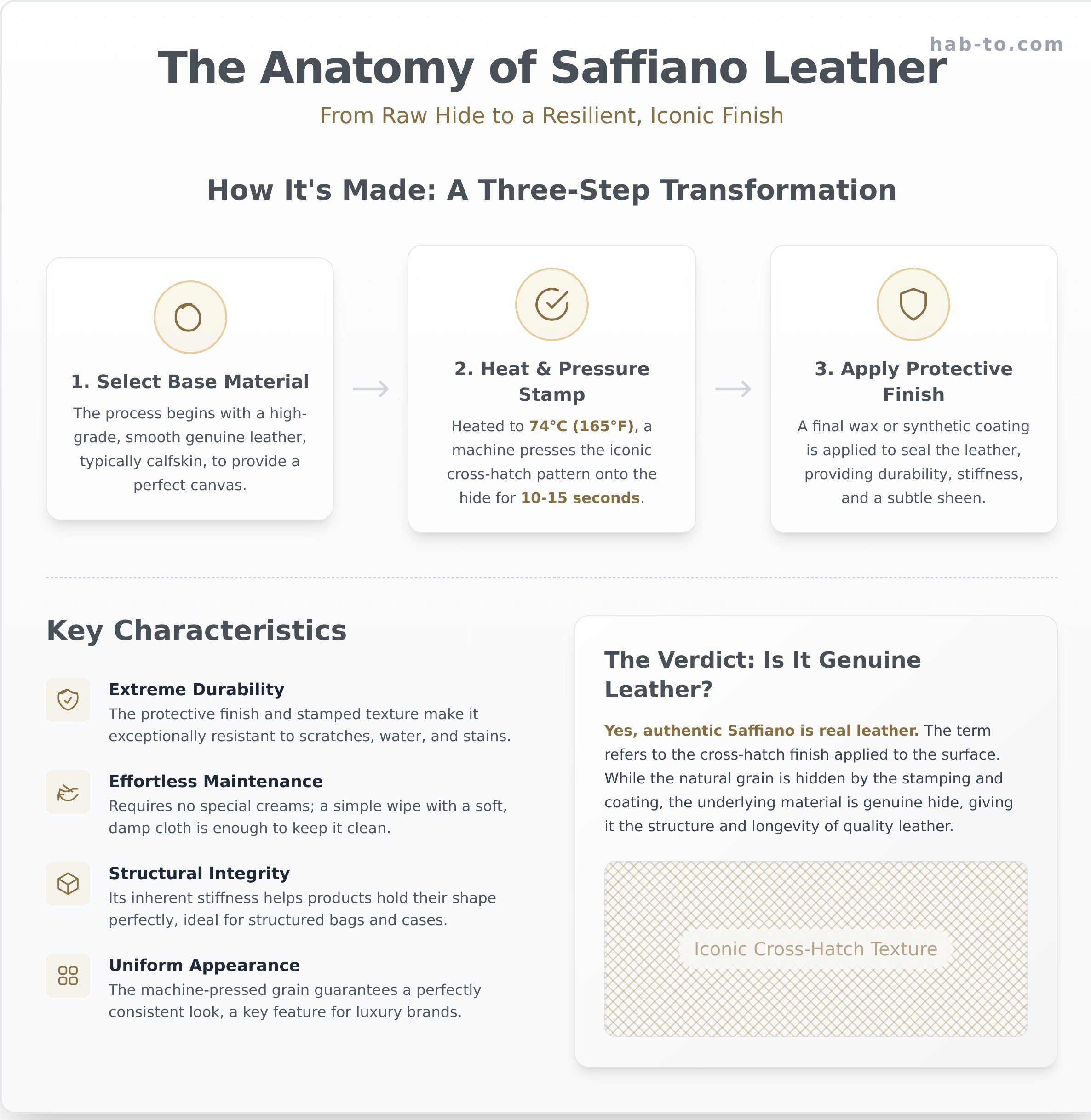
The iconic texture of Saffiano leather isn't a natural grain. It's the result of a precise, multi-stage manufacturing process originally patented by Mario Prada. Understanding this machine-driven craft is key to answering the question, what is Saffiano leather, and appreciating its unique properties. The process transforms a simple hide into a durable and distinctive material through a careful combination of heat, pressure, and a protective seal.
This method ensures a consistent and incredibly resilient final product, which is why it has remained a staple in the world of high-end accessories. Let's break down the journey from raw hide to finished Saffiano.
Step 1: Selecting the Base Material
Like any quality craft, it all starts with the foundation. Premium Saffiano leather is typically made from high-grade calfskin, chosen for its smooth, consistent surface that provides an ideal canvas for the stamping process. While the original grain is eventually hidden, the underlying quality of the hide still dictates the final product's durability and structure. It's important to note that this process always uses genuine leather, distinguishing it from the growing market of synthetic leather alternatives that may try to mimic its texture. Cheaper versions of Saffiano may use lower-grade splits, which can impact longevity.
Step 2: The Stamping Machine
This is where the transformation truly happens. The leather is heated to a specific temperature (around 74°C or 165°F), making it pliable. Then, a powerful machine presses a metal plate engraved with the signature cross-hatch pattern onto the surface at high pressure for about 10-15 seconds. This embossing process completely covers the hide's natural grain, creating a perfectly uniform and scratch-resistant finish across the entire piece. This consistency is a major reason why Saffiano is so popular for luxury goods, as it guarantees every item in a collection looks identical.
Step 3: The Protective Finish
The final step is arguably the most important for Saffiano's famous durability. After stamping, the leather is treated with a protective coating-often a specialized wax or a synthetic polyurethane finish. This coating serves two critical functions:
- Protection: It seals the leather, making it exceptionally resistant to water, stains, and scuffs.
- Aesthetics: It imparts the material's characteristic stiffness and subtle, sophisticated sheen.
The Pros and Cons: A Balanced Look at Saffiano's Characteristics
Saffiano leather is one of the most polarizing materials in the industry. For many consumers, it represents the pinnacle of practical luxury. For leather artisans and purists, however, it can feel like a departure from the very soul of the material. So, when considering what is saffiano leather, it's crucial to weigh its engineered resilience against the traditional character of natural hides. Let's break down the good, the bad, and the practical.
The Advantages: Durability, Consistency, and Easy Care
The primary appeal of Saffiano lies in its incredible performance for everyday items. The protective wax coating and stamped texture create a surface that is exceptionally tough, making it ideal for products that endure daily abuse, like handbags, wallets, and tech accessories.
- Highly Resistant: It’s a workhorse. The finish repels water, resists stains, and is remarkably difficult to scratch. A spilled coffee or a brush against a rough wall is far less of a disaster than with an untreated hide.
- Effortless Maintenance: Forget specialized creams and conditioners. Saffiano leather is easily cleaned with a simple soft, damp cloth, making it a low-maintenance choice for a busy lifestyle.
- Structural Integrity: The material's inherent stiffness means it holds its shape exceptionally well, perfect for structured totes and briefcases that need to look sharp and professional without sagging.
- Uniform Appearance: The machine-pressed grain ensures a perfectly consistent look from one product to the next, a key reason it's favored by large luxury brands for mass production.
The Disadvantages: A Crafter's Perspective
From an artisan's point of view, the very qualities that make Saffiano practical are also its greatest weaknesses. The synthetic coating seals off the natural leather, fundamentally changing its character and what you can do with it. It’s a material that looks the same on day one as it will on day one thousand, which misses the point of quality leather for many of us.
- It Doesn't Develop a Patina: True leather tells a story, aging gracefully and developing a unique patina over time. The plastic-like coating on Saffiano prevents this beautiful, natural process entirely.
- Cannot Be Conditioned or Burnished: There is no way to care for the leather underneath the coating. You can't oil it to keep it supple or burnish the edges for a refined, handcrafted finish.
- Nearly Impossible to Repair: While it resists minor scuffs, a deep gouge that tears the coating is permanent. There's no way to blend, buff, or treat the damage, unlike a full-grain hide.
- Lacks Natural Warmth: The feel is often described as rigid and artificial. It lacks the supple hand, warmth, and rich aroma that leather lovers cherish.
| Pros (For the Consumer) | Cons (For the Artisan) |
|---|---|
| Extremely durable and scratch-resistant | Cannot develop a natural patina |
| Water and stain-resistant | Cannot be conditioned, oiled, or burnished |
| Very easy to clean and maintain | Difficult or impossible to repair once damaged |
| Maintains a rigid, structured shape | Feels rigid and synthetic, lacking warmth |
Ultimately, the debate around what is saffiano leather comes down to purpose. For a durable, worry-free daily accessory, it's a sensible choice. But for those who seek the evolving beauty and authentic feel of a handcrafted piece, it falls short. If you're in the latter camp, we invite you to explore the rich character of our hand-selected vegetable-tanned leathers-hides that are meant to live and age with you.
Saffiano vs. Traditional Leathers: A Crafter's Comparison
As artisans, the real question isn't just what is saffiano leather, but how does it actually perform on the workbench and in a finished piece? When your name is on a creation, the integrity of the material is paramount. For the dedicated crafter, the choice between a coated, uniform leather and a natural, expressive hide is a choice between manufacturing and artistry. Let's compare Saffiano to the traditional leathers we know, love, and champion.
Saffiano vs. Vegetable-Tanned Leather
This is where the distinction becomes most clear for a leatherworker. Vegetable-tanned (veg-tan) leather is a living canvas, while Saffiano is a sealed surface.
- Workability: You can tool, carve, stamp, and wet-mold veg-tan leather to bring any vision to life. Saffiano’s rigid, synthetic coating makes these traditional techniques impossible.
- Aging: The hallmark of quality veg-tan is its ability to develop a beautiful, rich patina over time, telling a unique story. Saffiano's appearance is static; it resists character and looks the same on day one as it does years later.
- Feel: Veg-tan is natural, warm, and breathable to the touch. Saffiano often feels stiff and cool, a direct result of its plastic-based finish.
For projects that demand true craftsmanship and a personal touch, there is no substitute for the real thing. Discover our collection of premium Vegetable-Tanned Leather.
Saffiano vs. Full-Grain Leather
While both materials can be found in high-end goods, their character is worlds apart. Full-grain leather is prized for its authenticity-the very quality Saffiano is designed to conceal.
- Grain: Full-grain proudly displays the hide's natural markings, pores, and history. Saffiano’s cross-hatch grain is an artificial pattern pressed onto the surface, creating uniformity by erasing individuality.
- Repairability: Minor scuffs and scratches on full-grain leather can often be buffed or conditioned away, enhancing its character. A deep scratch that breaks Saffiano's coating is permanent and cannot be repaired.
Why We Champion Natural, Uncoated Leathers
At Hab-To, our philosophy is simple: No synthetics. No compromises. We believe the most beautiful materials are those that tell a story. Leather should evolve with its user, absorbing traces of a life lived and gaining character with every scuff and polish. Saffiano offers consistency, but it sacrifices the very soul of the material. True craftsmanship is a dialogue between the maker and their medium-a connection you can only forge with honest, natural leather that lives and breathes alongside you.
Saffiano's Place in Your Craft: A Final Word
Ultimately, understanding what is saffiano leather comes down to recognizing its purpose. It's a highly durable, water-resistant, and uniform material, prized in the fashion world for its resilience and consistent look. However, for the dedicated crafter, its synthetic wax coating can feel distant, masking the natural grain and character that makes leather a joy to work with. While practical, it doesn't tell a story or develop a rich patina over time like traditional leathers do.
At Hab-To, we believe in materials that inspire. No synthetics. No compromises. We champion leathers that live and breathe with your project. Backed by over 160 years of family experience, we offer a curated selection of sustainable, vegetable-tanned leathers chosen for their unique beauty and superior workability. And because we support crafters at every level, we have no minimum order requirements.
Ready to move beyond the uniform and embrace the authentic? Explore leathers with true character and workability. Your next masterpiece deserves it.
Frequently Asked Questions About Saffiano Leather
Is Saffiano leather from Prada real leather?
Yes, genuine Saffiano leather from luxury brands like Prada is absolutely real leather. It typically starts as high-quality, full-grain calfskin. The signature cross-hatch pattern is then machine-pressed into the surface, and a protective wax coating is applied. This treatment creates the famous texture and durability, but the foundation remains a premium, natural hide, embodying a perfect blend of traditional material and modern craftsmanship.
Does Saffiano leather crack or peel over time?
Authentic Saffiano leather is exceptionally resistant to cracking and peeling. Its unique wax finish creates a formidable barrier against moisture, scratches, and daily wear, making it one of the most durable finishes available. While any material can be damaged by extreme neglect, Saffiano is engineered for longevity. Be wary of fakes, however, as low-quality imitations with a plastic-like coating are very prone to peeling and cracking.
Is Saffiano leather considered high quality?
Saffiano is definitely considered a high-quality material, valued for its unique blend of luxury and practicality. It uses premium hides as a base and undergoes a sophisticated finishing process that makes it incredibly durable and easy to maintain. While it doesn't develop a natural patina like many vegetable-tanned leathers, its consistent appearance and superior resilience make it a top choice for high-end accessories built to withstand daily use.
How can you tell the difference between real and fake Saffiano leather?
Distinguishing real from fake Saffiano involves using your senses. Genuine Saffiano has a distinct, precise cross-hatch texture that feels firm yet supple, and it carries the faint, rich scent of real leather. Fakes often feel overly stiff, like plastic, and may have a chemical odor. Examine the pattern closely-on fakes, it can look flat or "printed on" rather than embossed into the material. True quality is in these details.
Why is Saffiano leather so expensive?
The cost of Saffiano leather is a direct reflection of its quality materials and complex production. The process begins with premium calfskin, which is expensive on its own. The meticulous, multi-step process of heat-pressing the pattern and applying the specialized wax finish requires precision machinery and adds significant labor and time. This investment in craftsmanship results in the superior durability and refined look that commands a higher price.
Can you use leather conditioner on Saffiano products?
We generally advise against using leather conditioner on Saffiano. The protective wax coating that gives Saffiano its durability also acts as a seal, preventing conditioners from actually reaching and nourishing the leather hide beneath. Applying creams or oils will likely just sit on the surface, creating a sticky residue. A simple wipe with a soft, damp cloth is the best and only method needed to keep your Saffiano products clean.