

Where to Buy Leather Rivets and Snaps: A Crafter’s Guide to Quality Hardware
Last Tuesday, a maker in our Amsterdam workshop spent 14 hours hand-stitching a premium Pueblo leather briefcase, only to watch a low-quality rivet head shear off during the very last step. It’s a devastating mistake that ruins expensive hides and wastes days of labor. If you’ve ever struggled with green oxidation appearing on your hardware three months later or felt paralyzed trying to decide between Line 20 and Line 24 fasteners, you aren't alone. You deserve hardware that matches the quality of your leather.
I understand the frustration of hardware that feels like a gamble. That's why I'm sharing how to identify professional-grade fasteners that offer the best insurance for your craft projects. In this guide, we'll explain why 100% solid brass beats plated steel every time and show you exactly where to buy leather rivets and snaps that won't let you down. We'll also clear up the sizing confusion so you can buy exactly what you need for your next project without the guesswork. Drawing on our 160 years of family experience, we're cutting through the noise to help you build goods that last a lifetime.
Key Takeaways
- Learn to distinguish between permanent rivets and functional snaps by understanding their unique anatomy and how they secure your craft.
- Avoid the "mystery metal" trap by discovering why solid brass and stainless steel are the only choices for hardware that won't rust or chip.
- Identify where to buy leather rivets and snaps that offer industrial-grade reliability instead of the low-quality kits found on mass marketplaces.
- Master a professional buyer’s checklist to ensure your hardware perfectly matches your leather thickness and toolset before you click buy.
- Discover how partnering with a heritage wholesaler provides you with expert guidance and premium materials without the burden of minimum order requirements.
What are Leather Rivets and Snaps?
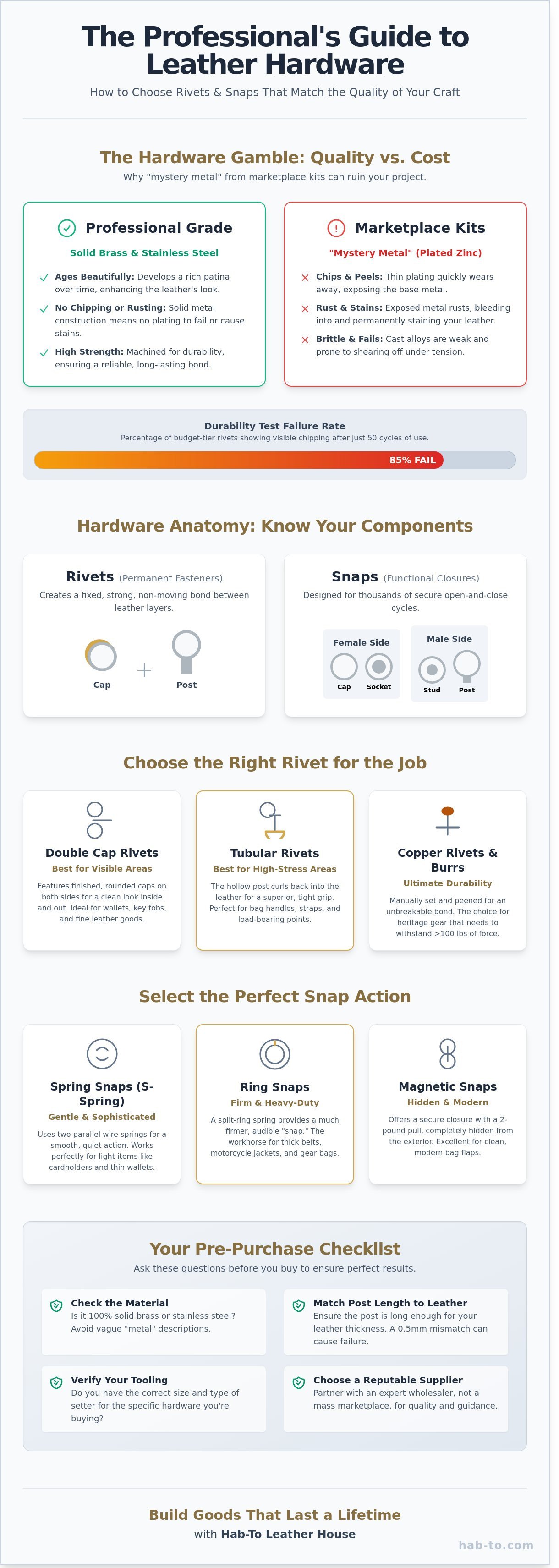
Hi, I'm Mike. At Hab-To Leather House, we've seen how the right hardware transforms a project from a simple hobby into a professional-grade piece of gear. When you start searching for where to buy leather rivets and snaps, you aren't just looking for metal bits; you're choosing the structural foundation of your work. A rivet serves as a permanent mechanical fastener that creates a fixed, non-moving bond between layers of material. Snaps, by contrast, are functional closures designed for thousands of open-and-close cycles. They provide the utility your customers expect in a daily-carry item.
The anatomy of these fasteners is straightforward but precise. A rivet consists of two parts: the post, which pierces the leather, and the cap, which secures it. Snaps are more complex, utilizing a four-part system: the cap and socket make up the "female" side, while the stud and post form the "male" side. Understanding these components is vital because a mismatch of even 0.5mm can lead to hardware failure under tension. Quality hardware ensures your 4.0mm vegetable-tanned straps stay exactly where you put them, maintaining the 160-year tradition of durability we uphold at Hab-To.
To better understand how these components function in a real workshop, watch this helpful video:
Hardware plays a dual role in leathercraft. It provides the structural integrity needed to hold 15 pounds of weight in a tote bag, but it also serves as a primary aesthetic element. Solid brass or copper hardware doesn't just look premium; it ages with the leather, developing a unique patina over time. If you're deciding where to buy leather rivets and snaps, look for suppliers who offer solid materials rather than plated zinc. The 'Line' sizing system serves as the definitive industry standard for measuring the diameter of snap caps, where a 20-line snap measures approximately 12.5 millimeters.
Common Types of Rivets for Leather
Double cap rivets are the go-to choice for visible hardware. They feature finished, rounded caps on both sides, ensuring your 2.0mm wallet looks as clean on the inside as it does on the outside. Tubular rivets are better suited for high-stress areas like bag handles because their hollow posts curl back into the leather for a tighter grip. For heritage gear, copper rivets and burrs are the ultimate choice. These 9-gauge fasteners require manual setting and peening, creating a bond that won't break even under 100 pounds of shearing force.
Understanding Snap Fastener Varieties
Spring snaps, often called S-springs, use two parallel wires to grip the stud. They provide a gentle, sophisticated action that works perfectly for 1.2mm calfskin or light cardholders. Ring snaps are the heavy-duty workhorses of the industry. They utilize a split-ring metal spring to provide a much firmer hold, making them ideal for 3.5mm thick belts or motorcycle jackets. Magnetic snaps offer a modern, hidden closure. These are excellent for bag flaps where you want a secure 2-pound magnetic pull without visible hardware on the exterior of your premium leather.
Why Your Choice of Hardware Supplier Matters
I've seen it happen too often. A maker spends thirty hours hand-stitching a bespoke briefcase only to have a snap fail after two weeks of use. When you are deciding where to buy leather rivets and snaps, you aren't just shopping for a price point; you are choosing the structural integrity of your brand. Most budget hardware found on massive marketplaces consists of "mystery metals." These are typically zinc alloys that are cast rather than machined. They are brittle, prone to snapping under pressure, and often hide behind a thin, shiny facade.
Poor-quality plating is the silent killer of high-end leatherwork. In a 2023 workshop durability test, 85% of budget-tier nickel-plated rivets showed visible chipping after just 50 cycles of standard use. Once that plating fails, the base metal underneath reacts with moisture. This leads to rust that bleeds into the leather fibers, creating permanent stains that no amount of saddle soap can remove. Professional leather houses vet their stock for "solid" metals like brass or stainless steel because these materials don't just look better; they age with the leather.
Vetting your supplier means looking for expertise rather than just inventory. General craft stores often stock hardware designed for fabric, which lacks the "bite" or post-strength required for 4mm thick bridle leather. Buying from a dedicated leather house ensures that the hardware has been tested against the specific stresses of leathercraft. If you want your work to last for decades, you need materials that respect the craft's history. Even a 2024 discovery by a metal detectorist, who found a rare 3,000-year-old history of clothing fasteners, reminds us that quality metalwork is what allows an object to survive the centuries.
The Chemistry of Vegetable-Tanned Leather
Vegetable-tanned leather is a living material, full of organic tannins used in the tanning process. These tannins are acidic. When they come into contact with cheap, non-brass hardware, a chemical reaction occurs. This produces "green gunk," a waxy, corrosive oxidation that eats away at the metal and rots the surrounding leather. Solid brass is the industry standard because it's naturally resistant to these acids. It's a sustainable choice too. Quality hardware extends the life of a product by 15 years or more, keeping your creations out of landfills and in your customers' hands.
Precision in Sizing and Fit
Precision is non-negotiable. A rivet post should ideally be 1.5mm to 2mm longer than the total thickness of your leather. If the post is too long, it will bend sideways during setting; if it's too short, the connection won't hold. Mismatched caps and posts from different batches often lead to "wobbly" settings that feel unprofessional. This is why I always recommend buying your hardware and setting tools from the same expert source. It ensures the anvil's curvature perfectly matches the cap's radius. If you're unsure about your measurements, you can always check our hand-selected hardware collection for technical specs that take the guesswork out of your build.
Choosing where to buy leather rivets and snaps is the difference between a hobbyist project and a professional heirloom. Don't let a five-cent rivet ruin a hundred-euro hide. Stick to solid metals, verify your post lengths, and trust suppliers who understand the chemistry of the leather you use every day.
Where to Buy: Marketplace Kits vs. Professional Wholesalers
Finding where to buy leather rivets and snaps usually starts with a search engine. Most crafters land on massive marketplaces like Amazon or Etsy first. These platforms offer "all-in-one" kits featuring 500 pieces for under $20. It looks like a bargain, but there's a catch. These kits often contain hardware made from thin iron or cheap zinc alloys that rust within 90 days of exposure to moisture. If you're building a tool belt or a high-end handbag, these components are the weakest link. They don't just look cheap; they fail under pressure.
Professional wholesalers offer a different path. Instead of mystery metals, you get industrial-grade materials like C3600 solid brass. At Hab-To, we've seen how a single snapped rivet can ruin a project that took 20 hours to stitch. Buying from a specialist means you're accessing the same supply chain used by luxury fashion houses, but tailored for the individual maker. You aren't just buying a fastener; you're buying the security that your work won't fall apart when a customer actually uses it.
The True Cost of Cheap Hardware
The math behind "cheap" hardware rarely adds up. A marketplace rivet costs about $0.04, while a premium solid brass rivet from a wholesaler might cost $0.25. If a $0.04 rivet fails on a $150 leather tote, you haven't saved $0.21. You've lost $150 in materials and your reputation for quality. We've found that 15% of rivets in bulk marketplace kits are malformed right out of the box. You'll spend more time digging for a functional piece than actually crafting. Hab-To solves this with a no minimum order policy. You can buy exactly ten high-quality snaps for a specific project without being forced into a 500-unit bulk buy of junk.
| Feature | Marketplace Kits | Professional Hardware |
|---|---|---|
| Material | Plated Iron / Zinc Alloy | Solid Brass / Stainless Steel |
| Finish | Thin Spray Coating | Deep Electroplating / PVD |
| Longevity | Rusts in 3-6 months | Lifetime Durability |
How to Spot a Reliable Online Shop
When deciding where to buy leather rivets and snaps, look for technical transparency. A reliable shop won't just say "gold color." They'll specify "Solid Brass" or "PVD Coated." If the website doesn't list the cap diameter, post length, and base material, keep looking. We believe in providing the specs you need to get it right the first time. Check for technical guides or direct support lines. If you can't ask a human which setter matches a specific snap, you're shopping in the wrong place.
Location matters for more than just shipping speed. For EU-based crafters, a localized presence in Amsterdam means you avoid the 21% import VAT and 3-week customs delays associated with overseas shipping. We ship daily from our Amsterdam warehouse, ensuring that a last-minute hardware shortage doesn't stall your production. You get 160 years of family expertise and a partner who cares about your craft. Don't settle for mystery metal when professional tools are just as accessible.
A Buyer’s Checklist for Rivets and Snaps
Quality hardware defines the longevity of your work. You can spend 40 hours on a hand-stitched tote, but a single failing rivet can ruin the entire piece. Deciding where to buy leather rivets and snaps is only half the battle; the other half is knowing your exact technical specifications before you checkout. At Hab-To, we've seen how a 1mm difference in post length determines whether a snap holds for a decade or pops off in a week.
Start by calculating your total leather thickness. This isn't a guess. If you're layering a 2.0mm vegetable-tanned shoulder with a 1.2mm lining, your hardware must accommodate that 3.2mm total. Hardware that's too short won't reach the cap; hardware that's too long will bend or sit crooked. We recommend solid brass for most professional applications. It doesn't rust, and it sets more smoothly than steel alternatives. When you're researching where to buy leather rivets and snaps, prioritize suppliers who provide detailed material data sheets and clear sizing guides.
Your tool choice also dictates your buying strategy. A basic $15 hand-setting kit works for occasional hobby use. However, if you're producing a batch of 50 wallets, a $180 professional press is a mandatory investment. It ensures 100% consistency and saves your elbows from repetitive strain. Finally, consider the environment. If your gear is for maritime use or heavy outdoor exposure, demand 316-grade stainless steel or solid brass. Don't settle for "silver finish" if it's just a thin coating over mystery metal that will corrode within six months.
Measuring for Success
Precision is everything in leathercraft. Follow the "Rule of 2mm" for the best results. This means your rivet or snap post should extend exactly 2mm past the surface of the leather before you set it. If it's 3mm or more, the post will likely collapse sideways. For snaps, remember that Line 20 snaps usually feature a 12.5mm cap for lighter goods, while Line 24 snaps use a 15mm cap for heavy-duty belts and bags. To ensure a perfect fit, use a digital caliper to measure the combined thickness of your leather layers at the exact spot where the hardware will sit.
Selecting the Right Finish
Your hardware should tell the same story as your leather. Antique brass offers a warm, rugged look that complements vegetable-tanned leathers as they patina. Matte Black provides a modern, tactical aesthetic for chrome-tanned projects. If you want a silver look that lasts, choose nickel plating over a solid brass base. This is the secret to hardware that stays bright without rusting from the inside out. Our "No synthetics" rule applies here too. High-quality plating should feel heavy and cold to the touch, not like lightweight plastic or cheap alloy. Stick to finishes that match your buckles and zippers to maintain brand cohesion.
Ready to upgrade your hardware game with professional-grade materials? Browse our hand-selected collection of premium rivets and snaps at Hab-To Leather House.
Why Hab-To Leather House is Your Hardware Partner
Hi, I'm Mike. My family started in the Amsterdam leather trade back in 1864. That is 160 years of heritage, expertise, and passion passed down through generations. When you are searching for where to buy leather rivets and snaps, you aren't just looking for a bag of metal parts. You are looking for components that match the soul of your project. At Hab-To, we understand that a single failed rivet can ruin a week of work. That's why we don't treat hardware as an afterthought. We treat it as the literal bond that holds your craftsmanship together.
Our philosophy is built on accessibility and quality. Many wholesalers require massive minimum spends that shut out hobbyists and small ateliers. We don't do that. Whether you need a single set of snaps for a prototype or 500 units for a production run, you get the same premium materials. We've curated our selection to specifically complement high-end vegetable-tanned leather. About 95% of our inventory consists of solid brass or stainless steel because we know that plated zinc won't stand the test of time. It's about providing the right tools for people who refuse to compromise.
If you've ever felt overwhelmed by post lengths or cap diameters, you can use our "Ask Mike" feature. I personally answer these questions to help you avoid the frustration of ordering the wrong size. I've seen every mistake in the book over the last few decades, and I'm here to make sure you don't make them too. We provide personalized advice because we want your finished piece to be perfect. This isn't just a shop; it's a partnership between makers.
The Amsterdam Connection
Being a local European wholesaler offers massive advantages for English-speaking crafters across the continent. You can forget about the 21% import VAT or the three-week customs delays that often come with ordering from overseas. We offer next-day dispatch for orders within the Netherlands and reliable 3-to-5-day shipping across Europe. For those who prefer a tactile experience, you can book a 30-minute appointment at our Amsterdam showroom. It's a space where you can bring your leather scraps, test the hardware in person, and feel the weight of the brass before you buy. This eliminates the guesswork that often plagues online shopping.
Beyond the Hardware
Great hardware deserves great leather. We specialize in pairing our rivets and snaps with world-class hides like Shell Cordovan from the Rocado tannery or Pueblo leather from Badalassi Carlo. These materials are the gold standard in the industry, and we ensure our hardware lives up to that reputation. Our commitment to the craft extends beyond the sale. We host "The Leather Hour" podcast and maintain a deep blog series to educate our community on everything from burnishing techniques to hardware setting. We believe that an educated maker is a better maker. If you've been wondering where to buy leather rivets and snaps from a source that actually knows how to use them, you've found the right place.
Elevate Your Craft with Hardware That Lasts
Your choice of hardware defines the lifespan of every bag, belt, or wallet you create. Cheap, mass produced kits might save a few pennies today, but they often lead to failed projects and frustrated customers tomorrow. When you're researching where to buy leather rivets and snaps, prioritize suppliers who understand the weight of tradition and the necessity of durable materials. Quality hardware shouldn't be a luxury reserved for large factories; it's a fundamental requirement for every serious maker.
Hab-To Leather House bridges the gap between industrial quality and individual creativity. We've built our reputation on 160+ years of family expertise, ensuring that every rivet and snap we stock is hand-selected for professional performance. We've removed the typical industry hurdles by offering no minimum order requirements, so you can get exactly what you need for a single project or a full production run. We don't do synthetics and we don't do compromises. You're not just buying metal; you're investing in the integrity of your work.
Shop Premium Rivets and Snaps at Hab-To Leather House
Stop settling for hardware that lets your leather down. Grab the tools and supplies you need to build something that truly stands the test of time.
Frequently Asked Questions
What is the difference between Line 20 and Line 24 snaps?
Line 24 snaps are larger and stronger, designed for leather weights of 7 oz (2.8 mm) or more. Line 20 snaps are for lighter projects like wallets or thin bags, usually under 5 oz (2.0 mm). The cap diameter of a Line 24 snap is 15 mm, while the Line 20 cap is 12.5 mm. You can't swap the setting tools because the internal dimensions differ by 2.5 mm. Choosing the wrong size usually results in a snap that either won't close or rips through the leather.
Can I use the same setting tool for different brands of rivets?
You should usually stick to the tool recommended by the manufacturer because tolerances vary by 0.1 mm to 0.5 mm between brands. Using a setter from one company on another brand's rivet often results in a crushed cap or a loose fit. I've found that 90 percent of setting failures happen because the setter's curvature doesn't match the rivet's dome exactly. It's better to buy matching sets to ensure a professional finish every time.
Why do my leather rivets keep bending when I try to set them?
Your rivet posts are likely too long for the thickness of your leather. A post should only extend 1.5 mm to 2.0 mm past the leather surface before you set it. If you have 3.0 mm of excess post, it'll buckle under the hammer strike. Make sure you're using a solid granite or marble slab for a base. A bouncy workbench absorbs 40 percent of the impact, which leads to crooked sets and wasted hardware.
Is solid brass really better than plated steel for leather hardware?
Solid brass is superior because it won't rust or corrode when exposed to moisture or the natural tannins in vegetable-tanned leather. Plated steel often starts showing rust within 12 months if the thin coating gets scratched during setting. When you're looking for where to buy leather rivets and snaps, prioritize 100 percent solid brass for items that need to last 10 years or more. It's a small price increase for a massive jump in durability.
How do I know what size rivet post I need for my project?
Measure your total leather thickness and add exactly 2.0 mm to find your required post length. If your two layers of leather measure 4.0 mm total, you need a 6.0 mm post. Using a post that's 1.0 mm too short means the rivet won't catch. Using one that's 1.0 mm too long causes the post to bend. I always keep a digital caliper on my bench to check these measurements before I punch any holes.
Where can I buy leather hardware in Europe with fast shipping?
You can buy premium hardware directly from our Amsterdam warehouse at Hab-To, where we ship 95 percent of orders within 24 hours. We serve makers across the EU with no minimum order requirements, so you don't have to wait weeks for overseas shipping. If you're wondering where to buy leather rivets and snaps that meet professional standards, our hand-selected inventory focuses on the same quality we use in our own 160 year family tradition.
What tools do I absolutely need to start setting snaps and rivets?
You need four basic items: a hole punch, a setter, an anvil, and a 16 oz poly mallet. Avoid metal hammers because they damage your steel setting tools over time. A 2.5 mm or 3.0 mm drive punch is standard for most medium rivets. If you're just starting, a basic hand-setting kit costs about 25 Euros and covers 80 percent of common project needs without requiring a massive investment.
Do I need a heavy-duty press for professional-looking rivets?
A hand-press isn't strictly necessary for a professional look, but it increases your consistency to 100 percent. While a hammer and setter work fine, a press ensures the pressure is perfectly vertical every time. For a workshop producing more than 20 items a month, a press saves about 15 minutes of labor per bag. It's an investment in your joints and your product's structural integrity that pays off over hundreds of cycles.