Best Lining Leather: Professional Buying Guide (2026)
The interior of your work shouldn't be an afterthought. Hi, I'm Mike, and at Hab-To Leather House, I've spent decades learning that the lining is the structural soul of a truly luxury item. Choosing the wrong lining leather often leads to a finished piece that feels clumsy, stretches over time, or suffers from unsightly glue seep-through. I've seen many talented crafters struggle with unintentional bulk that masks the quality of their handiwork. It's frustrating when a beautiful exterior is let down by a lining that just doesn't hold its weight or maintain its shape.
You deserve an interior finish that provides a premium tactile feel while maintaining the structural integrity of your project. This guide shows you exactly how to select vegetable-tanned materials that offer strength without adding unnecessary thickness. We'll look at professional bonding techniques and the best thin-gauge options like Agneaux Sheep Nappa or panels from Conceria Maryam to ensure your interiors are as refined as your exteriors. Let's transform your next project into a masterpiece of balance and durability.
Key Takeaways
- Understand why a dedicated lining is the secret to structural integrity and a professional, high-end interior finish.
- Compare the unique benefits of premium lining leather options like textured goatskin and supple Sheep Nappa for your specific craft.
- Learn to navigate weights from 0.4mm to 1.0mm to eliminate "ghosting" and keep your finished items sleek and professional.
- Identify the essential skiving techniques and adhesives required to create a permanent, bubble-free bond between your layers.
- Discover why vegetable-tanned linings are the superior choice for pieces intended to age and patina beautifully over decades.
Understanding the Role of Lining Leather in High-End Goods
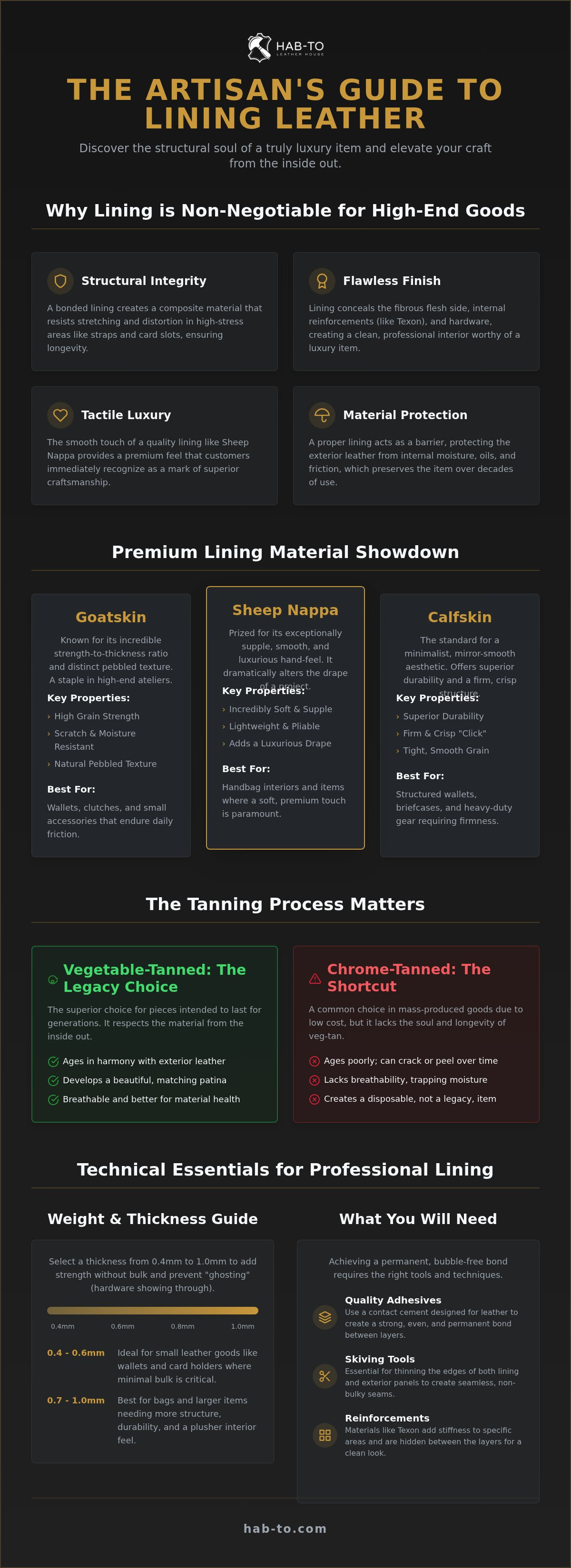
Lining leather is the hidden layer that defines the longevity and quality of your work. It is a thin, durable hide specifically prepared to cover the fibrous flesh side of your project. Why take the extra time to line? It isn't just about hiding the rough side of the hide. A quality lining protects the main material from moisture and oils, provides a clean aesthetic, and offers critical structural reinforcement. I've spent over 25 years at Hab-To Leather House seeing how a well-chosen liner can prevent a bag from losing its shape after just a few months of use. It turns a simple assembly of parts into a cohesive, professional product.
The character of your finished piece depends heavily on the Leather production processes used by your chosen tannery. While many commercial manufacturers use chrome-tanned pigskin because it's cheap, I exclusively recommend vegetable-tanned lining. Vegetable-tanned materials breathe and age in harmony with your exterior leather. They develop a matching patina over time rather than cracking or peeling like synthetic-heavy chrome options. This choice ensures your craft remains a legacy piece rather than a disposable accessory. It's about respecting the material from the inside out.
To better understand how a liner transforms a project, watch this helpful video:
The Structural Benefits of a Lined Project
A lined project is a stronger project. By bonding two layers together, you create a composite material that resists the natural tendency of leather to elongate under tension. This is vital in high-stress areas like card slots or bag straps where stretching can ruin the functionality. Lining leather also serves as a clever mask. You can hide internal reinforcements like Texon reinforcement or hardware like magnetic snaps and rivets between the layers. This creates a clean interior and allows you to finish the edges as one solid, burnished unit for a truly high-end look.
Tactile Luxury: The Hidden Value of Interior Finishes
The difference between a raw, fibrous interior and the smooth touch of Sheep Nappa is immediate. It changes the drape and stiffness of a handbag entirely. Professional buyers look for these lined interiors because they are a universal mark of quality. When a customer reaches into a bag and feels a supple, grain-side leather instead of rough suede, they know they've invested in luxury. Using premium goat lining or calfskin provides that specific "click" and firmness that distinguishes artisanal work from mass-produced goods. Don't underestimate the emotional impact of a smooth interior; it's often the first thing a customer notices when they open a wallet or bag.
Comparing Premium Lining Materials: Goat, Sheep, and Calf
Picking the right animal hide for your interior is a decision that dictates how the final piece behaves in the hand. While the exterior leather gets all the glory, the lining leather performs the heavy lifting. I often see beginners choose a lining based on color alone. That's a mistake. Each species offers distinct mechanical properties that can either fight against your exterior leather or complement it perfectly. After 160 years of family experience at Hab-To Leather House, we've found that matching the temperament of the lining to the purpose of the item is what separates a hobbyist from a professional.
Goat leather, particularly the Alran Chevre style, is a staple in high-end ateliers for a reason. It possesses incredible grain strength relative to its thickness. The natural pebble texture isn't just for show; it provides a level of scratch and moisture resistance that smooth calfskin often lacks. If you're building a wallet or a small accessory that will see daily friction, our goat lining options provide the resilience you need. It stays beautiful even as it's pulled in and out of pockets thousands of times.
For those seeking a minimalist, mirror-smooth aesthetic, bovine or calf lining is the standard. It offers superior durability for structured wallets and heavy-duty gear. Because the grain is tighter, it provides a very firm "click" and crispness when paired with a stiff exterior like Pueblo. You can explore these textures in our cow-hide collection to find the perfect match for your next rugged build.
Sheep Nappa: The Ultimate Soft-Touch Lining
Agneaux Sheep Nappa is the softest material we keep in stock. Its pliability is unmatched. This makes it the ideal choice for luxury handbag interiors where you want the bag to feel supple and alive. It has a very low weight, so it won't stiffen up delicate projects or garment interiors. We carry specific panels in our sheep collection that are perfect for these refined applications. It's the kind of material that makes a customer stop and say, "wow," the moment they touch the inside of a bag.
Goat vs. Bovine: Durability and Grain Texture
Choosing between these two often comes down to grain matching. If your exterior has a heavy grain, goat leather provides a harmonious transition. Bovine is better for projects requiring absolute structural stillness. Sometimes leather alone isn't enough to stop stretch in high-stress areas. In those cases, I recommend using Texon reinforcement between your layers. This ensures your card slots stay tight for years to come. The choice of tanning method also impacts these materials. For a deeper look at the environmental standards involved, you can consult the EPA guidance on leather tanning. At Hab-To Leather House, we stick to vegetable-tanned options because they age with grace. If you're unsure which hide suits your next project, our leather bundles are a great way to test different textures and weights.
Technical Selection: Weight, Thickness, and Pliability
Precision is the difference between a project that feels "handmade" and one that feels "professional." When you select your lining leather, you are working within a very narrow margin. Most lining applications require a thickness between 0.4mm and 1.0mm. Anything thinner risks tearing during the lasting or stitching process. Anything thicker adds bulk that ruins the silhouette of a sleek wallet. I always tell my students that the millimeter scale is your best friend. Industry standards promoted by organizations like the Leather and Hide Council of America emphasize precision in grading, which is especially critical when dealing with these thinner substances.
One of the most common mistakes I see is "ghosting." This happens when the texture or the edges of your internal reinforcements show through the exterior leather. If your lining is too thin or the glue isn't spread evenly, every internal bump becomes visible on the outside. It's a hallmark of poor planning. The weight you choose also dictates the "hand" of the item. A heavier lining makes a bag feel armored and stiff, while a lighter lining allows for a soft, luxurious drape. Finding that balance is an art form. Since professional projects often don't require a full hide of thin material, we've made it easy to get exactly what you need by offering panels and small cuts tailored for lining work.
Calculating the Total Thickness of Your Project
Don't guess your dimensions. Use a thickness gauge to measure every layer before you apply glue. The "Golden Rule" for a classic bifold wallet is to keep the total edge thickness under 3mm. If your exterior is 1.2mm and your pockets are 0.8mm, your lining leather needs to be skived paper-thin at the edges to maintain a slim profile. You must also factor in the glue. A layer of adhesive might seem microscopic, but across multiple pockets, it adds measurable bulk. If you aren't sure which weight to buy, I offer free video consultations to help you map out your project dimensions before you cut into your prime hides.
Pliability and Temper: Matching Lining to Exterior
Temper refers to the stiffness of the leather. If you're making a "turn bag" (sewn inside out and then flipped), you need a soft temper lining that won't crease or crack during the turn. For structured "edge bags" with painted or burnished edges, a stiffer temper helps the item hold its shape. A lining should never be stiffer than the exterior hide; if it is, the layers will fight each other. A lining leather with too much "spring" or stiffness will fight the exterior at the fold, causing the wallet spine to gape or buckle instead of closing flush. Match your tempers carefully to ensure the piece moves as one single, organic unit.
Advanced Techniques: What You Will Need to Line Professionally
Achieving a factory-level finish requires more than just good materials. It's about the chemistry of the bond and the precision of your preparation. I've seen many projects ruined by glue bubbling or edges that feel like a staircase because the skiving wasn't deep enough. To get that seamless, luxury feel, you need a disciplined approach. Professional lining leather work is unforgiving; every mistake on the inside shows on the outside. Success begins with having the right kit on your bench at Hab-To Leather House before you even open your glue pot.
What You Will Need for Professional Lining
You can't achieve a professional result with office supplies. High-end leathercraft requires specific tools designed to handle the delicate nature of thin hides. Here is what I keep on my own workbench:
- Lining leather: Choose Sheep or Goat based on the pliability needs we discussed earlier.
- Professional Adhesive: I exclusively use Ecostick 1804 because it stays flexible and won't stiffen your project.
- Glue Spreader: A flexible spatula ensures an even coat without clumps.
- Skiving Knife: A razor-sharp blade is essential for tapering edges to a feather-thin finish.
- Bone Folder: A bone folder is crucial for pressing edges and removing air pockets.
- Finishing Agents: Use Tokonole to slick the combined edges of your exterior and lining into a single, glassy unit.
Mastering the Bond: Avoiding Bubbles and Seepage
The secret to a flat, permanent bond is the "dry-to-touch" method. Apply a thin, consistent layer of Ecostick 1804 to both the flesh side of your exterior leather and the back of your lining. Don't rush to join them. Wait until the milky white adhesive turns completely clear. If you bond while the glue is still wet, you trap moisture between the layers. This is what causes the dreaded bubbling or "ghosting" effects. Once clear, carefully align the pieces and use a heavy roller or a bone folder to apply pressure from the center outward. This pushes out any micro-bubbles and ensures the fibers interlock perfectly.
When you're handling "turned" edges where the lining meets the exterior, your skiving must be impeccable. Taper the lining leather down to almost nothing at the very edge. This allows the material to wrap around the exterior hide without creating a bulky ridge. It's these small technical details that elevate a piece from a hobby project to a professional accessory that can sit on the shelf of any luxury boutique.
Sustainable Sourcing: Why Vegetable-Tanned Lining Wins
Sustainability in leathercraft isn't just a trend. It's a return to the principles that defined the craft for centuries. While mass-produced goods often rely on chrome-tanned "pigskin" for interiors, these materials have a heavy environmental footprint. Chrome tanning uses heavy metals that are difficult to process responsibly. In contrast, choosing a vegetable-tanned lining leather supports a slower, natural process that utilizes plant-based tannins. Our 160 years of family heritage ensures that we only stock materials that are built to last a lifetime. This commitment is why we source exclusively from tanneries within the Tuscan Vegetable Tanned Leather Consortium.
A vegetable-tanned interior is the only choice that respects the aging process of your exterior hide. If you use a premium exterior like Shell Cordovan but line it with a cheap synthetic or chrome-tanned leather, the two layers will age at different rates. The lining might crack or peel while the exterior is just beginning to develop its character. A veg-tan liner develops a matching patina, absorbing oils and moisture to become more supple over decades. It's the "honest" material choice for those creating heirloom-quality goods.
The Longevity of Vegetable-Tanned Interiors
Chrome-tanned linings often rely on surface coatings that eventually delaminate. You've likely seen old bags where the interior looks like it's shedding plastic flakes. Vegetable-tanned lining leather doesn't do that. Because the tannins penetrate the fibers naturally, the leather remains breathable. It handles the salt from skin oils and the humidity of daily use without losing its structural integrity. It's a material that thrives on use rather than degrading from it.
Sourcing with No Minimums at Hab-To
I know how frustrating it is to need just a small amount of premium material for a single project. You shouldn't have to buy a full hide just to line one wallet. That's why we offer small panels of world-class leathers like Pueblo or Maryam. You can get the exact quantity required for your interior without the waste or the heavy investment. If you're struggling to find the right thickness for your build, book a free video consultation with Mike to find your perfect lining match.
Master the Art of Professional Interiors
Selecting the right lining leather is the final bridge between a hobbyist project and a professional luxury item. At Hab-To Leather House, we back your craft with 160+ years of family expertise and a commitment to exclusively vegetable-tanned materials. You've learned how to balance pliability, avoid the pitfalls of ghosting, and use specialized tools to achieve a seamless bond. These technical choices define the tactile experience your customers will feel every time they open your work.
With our no minimum order policy, you can source the exact panels you need for your next build without unnecessary waste. If you need a second pair of eyes on your project plan, remember that I offer free professional video consultations to ensure your material selection is perfect for your specific design goals. Your next masterpiece is just one perfect layer away. I can't wait to see what you create.
Related Reading
- Mastering Edge Finishing with Tokonole and Burnishing Tools
- A Guide to Premium Italian Vegetable-Tanned Leathers
- How to Select the Right Reinforcements for Leather Bags
Featured Lining Essentials
- Agneaux Sheep Nappa Panels for Luxury Interiors
- Premium Goat Lining Leather with High Grain Strength
- Ecostick 1804 Water-Based Leather Glue
Frequently Asked Questions
What is the best thickness for a wallet lining leather?
The sweet spot for bifold wallets is between 0.4mm and 0.6mm. This thickness provides enough structural strength for card slots without creating a bulky profile. If you go much thicker than 0.8mm, your wallet will likely struggle to close flush once you add cards and cash. Precision here is what separates a sleek, professional build from a clumsy one.
Can I use pigskin for lining vegetable-tanned leather projects?
You can, but I don't recommend it for high-end work. Most commercial pigskin is chrome-tanned and won't age or patina in harmony with your vegetable-tanned exterior. Over time, these linings often peel or crack, which undermines the longevity of your craft. Stick to vegetable-tanned goat or sheep to ensure your project remains a legacy piece for decades.
How do I prevent my lining leather from wrinkling when I glue it?
Wrinkles usually occur when you join the layers while the adhesive is still wet. Use the "dry-to-touch" method and wait for your glue to turn clear and tacky. Always apply pressure from the center of the piece outward using a roller or bone folder. This technique ensures a flat, permanent bond and pushes out any trapped air before it causes trouble.
Is it necessary to skive the edges of the lining leather?
Yes, skiving is essential if you want a professional, refined look. You should taper the edges of your lining leather to a feather-thin finish where it meets the exterior hide. This prevents a bulky "step" or ridge at the edge of your project. It also makes the final burnishing or edge painting process much smoother and more consistent.
What is the difference between Nappa and regular lining leather?
Nappa refers to a specific grade of exceptionally soft, full-grain leather known for its buttery feel. While "regular" lining might include stiffer goat hides or lower-grade splits, Nappa is prized for its extreme pliability. It's the ideal choice for luxury handbags where the interior needs to feel supple and alive rather than stiff and utilitarian.
Do I need to line a bag if the flesh side of the leather is smooth?
Even a smooth flesh side benefits from a liner. A dedicated lining leather provides critical structural reinforcement that prevents the main hide from stretching out of shape over time. It also protects the interior from moisture, ink, and skin oils. Beyond the technical benefits, a lined interior is a universal mark of quality that customers immediately recognize and value.
Which glue is best for bonding lining leather without it smelling like chemicals?
Ecostick 1804 is my top recommendation for a smell-free workspace. It's a water-based, solvent-free adhesive that is virtually odorless, making it perfect for small studios or home workshops. Unlike traditional contact cements, it stays flexible once dry. This ensures your project maintains its natural feel without the stiff, crunchy bond often associated with cheaper chemical adhesives.
Does lining leather make the project too stiff for a turned bag?
Not if you choose a material with the correct temper. If you're making a turned bag, you should use a soft temper Sheep Nappa or a very thin goat hide. These materials are specifically designed to bend and flip without creating permanent creases or stress marks. Matching the temper of your lining to your exterior is the secret to a successful turn.
Disclaimer
All our blog articles are made for information purposes only we dont take responsability for any content from third parties.