Chrome-Free Leather: The Artisan’s Guide to Ethical Sourcing in 2026
What if the material you pour your soul into is secretly carrying a heavy chemical burden? For many artisans, the hidden reality of industrial tanning means dealing with skin allergies and the nagging weight of environmental guilt. You shouldn't have to choose between your craft and your health. Choosing chrome-free leather isn't just a trend for 2026. It's a return to the roots of authentic leatherworking where safety and quality coexist.
I understand the frustration of wanting the best materials but hitting a wall of high minimum orders. You deserve access to the same premium hides used by luxury houses, even if you're only making a single watch strap or a bespoke handbag. We agree that every hide should tell a story of tradition, not toxicity. In this guide, you'll discover why vegetable-tanned hides are the gold standard for sustainable craft. I'll show you how to identify truly ethical sources and how to select materials that develop a breathtaking patina over time. Let's look at how you can elevate your workshop with the world's finest Italian leather without the typical wholesale hurdles.
Key Takeaways
- Understand why chrome-free leather is the healthier choice for your workshop, eliminating the risk of chromium-related skin allergies and irritation.
- Learn the technical differences in tanning that make these hides the only viable option for professional tooling and decorative stamping.
- Master the art of moisture management and temper selection to ensure your leather projects age beautifully and maintain their structure.
- Discover how to source world-class Italian hides from tanneries like Maryam and Badalassi without the burden of high minimum order quantities.
What is Chrome-Free Leather? Defining the Ethical Standard
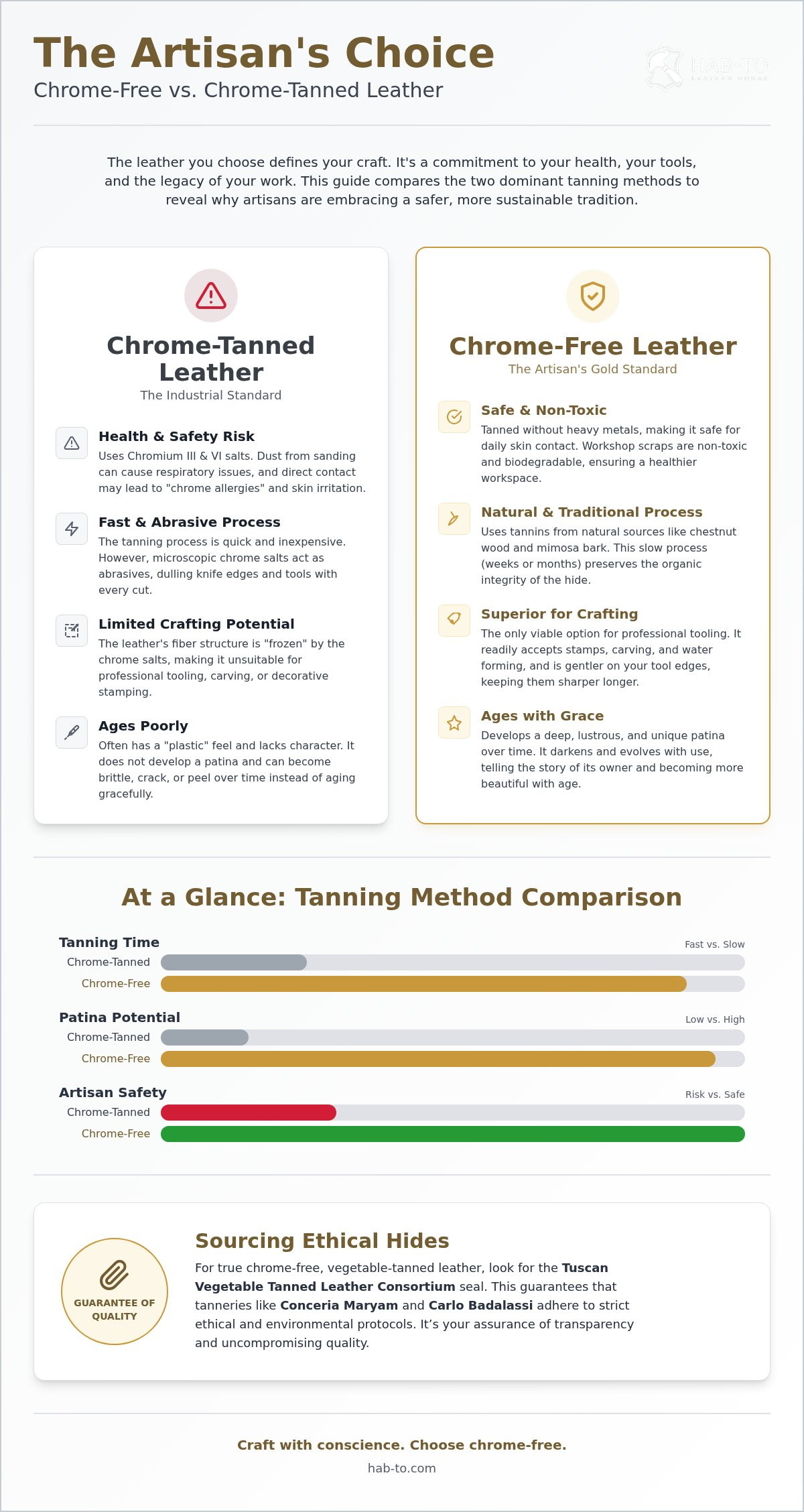
Let's be clear about what we're working with. For decades, the leather industry has been dominated by chrome tanning because it's fast and cheap. But speed comes at a cost. True chrome-free leather is tanned entirely without chromium salts, specifically avoiding both Chromium III and the hazardous Chromium VI. At Hab-To, we've spent 160 years as a family understanding that the best materials don't need heavy metals to be beautiful.
Our manifesto is simple. We never compromise. We refuse shortcuts. If a material isn't clean enough to touch your skin for hours, it doesn't belong in our warehouse. We refuse to stock synthetic or chrome-heavy materials because they lack the soul of a natural hide. When you browse our shop, you're seeing a curated selection of the cleanest hides available. It's better for the environment, better for the person wearing the finished piece, and significantly safer for you, the artisan, as you handle the material every day.
The Science of Tanning Without Heavy Metals
Nature provides everything we need. Instead of synthetic chemicals, we look to the forest. Tannins extracted from chestnut wood, mimosa bark, and quebracho leaves penetrate the hide over weeks or months. Traditional pit-tanning takes time, sometimes up to sixty days, while modern drum-tanning speeds up the process using mechanical action without sacrificing the organic integrity. 'Wet White' tanning is a common chrome-free leather alternative that uses synthetic or aldehyde-based agents to create a pale, metal-free hide.
Terminology Check: Chrome-Free vs. Vegetable-Tanned
Don't get lost in the jargon. While 'chrome-free' is a broad category that includes various metal-free methods, vegetable-tanned leather is the gold standard within that category. Every piece of vegetable tanned leather we offer is inherently chrome-free. In Europe, metal-free certifications are becoming the baseline for luxury production. When you're sourcing for a new project, look for the Tuscan Vegetable Tanned Leather Consortium seal. It's a guarantee that tanneries like Conceria Maryam or Carlo Badalassi are following strict ethical and environmental protocols. It's about transparency. It's about knowing exactly what's under your knife.
Why Artisans are Switching to Chrome-Free Materials
The movement toward chrome-free leather isn't just a marketing trend for 2026. It's a fundamental shift in how we value our health and the legacy of the items we create. While industrial chrome tanning produces a consistent, "frozen" finish, it lacks the soul and safety that many modern artisans demand. When you spend eight hours a day at your workbench, the materials you touch shouldn't just be beautiful. They should be safe for your skin and your lungs.
Health and Safety in the Atelier
Crafters often overlook the physical impact of their materials. Working with chrome-tanned hides can lead to "chrome allergies," which manifest as persistent skin irritation or respiratory discomfort from sanding dust. By switching to chrome-free leather, you eliminate these risks entirely. There's a profound peace of mind in knowing that your workshop scraps are non-toxic and biodegradable. Mike often shares a professional secret with our visitors: your tools actually stay sharper for longer when you work with metal-free hides. Chrome salts are microscopic abrasives that dull a blade's edge with every cut. When you work with purely vegetable-tanned materials, your knives and bevelers glide through the fibers with far less resistance.
The Aesthetic Advantage: Aging with Grace
There is a specific magic in how a natural hide reacts to the world. Through the science of oxidation, chrome-free materials darken and develop character as they are handled. Chrome-tanned leather often has a "plastic" quality that cracks or peels over time, but a hide like Pueblo leather does the opposite. It starts with a unique, slightly roughened texture and transforms into a deep, lustrous patina that looks better after five years of use than it did on day one.
When you sell your work, this aging process is your strongest selling point. You aren't just selling a bag; you're selling a companion that evolves with its owner. Explain to your customers that the darkening of the leather isn't a defect. It's a record of their journey. This emotional connection to the material is only possible when the tanning process allows the natural fibers to breathe and react to sunlight and oils. If you're ready to experience this difference firsthand, consider getting started with a curated selection of our finest Italian hides.
Sustainability in leathercraft goes beyond the initial purchase. Because these hides are tanned with organic plant extracts, they are part of a circular economy. They don't linger in landfills for centuries like synthetic alternatives. They return to the earth, making your craft a truly sustainable legacy for the next generation of makers.
Chrome-Free vs. Chrome-Tanned Leather: The Professional Comparison
Mass-market manufacturers often lean toward chrome tanning because it's fast, cheap, and consistent. As an artisan, you aren't looking for cheap; you're looking for character. The structural difference between these two materials is night and day. While chrome-tanned hides are soft and elastic from the start, they lack the internal density required for high-end structural work. Chrome-free leather, specifically the vegetable-tanned varieties we stock, offers a firm, dense fiber structure that provides a stable foundation for your projects.
Density isn't just about stiffness. It's about how the material responds to your hands. When you wet a piece of chrome-free hide, the fibers soften and become malleable, allowing you to mold, shape, or tool the surface with incredible precision. Once it dries, it "remembers" that shape. Chrome-tanned leather lacks this memory. If you try to stamp a logo or carve a decorative pattern into a chrome-tanned hide, the fibers simply bounce back, leaving a shallow, blurry impression that disappears over time.
Performance in the Workshop
You'll notice the difference the moment you pick up your tools. Chrome-tanned leather often "fights" the pricking iron. Because the fibers are chemically lubricated with chromium salts, they tend to stretch and distort around the blade rather than allowing a clean, surgical pierce. In contrast, chrome-free leather yields to the tool, resulting in perfectly aligned stitch holes that don't close up before you can get your needle through.
The most significant professional advantage is the edge finishing. High-end leathercraft is defined by edges that look like polished glass. This is only possible with chrome-free materials. The plant tannins allow the fibers to heat up and fuse together during burnishing. Chrome leather won't burnish. No matter how much friction you apply, the edges will remain fuzzy, forcing you to rely on thick edge paints that eventually crack and peel.
The Environmental Reality
We can't ignore the hidden cost of industrial production. Global leather manufacturing often struggles with chromium runoff, which can devastate local water systems if not strictly managed. This is why we are so selective about our partners. Tanneries like Conceria Maryam lead the industry in water treatment and closed-loop sustainability, ensuring that the tanning process respects the land.
There's also a common misconception that synthetic or "vegan" leathers are a better choice. Most of these materials are essentially plastic. They don't age, they can't be repaired, and they'll sit in a landfill for centuries. A high-quality, chrome-free animal hide is a byproduct of the food industry that would otherwise go to waste. By turning it into a durable piece of art, you are participating in a truly circular economy. It's a choice that respects both the craft and the planet.
Working with Chrome-Free Leather: A Project Guide
Working with chrome-free leather requires a different mindset than handling mass-produced materials. You need to listen to the hide. Choosing the right temper is your first decision. For a slim bifold wallet, you want a firmer temper that holds its shape, whereas a slouchy tote bag demands something more supple. Because these hides are natural, they're sensitive to moisture. A stray drop of water during the assembly phase can leave a permanent mark. Keep your workspace clean and dry until you're ready for the finishing stages.
Watch straps and belts are the perfect projects to showcase the strength of these materials. These items endure constant tension and friction. The dense fiber structure of chrome-free leather ensures they don't stretch out of shape after a month of wear. They maintain their structural integrity while slowly molding to the wearer's body. This creates a custom fit that synthetic alternatives simply can't match.
What You Will Need
- Essential tools: Pricking irons for clean stitching, edge bevelers to round off sharp corners, and a quality bone folder for crisp creases.
- Consumables: Natural waxes, Tokonole for a professional burnish, and solvent-free EcoStick glue to keep your assembly process non-toxic.
- The Hab-To Starter Bundle: This is the perfect entry point if you're looking to experiment with different weights and textures without committing to full hides.
Edge Finishing Techniques
Achieving a mirror-finish edge is a rite of passage for every artisan. Start by sanding your edges with progressively finer grits until the layers feel like a single piece of wood. Once smooth, use your beveler to remove the sharp corners. Apply a small amount of Tokonole and use a wooden slicker with rapid, light strokes. The magic of chrome-free hides lies in their reaction to friction. The heat generated by the wood slicker actually melts the natural fibers and tannins together. This creates a seal that is far more durable than any paint. Mike’s secret for a glass-like finish involves a final buff with a piece of heavy canvas and a touch of pure beeswax. This creates a deep glow that only improves as the item is handled.
Explore our curated starter bundles for your next project
Sourcing Premium Chrome-Free Hides at Hab-To Leather House
Finding a reliable source for chrome-free leather shouldn't feel like an uphill battle. Traditional wholesalers often hide behind high minimum order requirements that alienate individual artisans and small studios. At Hab-To Leather House, we've decided to do things differently. We believe that every maker, regardless of their scale, deserves access to the world's finest materials. Whether you're a seasoned professional or just starting your journey, our Amsterdam-based house is your partner in craft. We don't just sell hides; we share a legacy of 160 years of family history in the leather trade.
Why No Minimum Order Quantity Matters
We've pioneered a no-MOQ revolution because we know how artisans work. You don't have to buy an entire hide just to make a single watch strap or a small card holder. We offer the flexibility to purchase by the panel, shoulder, or even square decimeter. This approach directly reduces waste in your workshop and allows you to keep your inventory lean. It also opens the door to high-end experimentation. You can try a small piece of premium Shell Cordovan without a four-figure investment. This support for micro-brands is at the heart of our mission. We want to see your business grow hide by hide, without the wholesaler headache.
Personalized Service from a Master Crafter
Choosing the right weight or finish can be difficult through a screen. That's why Mike offers a free video consultation. With 25 years of hands-on experience, he can show you the specific grain, drape, and temper of our chrome-free leather in real-time. We act as an "expert friend" rather than just a supplier. We’re here to help you succeed by ensuring you have the exact material your project demands.
If you find yourself in the Netherlands, our Amsterdam atelier is a physical hub for the global crafting community. It's a place where you can feel the textures of hides from world-renowned tanneries like Badalassi, Virgilio, and Maryam. We’ve curated our collection to ensure that every hide we stock is inherently ethical, sustainable, and capable of developing a breathtaking patina. Our commitment to quality means we never stock synthetic or chrome-heavy materials. We stick to what we know best: authentic, vegetable-tanned excellence.
Explore our chrome-free collections today.
Elevate Your Craft with Ethical Excellence
The choice to work with chrome-free leather is a profound commitment to your health, your tools, and the longevity of your workshop's legacy. You've seen how these hides offer superior structural integrity for high-stress items while allowing for that signature glass-like edge finish that defines professional work. By sourcing directly from historic Tuscan tanneries, you ensure every project carries a story of authentic tradition and environmental respect.
We are here to support your growth, hide by hide. With 160 years of family expertise guiding our selections, we bridge the gap between industrial excellence and the individual artisan's atelier. Our worldwide shipping and strict no-minimum-order policy mean you can experiment with the world's finest materials without the traditional wholesale pressure or waste. It's time to create products that don't just look new today, but look even better a decade from now.
Your craft deserves materials that age as beautifully as the skills you've spent years perfecting. We are honored to be a part of your creative journey and look forward to seeing your next masterpiece.
Deepen Your Knowledge
- Master the basics of traditional craft with Mike's Leathercraft Masterclasses.
- Learn more about our heritage and commitment to quality on the About Us page.
- Have more questions? Find answers in our Frequently Asked Questions.
Featured Ethical Hides
- Badalassi Pueblo Leather: A unique, rustic texture that ages into a deep, lustrous patina.
- Maryam Vacchetta Leather: Traditional Italian excellence, perfect for durable bags and accessories.
- Virgilio Pueblo Leather: A thinner weight option for refined leathercraft projects.
Frequently Asked Questions
Is chrome-free leather the same as vegan leather?
No, chrome-free leather isn't the same as vegan leather. While vegan alternatives are typically made from synthetic plastics like PU or PVC, chrome-free options are genuine animal hides tanned using organic plant extracts or metal-free minerals. It's a natural byproduct of the food industry. This material offers the durability and breathability that synthetic "leathers" lack, making it the preferred choice for artisans who value longevity and authentic feel.
Does chrome-free leather water-spot more easily than chrome-tanned?
Yes, chrome-free hides are generally more porous and will water-spot more easily than chrome-tanned leather. Because the surface isn't sealed with heavy chemicals or plastics, liquids can penetrate the fibers quickly. You can mitigate this by applying a natural wax or leather conditioner. Over time, these spots often blend into the leather's unique patina, adding to the character of the finished piece rather than ruining its appearance.
Can I use chrome-free leather for making shoes and boots?
Absolutely. Chrome-free leather is the traditional standard for high-quality footwear. Its dense fiber structure provides the necessary support for shoe uppers and soles, while its natural breathability ensures comfort for the wearer. Many bespoke shoemakers prefer vegetable-tanned hides because they can be wet-molded to a last, retaining the exact shape of the foot. It's a durable choice that stands up to the rigors of daily walking.
Why is chrome-free leather generally more expensive than chrome-tanned?
The higher cost reflects the time and quality of the ingredients involved. While chrome tanning can be finished in a single day using cheap chemicals, producing chrome-free leather through vegetable tanning takes weeks or even months. The organic tannins derived from tree bark are also more expensive than industrial chromium salts. You're paying for a slower, artisanal process that prioritizes environmental safety and superior material density.
How do I care for chrome-free leather to ensure it lasts a lifetime?
Longevity comes down to simple, regular maintenance. Use a high-quality leather cream or wax every few months to keep the fibers supple and prevent cracking. Avoid storing your items in direct sunlight or near heat sources, as this can dry out the natural oils. If your leather gets wet, let it air-dry slowly at room temperature. With minimal care, these hides will outlast the user and develop a stunning individual character.
Is all vegetable-tanned leather automatically chrome-free?
Yes, all vegetable-tanned leather is inherently chrome-free leather. The very definition of vegetable tanning is the use of plant-based tannins instead of mineral chromium salts. At Hab-To, we exclusively stock vegetable-tanned hides to ensure our customers never have to worry about hidden chromium. It's the cleanest, most traditional tanning method available, ensuring your workspace remains free from toxic heavy metals and potential skin allergens.
Can I dye chrome-free leather at home?
Yes, you can certainly dye chrome-free hides at home, especially if you start with a "natural" or "crust" finish. These hides are highly receptive to water-based or oil-based dyes because they aren't coated in synthetic sealants. We recommend using products from our Fiebing's collection for professional results. Always test your dye on a small scrap first to ensure the color develops exactly how you intended before committing to the full piece.
What is the best way to store chrome-free hides to prevent drying out?
Store your hides in a cool, dark, and well-ventilated space. It's best to keep them flat or loosely rolled with the grain side facing in to prevent creasing or dust buildup. Never store leather in plastic bags, as the material needs to breathe; use cotton sheets or acid-free paper instead. Maintaining a stable humidity level in your workshop prevents the natural oils from evaporating, keeping your leather ready for your next project.
Disclaimer
All our blog articles are made for information purposes only we dont take responsability for any content from third parties.