How to Choose the Right Needle for Leathercraft: A Master Artisan’s Guide
Most beginners think the needle creates the stitch hole, but in traditional leathercraft, the needle simply follows the path your awl or pricking iron has already blazed. Learning how to choose the right needle isn't just about finding a sharp point. It is a precise technical calculation involving your leather thickness, hole diameter, and thread weight. When these three elements don't align, you end up with frayed thread, bent needles, or stitches that look swallowed by the leather.
You have likely felt the frustration of a needle snapping mid-stitch or the disappointment of seeing holes that look far too large for your thread. It's a common hurdle that can make even the most passionate artisan feel stuck. I promise that once you understand the relationship between your tools, these frustrations will disappear. This guide will teach you how to master the triad of needle size and thread weight to achieve a professional saddle stitch every time. We will also clarify the confusion between machine and harness needles so you can build a reliable kit for every project.
Key Takeaways
- Discover why blunt-tipped harness needles are the professional standard for protecting your thread and preserving pre-punched stitch holes.
- Learn how to choose the right needle by mastering the inverse numbering system where smaller sizes represent larger tool diameters.
- Apply the "Golden Triad" formula to perfectly balance your pricking iron width, thread weight, and needle thickness for a flawless finish.
- Identify the specific needle profiles required for different projects, ranging from delicate luxury goods to heavy equestrian gear.
- Understand why investing in high-quality needles is essential for gaining the tactile feedback necessary for consistent, professional craftsmanship.
Understanding the Role of Harness Needles in Leathercraft
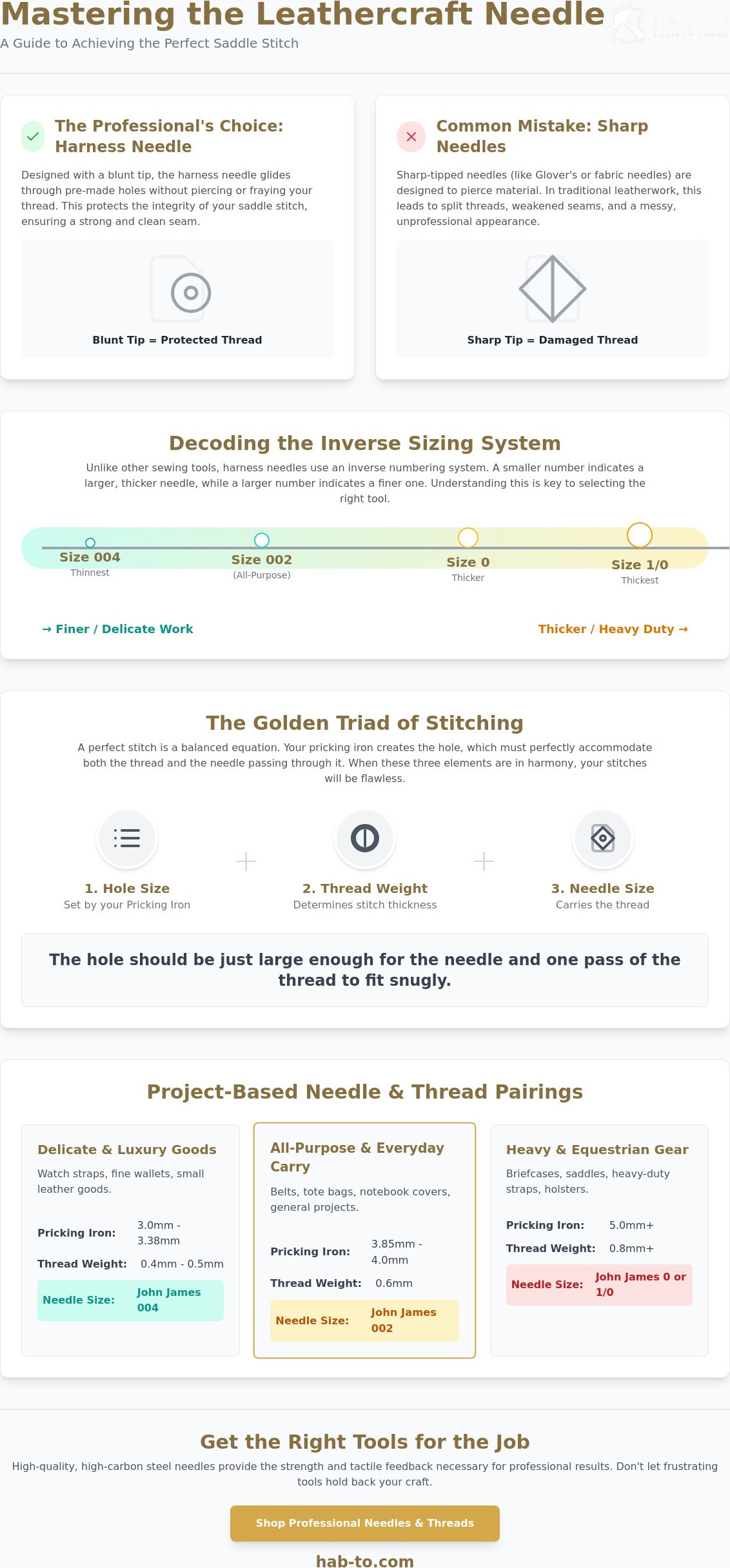
A harness needle is not your average sewing tool. Unlike the sharp needles found in a standard home repair kit, a true leathercraft needle features a blunt tip. This design is intentional. In traditional hand-stitching, you aren't using the needle to force a path through the material. Instead, you use an awl or a pricking iron to create the holes first. The needle's only job is to carry the thread through that existing channel. Understanding this distinction is the first step in learning how to choose the right needle for your project.
The philosophy behind the saddle stitch relies on thread integrity. If you use a sharp needle, you run a high risk of piercing the thread already resting in the hole. This creates a tangled mess of fibers and weakens the structural bond of your seam. Blunt tips glide past the existing thread, ensuring each stitch sits cleanly against the last. Fabric sewing needles often fail here because they are too flexible and sharp; they tend to bend against the density of high-quality hides or snag on the internal fibers of the leather. Choosing the wrong tip style will turn a relaxing craft into a frustrating battle with your materials.
To better understand this concept, watch this helpful video:
Harness Needles vs. Glovers Needles
You might encounter "Glovers" needles in your search for supplies. These have a triangular, razor-sharp point designed to cut through leather as you sew. While they are useful for thin garment leathers or soft suedes, they are a liability when working with vegetable tanned leather. Using a sharp needle on thick veg-tan usually results in accidental punctures in the wrong places. Stick to harness needles for any project involving structural hides to maintain a clean, professional look and avoid damaging your thread.
The Anatomy of a Professional Leather Needle
When you are figuring out how to choose the right needle, look closely at the eye and the shank. A professional needle features a polished eye. This smoothness is critical because it reduces friction on waxed linen or braided polyester threads. If the eye is rough, your thread will fray and snap during a long stitching run. High-quality needles are also made from high-carbon steel, providing the shank strength needed to resist bending when pulling through tight corners. Finally, consider the length; a needle that is too short will cause hand fatigue, while one that is too long can feel clumsy during delicate work. Different sewing needle types offer various grips, but for leather, the balance between diameter and length is everything.
Decoding Needle Sizing Systems for Artisans
One of the biggest hurdles in learning how to choose the right needle is the counterintuitive numbering system used in traditional leathercraft. If you come from a background in garment sewing, you might expect larger numbers to signify thicker needles. In the world of harness needles, the opposite is true. A size 004 is significantly finer than a size 002. This inverse relationship often catches beginners off guard. Most professional artisans rely on brands like John James, which set the industry standard for these measurements. Generic brands might use similar numbers, but the consistency of the eye and the taper can vary wildly.
Consistency is the backbone of craftsmanship. When you understand how these sizes interact with your leather, you can predict exactly how your stitch will lay. A larger needle might be easier to thread, but it will stretch your stitch holes and leave the thread looking lost. Conversely, a needle that is too small will be a nightmare to pull through, causing unnecessary hand strain and potentially snapping the steel. Mastering this system allows you to select the tool that complements your materials rather than fighting them.
Common Size Chart: 004 to 1/0
- Size 004 (Smallest): This is your go-to for delicate work. It’s perfect for watch straps and cardholders where you use fine thread and tight spacing.
- Size 002 (Medium): This is the 'Goldilocks' size. It works beautifully for most Pueblo leather projects like wallets and clutches.
- Size 1/0 and 2/0 (Large): These are heavy hitters. Reserve them for thick belts, heavy bags, or saddlery where you need the strength to handle thick, waxed thread.
How to Measure Your Needle at Home
If you have a drawer full of loose needles, don't guess. Use a pair of digital calipers to check the diameter. Comparing this measurement against the width of your pricking iron teeth is the most reliable way to ensure a fit. You can also try the 'light through the eye' trick. Hold your needle up to a light source; if the thread fills the eye without any light peeking through the sides, it’s likely too tight for a smooth stitch. Keeping a labeled reference set in your leatherworking tools kit saves time and prevents ruined projects. To make starting even easier, we have curated stitching sets that take the guesswork out of matching tools.
At Hab-To, we also consider the ergonomics of the craft. Your hand size matters just as much as the leather weight. If you have larger hands, a slightly longer needle provides better leverage and reduces the cramping that comes from hours of repetitive motion. Mike often recommends testing different lengths until the needle feels like a natural extension of your fingers. Technical specs are vital, but the tactile feedback you receive while stitching is the ultimate guide for how to choose the right needle for your unique style.
The Golden Triad: Matching Needle, Thread, and Hole Size
In the world of fine leathercraft, success isn't found in a single tool. It lives in the harmony between three specific elements: your pricking iron, your thread, and your needle. I call this the Golden Triad. Learning how to choose the right needle is actually an exercise in technical balance. If one part of the equation is off, the entire aesthetic of your saddle stitch suffers. The technical formula you should memorize is simple: Pricking Iron Width > Needle Diameter > Thread Thickness.
If your needle is larger than the hole created by your pricking iron, you will force the leather fibers apart. This causes permanent distortion. Instead of a clean, slanted slit, you'll see a rounded, stretched hole that looks amateurish. This precision is vital when working with high-end materials like Maryam Cordovan. Shell Cordovan is incredibly dense and has very little natural "give." Because the fibers are so tightly packed, a needle that is even slightly too large can cause the grain to pop or tear. Cordovan doesn't forgive mistakes; it demands the right tool.
How can you tell if your setup is correct before you ruin a project? Use the "Thread Drag" test. Take a scrap of your project leather and punch a few holes. Thread your needle and pull it through. You should feel a slight, consistent resistance. It should feel like a firm handshake. If you have to use pliers or a significant amount of force to pull the needle through, it is too thick. If it falls through with no resistance at all, your thread will likely look "swallowed" by the hole once the stitch is pulled tight.
Needle and Thread Compatibility Table
While every artisan develops their own preference, this chart provides a reliable starting point for most vegetable-tanned projects.
| Pricking Iron Spacing | Recommended Thread Weight | Recommended Needle Size |
|---|---|---|
| 2.7mm - 3.0mm | 0.35mm - 0.45mm | Size 004 |
| 3.38mm - 3.85mm | 0.5mm - 0.6mm | Size 002 |
| 4.0mm and up | 0.8mm and up | Size 1/0 or 2/0 |
Troubleshooting the 'Stuck Needle' Syndrome
If your needle gets stuck, don't just pull harder. First, check your leather thickness. If you are stitching through four layers of heavy hide, even a perfectly sized needle will face immense friction. In these cases, your pricking iron might only be marking the surface. You'll need to use a diamond-shaped stitching awl to open the path fully. Also, check your thread. A common mistake is using too much wax. While wax helps the thread glide, an excess can actually gum up the hole and create a vacuum effect. Lightly run your thread through a piece of scrap leather to remove any clumps before you begin how to choose the right needle for the actual project.
Project-Based Selection: What You Will Need
Every project has a unique personality that dictates your tool choice. A rugged belt made for decades of outdoor use requires a completely different technical approach than a refined dress watch strap. Understanding how to choose the right needle means looking at the final environment of the piece. Rugged gear often utilizes thicker thread and wider hole spacing to handle tension; luxury goods demand a tighter, more delicate aesthetic. If you use a heavy needle on a slim cardholder, the result will look bulky and unbalanced. Conversely, a fine needle will likely snap when trying to pierce the thick transitions of a heavy bag gusset.
When you approach multi-layered transitions, such as where a bag handle meets the body, the physical strength of the needle becomes your primary concern. While a size 004 might be perfect for the flat runs, you may need to switch to a 002 for these high-stress areas. The slightly thicker shank provides the leverage needed to pass through four or five layers of leather without bending. Having a variety of sizes in your stitching bundles ensures you are never forced to compromise the integrity of your work just because you lack the right tool.
What You Will Need: The Stitching Essentials
Before you begin your next project, ensure your workbench is equipped with these fundamental supplies. Having the right combination ready will save you from mid-project frustration.
- Needles: A pack of assorted harness needles, specifically ranging from sizes 004 to 002.
- Thread: High-quality waxed linen or polyester thread that matches your project color and weight.
- Hole Maker: A set of pricking irons or stitching chisels to establish your stitch line.
- Leather: A durable, high-character material like Vaccheta leather which holds a stitch beautifully.
Selecting for Small Goods (Wallets & Straps)
Small goods typically require a high stitch-per-inch (SPI) count, often between 9 and 12 SPI. In these tight configurations, space is at a premium. This is where knowing how to choose the right needle becomes critical. Using a size 004 needle is almost mandatory here. A larger needle will "crowd" the leather, causing the area between the holes to bulge or even tear under the tension of the thread. Fine needles also make the finishing process much cleaner. When you backstitch to lock your thread, a smaller needle profile prevents the final holes from looking twice as large as the rest of your seam. To ensure you have the perfect toolkit for these delicate tasks, explore our curated stitching tool bundles.
The Hab-To Standard: Why Quality Tools Define the Artisan
Mike often tells students that a cheap needle is the most expensive mistake you can make. This isn't just about the cost of the tool itself. It is about the risk to your materials. When you have spent hours preparing a piece of premium Italian leather, a snapped or rough needle can cause irreparable damage. A needle that breaks mid-stitch can scratch the grain or leave metallic stains inside the fibers. Choosing quality is an act of respect for your craft and your materials.
Our family legacy spans 160 years. Over those generations, we have learned that the best tools are those that vanish in your hand. A high-quality harness needle provides essential tactile feedback. It tells you exactly how the thread is seated and whether the tension is consistent. When you understand how to choose the right needle, you aren't just buying a piece of steel. You are investing in the sensory connection between your hands and the hide. This connection is what separates a hobbyist from a master artisan.
Why We Don't Sell Synthetic Needles or Tools
Our commitment to the craft is unyielding. We focus exclusively on supporting vegetable-tanned leatherwork with traditional, time-tested tools. Mass-market needles are often made from inferior alloys with plating that flakes off over time. We only offer artisan-grade high-carbon steel. Mike selects every tool in our shop based on his 25 years of bench experience. If a tool doesn't meet his standards for durability and precision, it doesn't make it into our inventory. We believe that traditional leather deserves traditional tools that can stand the test of time.
Your Next Steps in Leathercraft
Mastering your tools is a lifelong journey. If you are still feeling uncertain about how to choose the right needle for a specific project, we are here to help. You can book a free video consultation with Mike to get personalized advice tailored to your current skill level. For those who want to see these techniques in action, our Masterclasses provide deep dives into professional saddle stitching and construction.
Growth comes from moving beyond basic beginner kits and into professional setups that offer better control. Explore the related articles below to continue your education. Whether you are perfecting your edge finishing or selecting your next hide, the right knowledge is the most powerful tool in your kit.
Mastering the Fine Details of Your Craft
Mastering how to choose the right needle is the foundation of a professional saddle stitch. It is the technical bridge between your hands and the material. By aligning your needle size with your thread weight and hole diameter, you protect your leather and ensure a flawless finish. Mike uses these exact tools every day in our Amsterdam atelier to create pieces that last a lifetime. We bring 160 years of family leather expertise to your workbench. No compromises. Just quality.
Success in leathercraft comes from consistency. We support artisans at every level by offering professional-grade tools with no minimum order quantities. It's time to stop struggling with bent needles and frayed threads. When your tools work in harmony, your creativity can truly flourish. We are here to provide the mentor-led guidance and premium supplies you need to reach that next level of excellence.
Ready to build your ultimate stitching kit? Shop our curated collection of professional leatherworking tools and experience the difference that quality makes. Keep practicing, keep learning, and enjoy every stitch of the journey.
Frequently Asked Questions
What is the difference between a sharp and a blunt leather needle?
A sharp needle is designed to cut its own path through thin materials, while a blunt harness needle is made to follow holes already created by an awl or pricking iron. In traditional leathercraft, blunt tips are essential. They glide through the existing channel without piercing or shredding the thread already resting in the hole. Using a sharp needle for saddle stitching is a common mistake that leads to weakened seams and messy aesthetics.
Can I use a regular sewing machine needle for hand-stitching leather?
No, regular sewing machine needles are not suitable for hand-stitching. They are designed for high-speed piercing and have a specific eye geometry that doesn't handle the tension of manual saddle stitching well. Machine needles are also quite brittle and can snap under the lateral pressure of hand work. Professional harness needles are made from high-carbon steel specifically to withstand the rigors of manual labor without breaking or bending easily.
How do I know if my needle is too big for my thread?
Learning how to choose the right needle involves a simple visual check: the thread should comfortably fill about two-thirds of the needle's eye. If the needle is too large, it will create a hole much wider than the thread can fill, leaving your stitches looking "swallowed" or loose. Conversely, if you have to force the thread through the eye, the needle is too small, which will cause the thread to fray during your project.
Why does my thread keep breaking or fraying at the needle eye?
Thread fraying is usually a sign of poor needle quality or an incorrect size match. Cheap needles often have microscopic burrs inside the eye that act like tiny saws on your thread. If your needle is too small for the thread weight, the constant friction of the eye rubbing against the fibers will eventually cause a snap. Always use polished, high-quality needles and ensure the thread has enough room to move freely through the eye.
What needle size should I use for a 0.6mm thread?
For a 0.6mm thread, a size 002 harness needle is the professional standard. This combination is the "Goldilocks" setup for most medium-weight projects like wallets or clutches. It pairs perfectly with pricking iron spacings between 3.38mm and 3.85mm. This specific triad ensures the needle passes through the leather with just enough resistance to feel secure without distorting the shape of the pre-punched stitch holes.
Do I need different needles for Pueblo leather versus Shell Cordovan?
Yes, the density of the hide changes how to choose the right needle for the best result. Shell Cordovan is incredibly dense with a tight grain that doesn't stretch, so a finer size 004 needle is often required to avoid damaging the surface. Pueblo leather has a more open, rustic texture that is more forgiving. While a size 002 works for most Pueblo projects, the unforgiving nature of Cordovan demands the smallest needle possible for the thread weight.
How often should I replace my leatherworking needles?
Replace your needles the moment you notice a bend, a scratch, or a loss of the original mirror-like polish. While high-carbon steel needles are durable, they aren't permanent. Friction from hours of stitching eventually creates microscopic wear that increases drag. If you feel the needle "grabbing" the leather instead of gliding through, it's time to reach for a fresh pair from your kit to maintain your stitch quality.
What is a harness needle, and why is it called that?
A harness needle is a heavy-duty, blunt-tipped tool traditionally used by saddlers to create and repair horse harnesses. It's called a harness needle because it was originally engineered to handle the extreme tension and thick hides required for equestrian gear. Unlike garment needles, they prioritize shank strength and a smooth eye over sharpness. This heritage of durability makes them the perfect choice for modern artisans working with high-quality vegetable-tanned leathers.
Disclaimer
All our blog articles are made for information purposes only we dont take responsability for any content from third parties.