

How to Protect Veg Tan Leather from Water Stains: An Artisan’s Guide
Hi, I’m here to help you master the care of your materials. The most beautiful part of vegetable-tanned leather is its vulnerability, but that doesn't mean you should leave your finest Shell Cordovan or Pueblo leather hides at the mercy of a sudden rainstorm. You've likely spent hours perfecting a stitch or selecting the perfect Italian leather from Conceria Maryam, only to worry that a single drop of water will leave a permanent "tide line" on the surface. Understanding how to protect veg tan leather from water stains is not about encasing the material in plastic. It's about working with the natural fibers. It’s about enhancing resilience while respecting the tradition of the craft.
I know the anxiety of watching a rich, pale hide darken too much when you apply a finish, or the confusion that comes with choosing between a heavy wax and a light oil. You want a finish that repels moisture but still allows that coveted patina to develop over time. This guide will show you how to achieve that balance using professional techniques and the right conditioners. We'll explore which products safeguard your projects without sacrificing their character, and I'll even show you how to rescue a piece if a spill does happen.
Key Takeaways
- Understand why the open-pore structure of Vegetable Tanned Leather makes it naturally absorbent and how this affects its long-term durability.
- Learn how to protect veg tan leather from water stains by choosing the right balance of natural waxes and sustainable oils like the Olivenleder range.
- Master the professional application techniques using a horsehair brush or lint-free cloth to ensure even coverage on premium hides like Shell Cordovan.
- Discover how to tailor your protection strategy specifically for different textures, from smooth Italian Leather to the unique surface of Pueblo Leather.
- Gain the confidence to fix accidental spills using the "wet-to-dry" protocol to prevent permanent tide lines while preserving the leather's natural patina.
Why Veg-Tan Leather is Vulnerable to Water Stains
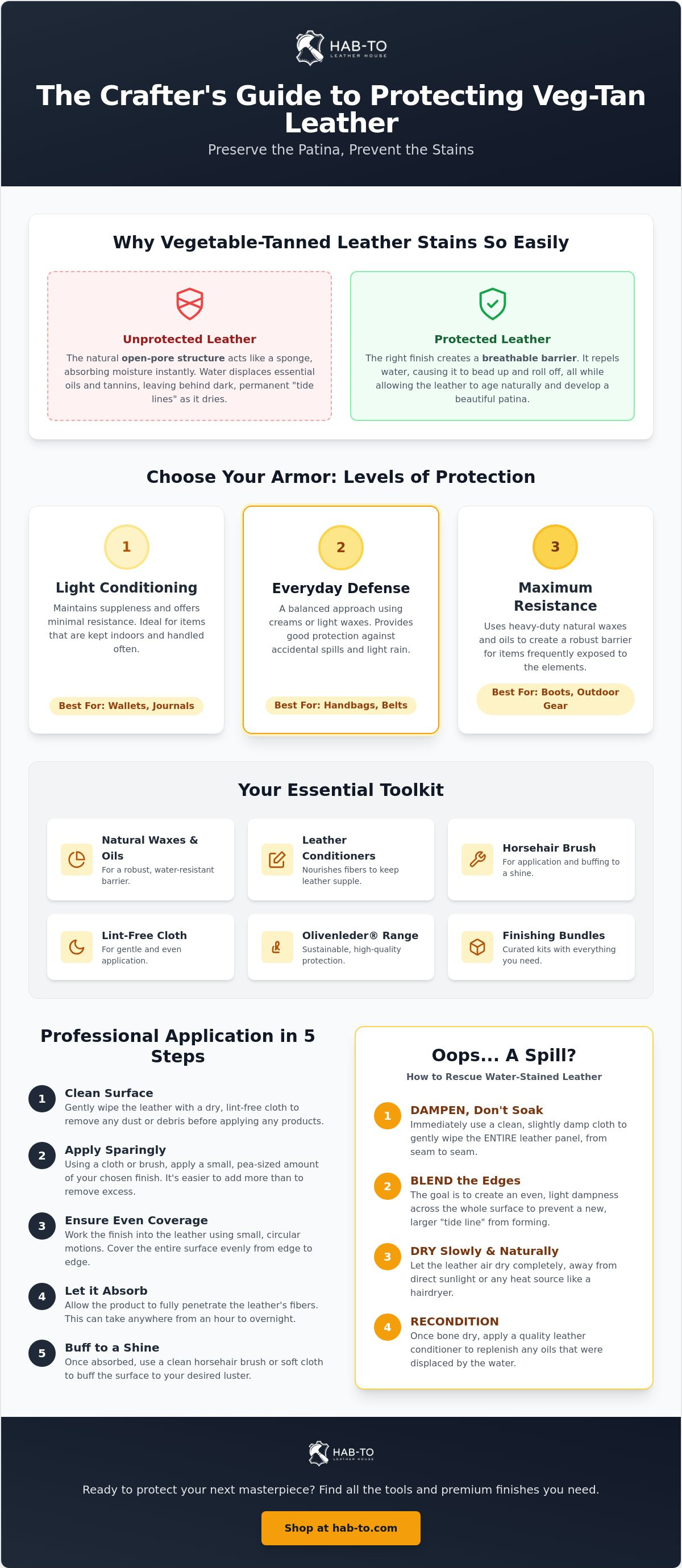
To understand how to protect veg tan leather from water stains, you first need to appreciate the organic nature of the material itself. Unlike mass-produced chrome-tanned leathers that are often sealed with a synthetic finish, Vegetable Tanned Leather remains largely "naked." The traditional vegetable tanning process uses natural extracts from tree bark, leaves, and fruits to stabilize the hide. This leaves the leather with an open-pore structure. It is breathable and beautiful, but it also means the fibers are incredibly thirsty. When moisture hits the surface, those open pores act like a sponge, pulling the liquid deep into the grain almost instantly.
To better understand this concept and see how water interacts with the surface, watch this helpful video:
The real trouble starts when water meets the tannins inside. These tannins are water-soluble. When a drop of water penetrates the hide, it dissolves some of the tannins and oils. As the leather dries, the water evaporates and carries these dissolved substances to the outer edge of the wet area. This migration creates the dark, permanent "tide marks" that many crafters fear. There is a significant difference between surface dampness, which can often be blended out, and deep-fiber saturation. If water reaches the core of the leather, it can displace the natural fats that keep the hide supple. This is why learning how to protect veg tan leather from water stains is essential for anyone working with premium materials like Shell Cordovan or Pueblo leather.
The Science of Tannins and Moisture
Tannins are not just for color; they are the glue that holds the leather fibers together. Because they are water-soluble, they are constantly in motion when wet. If you try to speed up the drying process using a heat source, you risk making the fibers brittle. The water leaves too quickly, causing the collagen structure to shrink and crack. Maintaining a proper pH balance is also vital. Most vegetable-tanned hides are slightly acidic. Water, especially tap water with high mineral content, can shift this balance and cause the leather to stiffen or discolor over time.
Patina vs. Damage: Finding the Balance
Artisans often walk a fine line between protection and preservation. A patina is the soul of a piece. This process creates the natural darkening that occurs from sunlight and the oils of your hands. If you use a heavy, silicone-based sealant, you might achieve total waterproofing, but you will kill the leather's ability to age. The goal is to provide enough resistance to stop a stain without sealing the pores entirely. By using high-quality treatments like those found in our Olivenleder collection, you can safeguard the hide while still allowing it to develop its unique character. True craftsmanship is about letting the leather live while protecting it from the elements.
Choosing the Right Protective Finish: Oils, Waxes, and Conditioners
Selecting the right finish is an act of balance. You want to shield the grain without suffocating it. The market is flooded with synthetic sprays, but I’ve found that silicone-based products are often the enemy of quality leather. They create a plastic-like film that prevents the hide from breathing. Over time, this leads to the very brittleness we’re trying to avoid. A study on leather degradation highlights how important it is to keep the internal fiber structure healthy. Natural barriers like beeswax or high-quality fats do this best. They sit near the surface, encouraging water to bead off while allowing the leather to age naturally.
There is a clear hierarchy of protection you should follow. Light conditioners are perfect for maintaining suppleness on items that stay indoors. Leather creams and "foods" provide a mid-level defense. For heavy-duty use, waxes are the gold standard. Beeswax is a particular favorite in my workshop. It’s a natural, breathable water barrier that doesn't compromise the integrity of the hide. It provides the grip and weather resistance needed for daily-carry items without the chemical smell of industrial sealants.
Olivenleder: The Sustainable Choice
Our Olivenleder collection is our answer to chemical-heavy alternatives. Using olive-oil based soaps and foods aligns perfectly with a chrome-free philosophy. These products nourish the leather fibers deeply. Many hobbyists suggest mink oil or neatsfoot oil, but these can often darken a hide by several shades or even go rancid in warm climates. Olive-based care is stable. It’s clean. To get a streak-free finish, apply it in thin, circular motions. It’s about building layers of protection rather than drenching the piece in one go.
Conditioning with Maryam Vaccheta Standards
Premium hides like Maryam Vaccheta leather have specific needs. This leather is already rich in fats, but those fats can migrate or dry out over time. By using a dedicated leather food, you pre-saturate the fibers. This is a key tactic in how to protect veg tan leather from water stains. When the fibers are already "full" of nourishing oils, they simply cannot absorb external moisture as easily. It’s the difference between being water-resistant and waterproof. We don't want a piece that’s waterproof like a rubber boot. We want a piece that survives a splash but still feels like genuine leather.
If you’re unsure which finish suits your specific hide, I recommend looking at our stitching and care bundles to find a combination that works for you. Testing on a small offcut is the best way to gain confidence before treating your final project.
Selecting Protection Based on Leather Type
One of the most common mistakes I see is treating every hide with the same heavy-handed approach. A one-size-fits-all method simply doesn't work because the surface texture dictates how a finish is absorbed. Learning how to protect veg tan leather from water stains requires you to look closely at the grain. Smooth, glazed leathers have tighter fibers that resist liquid for a few seconds. Sueded or "naked" crust leathers, however, have no defense. They will drink up a water drop before you can even reach for a cloth. Thickness also plays a role. A thin 1.4mm hide will reach deep-fiber saturation much faster than a heavy 4mm belt strap.
I always tell my students that the wholesaler's golden rule is to test on a scrap piece first. Every batch of leather can react slightly differently to oils and waxes. By using an offcut from the same hide, you can see exactly how much the color will shift and whether the protection is adequate. It's better to ruin a three-centimeter scrap than a completed handbag. This step gives you the confidence to apply your finish without the anxiety of darkening a beautiful, expensive hide beyond recognition.
Protecting the Unique Texture of Badalassi Pueblo
The iconic scuffed finish of Badalassi Pueblo leather presents a specific challenge. If you apply a heavy wax or a thick cream, you risk "flattening" that rustic, nap-like texture. The scuffs will smooth over, and the leather will lose its unique hand-feel. For Pueblo, I recommend a very light-mist protection or a thin layer of a high-quality conditioner. You want to coat the fibers without clogging the valleys of the texture. This keeps the character of the hide intact while providing just enough surface tension to make water bead off instead of soaking in.
Safeguarding the King: Maryam Shell Cordovan
Many artisans consider Shell Cordovan the pinnacle of materials. It's naturally more water-resistant than standard cowhide because of its incredible density. The fibers are packed so tightly that water has a hard time finding a way in. However, Cordovan is prone to "welling." This is when small bumps appear on the surface after it gets wet. Don't panic if this happens. Once the leather is completely dry, you can usually restore the mirror shine using a specialized polishing technique with a bone folder or a smooth cloth. It's about patience and understanding that how to protect veg tan leather from water stains on Cordovan is more about maintenance than heavy coating.
Step-by-Step: How to Waterproof Your Leather Projects
I’ve spent decades at the workbench, and I can tell you that preparation is 90% of the result. Before you even think about applying a finish to your Vegetable Tanned Leather, you have to look at the surface. Dust, oils from your skin, or tiny metal shavings from your Leatherworking Tools can get trapped under the wax. This creates permanent blemishes or dark spots that you can't undo. Ensure any squeeze-out from your leather glue is cleaned up, as finishes won't penetrate through adhesive residue.
What you will need
- Horsehair brush for surface prep (Leatherworking Tools)
- Clean, lint-free application cloths
- Natural protective finish (Olivenleder Care Supplies)
- Edge finishing agent (Tokonole)
- Edge beveler for smooth transitions (Edge Bevelers)
- Curated finishing kit (Stitching & Care Bundles)
When you are ready to apply the product, use your lint-free cloth or a dedicated applicator brush. Understanding how to protect veg tan leather from water stains is as much about the physical application as it is the product choice. Once the wax or conditioner is on the leather, don't just leave it. Buffing is the secret step. The friction heat generated by vigorous buffing slightly thins the waxes. This allows them to flow deeper into the open pores rather than sitting on top. Finally, let the piece cure. Give it at least 24 hours in a room-temperature environment to allow the protective barrier to fully set.
The "Less is More" Application Technique
Start with a pea-sized amount of product. It’s tempting to drench the leather to "be sure," but over-saturation ruins the temper and can make the hide feel mushy. Work in small, circular motions to follow the natural grain of the hide. You’ll know the leather has "taken enough" when the product no longer disappears instantly into the fibers. If the surface remains greasy or tacky after five minutes of resting, you’ve used too much. Simply buff away the excess with a fresh cloth. Remember that two thin layers are always better than one thick one.
Edge Protection: The Often Forgotten Step
Edges are the "end grain" of your leather project. They are incredibly thirsty and often where water first enters to cause damage. While you protect the face of the hide, don't forget to seal the sides. Using Tokonole or a firm beeswax rub creates a burnished barrier that moisture cannot easily penetrate. For a deeper dive into the technical side of this, check out our guide to vegetable tanned leather for more on professional edge finishing. Sealing these entry points is a vital part of how to protect veg tan leather from water stains for the long term.
Ready to safeguard your next masterpiece? Explore our curated leathercraft care and starter bundles to find everything you need for a professional finish.
Long-Term Care and the Beauty of the Patina
Maintenance isn't a chore. It's a relationship with the material. To keep up with how to protect veg tan leather from water stains, you must observe the hide. If the leather feels dry or looks "thirsty," it’s time for a light re-application of Olivenleder leather food. For daily-use items like wallets, I suggest a check-up every three months. For larger bags used seasonally, once a year is usually enough. The frequency depends on your climate and how often the piece faces the elements.
If you get caught in a sudden downpour, follow the "wet-to-dry" protocol. Never use a hairdryer or radiator. Heat is the enemy of natural fibers. Wipe away excess droplets with a soft cloth and let the piece dry naturally at room temperature. At Hab-To Leather House, we celebrate the marks of time. Our 160-year family history has taught us one thing: good leather doesn't just last. It matures. Every scratch and subtle shift in tone tells a story of where you’ve been.
What to Do if Water Stains Already Occurred
If a spot appears, your first instinct might be to scrub the area. Don't. You’ll likely damage the grain. Instead, use the "even-out" method. Take a clean, damp cloth and lightly moisten the entire panel from edge to edge. By wetting the whole surface, you allow the leather to dry into a uniform shade, effectively hiding the original spot. If the water has caused the fibers to swell and feel rough, use a smooth bone folder from our Leatherworking Tools collection to gently compress them back into place. For deep saturation or structural damage, it’s always best to seek professional advice before attempting a heavy DIY fix.
Your Craft, Our Heritage
Mike’s personal advice is simple: don't let the fear of a stain stop you from using your gear. The soul of a project is found in its use. Choosing premium hides from world-class tanneries like Virgilio or Maryam makes how to protect veg tan leather from water stains much easier because the base quality is so high. These tanners use traditional recipes that produce a dense, resilient grain. If you’re ever in the area, I invite you to visit our Amsterdam showroom for a tactile consultation. We can look at your projects together and find the perfect care routine that honors your hard work and our shared heritage.
Master Your Craft with Confidence
Crafting with vegetable tanned hides is a journey in patience and respect for the material. By now, you understand that mastering how to protect veg tan leather from water stains isn't about hiding the hide behind synthetic layers. It's about using natural waxes and specialized conditioners to build a breathable defense. Whether you're working with the rugged texture of Pueblo or the dense elegance of Shell Cordovan, your preparation and attention to edge sealing will define the longevity of your work. True protection honors the material while allowing its story to be told through a developing patina.
At Hab-To Leather House, we bring over 160 years of family expertise to every recommendation we make. From our base in Amsterdam, we offer worldwide shipping to artisans everywhere. We believe in supporting your growth without barriers. That's why we have no minimum order quantities. You can get exactly what you need for your next project, whether it's a single hide or a specialized care kit. We're here to ensure you have the best materials to match your dedication. Your craftsmanship is a legacy in the making, and we are honored to be part of it.
Shop Premium Veg-Tan Leathers & Care Supplies and give your projects the protection they deserve. Don't fear the elements; embrace the life of the leather and keep creating.
Artisan Care Essentials
Safeguard your projects with the same professional-grade supplies we use in our Amsterdam workshop. From sustainable conditioners to complete finishing kits, these products are curated for the serious leatherworker.
- Olivenleder® Care Collection – Sustainable, olive-oil based nourishment.
- Leathercraft Master Bundle – The ultimate kit for assembly and finishing.
- Tokonole Burnishing Bundles – Essential for moisture-resistant edge protection.
Frequently Asked Questions
Will protecting my veg-tan leather make it darker?
Yes, almost any protective finish will darken the hide to some degree. This happens because the oils and waxes penetrate the fibers and change how light reflects off the surface. If you want to minimize darkening, choose a light cream rather than a heavy oil. Always test on a scrap piece first to see the final tone before committing to your entire project. This ensures the result meets your expectations.
Can I use a hair dryer to dry wet leather faster?
No, you should never use a hair dryer or any external heat source to dry wet leather. Forced heat causes the natural collagen fibers to shrink and become brittle, which leads to permanent cracking. The best approach is to wipe away excess water and let the item dry naturally at room temperature in a well ventilated area. Patience is the only way to preserve the leather's temper and health.
Is beeswax better than synthetic waterproofing sprays?
Beeswax is superior because it provides a breathable barrier that doesn't suffocate the leather's grain. Synthetic sprays often contain silicones that create a plastic-like seal, preventing the hide from aging or taking in future conditioning. Beeswax allows for a natural patina while offering excellent water resistance. It's a key part of learning how to protect veg tan leather from water stains without ruining the material's organic character or unique feel.
How do I remove a water spot that has already dried?
You can often hide a dried water spot by using the "even-out" method. Lightly dampen a clean cloth and wipe the entire panel of the leather from edge to edge so the moisture is uniform. As the leather dries together, the original spot should blend into the rest of the surface. For raised fibers, a smooth bone folder can be used to gently compress the grain back to its original state without damaging it.
Does Shell Cordovan need different water protection than Cowhide?
Yes, Shell Cordovan is much denser and more naturally water-resistant than standard cowhide. It doesn't require heavy waxes or oils, which can actually dull its unique mirror-like luster. Most Cordovan care involves simple buffing and specialized creams designed for its tight fiber structure. If it gets wet and "wells" or bumps up, a specialized polishing session after it dries will usually restore the flat, glossy surface you expect from premium Italian leather.
How often should I re-apply a water-resistant finish?
You should re-apply protection based on usage rather than a strict calendar. For items like wallets that are handled daily, a light touch-up every three to four months is ideal. For bags or belts used less frequently, a seasonal application once or twice a year is sufficient. Knowing how to protect veg tan leather from water stains effectively means watching for signs of dryness or a loss of water beading on the surface.
Can I use olive oil from my kitchen to protect my leather?
No, you should avoid using standard kitchen olive oil on your leather projects. While we advocate for olive-oil based care like our Olivenleder range, those products are specifically refined and pH-balanced for tanning and leathercraft. Culinary oils can contain impurities that may turn rancid over time, causing unpleasant odors or attracting bacteria that can degrade the fibers. Always use professional-grade, leather-specific supplies to ensure the long-term durability of your handcrafted items.
What is the best way to store veg-tan leather to prevent moisture damage?
Store your leather in a cool, dry place away from direct sunlight and humidity. Never keep leather in plastic bags, as these trap moisture and can lead to mold or mildew growth. Instead, use breathable cotton dust bags or wrap the hides in acid-free paper. Maintaining a stable environment prevents the leather from drying out or absorbing excess ambient moisture, keeping the grain pristine until you're ready to start your next project.
Disclaimer
All our blog articles are made for information purposes only we dont take responsability for any content from third parties.