Starting a Handmade Leather Business: The Artisan’s Roadmap for 2026
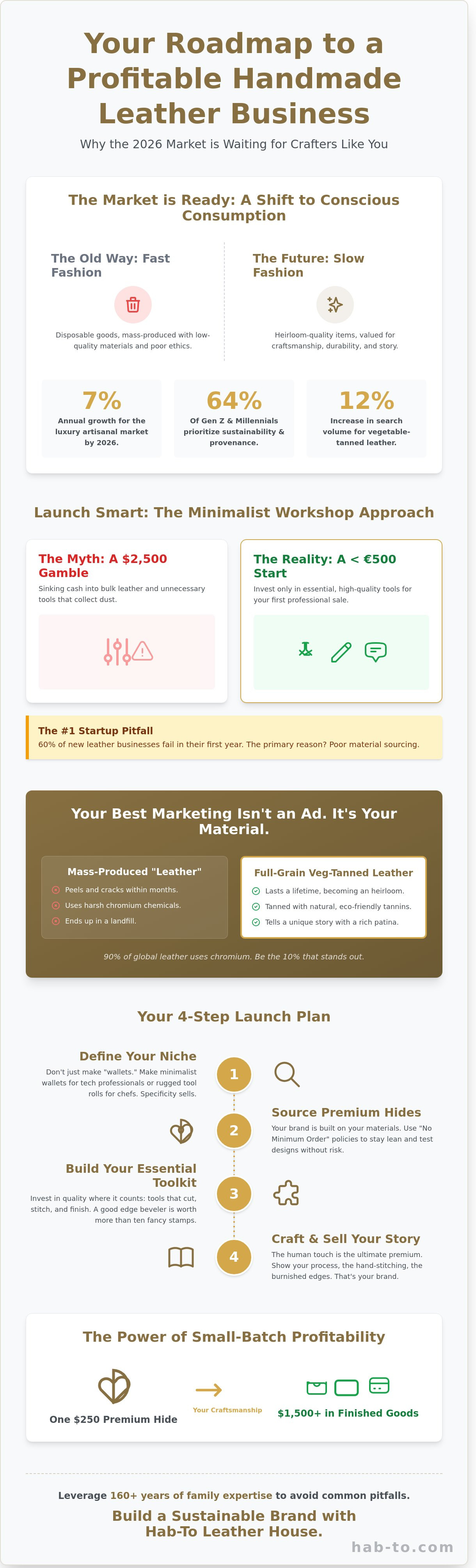
By 2026, the luxury artisanal market is set to grow by 7% annually, as consumers ditch fast fashion for items that actually last a lifetime. Hi, I'm Mike! I know that starting a handmade leather business feels daunting when you're worried about sinking $2,500 into the wrong equipment or struggling to compete with factory prices. It's a common anxiety; you have the passion for the craft, but you don't want to waste money on bulk leather or tools that will just collect dust in your workshop.
I'm here to show you that you can build a profitable brand by focusing on high-quality vegetable-tanned materials and lean operations. This roadmap provides a clear step-by-step launch plan to turn your hobby into a sustainable career. We'll cover everything from selecting premium hides without minimum order requirements to a pricing strategy that ensures you're finally paid what your craftsmanship is worth.
Key Takeaways
- Understand why the 2026 shift toward "slow fashion" creates the perfect environment for your artisanal brand to thrive against mass-produced alternatives.
- Master the "Minimalist Workshop" approach by identifying the essential tools you need to make your first professional sale without overspending on unnecessary equipment.
- Learn why starting a handmade leather business with premium, vegetable-tanned materials is your most effective marketing strategy for building lasting brand authority.
- Follow a proven 4-step roadmap to define your specific niche and stress-test your designs to ensure they meet the highest standards of durability.
- Discover how leveraging 160+ years of family expertise can help you avoid common startup pitfalls and build a sustainable brand with no compromises.
Is Starting a Handmade Leather Business Feasible in 2026?
Hi, I'm Mike. If you're looking at the landscape for 2026, you'll see a massive shift in how people buy. The era of "disposable everything" is hitting a wall. By 2026, the global ethical fashion market is projected to surpass $10 billion, growing at a steady 8% annually. This isn't just a trend; it's a correction. People are tired of plastic-coated "genuine leather" that peels after six months. This makes starting a handmade leather business one of the most viable paths for a modern maker who values quality over quantity.
A handmade leather business in 2026 is a brand built on the promise of durability. You aren't competing with mass-market factories in Southeast Asia. You're competing for the soul of the consumer's wardrobe. The economic reality is clear. While inflation has raised the cost of premium hides, the "No Compromises" philosophy allows you to command margins that fast-fashion brands can't touch. When you use full-grain, vegetable-tanned hides, you're selling an heirloom. That's your competitive advantage. You offer the grit and character that a machine simply cannot replicate.
The Rise of the Conscious Consumer
In 2026, transparency is the new luxury. Data shows that 64% of Gen Z and Millennial shoppers prioritize sustainability and "provenance" when making a purchase. They want to know where the cow lived and who tanned the hide. Vegetable-tanned leather is seeing a 12% increase in search volume because it avoids the harsh chromium chemicals used in 90% of global leather production. Labels like "Made in Europe" or "Hand-stitched in Amsterdam" carry more weight than ever before. Customers are finally shifting from "buying often" to "buying once." They'd rather spend $200 on a wallet that lasts twenty years than $30 on a synthetic version every season. This shift directly benefits the small-scale crafter who refuses to cut corners.
The Profitability of Small Batches
You don't need a 500-square-meter factory to be profitable. The "one-person workshop" model is more efficient than ever thanks to direct-to-consumer platforms. Mastering traditional leather crafting techniques allows you to turn a single $250 hide into $1,500 worth of finished goods. The key is in the math of your time versus the material. If you spend ten hours hand-stitching a briefcase, your storytelling must justify that labor.
- Focus on Niche: Don't just make "bags." Make specialized tool rolls for chefs or luxury cases for mechanical keyboards.
- Calculate Value: A premium Buttero hide might cost $15 per square foot, but the perceived value of a hand-burnished edge is priceless.
- Tell the Story: Use your process to build trust. Show the scars on the leather. Show the saddle stitch.
When starting a handmade leather business, your biggest asset is your voice. In a world flooded with AI-generated designs and mass-produced junk, the human touch is the ultimate premium. We've seen this in our 160 years of family experience; quality materials always find their market. If you stay committed to real craftsmanship, the 2026 market isn't just feasible. It's waiting for you.
The Lean Startup: Essential Tools and Sourcing for Beginners
Starting a handmade leather business doesn't require a 50-square-meter studio or a 10,000 euro hydraulic press. Most successful makers I know started on a kitchen table with less than 500 euro in equipment. Your goal is the Minimalist Workshop. This means buying only what's required to produce one professional-grade item. You don't need every size of hole punch; you need the one that fits your first belt design.
Sourcing is the primary reason 60% of new leather businesses fail within their first year. You can't build a premium brand on mystery leather from massive online marketplaces. High-quality hides like Pueblo or Buttero define your work. Before buying your first hide, consult an official business plan guide to ensure your tool investments align with your projected sales and brand positioning.
At Hab-To Leather House, we removed the biggest barrier for new artisans. Our No Minimum Order policy means you can buy a single shoulder of premium Italian veg-tan. You don't need to stock 2,000 euro of inventory just to test a single wallet design. This flexibility allows you to pivot your style without being buried under unsold leather. It's about testing the market with 160 years of family experience backing your material choices.
Balancing tool quality is a delicate game. Spend money on things that touch the leather. A 5 euro utility knife works for years, but a 15 euro edge beveler will leave your edges looking ragged. Invest in forever tools for your stitching and edging. These are the details customers touch and see. If you need help choosing your first set, you can always browse our hand-selected tools to see what we use in our own workshop.
Sourcing Quality Materials Without the Bulk
Low-grade leather often contains heavy metals or synthetic finishes that peel over time. This ruins your brand reputation before you've even made ten sales. Starting with premium vegetable-tanned leather like Pueblo or Buttero sets you apart instantly. These materials develop a patina that customers crave. When you talk to a wholesaler, ask for specific tannery names like Badalassi Carlo or Walpier. It shows you know your craft.
The Essential Tool Kit for Professional Results
Focus on the Big Three: Cutting, Stitching, and Edging tools. Professional hand-stitching, or saddle stitching, is a massive marketing feature for anyone starting a handmade leather business. It's physically stronger than a machine lockstitch and signifies true luxury. For hardware, always choose solid brass over plated alternatives. Zinc plating chips within 6 months of use, while solid brass lasts a lifetime. Quality hardware is a small price increase that prevents 90% of future customer complaints.
Avoiding the "Cheap Material" Trap: Why Quality is Your Best Marketing
Hi, I'm Mike. I've seen countless makers fall into the same hole when starting a handmade leather business. They think they should spend their first six months practicing on "scrap" or low-grade "craft" shoulders. This is a mistake that kills your progress before you even sell your first cardholder. Cheap leather is often heavily corrected with plastic-like finishes to hide scars. It feels like vinyl. It smells like chemicals. Most importantly, it doesn't age; it just degrades.
If you practice on bad leather, you learn bad habits. High-quality hides like Shell Cordovan or Buttero have a specific resistance and temper. Your hands need to learn how premium fibers respond to a knife or a burnishing tool. While you're following the SBA's 10-step guide to handle your legal registration and tax ID, don't forget that your material choice is your most important business decision. Premium leather does the "selling" for you. When a piece of Shell Cordovan takes six months to tan in a pit, that story becomes part of your product's value proposition.
The Psychology of Premium Leather
The "smell and feel" test is your most powerful sales tool. When a customer picks up a wallet made from genuine vegetable-tanned leather, the sensory input is immediate. It's heavy, it's warm, and it has that unmistakable earthy aroma. This creates an instant perception of luxury that chrome-tanned, mass-produced items can't match. For the luxury handmade market, vegetable-tanned leather isn't just an option; it's the gold standard. It signals to the buyer that you aren't just another hobbyist, but a serious artisan. For a deeper dive into these materials, check out our Vegetable Tanned Leather: A Complete Guide.
The "Patina Factor" is your long-term marketing strategy. A wallet made from high-quality Pueblo or Dollaro leather will look better in 2027 than it does the day it leaves your workshop. This creates a "walking billboard" effect. When your customer's friends see a three-year-old bag that has developed a deep, rich luster and character, they ask where it came from. That organic word-of-mouth is worth more than any paid Instagram ad.
Building Sustainability into Your Brand Story
Modern buyers are increasingly skeptical of industrial production. Roughly 80% of global leather is chrome-tanned using heavy metals that can be harmful to the environment if not managed correctly. By choosing vegetable-tanned, chrome-free hides, you position your business as the ethical alternative. Use "No Synthetics" as a core pillar of your brand. It's a simple, powerful promise: no plastic fillers, no toxic chemicals, just nature and craft.
- Educate your audience: Explain that your leather is a byproduct of the food industry that would otherwise go to waste.
- Highlight the process: Share that veg-tan leather uses natural tannins from tree bark and Quebracho.
- Emphasize longevity: A sustainable product is one that doesn't need to be replaced every twelve months.
When you're starting a handmade leather business, remember our motto: No synthetics. No compromises. Just quality materials for real craftsmanship. By investing in premium hides from day one, you aren't just making products; you're building a reputation that lasts as long as the leather itself.
The 4-Step Roadmap to Your First Leather Sale
Moving from a hobby to a brand requires a shift in mindset. You're no longer just making gifts; you're building a legacy. My family has been in this industry for over 160 years, and the most successful makers I've seen all follow a specific path to their first sale. When you're starting a handmade leather business, the goal is to build a foundation that won't crumble under the weight of its first ten orders.
Focus on one thing before you try to do everything. Beginners often try to launch with a 12-piece collection including bags, belts, and journals. This is a mistake. It splits your focus and drains your capital. By mastering one specific item, you ensure your quality stays high and your production time stays low. I always tell makers: be the expert in one niche first.
Finding Your Signature Product
Most makers find success by filling a specific gap. Look at minimalist wallets or tech accessories for a 15% faster turnaround on your investment. A single, perfectly executed cardholder is worth more than five mediocre bags. Use our Hab-To crafting bundles to test different leathers like Pueblo or Buttero without buying full hides. This allows you to experiment with three or four product lines for under $100 before committing to a bulk order.
Never sell a prototype. Every design must undergo a 30-day stress test. Carry the wallet in your back pocket. Soak it in the rain. Drop it. If the stitching pops or the burnish fades after 14 days, your customers will find out. You want your first customer to become a lifelong advocate, not someone who asks for a refund after three weeks of use.
Math is your best friend in business. The old "Time + Materials x 2" formula is a dangerous myth that leads to bankruptcy. It ignores the $500 you spent on a clicker press or the $20 you pay for monthly website hosting. To build a real business, you need a 3.5x multiplier on your raw material costs to cover overhead and future growth.
Pricing for Longevity
Your price must account for hidden costs like 15% for shipping materials and tool wear. Price for the business you want to become. If you want to eventually hire an assistant, your current prices must support that future wage. Use premium solid brass hardware to increase your "perceived value." A $5 upgrade in hardware can often justify a $25 increase in the final retail price because it signals professional quality to the buyer.
Pick your platform wisely for your digital showroom. Etsy is great for discovery because 90 million active buyers are already searching there. However, Shopify gives you 100% control over your brand story and customer data. Instagram serves as your living portfolio. Post a video of your saddle stitching process at 2:00 PM on a Tuesday to see which designs get the most "saves." This data tells you exactly what to stock for your official launch.
Ready to build your inventory with materials that last a lifetime? Browse our premium vegetable-tanned leather selection to find the perfect hide for your signature product.
Growing Your Brand with Hab-To Leather House
Success in this industry requires more than just a sharp knife and a steady hand. It demands a reliable foundation. When you’re starting a handmade leather business, your choice of supplier determines your profit margins and your reputation. Hab-To Leather House doesn't just sell hides; we act as a strategic partner. We’ve built our foundation on 160 years of family heritage in the leather trade, dating back to the mid-19th century. This isn't just a business for us; it’s a legacy of craftsmanship that we share with you.
The "Hi, I’m Mike!" approach is the heart of what we do. You aren't dealing with a faceless corporation or an automated ticketing system. You get direct access to expertise. Whether you’re struggling to choose between a 1.2mm or a 2.0mm thickness for a tote bag, or you’re unsure if Buttero or Pueblo leather fits your brand aesthetic, I’m here to help. This personal connection helps you transition from a weekend hobbyist to a professional maker with a curated inventory that reflects true quality. No synthetics. No compromises. Just quality materials for real craftsmanship.
Expert Mentorship and Consultations
Mistakes in leather selection are expensive. A single mismatched hide can cost you 150 to 300 euros in wasted material and shipping. That’s why we offer 15-minute consultations. These brief sessions allow us to look at your specific project requirements and steer you away from common pitfalls. We also provide free ongoing education through "The Leather Hour" podcast. With dozens of episodes covering everything from tannery visits to business scaling, it’s a masterclass in your pocket. If you’re near Amsterdam, you can even book a showroom appointment. Feeling the temper and seeing the grain of our vegetable-tanned hides in person eliminates guesswork entirely.
Scale Your Business at Your Own Pace
Growth isn't always linear. You might sell three wallets one month and fifty the next. Our "No Minimum Order" policy is designed for this reality. You don't need to sink 5,000 euros into stock just to get started. You can buy exactly what you need, when you need it. As your brand matures, we help you elevate your products with premium details. This includes high-end YKK Excella zippers and custom hardware that sets your work apart from mass-produced goods. Starting a handmade leather business is a marathon, and we provide the high-performance gear you need for every mile.
We believe in materials that tell a story. Our hand-selected leathers are sourced from the finest tanneries to ensure your work stands the test of time. When your customers touch your products, they should feel the quality immediately. That’s the Hab-To standard. We are here to support your journey from the first stitch to your hundredth sale.
Your Legacy Starts with the First Cut
The roadmap for 2026 is clear. You don't need a massive factory to succeed; you just need the right materials and a lean strategy. Success in starting a handmade leather business hinges on your refusal to settle for cheap, synthetic alternatives. Quality is your loudest marketing tool. When you choose premium hides, you're not just making a product. You're building a brand that lasts for generations.
At Hab-To Leather House, we bring 160+ years of family experience to your workbench. We believe every artisan deserves access to the world's finest materials without the burden of bulk buying. That's why we have no minimum order requirements. Whether you need sustainable vegetable-tanned leather or world-class Shell Cordovan, we've got you covered. We don't do compromises. We provide the foundation for your craft so you can focus on the art.
Start your journey with premium materials. Shop Hab-To Leather House
Your workbench is waiting. Let's build something incredible together.
Frequently Asked Questions
How much does it cost to start a handmade leather business?
You can launch your brand with an initial investment between $500 and $1,500. Budget approximately $250 for essential hand tools like a Japanese skiving knife, wing dividers, and diamond chisels. Allocate $400 for three high-quality vegetable-tanned hides and $300 for a basic e-commerce website. This lean approach ensures you focus on quality materials from the start. No synthetics. No compromises.
Do I need a sewing machine to start selling leather goods?
No, you don't need a machine because traditional saddle stitching is more durable and highly sought after by collectors. Hand-stitching requires only two needles and waxed polycord, which costs less than $30 total. High-end brands like Hermès use this technique because a hand-stitched seam won't unravel if a single thread breaks. It's a mark of true craftsmanship that justifies a premium price point.
What is the best type of leather for a beginner to sell?
Vegetable-tanned shoulder leather with a thickness of 1.2mm to 1.6mm is the ideal choice for new makers. Leathers like Pueblo from Badalassi Carlo or Buttero from Conceria Walpier are forgiving to cut and burnish beautifully with just a wooden slicker. These premium hides allow you to achieve professional edges without using messy paints. They provide the "wow" factor your first customers expect.
Is the handmade leather market too saturated?
The market isn't saturated for quality goods, as the global leather goods sector is projected to reach $405 billion by 2030. Success in starting a handmade leather business depends on finding a specific niche like everyday carry (EDC) gear or bespoke watch straps. While thousands of hobbyists sell basic wallets, very few offer the 160 years of tradition and passion we pour into every selection.
How do I price my handmade leather products?
Use a transparent formula: (Materials + Labor) x 2 for wholesale, or x 3.5 for retail sales. If a cardholder takes 2 hours to make at a $30 hourly rate and uses $10 in leather, your retail price should be $245. Don't forget to include 3% for payment processing fees and $5 for shipping supplies. Professional pricing ensures your business remains sustainable and respects your time as an artisan.
Where can I buy leather without a business license or huge minimum orders?
You can buy premium hides directly from Hab-To Leather House in Amsterdam, where we have no minimum order requirements. Most industrial tanneries demand a 500-square-foot minimum, but we provide individual hides to support growing makers. This gives you access to world-class tanneries without needing a VAT number or massive upfront capital. Need my advice on which hide to pick? Just ask.
How do I legally set up my leather business?
Register your business as a Sole Proprietorship or LLC, which typically costs between $50 and $500 depending on your local jurisdiction. You'll need a tax identification number and a basic sales permit to operate legally. When starting a handmade leather business, open a dedicated bank account immediately to track every Euro or Dollar spent. Proper documentation from day one builds a foundation for a serious, long-term brand.
What are the most profitable leather items to make and sell?
Small leather goods like minimalist wallets and key organizers offer profit margins exceeding 75%. A single 15-square-foot hide of premium Buttero leather can produce roughly 40 slim wallets. If each wallet sells for $85, that hide generates $3,400 in total revenue from a $210 material investment. Focus on items that take less than 90 minutes to complete to maximize your effective hourly rate.