The Professional's Guide to Leather Glue from Ecostick Intercom
Why should your pursuit of a perfect bond come at the cost of your health or the comfort of your workshop? For too long, the leathercraft community has accepted toxic fumes and stiff, brittle seams as the price of doing business. You know the frustration of a contact cement that dries too fast or an adhesive that simply slides off greasy leathers. It's time to stop making those concessions. I've spent decades sourcing materials that respect both the artisan and the craft, and that's where leather glue from Ecostick Intercom changes everything.
We agree that a bond should be permanent, flexible, and completely odorless. No more fumes. No more failed bonds. Just pure craftsmanship. In this guide, I'll show you how to master these professional water-based adhesives to create work that lasts a lifetime. You'll discover the specific technical differences between the 1804 and 1816B formulas, learn how to handle oily hides with a grease content up to 15%, and find out how to keep your leather supple at the bond site. Let's dive into the art of clean, high-strength bonding.
Key Takeaways
- Learn why transitioning to water-based adhesives protects your health without compromising the structural integrity of your leather projects.
- Understand the technical differences between 1804 and 1816B to ensure a permanent bond on both dry and oily hides.
- Discover how leather glue from Ecostick Intercom effectively penetrates fibers even on leathers with up to 15% grease content.
- Master professional application techniques, focusing on surface roughening and the "less is more" approach for a flexible, non-stiff finish.
- Find out how to source these premium Italian supplies through Hab-To with no minimum order quantities, regardless of your project scale.
The Science of a Perfect Bond: Why Leather Glue Matters for Your Craft
Every artisan understands that a project's integrity rests on the strength of its hidden components. In professional leathercraft, glue is far more than a temporary tack for stitching; it is a structural necessity that dictates the longevity of the final piece. To master the craft, one must understand the science of adhesion and how different polymers interact with the protein fibers of a hide. For decades, the industry relied on solvent-based contact cements that filled workshops with toxic fumes. At Hab-To Leather House, we believe your atelier should be a space of health and creativity. This is why we have made the principled choice to stock only adhesives that respect the artisan, the material, and the environment.
The shift away from traditional solvents isn't just about safety; it is about performance. Leather glue from Ecostick Intercom has redefined what a water-based adhesive can achieve. Developed in Florence, Italy, by Intercom Srl, these products allow for a fume-free environment without sacrificing the permanent, high-strength bond professionals demand. Our philosophy at Hab-To Leather House is rooted in 160 years of family expertise. We don't make concessions on quality. If a product doesn't meet our strict standards for durability, it doesn't earn a place on our shelves. It is about providing a foundation that supports your growth as a maker.
What is Ecostick Intercom?
Ecostick Intercom is a specialized line of water-based, non-toxic adhesives engineered for the global leather industry. These formulas are fully REACH compliant, meeting the rigorous safety standards required by high-end European fashion houses. Unlike traditional cements, these adhesives are completely odorless, non-flammable, and dry clear. They offer a sophisticated alternative to the "all-purpose" glues found in hardware stores. These are technical solutions specifically designed for the unique porosity of animal hides. You can find these professional solutions in our curated Ecostick bundles.
The Impact of Glue on Leather Quality
Choosing the wrong adhesive can lead to disastrous results for premium materials like Badalassi Pueblo leather. Harsh chemicals in low-grade glues can migrate through the fibers, causing "ghosting" or dark stains on the surface. Many cheap adhesives also turn brittle over time. They create a stiff, plastic ridge that ruins the natural handle of the hide. Using leather glue from Ecostick Intercom ensures your work remains supple. It penetrates the fibers of Maryam Vacchetta without altering its temper or feel. This maintains the authentic quality of the vegetable-tanned leather you have worked so hard to source.
Inside Ecostick Intercom: Water-Based Innovation vs. Traditional Solvents
Many artisans still cling to the belief that an adhesive must smell strongly to be effective. It is a common myth that "smelly means strong," but this is a relic of the past. In my 25 years of experience, I have seen the industry shift away from the harsh, amber-colored contact cements of the last century. Modern leather glue from Ecostick Intercom matches or exceeds the peel strength of traditional solvent-based cements without the neurotoxic side effects. While traditional glues create a bond by dissolving a layer of the surface with chemicals, Ecostick uses water as a carrier to transport high-tech polymers deep into the leather fibers.
The technical mechanism is fascinating. As the water evaporates, the adhesive particles coalesce and entangle with the collagen structure of your cow hide or vegetable-tanned leather. This creates a mechanical bond that is incredibly difficult to shear. Unlike solvent glues that can sit on top of the material like a layer of plastic, this water-based innovation becomes part of the leather itself. This deep penetration allows for a much thinner application. You get a high-strength hold with significantly less bulk in your seams. This is why it is the preferred choice for artisans who demand structural integrity in their work.
Performance Metrics: Strength and Flexibility
One of the biggest complaints about cheap, hardware-store glues is that they become brittle. When the leather flexes, the glue cracks. Ecostick remains permanently flexible. This prevents the internal delamination that occurs when a bond line fails. Another advantage is the "open time." For example, 1816B allows for cold bonding for up to 20 minutes after drying, while 1804 extends that to 30 minutes. You can even reactivate the bond with heat up to 48 hours later. This flexibility in the production process allows you to apply glue to multiple components at once, streamlining your workflow. If you want to test these properties yourself, our Ecostick bundles are the perfect starting point.
VOCs and Workshop Safety
Traditional contact cements are loaded with Volatile Organic Compounds (VOCs) like toluene. Prolonged exposure to these fumes can lead to chronic health issues. For those of us working in home studios or small ateliers, ventilation is often a challenge. Choosing leather glue from Ecostick Intercom eliminates this risk entirely. It is non-toxic and odorless. Beyond health, there is a practical business benefit: these glues are non-flammable. This simplifies shipping and reduces insurance risks for your workshop. It is a cleaner, safer way to build a professional leather business. For a complete setup, consider exploring our professional crafting bundles at Hab-To Leather House to ensure every tool in your shop meets this high standard of safety and quality.
Choosing Your Adhesive: Ecostick 1804 vs. 1816B for Different Leather Types
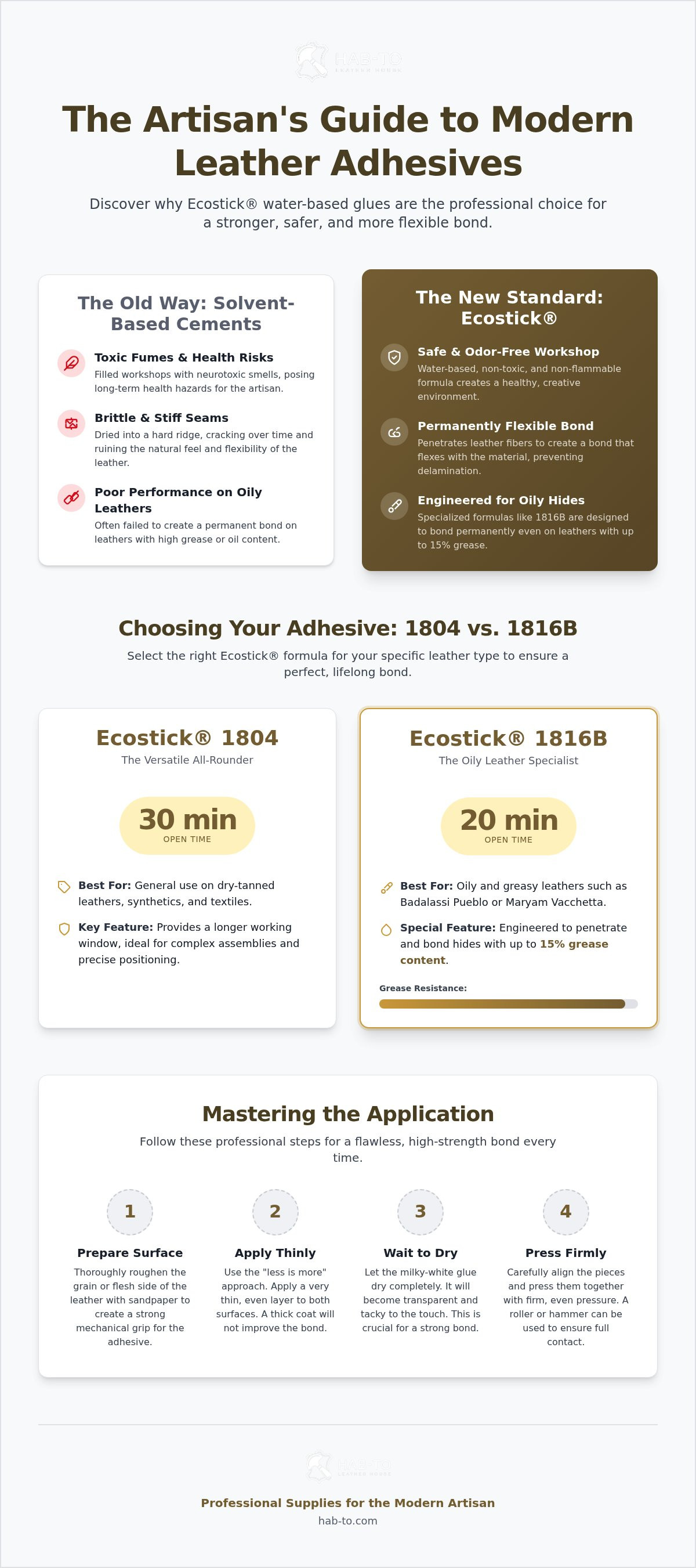
Not all hides are created equal. Some are dry and porous, while others are heavily saturated with fats, waxes, and oils. This "Grease Factor" is the primary reason most adhesives fail in a professional setting. If your glue can't penetrate those natural barriers, it will simply sit on the surface and peel away when the leather flexes. Finding the right leather glue from Ecostick Intercom means matching the chemical profile of the adhesive to the fat content of your material. It's about ensuring that the bond becomes a permanent part of the leather structure rather than a superficial layer.
When to Use Ecostick 1804
Think of Ecostick 1804 as the versatile workhorse of your atelier. It's a high-strength formula designed for permanent bonding on dry vegetable-tanned leathers and linings. It's my go-to recommendation for assembly before stitching on wallets, watch straps, and small leather goods. If you're working with a material like Badalassi Pueblo, which has a distinct, sanded texture, 1804 provides an exceptional mechanical hold. It also pairs perfectly with structural reinforcement materials like Texon. Using leather glue from Ecostick Intercom in these applications ensures a thin, flexible seam that won't add unnecessary bulk to your edges.
When to Use Ecostick 1816B
When your project involves "fatty" or heavily oiled leathers, you need a more aggressive solution. Ecostick 1816B is specifically engineered to handle materials with a grease content of up to 15%. This makes it the essential choice for pull-up leathers or rich hides like Maryam Vacchetta. While 1804 is great for assembly, 1816B is often used in stitch-free applications where the adhesive must shoulder the entire structural load. It's also remarkably capable of bonding leather to difficult synthetics. If your design incorporates PVC, EVA, or nylon reinforcements often found in professional footwear, 1816B provides the bridge between these disparate materials. It ensures a permanent bond that withstands the constant movement and stress of daily use.
Mastering the Application: A Step-by-Step Guide to Professional Gluing
Professional bonding isn't an accident. It's the result of a disciplined process. I've spent years refining this technique in my own workshop, and I can tell you that the first rule is preparation. Your surface must be ready to receive the adhesive. For vegetable-tanned hides, this means mechanical roughening. You aren't just cleaning the leather; you're creating microscopic valleys for the glue to anchor into. Start by ensuring the leather is free from dust. Then, use a roughing tool to abrade the grain. Without this, even the best leather glue from Ecostick Intercom will only have a superficial grip.
When you apply the glue, remember that less is almost always more. A thin, even coat is superior to a thick, gloopy layer. Water-based adhesives work through evaporation. If the layer is too thick, moisture gets trapped, leading to a weak, gummy bond. Watch the color carefully. It starts as a milky white liquid. You must wait until it turns completely clear before joining the pieces. This is the visual signal that the water has evaporated and the polymers are ready to link. Once clear, align your pieces and apply firm pressure. A leather roller is essential here to collapse air pockets and lock the fibers together.
What You Will Need
To achieve a master-level result, you must use the right equipment. Start with either Ecostick 1804 or 1816B. You'll also need silicone spreaders from our tools collection to ensure an even coat. Don't forget 120-grit sandpaper for roughening and a heavy roller for edge compression. Having these items ready prevents mistakes during the critical bonding window.
Mike's Pro-Tips for a Flawless Bond
If you get interrupted and the glue dries past the 30-minute window, use a heat gun to reactivate the bond. Heating to 60° Celsius wakes up the adhesive for a permanent hold. If a drop lands on your premium Italian leather, let it dry and rub it away gently. This formula of leather glue from Ecostick Intercom is remarkably forgiving compared to traditional cements.
Elevating Your Atelier: Sourcing Professional Supplies with Hab-To Leather House
Choosing where to source your materials is just as vital as the technique you use at the bench. Generic marketplaces often prioritize volume over the nuanced needs of an artisan, but professional leathercraft requires a more specialized touch. At Hab-To Leather House, we provide more than just inventory; we offer a connection to a 160 year old tradition of excellence. When you source leather glue from Ecostick Intercom through our shop, you are backed by Mike’s 25 years of personal bench experience. We don't just sell products; we verify that every adhesive and tool meets the strict standards of a high-end European atelier.
Our "No Minimum Order Quantity" (MOQ) policy reflects our commitment to the entire crafting community. Whether you are assembling a single bespoke watch strap or scaling a full production run, you have access to the same professional grade materials used by major luxury houses. If you find yourself stuck on a specific bonding challenge or a difficult material pairing, take advantage of our free video consultations. This personal guidance ensures you use your premium hides with total confidence, avoiding costly errors before you ever apply a drop of adhesive. Our focus is on building a sustainable, expert driven craft together.
Curated Bundles for Every Skill Level
We've streamlined the transition to a cleaner, fume free workshop with our specialized Ecostick Bundles. These sets are designed to take the guesswork out of tool compatibility, ensuring you have the right spreaders and roughing tools from the start. For those ready for a complete workshop evolution, the Leathercraft Master Bundle provides a comprehensive toolkit. By choosing leather glue from Ecostick Intercom as part of a curated set, you save time and ensure your assembly process is as efficient as possible.
Join the Hab-To Community
Education is at the heart of our mission. You can deepen your technical skills through our Masterclasses or watch live application demos on and Instagram. These platforms allow us to share the "why" behind the materials we stock, from the sourcing of Italian hides to the chemistry of our adhesives. Your craft is ultimately defined by the quality of the materials that hold it together. By partnering with Hab-To Leather House, you are choosing a supplier dedicated to the longevity and health of your professional practice.
Master Your Craft with Clean Professional Bonding
Transitioning to a water-based workflow isn't just a health choice; it's a commitment to superior quality. You've learned how to prep surfaces for maximum mechanical adhesion and how to choose between the 1804 workhorse and the heavy-duty 1816B for oily hides. By integrating leather glue from Ecostick Intercom into your process, you ensure that your work remains flexible and structural without the burden of toxic fumes. This shift allows you to focus entirely on the artistry of your seams and the longevity of your designs.
We believe that professional tools should be accessible to everyone. Our 160 years of family history are built into every recommendation we make. Whether you need a single bottle or a full workshop setup, we offer no minimum order quantities to support your growth. If you're facing a specific technical hurdle, remember that you can always book a direct video consultation with me for personalized advice. Your atelier deserves the best Italian innovation available.
Your dedication to the craft deserves materials that match your passion. It's time to build something that lasts. I look forward to seeing what you create with these professional solutions at your bench.
Frequently Asked Questions
Is water-based leather glue really as strong as traditional contact cement?
Yes, modern water-based adhesives match or exceed the peel strength of solvent cements. They create a powerful mechanical bond by penetrating deep into the collagen fibers rather than just sitting on the surface. This ensures structural integrity without the brittleness or toxicity associated with old-school amber glues. It's a cleaner, more effective solution for high-end craft.
How long does Ecostick glue take to dry before I can stitch?
You can join your pieces as soon as the glue turns from milky white to completely clear, which usually takes 10 to 20 minutes. Once you've joined the layers and pressed them with a roller, the bond is immediate. It's strong enough to hold your assembly perfectly in place while you use your stitching irons and needles.
Can I use Ecostick 1804 on greasy leathers like Pueblo or Cordovan?
Ecostick 1804 is best for dry vegetable-tanned leathers, so you should use Ecostick 1816B for heavily waxed or oily hides. 1816B is specifically formulated to penetrate materials with a grease content of up to 15%. This makes it the reliable choice for pull-up leathers or rich hides where standard adhesives might fail to grip the fibers.
What happens if the glue dries for more than 30 minutes before I join the pieces?
If the adhesive dries past its open time, it won't bond at room temperature, but you don't need to reapply it. You can reactivate the polymers by heating the surface to 60 or 70 degrees Celsius with a heat gun. This wakes up the adhesive, allowing for a permanent, structural bond up to 48 hours after your initial application.
Is Ecostick Intercom safe to use in a small, unventilated room?
Yes, leather glue from Ecostick Intercom is non-toxic, odorless, and completely free of harmful VOCs like toluene. It is REACH compliant and water-based, making it perfectly safe for home studios or small ateliers. You won't have to worry about the lightheadedness or respiratory risks that come with using traditional solvent-based contact cements in confined spaces.
How do I remove Ecostick glue if I make a mistake on the leather surface?
You can remove excess glue by letting it dry completely and then gently rubbing it away with your finger or a crepe rubber. Since it's water-based and dries clear, it doesn't soak in and stain like solvent glues. For stubborn spots on the grain side, a slightly damp cloth can help lift the residue without damaging the finish.
Do I need to roughen the surface of vegetable-tanned leather before gluing?
Roughening is essential for achieving a professional-grade mechanical bond on the grain side of your leather. By abrading the surface with sandpaper or a roughing tool, you create microscopic valleys for the adhesive to anchor into. It ensures the leather glue from Ecostick Intercom penetrates deeply, providing a lifetime hold that won't peel or delaminate over time.
Can Ecostick be used for bonding leather to fabric or linings?
Ecostick is incredibly versatile and bonds leather to a wide variety of materials including fabric, nylon, and synthetic linings. It's particularly effective for attaching reinforcements or assembly before stitching. The clear-drying formula ensures that no glue seeps through or discolors delicate lining materials, maintaining a clean, professional interior for your bags or wallets.
Disclaimer
All our blog articles are made for information purposes only we dont take responsability for any content from third parties.