What is a Swivel Knife? The Artisan’s Guide to Leather Carving Precision
Have you ever wondered why some leather carvings look like they're breathing, while others look forced and rigid? The difference isn't just talent; it's the hidden dance between your hand and a single, pivoting blade. If you've spent any time in a workshop, you've likely asked, what is a swivel knife and why does it feel so different from every other cutter? It's the heartbeat of traditional leathercraft. This tool is designed to turn the resistance of vegetable-tanned hide into a canvas for fluid, artistic expression.
We know the frustration of a blade that stutters across the surface or the hand fatigue that sets in after just twenty minutes of work. It's a common hurdle for every artisan. This guide is here to help you master this iconic tool by diving deep into swivel knife mechanics, blade selection, and professional carving techniques. You'll learn exactly which blade to buy for your specific style, how the swivel action actually works, and the essential casing process that ensures your leather is ready for the perfect cut. Let's turn that dragging blade into a precision instrument.
Key Takeaways
- Discover what is a swivel knife and how its unique 360-degree rotation allows you to carve fluid, organic curves that fixed blades simply cannot achieve.
- Learn the mechanics of the yoke and barrel to master downward pressure and rotation for effortless, stutter-free incisions.
- Identify the right blade geometry for your project, choosing between straight blades for sweeping lines or slanted blades for intricate detail work.
- Master the "casing" process to achieve the perfect moisture balance, ensuring your blade glides through the leather without resistance or hand fatigue.
- Understand the vital synergy between professional-grade tools and premium vegetable-tanned leather to elevate the depth and clarity of your carving.
Understanding the Swivel Knife: The Essential Tool for Leather Carving
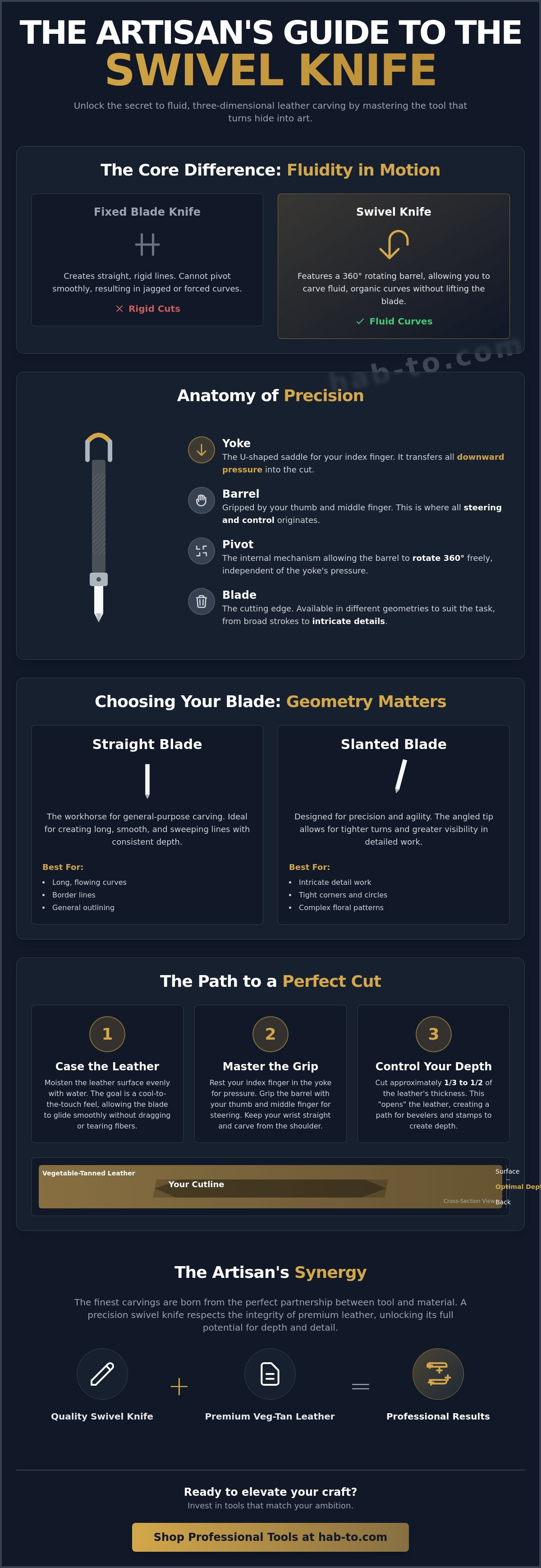
To understand the heart of traditional Western or floral leathercraft, you must first master the tool that brings the hide to life. A swivel knife is more than just a cutter. It's a precision instrument designed to pivot at your fingertip. While a standard utility knife is locked in one direction, this tool features a 360-degree rotating barrel. This allows you to follow the natural, organic curves of a design without ever lifting the blade from the surface. It's the only way to achieve the fluid, sweeping lines seen in professional saddles and wallets.
When artisans ask what is a swivel knife, they're looking for the secret to those deep, expressive lines that define high-end work. It's the foundational step in the carving process. You aren't just making a mark; you're physically "opening" the leather fibers to create a path for your stamps and bevelers. A standard craft knife fails here because it cannot pivot with the subtle pressure of your index finger. Without that swivel action, your curves will look jagged and forced. This tool bridges the gap between a simple sketch and a three-dimensional masterpiece.
To better understand this concept, watch this helpful video:
The Role of the Swivel Knife in Leather Tooling
The primary job of this knife is to create the "cut-line." This incision defines the depth and boundaries of your design. Without it, your stamps would simply crush the surface of the leather rather than displacing the fibers. A true swivel cut goes about one-third to halfway through the leather's thickness. This depth allows your beveling tools to move the leather effectively. It creates that iconic 3D effect. Don't confuse this with surface scratching. A shallow scratch won't hold a stamp. A proper cut provides the structural relief needed for the entire tooling process to succeed.
Why Quality Materials Require a Precision Edge
The interaction between a polished blade and high-tannin vegetable-tanned leather is a tactile experience. At Hab-To, we believe that premium hides like Badalassi Pueblo deserve tools that respect their integrity. Cheap starter kit knives often have "stuttering" blades that drag or catch. This can ruin a beautiful piece of leather instantly. A high-quality swivel knife, properly sharpened, glides through the grain like butter. It preserves the natural beauty of the material while giving you the control required for intricate work. Investing in a tool with a weighted barrel and a smooth swivel mechanism isn't just about luxury. It's about preventing the hand fatigue and frustration that stops many beginners before they've truly begun.
The Anatomy of Precision: Why Every Component of a Swivel Knife Matters
To master the art of carving, you must first understand your instrument. Asking what is a swivel knife is only the start. You need to know how each component works in harmony to prevent fatigue and ensure every incision is deliberate. A high-quality knife is an assembly of four critical parts: the yoke, the barrel, the pivot, and the blade. When these elements are perfectly aligned, the tool disappears in your hand, leaving only your creativity on the leather.
The yoke is the U-shaped cradle at the top of the knife. It's the saddle where your index finger rests. This component is responsible for all downward pressure. If the yoke is too narrow or poorly polished, it will create pressure points on your finger during long sessions. The barrel is the body you grip with your thumb and middle finger. This is where the "steering" happens. Most barrels feature knurling, a textured pattern that provides grip security. The pivot is the internal mechanism that allows the barrel to spin. Finally, the blade is the business end that actually meets the hide.
Ergonomics: Barrel Diameter and Hand Fatigue
Hand size matters more than most beginners realize. If you have smaller hands, a large-diameter barrel can lead to "clawing." This is where your muscles overwork just to maintain a grip. Conversely, artisans with larger hands often find small barrels unstable for long, sweeping lines. Finding the right fit is essential for precision. Many professionals prefer adjustable-length knives. These allow you to change the distance between the yoke and the blade, ensuring your hand stays in a neutral, relaxed position regardless of the project size.
The knurling pattern on the barrel also plays a role in your comfort. A deep, aggressive cross-hatch provides maximum security when your hands are damp from casing leather. However, a finer, vertical pattern might feel more comfortable for delicate, intricate scrollwork. Choosing the right combination of diameter and texture is the best way to avoid the "stuttering" cuts caused by hand strain.
The Importance of Ball Bearings in Modern Knives
The internal pivot is the soul of the tool. Traditional knives often use a simple friction-fit pivot, which can become "sticky" over time. Modern professional versions utilize stainless steel ball bearings to reduce friction to almost zero. A smooth swivel action is vital for floral patterns and tight curves. If the knife resists your rotation, your lines will look segmented rather than continuous. Precision requires smoothness. To keep your pivot rotating freely, a tiny drop of light machine oil every few months is usually all it takes to maintain that factory-new feel.
Selecting the right tool is the first step toward professional results. Once you've found a knife that fits your hand, pairing it with a responsive material like Virgilio Vaccheta leather ensures your incisions remain crisp and develop beautiful depth as you tool. High-quality leather reacts to a sharp blade with a consistency that cheaper hides simply cannot match.
Selecting Your Blade Geometry: Straight vs. Slanted and Width Variations
Choosing the right blade is like picking the right brush for a painting. It's the most personal part of the tool. If you're still exploring what is a swivel knife, think of it as a modular system where the blade acts as the interchangeable engine. The geometry you choose dictates how the tool interacts with the leather grain. Most professionals keep a variety of blades on hand to switch between broad, sweeping strokes and tight, intricate details. The right edge doesn't just make the work easier; it makes the results more professional.
Straight blades are the traditional workhorses of the craft. They provide a stable vertical axis, making them the perfect choice for beginners or for cutting long, straight borders. Slanted blades, often called angle blades, feature a clipped point. This geometry allows you to see exactly where the tip meets the grain. It's the secret to those tight, overlapping scrolls found in Sheridan-style carving. Beyond the shape, you must consider the width. A 1/4 inch blade is nimble and perfect for small goods, while a 1/2 inch blade offers the mass and stability needed for large floral patterns on saddles or belts.
Material science also plays a role in your selection. High-carbon tool steel is the gold standard for many because it's easy to strop to a razor edge. Stainless steel offers better corrosion resistance but can be harder to sharpen. Ceramic blades have gained popularity because they hold their edge significantly longer than metal. However, they are brittle. A single drop on a concrete floor can shatter a ceramic blade instantly. For most artisans, a well-polished steel blade remains the most reliable companion for daily work.
When to Use a Detail (Hair) Blade
Detail blades, sometimes called hair blades, are ultra-thin versions of the standard slanted edge. They are essential for realistic animal carvings where you need to simulate fur or feathers. These blades don't just cut; they whisper across the surface. Because they are so thin, they require frequent stropping to maintain their "bite." When working on a complex piece using Virgilio Pueblo leather, a detail blade allows you to add texture without compromising the structural integrity of the hide. It's about achieving depth without excessive width.
Understanding Blade Grinds and Polishing
The way a blade is ground determines how it "tracks" through the leather. Hollow ground blades have a concave curve that reduces surface area. This leads to less friction and a smoother glide. Flat ground blades are more robust and less prone to chipping. Regardless of the grind, a mirror finish is non-negotiable. The sides of your blade must be polished until they are friction-free. Most professional blades are set at a 30-degree angle. This specific geometry provides the perfect balance between a sharp, penetrating point and a strong, durable edge that won't roll under pressure.
Step-by-Step: How to Use a Swivel Knife for Perfect Incisions
Mastering the physical technique is just as important as knowing what is a swivel knife and how its components function. To begin, place your index finger in the yoke. Your thumb and middle finger should grip the knurled barrel. This three-finger grip provides the stability of a tripod while allowing for effortless rotation at your fingertips. Always draw the knife toward your body. As you pull, use your thumb and middle finger to pivot the barrel, navigating the curves of your pattern with a single, continuous motion. This synergy between pulling and twisting is what creates fluid lines.
Depth control is where many beginners struggle. You want to cut deep enough to create a permanent relief but not so deep that you compromise the leather's structural integrity. Aim for approximately one-third to one-half of the hide's total thickness. If you're working on a 4mm thick piece, your cut should be roughly 1.5mm deep. This provides enough "wall" for your beveling tools to push against. It creates the beautiful three-dimensional look that defines professional leathercraft. Consistency is key here. An uneven depth will lead to shadows and "flat" spots in your final design.
The Art of Casing: Preparing the Hide
The most common reason for a "dragging" blade isn't the tool; it's the leather itself. Casing is the process of adding moisture to the fibers to make them receptive to cutting. Apply water evenly with a sponge until the leather darkens significantly. Now, you must wait. As the water evaporates, the surface will start returning to its natural color. When the leather feels cool to the touch but looks almost dry, it is perfectly cased. Wet leather is too mushy and will tear under the blade. Cased leather, however, offers a firm resistance that allows the knife to glide like a hot wire through wax. For a deeper look at grain density and how it affects your work, check out our Vegetable Tanned Leather: The Complete Guide.
Mastering the Strop: Keeping the Knife Sharp
A dull knife is dangerous and frustrating. We recommend following the "10-cut rule." Every ten to fifteen cuts, you should strop your blade to maintain its razor edge. Use a scrap of firm leather loaded with jeweler's rouge or chromium oxide. Pull the blade backward across the strop, ensuring you match the 30-degree factory grind exactly. Never push the blade forward on a strop, as this will cut the leather and dull the edge. If you feel the knife start to "pull" or if the incision looks "hairy" rather than clean, it's time to strop. Consistent maintenance ensures that your focus remains on the design rather than fighting the tool.
Ready to start your first project? Browse our selection of premium vegetable tanned leather to find the perfect canvas for your carving.
The Artisan’s Synergy: Matching Your Knife to Premium Vegetable Tanned Leather
The finest blade in the world is only as good as the grain it enters. If you've invested in a professional-grade tool, pairing it with bargain leather is a recipe for frustration. When you truly understand what is a swivel knife, you realize it isn't just a cutter; it's a sensory bridge between your hand and the hide. Premium vegetable-tanned leather reacts to the blade with a predictable, buttery resistance. This allows for the deep, crisp incisions that define heirloom-quality work. High-quality materials and professional tools are two halves of the same whole.
Vacchetta leather is a perfect example of this synergy. Its high oil content acts as a natural lubricant for your blade. This reduces drag and prevents the stuttering often found in drier, lower-quality tannages. As the knife opens the fibers, the internal oils react to the friction. This creates a natural, dark burnish inside the cut-line itself. This immediate depth is something you simply can't replicate with synthetic or poorly tanned materials. It gives your carving a head start before you even pick up a stamping tool.
For carving projects, sourcing the right part of the hide is vital. We always recommend using the shoulder or the back. These areas possess the highest fiber density. This density ensures that your swivel cuts stay open and hold their shape during the stamping and beveling process. A looser grain, like that found in the belly, will often collapse or heal over after the cut. This ruins the clarity of your design. Stick to the denser cuts to ensure your hard work remains visible for the life of the product.
Why Pueblo and Vacchetta are Carving Favorites
Artisans often reach for Virgilio Vacchetta because of its exceptionally tight grain structure. It allows for microscopic detail that stays crisp for decades. On the other hand, the unique, slightly scuffed texture of Badalassi Pueblo offers a fascinating canvas. When the swivel knife breaks that matte surface, the contrast between the raw interior and the textured top grain is stunning. It adds an immediate layer of character to any floral or geometric pattern. These leathers don't just endure the knife; they celebrate it.
Hab-To’s Commitment to Your Craft
Our family has been sourcing the finest vegetable-tanned hides for over 160 years. We don't just sell leather; we live the craft. We believe that every artisan deserves materials that honor their hard work. That's why we meticulously select our European tannages to ensure they meet the rigorous standards of traditional carving. We're here to provide the expertise and the materials you need to succeed. Remember, mastering the swivel knife is a journey, not a destination. It takes time, patience, and a few scraps of practice leather. Don't be discouraged by your first few cuts. With the right tool in your hand and a premium hide on your bench, you're already building something that lasts.
Elevating Your Leathercraft Through Precision and Passion
Mastering the swivel knife is a defining moment for any artisan. It marks the transition from simple assembly to true artistic expression. By understanding the mechanics of the yoke and the necessity of proper casing, you've gained the foundation needed for fluid, professional curves. Now that you've answered the fundamental question, what is a swivel knife, the next step is applying that knowledge to the highest quality materials available. The synergy between a sharp blade and a responsive hide is where the magic happens.
Our family has dedicated 160 years to sourcing the finest hides in Europe. We are specialists in Italian Shell Cordovan and vegetable-tanned leathers, ensuring every piece meets the standards of the world's best artisans. We believe high-end craft should be accessible; that's why we have no minimum order requirements for crafters. You deserve a canvas that responds to your blade with consistency and grace. Your dedication to the craft deserves nothing less than the best materials available.
Ready to begin your next masterpiece? Explore our curated selection of Premium Vegetable Tanned Leather for your next carving project. Your workshop is waiting, and the possibilities for your next design are truly endless. Keep carving, keep practicing, and enjoy every incision.
Frequently Asked Questions
How deep should I cut with a swivel knife?
You should generally aim for a depth of 1/3 to 1/2 of the leather's total thickness. Cutting too shallow prevents your stamping tools from seating properly, which results in a flat, lifeless design. Conversely, cutting too deep can compromise the structural integrity of your hide or even slice through to the back. Finding this balance is key to achieving a professional, three-dimensional look that lasts.
Can I use a swivel knife on chrome-tanned leather?
Using a swivel knife on chrome-tanned leather is not recommended. Chrome-tanned hides are too soft and spongy, which causes the blade to drag rather than cut cleanly. These tools are designed specifically for vegetable-tanned leather. Veg-tan has the necessary firmness to hold an incision open, allowing you to follow up with bevelers and stamps to create the iconic relief seen in traditional leathercraft.
How often should I sharpen my swivel knife?
You should strop your blade every 10 to 15 cuts to maintain its razor-sharp mirror finish. While actual sharpening on stones is rarely required, regular stropping with jeweler's rouge is essential. This process removes microscopic burrs and keeps the drag to a minimum. If you wait too long between stropping sessions, the blade will start to skip, which can ruin the fluid lines of your design.
What is the difference between a straight and a slanted blade?
The main difference lies in visibility and control during the carving process. A straight blade is generally easier for beginners to keep vertical and is ideal for long, sweeping lines. A slanted or angled blade features a pointed tip that provides much better visibility of the cut-line. This makes it the preferred choice for carving tight circles or intricate details. Understanding what is a swivel knife and how its blade geometry affects your work is vital for choosing the right tool.
Why is my swivel knife dragging or skipping?
Dragging or skipping is usually caused by a dull blade or improper leather casing. If your blade needs stropping, it will resist the leather grain instead of gliding through it. Similarly, if the leather is too dry, the resistance increases; if it's too wet, the blade will plow and tear the fibers. Achieving that perfect, butter-like cut requires a polished edge and a hide that has been properly moistened and allowed to rest.
Do I need an adjustable swivel knife?
You need an adjustable knife if you want to customize the tool to your specific hand size for better ergonomics. These knives allow you to change the distance between the yoke and the blade. This ensures your index finger can apply downward pressure comfortably without straining your grip. When you're learning what is a swivel knife, finding one that fits your hand properly is the best way to prevent fatigue during long carving sessions.