

5 Leather Items That Sell at Craft Fairs as Small Gifts
Small leather gifts can make a strong craft fair display when they’re useful, easy to pick up, and personal. The leather items that sell best at craft fairs often include card holders, coasters, coin pouches, bookmarks, and keychains, because shoppers can quickly picture who might enjoy them. No single item is right for every audience, but these five offer practical starting points for a thoughtful gift range.
At a craft fair, shoppers often gravitate toward leather pieces that are easy to understand, useful, and giftable. This guide covers practical options, ways to present them, and details to consider when choosing projects for your stall. From desk accessories to small keepsakes, these ideas combine everyday function with the character of handcrafted leather.
Key Takeaways
- Choose compact projects that shoppers can understand at a glance and imagine giving as a gift.
- Use initials, names, or meaningful dates to turn a useful accessory into a personal keepsake.
- Match your product mix to the people attending the fair and the needs they’re likely to have.
- Favor designs with straightforward steps and materials so you can make them consistently.
- Present small gifts clearly, with examples that help shoppers picture how they’ll use or give each piece.
1. Business card holders and coasters
For a simple project with modest material needs, start with a card holder or flat coaster. A minimalist business card holder can use two rectangular leather pieces; a coaster needs only one shaped piece. Their straightforward designs require less cutting and assembly than multi-part accessories. Which is quickest depends on the finish and the handwork involved.
A card holder meets a clear everyday need: carrying a few business cards neatly. Keep the design slim, with two matching rectangles and clean edges. Align the pieces, mark evenly spaced stitching holes, then stitch the sides while leaving the opening accessible. Its simple shape is easy to display and explain; initials or a logo can also make it a corporate gift.
Coasters are another small format with room for personal details. Cut matching shapes from leather and finish the edges for a tidy look. Choose a finish suited to an item used beneath a drink, where moisture and stains may be a concern. Names, short wishes, or a logo can give a set a personal touch. Wedding guests, new homeowners, and corporate event organizers may appreciate coasters as practical gifts, particularly for protecting handcrafted surfaces like the bespoke dining pieces from The Table Guy.
Help shoppers see the difference between the two designs. Place a card holder beside a few business cards to show its purpose, and display a coaster with a cup nearby while keeping the leather visible. Set a personalized sample beside a plain one so shoppers can compare at a glance. A small sign can identify options such as initials or a short message.
Material use affects the cost of making each item, but leather choice, waste, and finishing time matter too. A two-piece card holder uses a compact pattern, while coaster shapes can make productive use of suitable offcuts. Before making a batch, cut a sample from the leather you plan to use. Check its feel, shape, stitching, and finish, then adjust the pattern to reduce trimming or rework.
At craft fairs, these designs can sell separately or as a coordinated desk set. Make the card holder’s opening practical for cards, and size coasters for the drinkware you use in your display. Personalization can appeal to buyers looking for a custom gift, while a plain version offers a ready-to-gift alternative. Both designs keep the focus on leather, neat construction, and a clear purpose.
Present personalization as an option, not a requirement. Offer a business card holder with initials or a logo, and label it as a possible corporate gift. Place a plain version beside the personalized sample so shoppers can compare quickly. Keep the display focused on the holder itself so its purpose stays clear.
For coasters, show personalization options such as names, wishes, or logos. Display them on a sample set, while keeping a plain coaster available for buyers who prefer a simpler gift. Clear examples help shoppers choose a detail that suits the occasion without changing the item’s shape or practical use.
2. Choosing leather goods for a specific audience
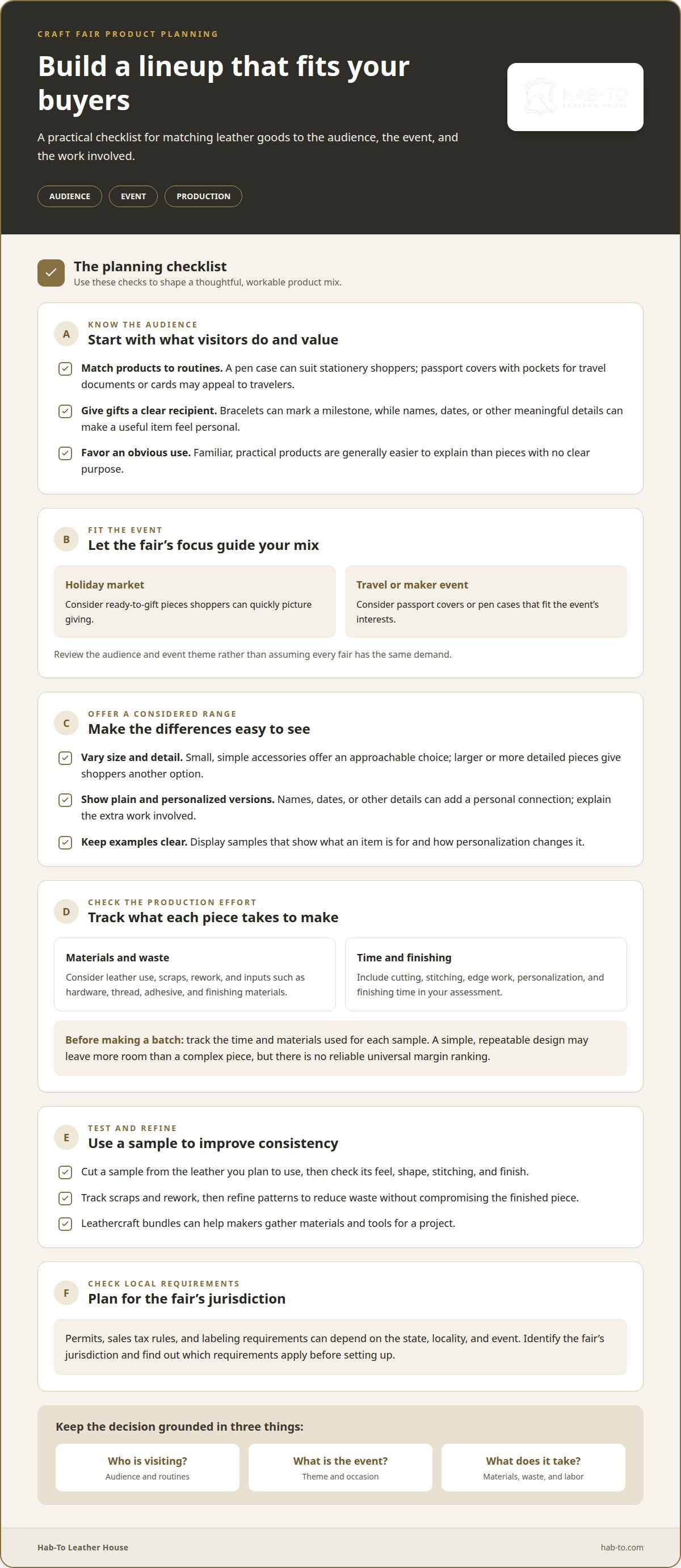
Consider who is likely to visit the fair, then choose leather goods that fit their routines. A pen case beside a handmade pen makes a useful pairing for stationery shoppers. At a gift-focused stall, leather bracelets can work as keepsakes for men and women. Products that meet familiar needs are generally easier to explain than pieces with no obvious use.
Which leather craft fair products have the highest profit margins? There’s no reliable universal ranking: margins depend on material use, waste, labor, and finishing time. A simple, repeatable design may leave more room than a complex piece, even when both attract interest. Track the time and materials used for each sample before deciding what to make in quantity.
For gift shoppers, choose items with a personal connection or a clear recipient. A bracelet can mark a milestone, while a pen case suits someone who carries writing tools. Passport covers with pockets for travel documents or cards may appeal to travelers. Names, dates, or other meaningful details can make a useful item feel chosen for one person.
How do leather product sales vary by season and type of craft fair? Use the audience and event theme as your guide instead of assuming every fair has the same demand. A holiday market may favor ready-to-gift pieces, while a travel or maker event may suit passport covers or pen cases. Review the fair’s focus and plan a mix that fits.
What permits, sales tax rules, and labeling requirements apply to selling leather goods at U.S. craft fairs? Treat these as location-specific planning questions: requirements may depend on the state, locality, and event. Identify the fair’s jurisdiction and find out which requirements apply before setting up, rather than relying on a single nationwide checklist.
Offer different price points through variations in size, construction, and customization, rather than assuming every buyer has the same budget. Small, simple accessories provide an approachable option; larger or more detailed pieces give shoppers another level to consider. Make the distinction clear: display a plain example beside a personalized one, and explain the extra work involved.
Material choice affects how much leather a pattern uses, while hardware, thread, adhesive, and finishing materials add to production inputs. Labor matters too: cutting, stitching, edge work, and personalization each take time. Track scraps and rework alongside material and labor use, then refine patterns to reduce waste without compromising the finished piece. Leathercraft bundles can help makers gather materials and tools for a project.
3. Cord organizers and small pouches
A leather cord organizer turns a familiar tangle into a small, useful accessory. A simple design wraps around a charging cord and fastens with a central snap. Display it around a cable so shoppers can quickly see its purpose. Keep the shape compact, but long enough to close around the cords you want to demonstrate.
Plan the organizer around its closure before cutting the leather. Mark the center, then position the snap so the folded ends meet without pulling tight. Test the pattern with a scrap strip and a real charging cable. This shows whether the wrap is long enough and the snap lands where intended.
A small coin pouch is another project with a clear everyday use. One simple version uses two rounded pieces of soft leather. Match the pieces, align their edges, and stitch around the curve, leaving an opening for access. A sample filled with coins shows its scale more clearly than an empty pouch.
Small pouches can also hold earbuds, spare buttons, or tiny craft supplies. Give your display example one clear purpose, such as keeping earbuds together in a tote. This gives shoppers a specific use to picture. Keep the opening easy to find, and avoid making the pouch so tight that its contents are difficult to remove.
When choosing leather items that sell best at craft fairs for your display, consider how quickly shoppers understand each design. For batch production, start with a paper pattern. Trace it onto the leather, arrange the shapes to reduce waste, and cut several pieces before stitching. Mark snap placement consistently for cord wraps, and align pouch edges before punching stitch holes. A repeatable sequence helps keep the pieces consistent.
At a craft fair, show each item in use. Wrap an organizer around a charging cable, and place a pouch beside the small objects it can carry. Leave one unfilled pouch open to show its construction; a second, filled sample communicates capacity. These demonstrations help shoppers distinguish the projects without a lengthy explanation.
Personalization can make either design more suitable as a gift. A short name or initial on a pouch identifies its owner, while a small mark can distinguish a cord wrap in a shared workspace. Keep lettering clear and restrained on these compact surfaces. Test the placement on a sample before making a batch, so it remains legible and doesn’t interfere with the closure.
Use these examples to assess leather items that sell best at craft fairs for your audience, then compare the time spent cutting, assembling, and finishing each sample. Keeping a record helps you choose what suits your process and the shoppers at your next event. The organizer’s snap and the pouch’s curved seam each need careful placement, but both designs focus on a single function.
4. Leather bookmarks and luggage tags
A corner bookmark is a compact project with an obvious purpose for readers. Its basic form uses two small leather triangles joined to create a pocket that slips over a page corner. Leave the opening wide enough to fit a book page without forcing it. A sample in a paperback helps shoppers see how it sits.
Choose a pattern that keeps the triangles aligned. Cut matching pieces, mark the stitching line, then join the sides while leaving the opening clear. Matching corners give the finished bookmark a neat shape. Before making a batch, test one sample in a paperback and a hardcover, since page thickness can affect the fit.
Personalization can make a bookmark a keepsake without changing its function. Initials, a short name, or a small stamped motif can identify the reader’s copy. Keep the design away from the pocket opening, where it could make the bookmark harder to slide onto a page. Leather bookmarks also develop character with age, making the changing surface part of their appeal.
Luggage tags meet a different need: identifying a bag while adding a personal touch. Keep the name area visible and make the tag easy to distinguish. A paper insert behind a leather cover can hold the traveler’s details. For a wedding or anniversary gift, adding names and the wedding date can make the tag personal to a couple.
Make your display tell that story. Place a tag on a travel bag, then show another with a couple’s names and wedding date. For bookmarks, fit the corner piece over a page in a book. These demonstrations communicate scale and use more clearly than a row of flat samples. Keep lettering on personalized examples legible and sized for the available surface.
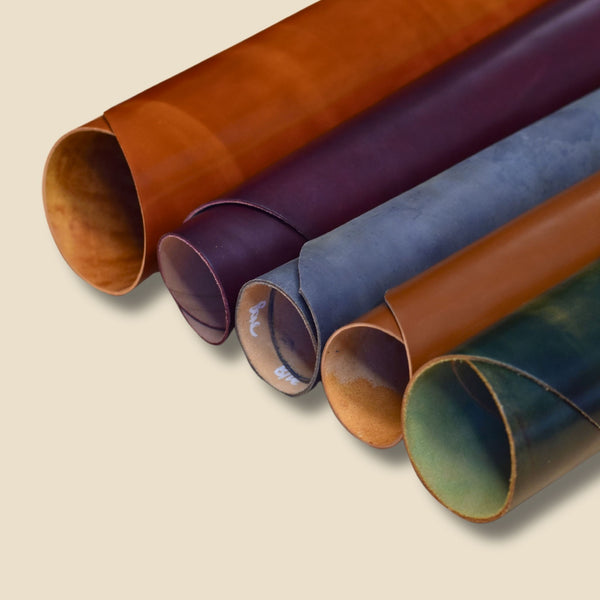
Material selection shapes the look and handling of both projects. A maker considering vegetable-tanned Pueblo leather can assess its color and surface alongside the planned pattern. Cut a sample first, then test the corner fit or tag layout before preparing multiple pieces. This step helps reveal whether the chosen design leaves enough room for stitching and personalization.
Use a simple production sequence for consistent results: cut the pattern, mark the stitch line, assemble the piece, then add the personal detail. For luggage tags, test the name placement before making the final mark. For bookmarks, check the opening against a real page. These checks help each piece stay usable while retaining the crisp geometry of a compact leather gift.
5. Leather keychains and personalized accessories
A leather keychain gives shoppers a useful object with room for personal meaning. Keep the shape simple, then add a name, logo, or special date. A sample with initials shows how a small detail can change the piece. Display it beside a plain version so visitors can compare the options quickly.
What are typical craft fair prices for leather keychains, wallets, belts, and bags? Set each price by accounting for leather, hardware, labor, and finishing. A keychain, wallet, belt, and bag use different amounts of material and take different amounts of time to make, so calculate each design’s costs separately.
Start a keychain pattern with the leather shape and attachment point. Mark where the split ring or other hardware will sit before cutting. Leave enough leather around the attachment to support the finished piece. Test the placement with the hardware you plan to use, then check that the keychain hangs as intended.
A lip balm holder is another personalized accessory. Its design forms a loop around a lip balm tube and attaches to a keyring. Make a sample with the intended tube, then adjust the loop for a practical fit. This demonstration helps shoppers understand the item’s purpose at a glance.
Personal details work best when they’re easy to read. A name suits a gift for an individual, while a logo can identify a business giveaway. A special date can mark an anniversary or another occasion. Keep the lettering clear on the small surface, and place it away from the hardware opening.
At the fair, arrange keychains by shape or personalization rather than piling them together. Hang a few samples from a display hook so shoppers can see their size and finish. Place a name-marked example beside a logo version. A short sign can explain personalization options, while a plain sample gives visitors a simple alternative.
Hardware and leather both influence how a keychain looks and feels. Choose a ring that fits the design, then test the attachment before preparing a batch. Leather hardware can help makers consider suitable findings for small accessories. Record material use and assembly steps for each design, and consider crafting bundles as you organize project supplies.
A leather chapstick holder is a loop around a lip balm tube, fitted with a keyring. Use the intended tube as a sizing guide, shaping the loop for a secure fit that still lets the tube come out easily. Before preparing a batch, attach the holder to its ring and check how it hangs. A neat edge and careful finishing give this small accessory a polished look without distracting from its practical purpose. Keep the loop opening accessible, and make sure the ring doesn’t get in the way when removing or replacing the tube.
At the fair, show the holder with a tube in place so visitors immediately recognize its use. A second sample without a tube can show how the loop is constructed. Display it near related keychains, but leave enough space for it to stand out. If you offer personalization, demonstrate how a small mark fits without obscuring the loop or making the holder harder to use. This helps shoppers compare an everyday accessory with other small leather gifts.
Hab-To Leather House: Leatherworking Tools
Hab-To Leather House sells leatherworking tools and crafting bundles for makers preparing small gifts for a craft fair. These supplies can help you move from choosing a project to gathering the materials and equipment to make it. A keychain, pouch, and luggage tag each involve different steps, so plan around the design you intend to produce.
For projects that use leather and hardware, explore Hab-To Leather House’s leathercraft tools and crafting bundles. The product range also includes equestrian-related leathers and hardware, alongside leather, tools, and other hardware. Choose materials and supplies that fit your project and workflow.
If you’re planning a craft fair project, contact Hab-To Leather House to discuss the leatherworking supplies that fit your work.
Make Your Next Fair a Learning Opportunity
Let your next craft fair guide what you develop afterward. Notice which pieces prompt questions, attract attention, or start conversations about personalization. These observations can help you build a collection around the people who stop at your stall.
For related reading, explore topics such as selecting leather for small projects and personalizing handmade accessories. A contextual product starting point is a leathercraft bundle for organizing project supplies, which can support your preparation for a new design.
Use these ideas to choose leather items that sell best at craft fairs for your audience, then refine one design at a time. A memorable gift idea can begin with a thoughtful project and a willingness to learn from each event.
Frequently Asked Questions
What leather goods sell best at craft fairs in the United States?
There isn’t one universal bestseller across U.S. craft fairs. Compact, useful gifts with clear functions and personalization options are practical choices to test, but audience and event theme matter. Start with a small assortment of different uses and levels of detail, then observe which pieces draw attention and questions. Use what you learn to refine your selection for future fairs, rather than treating one event’s response as a universal sales ranking.
Disclaimer
All our blog articles are made for information purposes only we dont take responsability for any content from third parties.