

A Crafter's Guide to Essential Leather Hardware
You’ve spent hours cutting, stitching, and finishing a beautiful piece of leather. Now comes the final, crucial step: the hardware. Staring at an endless catalogue of buckles, rivets, and snaps can feel overwhelming. Will this brass buckle tarnish? Is this D-ring strong enough for a bag strap? Choosing the wrong piece feels like a risk that could undermine all your hard work. This confusion is exactly why a solid understanding of quality leather hardware is one of a crafter's most valuable assets.
Forget the guesswork. This guide is your personal roadmap, designed to take you from confused to confident. We'll break down the essentials, from the timeless durability of solid brass to the sleek finish of nickel-plated steel. You'll learn precisely how to match the right size and type of hardware to your specific project, whether it's a rugged belt or an elegant handbag. No more uncertainty, just clear, practical advice for real craftsmanship.
By the time you finish reading, you'll have the knowledge to select components that elevate your work from handmade to professional. You'll be making informed choices that ensure your projects are not only beautiful but are built to last a lifetime. Let's give your craft the uncompromising quality it deserves.
Key Takeaways
- Discover how premium hardware is the secret to transforming your projects from a homemade look to a professional, artisanal finish.
- Confidently choose the right fasteners, from rivets to snaps, to ensure your closures are both beautiful and highly functional.
- Master the essential structural leather hardware, like buckles and D-rings, to give your bags and belts professional-grade strength.
- Get practical 'shopping lists' that take the guesswork out of selecting the perfect hardware for popular projects like tote bags and wallets.
Why Quality Hardware is the Cornerstone of Great Leatherwork
In the world of leather craftsmanship, every detail matters. While we pour hours into selecting the perfect hide, cutting patterns, and stitching seams, the final choice of leather hardware can make or break the entire piece. These metal components-buckles, rivets, snaps, and rings-are far more than just functional necessities. They are the signature on your work, a testament to its quality, and the critical element that elevates a project from a homemade craft to a professional, artisanal creation.
To see some of these essential pieces and the tools used to set them, this video offers a fantastic overview:
Imagine pouring your soul into a beautiful handbag, only for a cheap, plated clasp to start flaking or a buckle prong to snap after a few months of use. Low-quality hardware can rust, corrode, or break under stress, ruining your meticulous work and your reputation. Investing in solid, durable hardware isn't an expense; it's an insurance policy that ensures your project not only looks exceptional but endures for a lifetime.
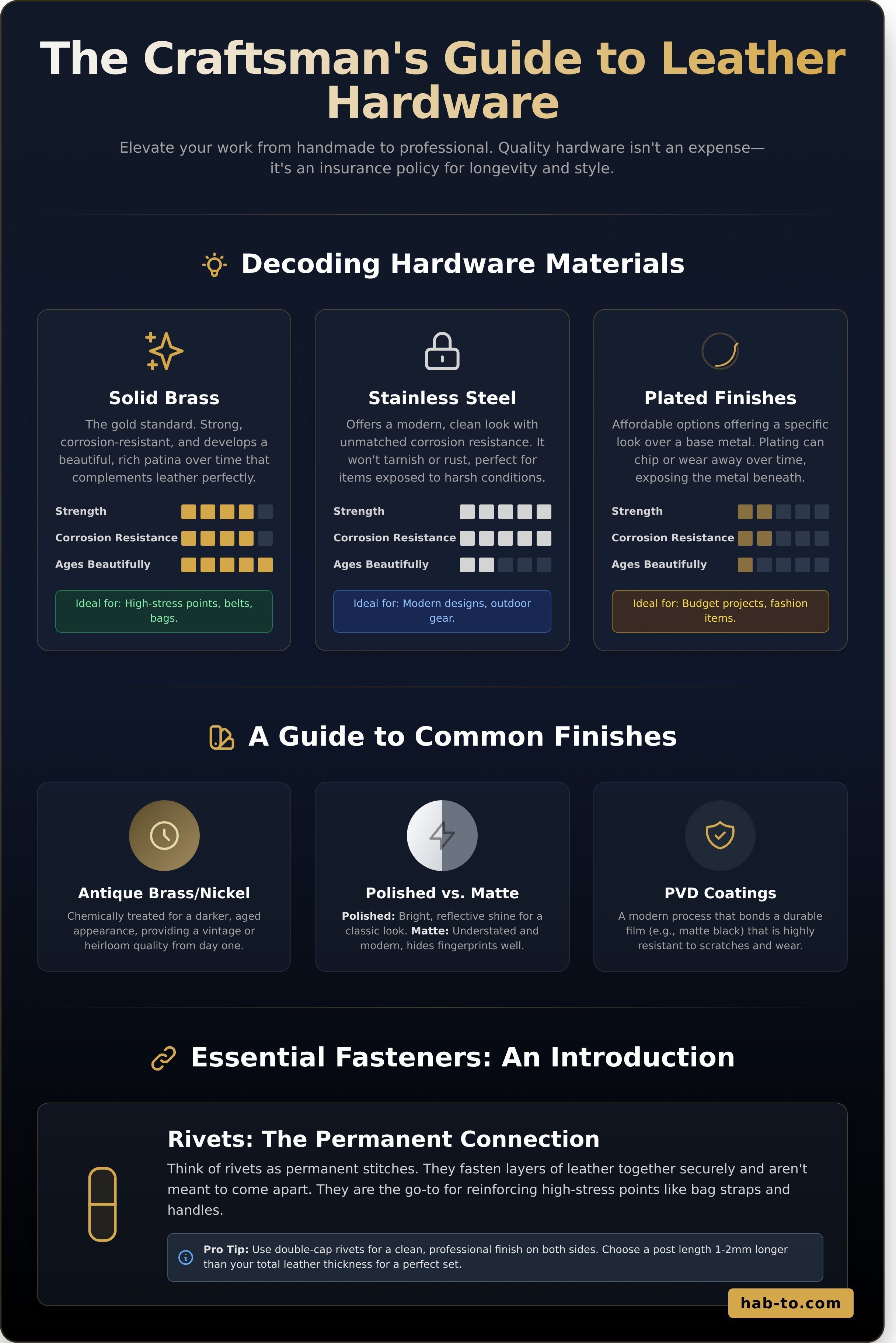
Decoding Hardware Materials: Solid Brass, Steel, and More
The material of your hardware dictates its strength, weight, and how it will age. Choosing the right one is crucial for both aesthetics and long-term performance.
- Solid Brass: The undisputed gold standard. It's strong, resists corrosion, and develops a beautiful, rich patina over time that complements vegetable-tanned leather perfectly. Its heft and strength make it ideal for high-stress points on bags and belts; in fact, the history of the buckle is intertwined with durable metals like brass.
- Stainless Steel: For a modern, clean look and unmatched corrosion resistance, stainless steel is the top choice. It’s perfect for items exposed to harsh weather or marine environments and won't tarnish or rust.
- Plated Finishes: More affordable options like nickel-plated or brass-plated hardware offer a specific look without the cost of solid metals. However, be aware that the plating can chip or wear away over time, exposing the base metal beneath.
A Quick Guide to Common Finishes
Beyond the base material, the finish provides the final aesthetic touch. It’s how you match the hardware to the style of your leather good, whether it's rugged and vintage or sleek and contemporary.
- Antique Brass/Nickel: These finishes are chemically treated to create a darker, aged appearance, perfect for achieving a vintage or heirloom quality right from the start.
- Polished vs. Matte: A polished finish offers a bright, reflective shine for a more classic or formal look. A matte or satin finish, by contrast, is understated and modern, hiding fingerprints and minor scratches well.
- PVD Coatings: Physical Vapor Deposition (PVD) is a modern process that bonds a durable, thin film to the hardware. It's used to create resilient finishes in various colors, like matte black or gunmetal, that are highly resistant to scratching and wear.
The Essentials Part 1: Fasteners for Joining and Closing
When you begin working with leather, you quickly realize that joining pieces and creating secure closures is fundamental. This is where fasteners, a critical category of leather hardware, come into play. Choosing the right one-and installing it correctly-is the difference between a project that lasts a lifetime and one that fails at the first sign of stress. The fastener you choose depends entirely on your project's needs, from the thickness of your leather to the strength required. Let’s break down the three most essential types: rivets, snaps, and studs.
Rivets: The Permanent Connection
Think of rivets as the permanent stitches of the hardware world. Their sole job is to fasten two or more layers of leather together, and once set, they aren't meant to come apart. We recommend double-cap rivets for a clean, professional finish on both sides of your project. The key to success is sizing: choose a post length that is 1-2mm longer than your total leather thickness to ensure a secure roll. They are the go-to for reinforcing stress points on bag straps, handles, and belts.
Snaps (Press Studs): For Secure, Reusable Closures
For closures that need to open and close with a satisfying click, snaps are your answer. A standard snap consists of four parts (cap, socket, stud, and post) that work in pairs to create a secure connection. Getting these parts set correctly is crucial for a smooth action. For a detailed visual walkthrough, educational resources like the University of Wyoming's Leathercraft Project Guide offer excellent step-by-step instructions. Common sizes include Line 20 for wallets and pouches, and the more robust Line 24 for jackets and heavy-duty bags.
Sam Browne Studs & Collar Buttons: The Elegant Fastener
When your design calls for simplicity and elegance, the Sam Browne stud (or collar button) is an unmatched choice. This piece of leather hardware consists of a single screw-back stud with a ball head. It functions by simply pushing through a keyhole slot cut into the corresponding leather strap. Installation is wonderfully straightforward compared to snaps, requiring only a punch for the hole and a small slit. They are perfect for minimalist closures on journal covers, briefcases, and modern wallets.
The Essentials Part 2: Structural & Connection Hardware
While decorative pieces add character, structural leather hardware is the functional skeleton of your project. These are the load-bearing components that provide strength, create connection points, and offer adjustability for hardworking items like bags, belts, and pet collars. When choosing these pieces, strength and durability are non-negotiable. No compromises means selecting hardware that can handle the stress of daily use.
Let's explore the essential pieces that hold your craftsmanship together.
Buckles: The Key to Adjustability
Buckles are the classic solution for securing straps and allowing for a perfect fit. When selecting a buckle, always match its internal width to the width of your leather strap for a snug, professional look. They are essential for belts, adjustable bag straps, watch straps, and collars.
- Center Bar Buckles: Feature a bar in the middle for the prong to rest on, offering a traditional and sturdy design.
- Roller Buckles: Include a small roller on the frame, which helps the leather strap glide through easily, reducing wear and tear over time.
- Heel Bar Buckles: A simple, strong design where the prong rests directly on the end of the frame (the "heel").
D-Rings, O-Rings, and Square Rings
These simple rings are the unsung heroes of connection, creating secure attachment points for straps, clips, and handles. The most critical factor here is choosing welded versus unwelded rings. For any application that will bear weight-like a shoulder strap-always use welded rings. Unwelded rings have a small gap and can be pulled open under pressure. The shape also matters; a D-ring provides a flat edge for a strap to sit against, while an O-ring is ideal for connections that may pull from multiple angles. Attaching these components securely is vital, and for a deeper look at the methods involved, the International Leather Club has a great guide to setting tools and techniques for various hardware.
Swivel Snaps & Trigger Clips
When you need a connection that is both strong and detachable, turn to swivel snaps and trigger clips. Their key feature is the base that rotates 360 degrees, which brilliantly prevents straps on cross-body bags and dog leashes from twisting and tangling. When choosing one, consider the gate mechanism-a trigger snap is opened with a thumb lever, while a bolt snap uses a spring-loaded slider. They are the perfect choice for lanyards, key fobs, and any strap you want to easily clip on and off.
Choosing the Right Hardware for Your Project
Now that we’ve covered the fundamentals of materials and finishes, let's put that knowledge into practice. Thinking about your project's function first is the secret to selecting the perfect pieces. This section serves as a practical shopping list for some classic leathercraft projects. Consider these your starting points-a solid foundation you can adapt to your own unique designs and craftsmanship.
Hardware Checklist for a Classic Leather Belt
A belt is more than a utility; it's a statement piece that demands durability. For a belt that will last a lifetime, focus on strength and classic style. Your essential components are:
- One high-quality buckle: We recommend a solid brass or stainless steel roller or heel bar buckle for its strength and timeless appeal.
- Two Chicago screws or rivets: To secure the buckle to the belt strap. Screws allow for interchangeable buckles, while rivets offer a permanent, robust fix.
- One leather keeper loop: This holds the belt tip in place and can be secured with a small, subtle rivet or stitched by hand.
Hardware Checklist for a Cross-Body Bag
A cross-body bag requires a thoughtful combination of leather hardware to ensure it's both beautiful and functional. Each component plays a critical role, from carrying the load to securing your belongings. Here’s a typical setup:
- Two D-rings or square rings: Attached to the bag's body, these provide strong anchor points for the strap.
- Two swivel snaps: For a detachable strap, allowing it to move freely without twisting.
- One slide buckle: Essential for making the strap adjustable for a perfect fit.
- Rivets: To reinforce stress points like strap ends and handle attachments, ensuring longevity.
- A magnetic snap or Sam Browne stud: For a secure and easy-to-use main closure.
Hardware Checklist for a Simple Card Wallet
With a card wallet, less is often more. The goal is a slim profile and secure closure, allowing the quality of your leather to be the main attraction. Minimalism is key here.
- One or two sets of durable snaps: Line 20 or Line 24 snaps provide a reliable closure without adding bulk.
- Optional D-ring: A small, solid D-ring can be added if you want to include an attachment point for a lanyard or chain.
Every project is a unique challenge, and these checklists are just the beginning. The real magic happens when you start mixing, matching, and finding the premium components at hab-to.com that bring your specific vision to life. Need advice for your project? Hi, I'm Mike! Let's chat.
Why Source Your Hardware from Hab-To?
In leathercraft, the smallest details make the biggest difference. A project built with passion and premium leather deserves more than a buckle that will tarnish or a rivet that will fail. We understand this because we're crafters, too. Sourcing the right leather hardware isn't just about finding a part that fits; it's about choosing a component that elevates your work and stands the test of time.
We believe the quality of your hardware should match the quality of your craftsmanship. That’s why we’ve built our collection on a foundation of durability, expertise, and a genuine passion for the craft.
Curation, Quality, and No Minimum Orders
We believe in quality without exception. That's why our collection is carefully curated, not just compiled. Forget sifting through pages of cheap, plated alloys that will chip and break. We focus exclusively on hardware that we would use in our own projects.
- Solid Brass & Stainless Steel: We hand-select pieces made from durable, corrosion-resistant base metals for a lifetime of reliable use.
- No Compromises: You won’t find flimsy, mystery-metal components here. Just quality materials for real, lasting craftsmanship.
- No Minimums: Whether you need a single D-ring for a personal project or a hundred rivets for a production run, we support crafters at every scale.
Expertise You Can Rely On
With over 160 years of family experience in the leather trade, we’ve learned what works and what doesn't. That knowledge is something we're passionate about sharing. We're not just an anonymous webshop; we're a resource for the crafting community.
Confused about the right finish for your project, or which size rivet you need for a specific leather thickness? Just ask. Our goal is to provide you with the materials and the confidence you need to bring your vision to life.
Ultimately, we see ourselves as more than a supplier-we are your partner in craftsmanship. Our commitment is to provide premium leather hardware and genuine support, helping you create beautiful, durable goods you can be proud of. Explore our collection and see the Hab-To difference for yourself.
The Finishing Touch: Choosing Hardware with Confidence
As we've explored, the leather hardware you choose is far more than a simple finishing touch-it's the cornerstone of your project's strength, function, and aesthetic. Understanding the essentials, from secure fasteners to structural D-rings, empowers you to make choices that truly honour your craftsmanship. It’s the difference between a project that’s simply finished and one that’s built to last.
At Hab-To, we share that passion for quality without compromise. That’s why our collection features only expertly curated solid brass and stainless steel hardware, selected to meet the highest standards. We believe every crafter deserves the best, which is why we have no minimum order requirements. And if you ever need personal advice for your project, I'm here to help, backed by over 160 years of my family's experience.
Ready to find the perfect finish? Browse our curated hardware collection.
Your next creation is waiting. Make it exceptional.
Frequently Asked Questions About Leather Hardware
What's the difference between solid brass and brass-plated hardware?
Solid brass hardware is crafted from a single, durable brass alloy. It won't chip or flake and develops a beautiful, rich patina over time, adding character to your work. Brass-plated hardware, on the other hand, consists of a base metal like zinc or steel coated with a thin layer of brass. While more affordable, this plating can wear away with use, exposing the metal underneath. For lasting quality and a piece that ages gracefully, solid brass is always the superior choice.
How do I match my hardware size to the thickness of my leather?
For rivets and snaps, the post length is crucial. It should be about 1-2mm longer than the total thickness of the leather layers you're joining. This gives you just enough material to set it securely without bending or being too loose. For items like buckles or D-rings, you're matching the hardware's 'strap width' to the width of your leather strap, not its thickness. Always check the product specifications for both measurements for a perfect fit.
What are the absolute essential tools needed for setting hardware like rivets and snaps?
To get started, you only need a few key tools. First, a quality hole punch to create clean holes in your leather. Second, a specific setter for the hardware you're using-a rivet setter has a concave tip, while a snap setter has multiple parts. Finally, you'll need a solid, non-bouncing surface like a small anvil or granite slab and a mallet to strike the setter. These essentials will ensure your hardware is set securely and professionally.
Can I mix different metal finishes (e.g., brass and nickel) on the same project?
Absolutely! Mixing metal finishes is a creative choice that can add a unique, custom look to your projects. Combining the warmth of brass with the cool tone of nickel, for instance, can create a striking contrast. The key is to be intentional. A planned mix can look modern and deliberate, while a random assortment might appear accidental. Trust your creative instincts-if it looks good to you, then it's the right choice for your piece.
How do I properly care for leather hardware to prevent it from tarnishing?
Proper care keeps your leather hardware looking its best. For all finishes, regularly wipe away dirt and moisture with a soft, dry cloth. Avoid harsh chemical cleaners, as they can damage the finish. Solid brass will naturally develop a patina, which many crafters appreciate. If you prefer a shine, a gentle brass polish will restore it. For plated hardware, be extra gentle to prevent scratching the thin top layer and exposing the base metal underneath.
What does 'strap width' mean when choosing a buckle or D-ring?
'Strap width' is one of the most important measurements when selecting leather hardware like buckles, D-rings, and keepers. It refers to the internal width of the hardware's opening. For example, a buckle with a 25mm (1 inch) strap width is designed to fit a leather strap that is exactly 25mm wide. Always match your leather strap's width to the hardware's specified strap width for a snug, professional fit without any bunching or excessive play.