





Avoiding Tool Choice Overwhelm by Setting Clear Limits
The best tool choice may be the one you stop researching sooner. When every option promises a better workflow, more comparison can make a practical decision feel harder, not wiser. Avoiding the overwhelm of too many tool choices starts with setting limits: name the job the tool must do, decide what matters most, and stop when an option meets those needs.
That doesn’t mean settling for a poor fit. It means recognizing the difference between a tool that meets your real requirements and one that wins an endless feature-by-feature contest. If you’re choosing tools for customers or a team, a smaller, clearly defined set of options can make the decision easier to understand without forcing one answer on everyone.
This article will help you narrow the field, set boundaries around time and energy, and feel comfortable choosing a good-enough option. We’ll look at how to identify essential criteria, when extra comparison stops helping, and how businesses can present choices without overwhelming customers. The aim is a considered decision based on the information and capacity you actually have, rather than a perfect choice that keeps moving out of reach.
Key Takeaways
- Set limits around your time, energy, and practical needs before comparing tools.
- Define the essential job a tool must do, then stop searching once an option meets your criteria.
- Recognize when more options are slowing a decision instead of improving it.
- Choose a good-enough fit without expecting one tool to be perfect for every situation.
- For leathercraft, focus on the materials and tools your project actually calls for.
Limitations such as location, tools, time, and energy
Tool choice depends on more than features. Your location, current setup, available time, and energy shape what you can realistically adopt.
Practical Constraints on Tool Selection
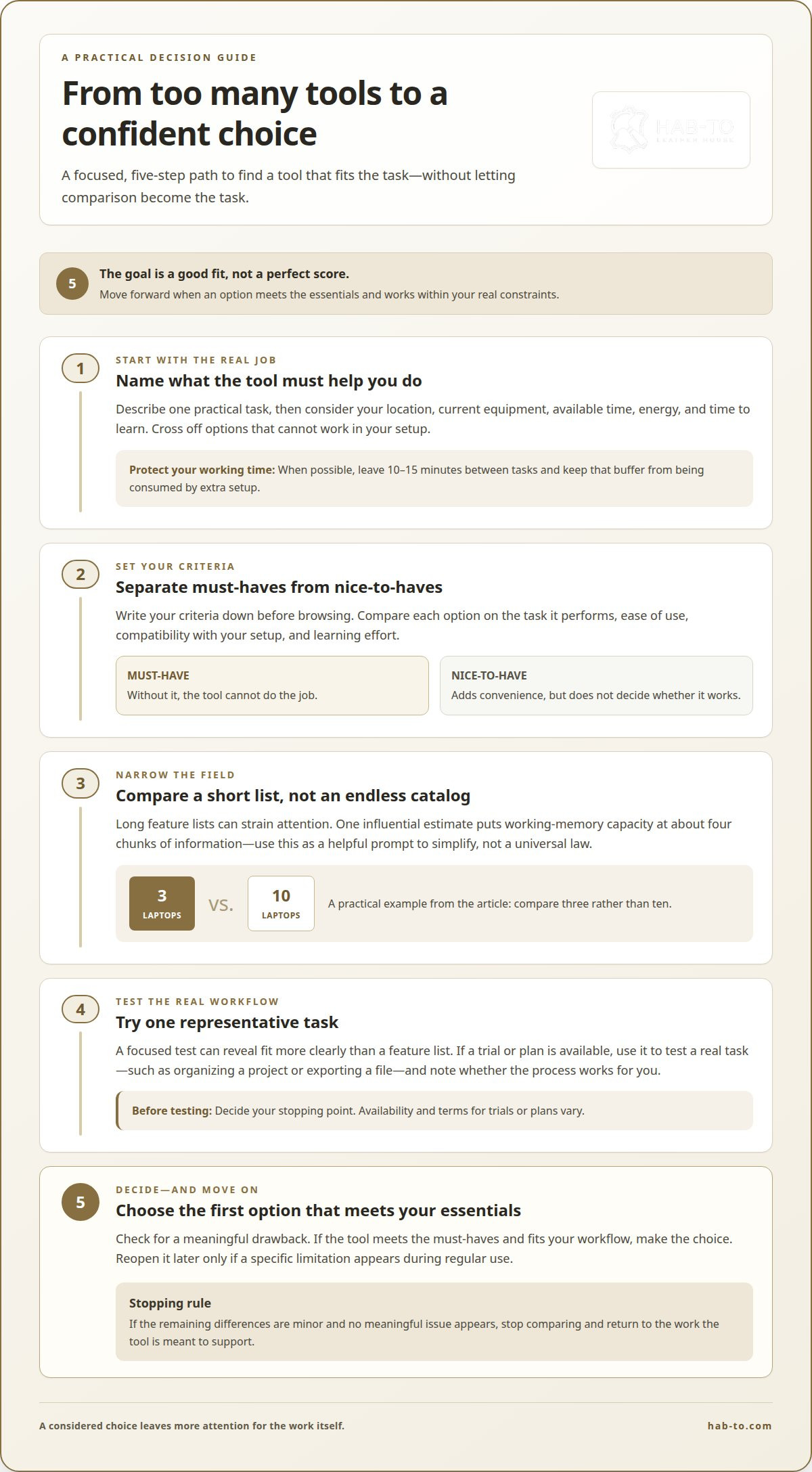
Practical constraints are the conditions that make some tools usable and others unsuitable. Start by naming where you work, what equipment you already have, and how much time you can spend learning. A tool that requires a separate device may not fit a location with limited equipment. A complex setup can also become a problem when your schedule is already full. Leave 10-15 minutes between tasks when possible, and protect that buffer from extra setup work. Which framework helps simplify selection? Compare each option against your actual constraints, then remove choices that fail a must-have.
Working-Memory Limits and Option Overload
Working-memory limits make it harder to compare many features at once. One influential estimate puts capacity at about four chunks of information, so long feature lists can strain attention. When you feel overloaded, every difference may seem important, even if only a few affect the task. A practical response is to write down your criteria before browsing, then compare a short list. Evidence for broad scarcity-based claims is mixed, so treat limits as a useful aid, not a universal law.
Narrowing Choices with Clear Criteria
Clear criteria turn a large catalog into a manageable decision. Compare tools by the task they perform, ease of use, compatibility with your current setup, and learning effort. Must-have features are requirements: without them, the tool cannot do the job. Nice-to-have features add convenience but don’t determine whether it works. Try comparing three laptops rather than ten. To avoid frequent switching, decide what would justify a change, such as a missing essential function. This keeps your choice consistent instead of letting each new feature sway you.
Testing Tools Before Committing
A focused test shows whether a tool fits real work better than a feature list can. Some providers offer free trials or plans, though availability and terms vary. Test one representative task, such as organizing a project or exporting a file, and note whether the process fits your workflow. Set a stopping point before you begin, then decide using your must-haves. This keeps experimentation useful without turning it into another open-ended search.
Accepting good-enough choices
A good-enough choice meets the needs that matter without winning every possible comparison. It lets you move from trying to decide to taking useful action. The standard isn’t “exactly perfect”; it’s fit for the task, workable within your constraints, and unlikely to create a bigger problem later. That distinction can reduce the stress of treating every small difference as decisive.
Barry Schwartz’s The Paradox of Choice, published in 2004, explores how abundant options can complicate decisions. A practical response is to define “good enough” before opening another comparison page. For a note-taking tool, that might mean it captures ideas, lets you find them again, and works with your existing process. A decorative feature can wait if it doesn’t change those outcomes.
Try this decision rule when two or more options seem close:
- Keep the essentials: Name the functions the tool must perform for one real task.
- Set a stopping point: Choose the first option that meets those essentials and fits your workflow.
- Review the decision later: Reopen the choice only if a specific limitation appears during regular use.
This approach doesn’t mean ignoring meaningful drawbacks. If a tool fails a core requirement, it isn’t good enough. But when the remaining differences are minor, further comparison can consume attention without improving the result. Ask what would make you reject the leading option, then check that point directly. If no meaningful issue appears, decide and return to the work the tool is meant to support.
For a leathercraft purchase, the same principle is useful: choose tools around the technique and project at hand, not every feature you might someday want. A defined set of related items may also make the choice more manageable. Explore leathercraft bundles if that format suits your project. Good enough is a clear standard, not a careless compromise: it protects attention for making, learning, and finishing the task.
Choice overload and decision delays
Too many alternatives can turn a simple selection into a postponed decision. In one study, shoppers offered more than 22 options were more likely to make no choice. The lesson isn’t that every large catalog causes paralysis. It’s that an expanding list can make comparison feel like another commitment, especially when the differences seem equally important.
The 1995 jam study found that shoppers were less likely to buy when presented with many options. A 401(k) enrollment study also showed participation varied with fund choice and financial knowledge. About 65% of investors with low financial knowledge participated when offered many funds, compared with 88% of those with high knowledge. In the same study, participation with a small number of funds was 65% for high-knowledge investors and 80% for low-knowledge investors. More options don’t affect every person in the same way.
Reviews and recommendations can reveal recurring strengths or limitations, but reading too many may replace your priorities with other people’s. You could end up comparing tools praised for features your work doesn’t require, while overlooking a practical fit. Use reviews to investigate a specific concern, not as a vote that must decide for you.
Try a short decision process instead of another round of browsing:
- Name the task: Write one sentence describing what the tool needs to help you do.
- Prioritize: Separate essential requirements from preferences before reading recommendations.
- Set a time limit: Spend a defined block of minutes reviewing options, then make a decision or identify one unanswered question.
For a team, agree on the same boundaries. A client-facing tool, for example, should support the actual service workflow, not every feature mentioned in reviews. Record the chosen option and why it fits. Revisit the decision only when a clear issue affects work or commitments. This keeps comparison tied to evidence from your own use, rather than restarting whenever a new recommendation appears.
Maximizing versus being a satisficer
A maximizer tries to find the best available option, while a satisficer chooses one that meets defined needs. Barry Schwartz’s The Paradox of Choice, published in 2004, explores how abundant options can complicate decisions. Maximizing can be useful when a choice has lasting consequences, but searching for the perfect tool can consume attention long after useful differences become small. Satisficing sets a clear threshold, then turns thinking into action.
Neither approach fits every decision. For a tool handling sensitive work, careful comparison may be worthwhile. For a basic task, such as organizing personal notes, a tool that reliably captures and retrieves information may be enough. The useful question isn’t whether another option exists. Ask whether it could change the result you need. If not, further comparison may add effort without improving the decision.
Limits make the distinction practical. Before researching, write down the task, essential requirements, and stopping point. For example, visiting two stores rather than an entire mall creates a boundary when buying clothes without preventing a considered choice. Apply the same idea to software: compare a defined shortlist, then choose an option that meets your requirements. Reopen the decision only if actual use reveals a specific problem.
- Maximize when stakes are high: Compare carefully if a tool affects privacy, essential records, or a critical workflow.
- Satisfice for routine needs: Choose a workable fit for a reversible, everyday task.
- Notice the cost of more research: If repeated comparisons increase anxiety or delay action, return to your original criteria.
A meta-analysis found an association between higher self-reported anxiety and poorer working-memory capacity, with an effect size of g = -0.334. That finding doesn’t prove anxiety causes a poor choice, but it offers a reason to avoid making research endless when stress is already high. A written stopping rule can protect attention and leave room for the work that follows. Good judgment includes knowing when enough information is enough.
How can I choose the right tool without getting overwhelmed by too many options?
Start with the work, not the catalog. If you need a tool to track orders, for example, define what a completed order record must contain. Then judge each candidate against that outcome instead of collecting features that don’t affect the task.
David Allen’s approach offers a useful structure: capture, clarify, organize, reflect, then engage with the most useful action. Apply it to tool selection by writing down the problem, separating essential requirements from preferences, and arranging the remaining candidates by fit. A tool that fails an essential requirement drops out. This gives your decision a reasoned path instead of an endless stream of possibilities.
Make the final choice easier to carry out with an if-then plan. A meta-analysis of 94 independent tests found that if-then plans had an effect of d = .65 on goal attainment. For a tool decision, try: “If this option meets my essential requirements and works with my current process, then I’ll choose it and begin the task.” The plan connects a clear condition with a specific action.
- Capture: Write the problem in one sentence, such as “I need to organize project deadlines.”
- Clarify: List the functions required to solve that problem, not every appealing feature.
- Organize: Remove candidates that fail a requirement or disrupt your existing workflow.
- Reflect: Ask whether any unresolved difference would change the result.
- Engage: Choose the strongest fit and use it for the task you identified.
Keep a short decision note with the selected tool, its purpose, and why it passed your criteria. If you later consider switching, compare the new option against that same note. A specific shortfall, such as missing order tracking, can justify reconsideration. A fresh feature announcement alone doesn’t. This simple record turns avoiding the overwhelm of too many tool choices into a repeatable practice and keeps attention on the work the tool should support.
Limit the comparison set: interview and choose from among 3 accountants, or compare 3 laptops instead of 10. David Allen advises choosing the action with greatest value at that moment.
What You Will Need
A useful tool list starts with the project, not a full workshop catalog. For leathercraft, identify the material, technique, and finish you plan to use. A small repair and a stitched watchstrap call for different equipment. Listing the actual steps first helps separate essentials from tools that can wait.
For a leather project, consider these categories:
- Cutting and shaping: Choose tools suited to preparing leather and shaping its edges. An edge beveler or other leatherworking tool may be relevant when your project calls for beveled edges.
- Assembly: Select the tools and hardware required for your chosen construction method, such as stitching or setting fasteners.
- Finishing: Tokonole finishing supplies are an option to consider for leather edges. Match the materials to the finish you intend to achieve.
- Project materials: Select leather and any supporting materials based on the item you’re making and the method you’ll use.
Tie the list to a specific outcome. If you’re making a watchstrap, write down the operations involved, then identify which tools support each one. Avoid adding equipment simply because it appears on a broad starter list. A tool is useful when it serves a step in your project, suits your current technique, and helps you complete the work.
Related crafting bundles can make it easier to review several project supplies together. Check each bundle’s contents against your own list instead of assuming every item is necessary. A bundle is a good fit only when its components match the work you plan to do.
Before choosing, put the project steps in order: prepare the leather, cut and shape it, assemble the pieces, then finish the edges. Match each step to the tool or material you need. This makes gaps visible without turning preparation into an open-ended search. Start with the essentials for one project, then add specialized equipment when a technique you plan to use requires it.
Hab-To Leather House
Hab-To Leather House is a natural next step when your tool decision connects to a leathercraft project. Rather than treating each choice as an isolated purchase, consider how the material, tools, and hardware need to work together. A clear project goal helps you focus on what supports the work and leave unrelated options aside.
Hab-To Leather House offers vegetable-tanned leather, leather hardware, leatherworking tools, and crafting bundles. These products support different stages of making, from selecting material to choosing equipment for a particular technique. If you’re planning a watchstrap, think through the leather and tools needed for your intended construction before adding other items to your list. For a project with several related needs, consider a leathercraft starter bundle alongside individual tools.
Bundles aren’t automatically right for every maker. An experienced craftsperson may need only a specific tool, while someone starting a project may prefer to consider related items together. Compare what the project calls for with what each option contains. That keeps the decision grounded in the work, rather than in the appeal of owning more equipment.
Hab-To Leather House also offers personalized service, which can help when you’re weighing material, hardware, and tool choices together. Bring the project into focus: describe what you plan to make, which techniques you expect to use, and where you’re uncertain. Those details give the conversation a practical starting point and help you make a considered selection without turning every possible product into a separate decision.
Choose with care. Make the work. Add tools or materials as your next project calls for them. To discuss your leathercraft choices, contact Hab-To Leather House.
Put Your Next Choice to Work
Give one considered choice a real job. Choose a project, use the tool or materials you selected, and notice what helps the work move forward. A brief note afterward can capture what worked, what slowed you down, and what you’d choose differently next time. That experience gives your future decisions a practical foundation.
This is the lasting value of avoiding the overwhelm of too many tool choices: not simply reaching a decision, but making room to learn through doing. You don’t need to settle every future question today. Let your next project show you whether your current setup suits your process, then make additions with purpose.
If your next leathercraft project calls for a coordinated set of supplies, explore Hab-To Leather House’s crafting bundles and choose what fits the work ahead.
Start with the work you’re excited to make. One thoughtful choice can be enough to begin.
Frequently Asked Questions
How can businesses reduce choice overload for consumers?
Businesses can make decisions easier by grouping options around customer tasks and explaining differences in plain language. A craft supplier, for example, could organize tools by cutting, stitching, and finishing, helping shoppers start with the work they plan to do. Showing relevant options first, with details available as needed, lets customers explore without facing every product at once.
Is it better to have too few or too many choices?
Neither extreme suits every decision. Too few options may leave a customer without a fit for their materials or workflow; too many can obscure useful differences. A selection works best when it serves distinct needs and makes those differences clear. A beginner and an experienced maker, for instance, may need different equipment for similar projects.
How can I narrow a long list of tools to a shortlist?
Remove tools that won’t work in your actual setup. If your workspace has no room for a bench-mounted press, rule it out before comparing features. Then group the remaining tools by task, such as cutting or setting hardware. Choose a representative from each useful group and compare those candidates against the project you intend to complete.
Related Articles to Explore
- Choosing Leathercraft Tools for a Specific Project
- Setting Practical Limits Before Comparing Tools
- Planning Materials and Tools for a Leathercraft Project
Related Product
For a project that calls for several coordinated supplies, explore leathercraft bundles and consider which items match the work you plan to do.
Disclaimer
All our blog articles are made for information purposes only we dont take responsability for any content from third parties.