

Hi, I'm Mike. Just last Tuesday, a new crafter messaged our shop, completely frustrated. He'd spent over €100 on a gorgeous-looking hide, only to discover his card slots were too soft and floppy to be functional. His project was a beautiful failure before it was even stitched.
It’s a story I hear all the time. You find a stunning piece of leather online, but the description is a confusing jumble of ounces, tempers, and tannages. You end up wasting money on a material that just doesn't work, and the dream of a crisp, professional-grade wallet feels miles away. That confusion ends today. I’m going to break down everything you need to know to find the best leather for wallet making, so you can select the perfect hide with complete confidence.
In this guide, we'll dive into the critical differences between tannages, demystify the relationship between temper and thickness for bifolds versus cardholders, and show you exactly what to look for to get those glassy, burnished edges you've been chasing. No compromises. Just the right material for real craftsmanship.
Key Takeaways
- Understand the "Big Three" criteria-tannage, temper, and grade-to confidently select a hide that will give your wallets professional structure and longevity.
- Full list of links to help you create the best wallets
- Discover the ideal leather thickness for different wallet parts, from the exterior to the card slots, to avoid creating a bulky final product.
- Get expert recommendations on the best leather for wallet making, including specific hides from renowned tanneries for both rugged and sophisticated styles.
- Elevate your craft by learning how to match specific leather characteristics to your desired wallet design, ensuring a functional and beautiful result every time.
Table of Contents
What Makes a 'Wallet Leather' Different?
Not all leather is wallet leather. It’s a specific class of material defined by a paradox: it must be tough enough for years of daily abuse, yet thin enough to live in a pocket without feeling like a brick. The search for the best leather for wallet making is a mission to master this delicate balance between durability and slimness. You aren't just looking for a pretty hide; you're looking for a material with the structural integrity to be folded, stitched, and stressed, all while remaining elegant and functional.
To better understand this concept, watch this helpful video from Joe Meling on choosing the right leather for your projects:
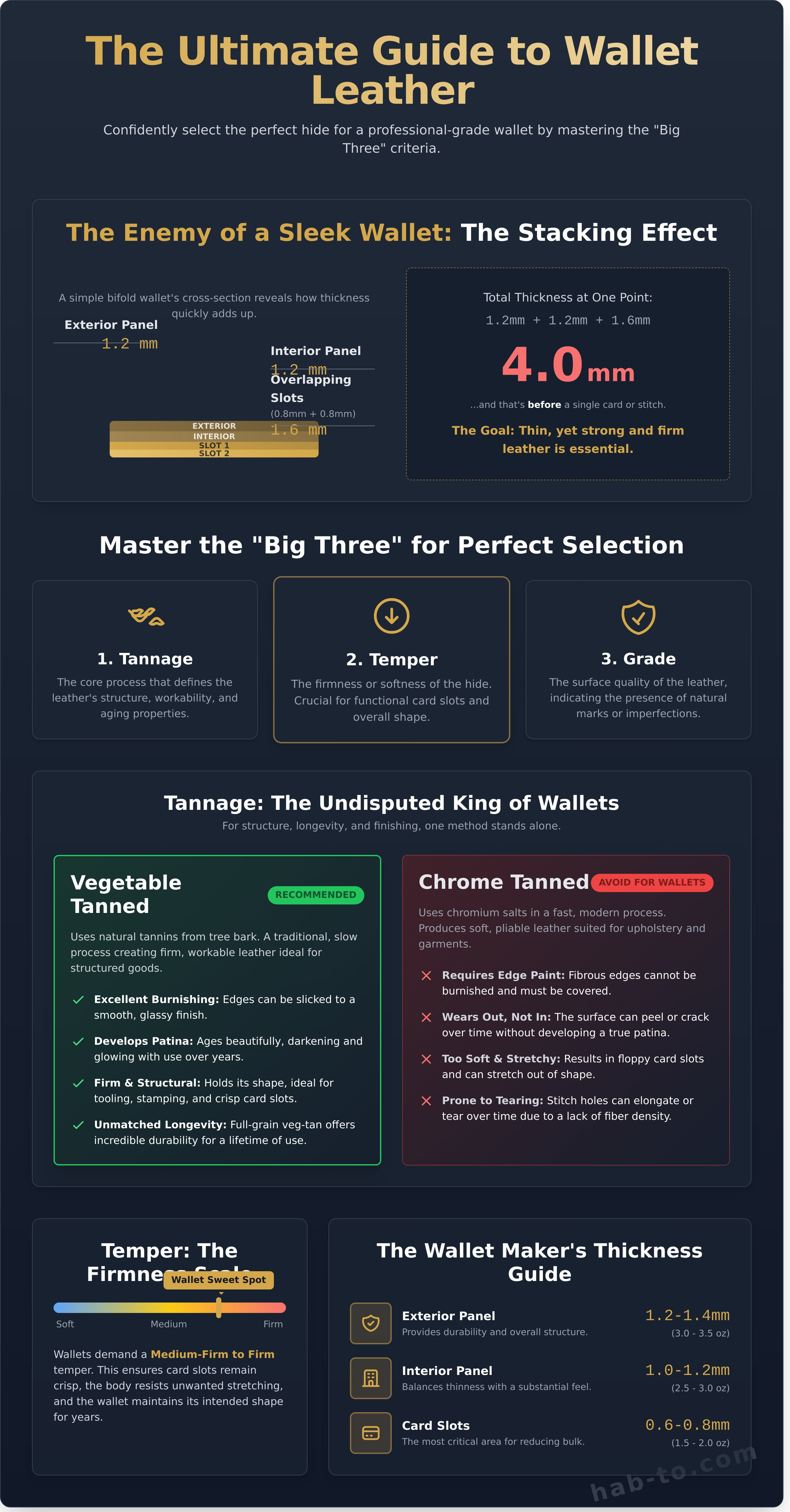
The biggest enemy of a sleek wallet is 'stacking'. Let's do some quick math on a simple bifold. You have an outer panel (1.2mm thick) and an inner panel (another 1.2mm). Now, add two T-slot card pockets on one side, each made from 0.8mm leather. Where those two pockets overlap, you've already got 1.6mm of material. The total thickness at that single point becomes 1.2mm + 1.2mm + 1.6mm = a whopping 4.0mm. That's before a single stitch or credit card. This is why experienced crafters are obsessed with leather that is thin but has a firm, dense fiber structure.
I've seen countless beautiful leathers that are buttery soft and perfect for a jacket lining, but they're a nightmare for wallets. Trying to skive a soft, stretchy chrome-tanned hide often results in it gumming up the blade or stretching out of shape. Stitching it can cause puckering, and the stitch holes themselves can tear over time because the fibers lack rigidity. A great wallet leather isn't just about surface appeal; it's about performance under pressure.
This brings us to our core belief here at Hab-To. For us, there is no debate: vegetable-tanned leather is the undisputed king of wallets. While a comprehensive overview of leather reveals dozens of tanning methods, the traditional veg-tan process creates a material that is uniquely suited for small, structured goods. It's firm, it can be molded, it holds its shape, and it responds beautifully to crafting tools. It’s not just a covering; it's a building material. No synthetics. No compromises.
The Importance of Edge Finishing
A wallet’s edges are its calling card. Raw, fuzzy edges instantly signal an amateur piece. This is where vegetable-tanned leather truly shines. The natural tannins infused into the hide react to friction and heat, allowing you to burnish the edges to a smooth, glassy, and perfectly sealed finish. Chrome-tanned leathers lack these tannins, leaving you with fibrous edges that must be hidden with edge paint, a tedious process that can chip and peel after just a few years of hard use.
Longevity and the Patina Factor
A wallet is a high-friction workhorse. It's pulled from a pocket more than 5,000 times a year, absorbing oils from your hands and polishing against denim. This is where the magic of patina comes in. Full-grain veg-tan leather doesn't just wear out; it wears in. It develops a unique character, darkening and glowing in high-contact spots. This is the story of its owner, written on its surface. For a wallet that lasts 10 years and gets better with every one, full-grain is the only real choice. Its intact grain provides unmatched strength for a lifetime of service.
The Technical Specs: Tannage, Grade, and Temper
Choosing the right hide can feel overwhelming. Walk into any supplier, and you're hit with a wall of options. But here's the secret I've learned from my family's 160+ years in the business: you only need to master three core specifications to find the best leather for wallet making. Think of Tannage, Grade, and Temper as your compass. Get these right, and you're 90% of the way to a wallet that will last a lifetime.
Vegetable Tanned vs. Chrome Tanned for Wallets
The first major decision is the tanning method. This process converts raw animal hide into the durable material we know as leather. For classic, long-lasting wallets, there is one clear winner.
-
Vegetable Tanned (Our Recommendation): This is the traditional way. The vegetable tanning process uses natural tannins from tree bark and other plant matter, which can take up to two months to complete. The result is a firm, structured leather with a beautiful natural grain. It's the only type that can be properly tooled, stamped, and burnished to a glass-like edge. Most importantly, it develops a rich, deep patina over time, telling the story of its use.
-
Chrome Tanned: This modern method uses chromium salts and is much faster, often completed in a single day. Chrome-tan is typically softer, more pliable, and comes in a vast array of vibrant colors. While great for bags or upholstery, its inherent stretchiness makes it a poor choice for card slots, which can become loose. Its edges also can't be burnished, requiring paint or other finishing methods.
-
Combination Tanned: A hybrid that offers a middle ground. It might have the initial structure of a veg-tan but with some of the softness of a chrome-tan. It's a niche choice for specific modern wallet designs but lacks the classic character and workability of a true veg-tan.
After the tanning process, we look at the quality of the hide's surface. This is its 'grade'. Don't be fooled by marketing terms; the difference is simple. Full-grain is the highest quality. It uses the entire top layer of the hide, complete with all its natural scars and markings. It's the strongest and most durable cut. Below that is top-grain, where the very top surface has been sanded down to remove imperfections. It's still good quality, but it loses that unique character. And 'genuine' leather? Avoid it. It's a catch-all term for lower-quality splits that are often painted to look like something they're not.
Understanding Leather Temper (Stiffness)
Temper is the most overlooked, yet critical, specification for wallet function. It describes the leather's stiffness or pliability. A wallet with the wrong temper will either be a rigid brick in your pocket or a flimsy pouch that loses its shape. Finding the right balance is key to creating the best leather for wallet making.
-
Soft Temper: Very pliable and flexible. It’s best reserved for linings or for wallets using a turned-edge construction, where the edges are skived thin and folded over.
-
Medium Temper: This is the sweet spot for 9 out of 10 wallet projects. It has enough body to feel substantial and hold its shape, but it's flexible enough to fold neatly and feel comfortable. Perfect for bifolds, minimalist card sleeves, and most classic designs. If you're just starting, you can't go wrong here.
-
Firm Temper: Very rigid with minimal flex. This is ideal for projects that need maximum structure, like a single-pocket cardholder or the outer shell of a field notes cover.
Nailing this trifecta of a full-grain, vegetable-tanned leather with a medium temper is the foundation of exceptional craftsmanship. When you're ready to feel the difference a premium material makes, take a look at our hand-selected Italian veg-tan leathers to find the perfect starting point for your next project.
Top 5 Leather Recommendations for Professional Wallets
Hi, I'm Mike. As a crafter, the leather you choose is your signature. It's the first thing your customer touches and the last thing they forget. After years of working with hides from around the globe, I've curated a list of the absolute best performers from world-renowned Italian and American tanneries. Your choice here defines the final product. Are you building a rugged, adventurous bifold that tells a story, or a sleek, sophisticated cardholder for the modern professional?
These leathers aren't just passing trends. They are the consistent, reliable choices that master artisans are building their 2026 collections around because of their unmatched quality and aging potential. Investing in premium material can feel like a big step, but it's the difference between a project that fights you at every turn and one that comes together beautifully. Let's find the perfect hide for your skill level and vision.
Pueblo (Badalassi Carlo): The Beginner's Best Friend
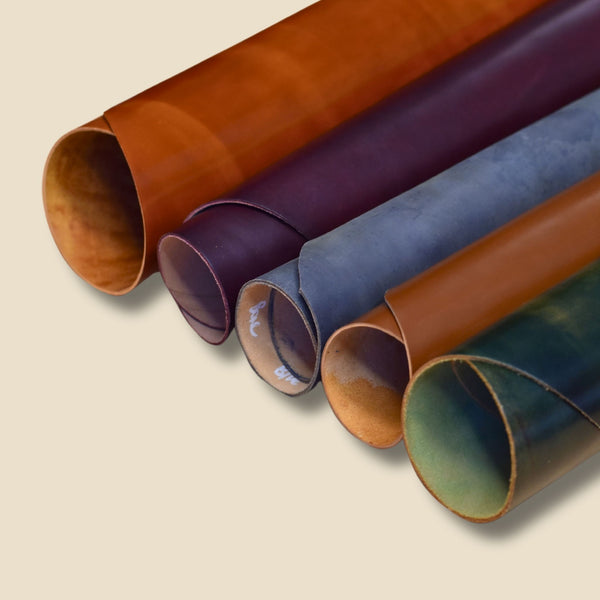
Pueblo is a pure vegetable-tanned leather from the Badalassi Carlo tannery in Tuscany, Italy. What makes it unique is its slightly 'scuffed' surface. It has a distinct, almost suede-like texture that feels incredible in the hand. But the real magic happens over time. This gentle roughness patinas beautifully, smoothing out into a rich, high-gloss finish with a depth of color you won't find anywhere else. For new crafters, it's the most forgiving premium leather available. It cuts like a dream, glues solidly, and its edges burnish to a glass-like shine with minimal effort, giving you a professional result that builds incredible confidence.
Buttero (Walpier): The Sophisticated Standard
When you see a high-end minimalist wallet with impossibly crisp lines and a vibrant, uniform color, there's a very high chance you're looking at Buttero. Hailing from Conceria Walpier, another Tuscan legend, this leather is the gold standard for refined goods. It's firm, smooth, and has a tight grain structure. This is a true full-grain leather, which means it's the highest-quality leather you can buy, utilizing the strongest part of the hide. Its smooth surface, however, requires care. To avoid premature scratches:
-
Always work on a clean, soft cutting mat.
-
Keep your tools sharp and clean.
-
Handle the panels by their edges as much as possible during assembly.
A little mindfulness goes a long way in preserving its flawless finish.
Shell Cordovan: The King of Leathers
Shell Cordovan isn't just leather; it's a statement. Sourced from a specific membrane on a horsehide and tanned over a laborious six-month period by artisans like Horween in Chicago, it's in a class of its own. It's incredibly dense, non-porous, and has a unique self-healing quality. Instead of creasing, it develops soft, elegant rolls over time. A wallet made from Shell Cordovan is a true legacy piece, an heirloom that can genuinely last for generations. Its price, often exceeding $100 per square foot, reflects this rarity and intensive process. This isn't a material for practice. It demands sharp tools, precise patterns, and a confident hand. When you're ready to create a masterpiece, this is the best leather for wallet making, period.
Thickness and Weight: The Wallet Maker's Guide
You can choose the most beautiful hide in the world, but if it's the wrong thickness, your wallet project is doomed before you make the first cut. This is one of the most critical details that separates a clunky, amateur piece from a slim, professional-grade wallet. It's not just about the total thickness; it’s about strategically using different weights for different components to achieve a perfect balance of durability and elegance.
In the world of leather, you'll see two primary measurements for thickness: ounces (oz) and millimeters (mm). It’s a traditional system, but simple once you know the rule. One ounce of leather equals 1/64th of an inch in thickness, which is approximately 0.4mm. So, a 3 oz leather is about 1.2mm thick. We list both on our products because clarity is key for quality craftsmanship.
A 'one size fits all' approach simply doesn't work for wallet construction. Imagine building a bifold wallet entirely from a beautiful but sturdy 1.5mm (4 oz) leather. The outer shell would be fine, but once you add four card slots on each side, you're looking at a disaster. Let's do the math: an outer layer (1.5mm), an inner layer (1.5mm), and eight card slots (8 x 1.5mm = 12mm) add up to a staggering 15mm of leather at the seams, even before folding. That’s a brick, not a wallet.
Recommended Thickness by Component
To avoid creating a pocket monster, you must think in layers. Each part of the wallet has a different job, and its thickness should reflect that. Here are the standards we use in our own workshop and recommend to fellow crafters searching for the best leather for wallet making:
-
Outer Shell: 1.2mm to 1.5mm (3-4 oz). This is your wallet's first line of defense. This thickness provides excellent structure, durability, and protection for the contents without being excessively rigid.
-
Internal Card Slots: 0.8mm to 1.0mm (2-2.5 oz). This is where you save the bulk. These pieces need to be durable enough to handle daily use but thin enough to stack without creating a massive bulge.
-
Linings: 0.4mm to 0.6mm (1-1.5 oz). If you're adding a lining for a touch of luxury or a pop of color, it should be paper-thin. A fine goat or calfskin at this weight adds a premium feel with almost no added thickness.
The Art of Skiving and Essential Tools
Achieving these precise thicknesses often requires thinning the leather yourself, a process called skiving. This is especially important along the edges where you'll be folding and stitching. By skiving the edges, you create a tapered profile that allows for crisp, clean folds and flat, strong seams. It’s a non-negotiable skill for high-end wallet making.
To control this process, you need the right gear. A sharp skiving knife or a safety skiver is fundamental for accurately removing material. Just as crucial is a digital thickness gauge. It allows you to check your work constantly, ensuring every card pocket is a consistent 0.8mm, not a random assortment of 0.7mm to 1.1mm. Precision is everything. If you're building your workshop, check out our essential leatherworking tools for beginners for our trusted recommendations.
Ultimately, mastering leather thickness is a core discipline in finding the best leather for wallet making. It's about planning your layers and having the skill to modify your material to fit your design. Ready to find the perfect hide for your next project? Browse our collection of premium leathers, available in the precise thicknesses you need.
Hab-To Leather House: Premium Materials, No Compromises
Hi, I'm Mike. For over 160 years, my family has been immersed in the world of premium leather. That's not just a number; it's four generations of expertise poured into sourcing the absolute finest hides for artisans like you. This legacy means we don't just sell leather. We partner with you, ensuring the material you choose has the right temper, finish, and character to bring your wallet designs to life. We've built our reputation on a simple principle: No synthetics. No compromises. Just quality materials for real craftsmanship.
We understand that great craftsmanship often starts small. That's why we established our 'No Minimum Order' promise. Unlike traditional wholesalers who require you to purchase an entire side, we empower you to buy exactly what you need, whether it's a single panel of Buttero for a prototype or a small cut of Shell Cordovan for a special commission. This approach supports the independent maker, the weekend hobbyist, and the small-scale artisan, giving you access to world-class materials without the prohibitive upfront cost.
Our commitment to quality is inseparable from our commitment to the planet. We exclusively source and supply vegetable-tanned leathers from the world's most respected tanneries, including Italy's Conceria Walpier and La Perla Azzurra. We believe these eco-conscious hides, tanned using natural tannins from bark and leaves, are simply the best leather for wallet making. They develop a rich, beautiful patina over time and offer an unmatched crafting experience. Your project is more than just a wallet; it's a story. And that story shouldn't begin with harsh chemicals.
A wallet is more than just its leather. The final details are what elevate a good project to a great one. That's why we provide a curated selection of professional-grade supplies to complete your work. You'll find:
-
Hardware: Solid brass and stainless steel buckles, snaps, and rivets that offer lifetime durability.
-
Thread: Premium linen threads like Fil au Chinois and Ritza 25 Tiger Thread for strong, beautiful saddle stitching.
-
Tools & Dyes: From Japanese cutting tools to Giardini edge paints, we stock the essentials to give your wallet a flawless finish.
The Amsterdam Showroom Experience
There is no substitute for seeing and feeling leather in person. We invite you to book an appointment at our Amsterdam showroom. Here, you can personally inspect our collection, feel the waxy finish of a Pueblo hide, and see the deep colors of our shell cordovan. During a personalized consultation, we can help you match the perfect hide to your specific wallet pattern, ensuring your final product is exactly as you envisioned.
Start Your Next Project Today
Don't wait until you feel your skills are 'perfect' to work with premium materials. Using high-quality leather from day one accelerates your learning and results in pieces you can be proud of immediately. For an easy start, explore our curated 'Crafting Bundles,' which include pre-cut leather, thread, and instructions for projects like our Minimalist Cardholder. Your search for the best leather for wallet making ends here.
Browse our full leather collection and find your perfect hide.
Turn Your Vision into a Lasting Wallet
Choosing the best leather for wallet making isn't about finding one single 'perfect' hide. It's about mastering the details. Your project's success depends on matching the right technical specs, like a firm temper and a specific thickness between 1.0mm and 1.4mm, to your unique design. Understanding how a textured leather like Pueblo differs from a smooth Buttero is what elevates a good wallet into a true piece of craftsmanship.
That's where our expertise can guide you. At Hab-To Leather House, we pour 160+ years of family experience into every hide we select. We're committed to quality materials for real artisans, which is why we exclusively offer premium, sustainable, vegetable-tanned hides. No synthetics. No compromises. And with no minimum order requirements, you get exactly the right piece for your project, every time.
Hi, I'm Mike! Browse our hand-selected leathers for your next wallet project.
Your next masterpiece is waiting. Let's build something that lasts.
Frequently Asked Questions
What is the absolute best thickness for a bifold wallet?
The ideal thickness for a bifold wallet exterior is 1.2-1.4mm (3-3.5 oz), with interior pockets at 0.8-1.0mm (2-2.5 oz). This combination keeps the wallet slim yet ensures it's durable enough for years of daily use. Using leather thicker than 1.6mm for the exterior often results in a bulky final product. For a refined look, skiving the pocket edges down to 0.6mm creates a much cleaner, professional-looking fold.
Can I use chrome-tanned leather for wallet making?
Yes, you can use chrome-tanned leather, but it behaves very differently from vegetable-tanned leather. Chrome-tan is often softer and more pliable from the start, which can suit certain minimalist designs. However, its edges cannot be burnished and must be painted. For crafters seeking the best leather for wallet making that develops a rich patina and allows for tooling, vegetable-tanned leather remains the preferred choice for over 90% of traditional artisans.
Why is vegetable-tanned leather so much more expensive?
Vegetable-tanned leather costs more because the tanning process is significantly longer and more labor-intensive. A typical chrome-tanning process can be completed in about 24 hours. In contrast, traditional vegetable tanning requires 30 to 60 days, using natural tannins from materials like tree bark. This slow, artisanal method demands more skilled labor and time, which is reflected in the final price of premium hides like Buttero or Pueblo.
How many card slots can I stack before the wallet gets too bulky?
You can typically stack three card slots per side, for a total of six, before a classic bifold design becomes too thick. This calculation assumes you're using 0.8mm (2 oz) leather for the pockets. Adding a fourth slot on each side would introduce at least 3.2mm of extra thickness at the wallet's fold, making it uncomfortable in a pocket. For more capacity, consider a T-slot design which staggers the layers to reduce bulk.
Do I need to line my leather wallets?
No, lining a wallet is not necessary, especially when you're working with high-quality full-grain leather. A premium veg-tan leather has a clean, finished flesh side that looks and feels great without any additions. Lining is a stylistic choice, often done with thin pigskin or goat leather (around 0.5-0.6mm) to add a pop of color or a different texture. An unlined wallet is a fantastic way to showcase the leather's natural beauty.
What is 'temper' and why does it matter for cardholders?
Temper describes the stiffness or pliability of a piece of leather, and it's crucial for ensuring cardholders hold their shape over time. For a cardholder or wallet pocket, you need a medium-to-firm temper. This prevents the card slots from stretching out and losing their grip after a few months of use. A leather with a soft temper, while feeling luxurious, won't provide the necessary structure to keep your cards secure.
Is Shell Cordovan worth the price for a beginner?
No, Shell Cordovan is generally not a wise investment for a beginner due to its high cost and difficult handling. A single shell can cost over €100, making any cutting mistake very expensive. It’s a dense, unique material that requires specific techniques that differ from cowhide. I always advise new crafters to complete at least 10-15 projects with more forgiving leathers before attempting to work with the beautiful but demanding Shell Cordovan.
How do I care for a vegetable-tanned leather wallet?
Proper care for a new vegetable-tanned wallet involves minimal conditioning and protection from excessive water. For the first 6 to 12 months, the natural oils from your hands are all it needs to begin developing its patina. After that, a light application of a quality conditioner like Smith's Leather Balm once or twice a year is sufficient. If it gets wet, simply let it air dry slowly, away from any direct heat source.