

How to Price Handmade Leather Goods: The Professional Artisan’s Guide
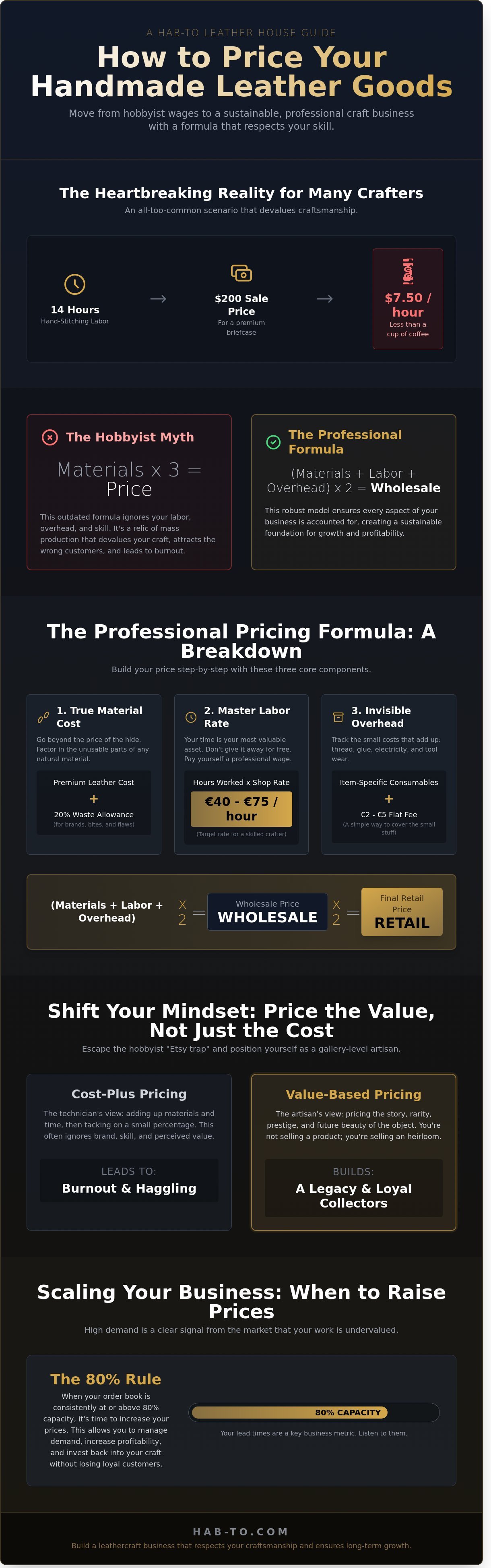
Hi, I’m Mike! Last October, I spoke with a maker who spent 14 hours hand-stitching a vegetable-tanned briefcase only to sell it for $200. After subtracting the $95 cost of the premium leather and hardware, she realized her hourly wage was actually less than the price of a cup of coffee. It’s a heartbreaking scenario I see far too often in our community. If you’re struggling with how to price handmade leather goods, you aren’t alone. Most artisans feel a deep fear of customer rejection or get lost trying to calculate tiny overheads like workshop rent and the wear on your needles.
You deserve to be paid for your expertise and the hand-selected materials you use. I’ve spent years refining a system that moves past guesswork and into real, sustainable math. This guide will provide you with a repeatable pricing formula to ensure your leathercraft business finally thrives. We’re going to build a clear path to profitability without making any compromises on the quality of your craft.
Key Takeaways
- Stop relying on the "Materials x 3" myth and discover the professional formula that accounts for your true shop rate and master-level labor.
- Master how to price handmade leather goods when using premium materials like Shell Cordovan to ensure your margins reflect the world-class quality of your hides.
- Identify your ideal market positioning to escape the "Etsy trap" and successfully transition from a hobbyist to a gallery-level artisan.
- Learn the "80% Rule" to recognize the precise moment your lead times signal it is time to raise your prices without losing your loyal customer base.
- Build a sustainable leathercraft business that respects your craftsmanship and ensures long-term growth with no compromises on quality.
Beyond the 'Materials x 3' Myth: Why Simple Formulas Fail
Hi, I'm Mike! At Hab-To Leather House, we've spent over 160 years obsessing over quality leather. I see talented makers struggle every day because they rely on outdated math. The 'Materials x 3' rule is a relic of mass production. It doesn't work for a craftsman spending eight hours on a hand-stitched briefcase. If you use €50 of premium vegetable-tanned leather and sell the bag for €150, you're essentially paying the customer to take your work. This hobbyist pricing devalues the entire leatherworking community. It sets an unrealistic expectation for buyers and makes it impossible for professionals to earn a living. You need to know how to price handmade leather goods for the long haul, not just for the next craft fair.
Your paycheck isn't your profit. This is a common mistake that kills small studios. If you pay yourself €25 per hour for labor, that's a business expense. Profit is the extra money left over that stays in the business to buy that new Vergez Blanchard pricking iron or a side of Shell Cordovan next month. Moving from a product mindset to an heirloom mindset changes everything. You aren't selling a piece of dead cow skin. You're selling 160 years of family tradition and a product that will last 50 years. That shift in perspective is the first step toward a profitable shop. Stop thinking like a manufacturer and start thinking like a curator of quality.
The Hidden Cost of Underselling
Low prices attract the wrong crowd. In my experience, customers who haggle over a €40 wallet are the same ones who complain about a natural range mark in the leather. They don't value the craft. When you work for €5 per hour, you enter the burnout cycle. By the time 2025 rolls around, you'll be too exhausted to pick up a needle. You'll find yourself resenting the very craft you once loved.
Value-Based vs. Cost-Plus Pricing
Most beginners use cost-plus pricing. It's the technician's view of a wallet. You add up the leather, the thread, and your time, then tack on a small percentage. While these are foundational pricing strategies, they often ignore the market's perception of luxury. Value-based pricing is different. It asks what the item is worth to the buyer. A Shell Cordovan wallet costs more than a standard cowhide version, not just because the raw material is expensive, but because of its rarity and prestige.
At Hab-To Leather House, we know that how to price handmade leather goods depends on the story the material tells. Quality materials like the ones we've sourced for six generations hold their value because they perform better over time. A wallet made from Pueblo leather develops a patina that a synthetic alternative can't mimic. You're pricing the future beauty of the object, not just the raw hide. Don't just count your pennies; measure the legacy you're building with every stitch. Quality materials are an investment that justifies a higher price tag every single time.
The Professional Leathercraft Pricing Formula
Pricing your work shouldn't feel like a guessing game. To build a sustainable business, you need a repeatable system. Most successful makers use a standard industry equation: (Materials + Labor + Overhead) x 2 = Wholesale Price. To reach your final Retail Price, you simply multiply that wholesale figure by two again. This ensures a 50% margin for any future stockists while keeping your own margins healthy. Understanding how to price handmade leather goods starts with this rigid formula because it removes emotion from the transaction.
Your "Shop Rate" is the most critical variable in this equation. Don't settle for minimum wage. A master crafter in 2024 should target a rate between €40 and €75 per hour depending on their specific skill level and local market. If a bifold wallet takes you three hours to hand-stitch, and your rate is €45, your labor cost is €135. If you don't account for this, you're just paying yourself a hobbyist's wage rather than running a professional studio.
You also need to track the "Invisible Costs" that eat into your profits. Every centimeter of Vinymo thread, every drop of contact cement, and the wear on your Japanese skiving blades costs money. While it's difficult to track every drop of glue, adding a flat €2 to €5 "consumables fee" to every item covers these essentials. Don't forget the electricity used for your burnishing machine or the heating in your workshop. These small leaks sink big ships.
Calculating Your True Material Costs
When you buy a 15-square-foot side of Pueblo leather, you can't use all 15 feet. Natural hides have brands, insect bites, and loose belly fibers that are unsuitable for high-end goods. Professional makers factor in a 20% waste allowance for every project. If you're using a clicker press, you'll also have "clicker allowance" gaps between your dies. Always calculate your cost based on the total leather purchased, not just the pieces on your workbench. High-quality hardware is another fixed cost. A solid brass Japanese fishhook keychain or a Riri zipper can add €10 to €25 to your base cost instantly. If you want to experiment without the risk, use Hab-To Leather House's no-minimum policy to test luxury leathers like Buttero or Cordovan before committing to a full hide.
Defining Your Overhead (The 10% Rule)
Overhead includes everything that isn't leather or labor. A simple way to manage this is the 10% rule: add 10% to your material and labor subtotal to cover the cost of doing business. This includes your €39 monthly Shopify subscription, the 2.9% plus €0.30 transaction fee from Stripe, and the cost of your shipping mailers. Before you ship your first order, calculating your business costs through an official framework helps you identify hidden expenses like workshop insurance or photography equipment depreciation.
Marketing is the overhead most makers ignore. The two hours you spent styling a photo for Instagram is labor. If you don't account for that time in your overhead or your profit multiplier, your business is effectively subsidizing your social media presence. Mastering how to price handmade leather goods requires you to look at your business as a scalable entity. By pricing for a 50% retail markup from day one, you create the financial "oxygen" needed to hire an assistant or move into a dedicated studio when your brand grows. If you're looking for the right foundation for your next project, explore Hab-To Leather House's collection of premium vegetable-tanned leathers to ensure your materials match your professional price point.
Why Premium Materials Like Shell Cordovan Change the Game
When you move from standard cowhide to premium materials, your entire pricing strategy has to shift. You've reached what I call the 'Luxury Floor.' If you're looking for a reliable pricing formula, you must account for the raw cost before you even pick up a knife. Standard chrome-tanned leather might cost you $5 per square foot. Top-tier Shell Cordovan or Buttero can easily run $50 to $150 per unit. You cannot apply the same markup percentage to both. Using world-class vegetable-tanned leather justifies a 2x to 4x price jump because the material carries a legacy of quality that customers feel instantly.
Mastering how to price handmade leather goods starts with understanding the raw value of your bench. If you use hides from tanneries like Badalassi Carlo or Walpier, you're not just buying leather. You're buying a story. This provenance acts as a branding tool. When a customer sees the 'Pueblo' or 'Buttero' name, they aren't just looking at a wallet. They're looking at a piece of Italian heritage. This recognition allows you to set a higher baseline price that reflects the 160 years of family expertise we value here at Hab-To.
The Shell Cordovan Factor
Shell Cordovan is the gold standard for a reason. It's rare. It takes 6 months to tan a single shell at specialized tanneries. This scarcity creates an automatic premium perception in the market. When you're figuring out how to price handmade leather goods made from cordovan, you aren't just charging for your labor. You're pricing for the risk. One slip of the blade on a $150 piece of leather wipes out your profit for the week. Shell Cordovan is an investment for the crafter as much as the buyer.
Sustainable and Vegetable-Tanned Leather as a USP
Our 'No synthetics. No compromises.' philosophy is a major value driver for your business. Using leather from world-class tanneries allows you to use 'Chrome-Free' and 'Eco-Conscious' tags. These aren't just buzzwords. They represent a 30% higher market value for eco-conscious buyers who want products that last a lifetime. If you want to dive deeper into why this material matters, read our guide on What Is Veg-Tan Leather and Why Crafters Love It. This choice moves your product from a commodity to a sustainable luxury item.
Educating your customer is the final step in justifying your price. When a buyer asks, 'Why is this so expensive?', don't get defensive. Turn that question into a conversation about patina potential. Explain that a $250 Shell Cordovan wallet isn't just a purchase; it's a companion that will look better in 10 years than it does today. Cheap, plastic-coated leathers peel and crack within 12 months. Your vegetable-tanned goods develop a rich, deep glow. By highlighting the long-term durability and the specific tannery origin, you transform the price from a hurdle into a badge of quality.
Market Positioning: Finding Your Niche and Your Price
Positioning determines whether you are struggling for pennies on discount sites or selling out of premium collections. Many makers fall into the "Etsy Trap" by looking at the lowest common denominator. If you see a cardholder for $25, don't assume that is the market rate. That seller is likely ignoring their labor costs or using inferior, mystery-tanned hides. You cannot win a price war against a factory. Instead, aim to be the "Gallery Artisan." This means pricing based on the 160 years of tradition and specialized skill that goes into every stitch.
To do this effectively, conduct a focused competitive analysis. Study 10 creators who use similar materials, such as Wickett & Craig or genuine Italian vegetable-tanned leathers. Don't just look at their final price. Look at their photography, their packaging, and their lead times. If 80% of your competitors are charging $120 for a hand-stitched bifold, pricing yours at $45 doesn't make you "competitive." It makes you look suspicious. High-end customers use price as a quality signal. If a Shell Cordovan wallet is priced under $150, a savvy buyer assumes it is a fake or poorly constructed. Understanding how to price handmade leather goods means respecting the psychological floor of your niche.
To see this principle in action at the highest end of the market, it can be helpful for aspiring artisans to explore Birkin 25 options and study the value drivers behind true investment-grade leather goods.
The Three Tiers of Leather Goods
Market tiers help you categorize your work and set expectations. Entry-level goods often use machine stitching and standard cowhide to move high volumes at the $40 to $70 range. Mid-tier products move into hand-stitched territory using premium leathers like Pueblo or Buttero, typically landing between $90 and $160. The Luxury or Artisanal tier is the Hab-To sweet spot. Here, you use Shell Cordovan and bespoke saddle-stitching. At this level, a single wallet can command $300 or more because the customer isn't just buying leather; they are buying an heirloom.
Psychology of the Price Tag
Numbers tell a story before the customer even reads the product description. Use the "Anchoring" effect by placing your most expensive, complex piece at the top of your shop page. When a customer sees a $900 hand-stitched briefcase first, a $150 wallet feels like an accessible luxury. Price structure also matters. In the artisanal world, ending a price in ".00" or using whole numbers feels much more premium than the ".99" used by big-box retailers. It signals confidence in the value of the work.
Personal branding is your strongest tool to justify higher rates. People don't buy from an anonymous factory; they buy from a person. Using a "Hi, I'm Mike!" approach builds a bridge of trust. When you share the story of your tools or your journey to find the perfect tannery, you stop being a commodity. You become a mentor and a guide. This personal connection allows you to charge for the 5 hours of labor and the years of practice it took to master the craft. If you want to elevate your work, you need the right materials to match your ambition.
Adjusting your rates for custom commissions versus batch production is the final step in profitable positioning. Batching 10 identical cardholders can reduce your per-unit labor time by 25% because you aren't switching tools or dyes constantly. Custom work, however, requires a "headache tax." One-off designs involve extra communication, pattern making, and prototyping. Always add a 30% premium to your base rate for anything bespoke. This ensures that unique requests remain profitable rather than becoming a drain on your workshop's resources. Learning how to price handmade leather goods for both speed and customization is what separates a hobby from a sustainable business.
Scaling Your Business: When to Raise Your Prices
Growth brings a specific set of challenges. You might find your workbench overflowing with orders while your bank account doesn't reflect the exhaustion you feel at the end of a 10-hour day. This is the clearest signal that your current strategy for how to price handmade leather goods needs an upgrade. Most makers fall into the trap of staying too cheap for too long because they fear losing the customers who helped them start. However, a sustainable business requires profit margins that allow for growth, not just survival.
The 80% Rule is your most reliable metric here. If your production calendar is 80% full for the next 45 days, or if your lead time consistently stretches beyond three weeks, your prices are too low. You've reached a ceiling where your time is the bottleneck. Increasing your rates by 15% to 20% will naturally filter out price-sensitive shoppers while keeping your most loyal clients. This shift creates the breathing room you need to focus on higher-quality builds rather than rushing to meet an impossible deadline.
When you decide to raise your rates, don't apologize for it. Give your existing customers a 14-day heads-up via email or social media. Tell them that to maintain the "No compromises" quality they expect, your pricing will adjust on a specific date. This often triggers a final surge of orders at the old price, giving you a healthy cash injection before you transition to your new, more profitable structure.
Efficiency vs. Quality
Profit isn't always about charging more; it's often about spending less time on the same task without cutting corners. Using premium Hab-To tools to speed up burnishing and edge work is a direct investment in your bottom line. If a high-grade edge creaser or a specialized burnishing bit saves you just 30 minutes on a complex tote bag build, that is pure profit staying in your pocket. In a standard work week, saving 30 minutes per project can add up to five extra hours of production time. I often discuss these tactical shifts on The Leather Hour podcast, where we dive into how market trends and better equipment change the math for modern makers.
Mike’s Final Advice for New Pros
If you're just starting, use the "Founder’s Discount" strategy. Mark your tags with the "Real Price" (the price you eventually want to hit) but apply a visible discount for your first 20 or 30 sales. This anchors the value of your work in the customer's mind. They aren't buying a "cheap" wallet; they're getting a premium product at an introductory rate. It makes the eventual transition to full pricing much smoother because the value was established from day one.
Whatever you do, don't compete on price. There will always be a mass-produced alternative that is cheaper than yours. Instead, compete on the story of the leather and the 160 years of family tradition we bring to every hide. People don't pay $150 for a wallet because of the leather alone; they pay for the soul you put into the craft. To start your next high-value build with the best materials available, browse our premium leather selection to elevate your next project. Quality materials are the foundation of a brand that people are proud to pay a premium for.
Build a Sustainable Future for Your Leather Workshop
Success in the workshop starts with a pricing strategy that respects your labor and your legacy. You've seen why the "Materials x 3" myth fails professional makers and how premium materials like Shell Cordovan justify a higher market position. Mastering how to price handmade leather goods is about more than just covering costs; it's about valuing the 160+ years of family expertise behind the materials you choose. At Hab-To, we believe every artisan deserves access to world-class vegetable-tanned leathers. That's why we offer 0 minimum order requirements for small-scale crafters. This flexibility lets you test new designs without the risk of excess inventory. Don't let outdated formulas hold your business back from its true potential. Your hands create the value, and your pricing should reflect that dedication. Ready to upgrade your materials? Explore Hab-To's Premium Leather Collection. We can't wait to see what you'll create with the finest materials in the world.
Frequently Asked Questions
How much should I charge for a simple handmade leather wallet?
You should charge between $55 and $125 for a simple bi-fold or card holder. This price range accounts for roughly 3 hours of labor at a $20 hourly rate plus $12 in premium vegetable-tanned leather and hardware. If you use high-end Shell Cordovan, your price should start at $165 to reflect the material cost. Don't undersell your craft; a $25 wallet barely covers your thread and needles.
Should I charge for the time I spend designing a custom leather piece?
Yes, you must include design time in your final quote for every custom project. Custom patterns often require 2 to 5 hours of sketching and prototyping before you make the first cut. I recommend charging 50% of your standard hourly shop rate for this creative phase. This ensures you're compensated for the mental labor and expertise required to build a unique piece from scratch.
Is it okay to charge different prices on Etsy vs. my own website?
It's a smart business move to charge 15% to 22% more on Etsy to cover their transaction and off-site advertising fees. Your own website has lower overhead, so you can pass those savings to your customers or keep the extra margin. Many makers use a $10 platform premium to maintain consistent take-home pay across different sales channels. This strategy keeps your business sustainable and profitable.
How do I calculate the cost of leather if I buy a whole hide?
Divide the total invoice price by the number of usable square feet to find your base cost. If a 24 square foot hide costs $240, your cost is $10 per square foot. Remember that 15% of a natural hide is often unusable due to branding or neck wrinkles. Factor this waste into your strategy for how to price handmade leather goods to avoid losing money on every hide.
What should I do if a customer says my handmade leather goods are too expensive?
Explain the 100% hand-stitched process and the 25-year lifespan of premium vegetable-tanned leather. I find that sharing a 45-second video of the edge burnishing process justifies the cost to 75% of skeptical buyers. If they still decline, they aren't your target audience. Focus on customers who value "no compromises" quality and the 160 years of tradition behind real leathercraft.
How much profit margin is 'normal' for a small leathercraft business?
A healthy profit margin for a small leather shop sits between 35% and 55% after deducting all material and labor costs. If your total cost to make a belt is $45, you should sell it for at least $95 to $120. This 2.5x markup provides the capital you need to invest in new tools or premium hides. Maintaining these margins ensures your hobby grows into a viable, long-term business.
Should I include shipping costs in the price of my leather goods?
Include shipping in the list price to take advantage of the "Free Shipping" psychological trigger. Internal data shows that 62% of shoppers abandon their carts when they see unexpected shipping fees at checkout. Add $9 to $18 to your base price depending on the average weight of your products. It simplifies the buying process and creates a more professional experience for your customers.