
Leather Thickness for Belts: The Ultimate Crafter’s Guide (2026)
Hi, I'm Mike. Ever wonder why that beautiful 9 oz veg-tan belt you crafted feels more like a piece of armor than a refined accessory? It’s a common frustration in the workshop. I see crafters get tangled in the web of ounces versus millimeters, worrying their next project will stretch into an unusable strap. That uncertainty between using a single thick layer or two thinner ones can stop a great project before it even starts.
No more compromises. My promise is simple: by the time you finish this guide, you will master the art of selecting the perfect leather thickness for belts for any project you can imagine. We're going to give you the confidence you need with a clear chart for every belt type, a breakdown of why certain tannages are superior for durability, and a guide to matching your hardware to your leather’s weight. Let's build something that lasts a lifetime, the right way.
Key Takeaways
- Decode traditional leather measurements by understanding the relationship between ounces (oz) and millimeters (mm) to confidently select your material.
- Master the art of choosing the perfect leather thickness for belts by matching the weight to the style, from everyday casual to heavy-duty workwear.
- Discover why the tanning method is just as crucial as thickness for a belt's longevity and why not all 4mm leathers perform the same.
- Ensure a professional finish by learning how to perfectly match your hardware, like buckles and thread, to your chosen leather's weight.
Understanding Leather Thickness: Ounces vs. Millimeters
Hi, I'm Mike. Let’s tackle one of the first and most confusing topics for any crafter: leather thickness. You see a hide listed as "8-9 oz" and your pattern calls for "3.5mm." What gives? It's a question I get almost daily here at our Amsterdam workshop. Getting this right is the foundation for a great project, especially when you're determining the perfect leather thickness for belts that need to last a lifetime.
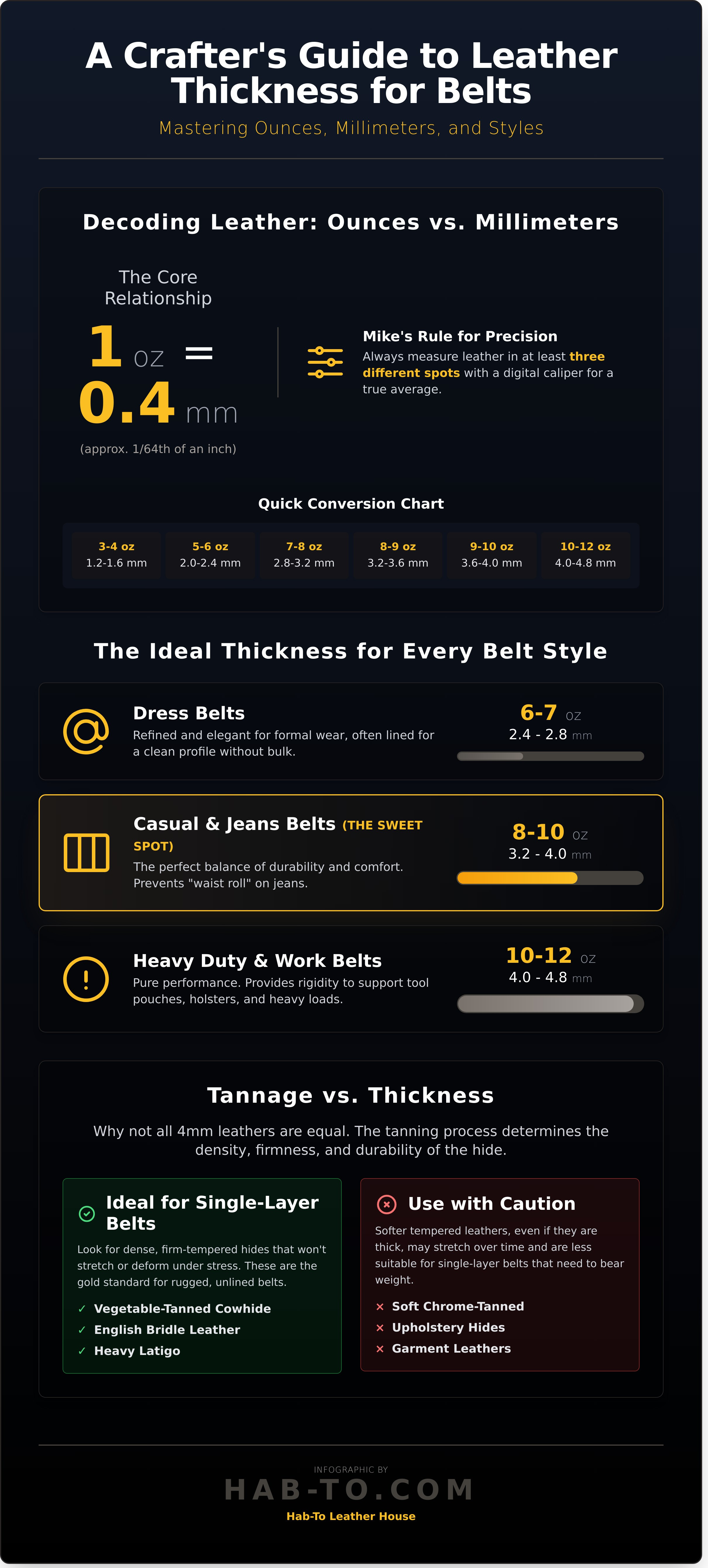
The system is a holdover from traditional tanneries, where leather was measured by weight. The core relationship is simple, but not always exact:
- 1 ounce (oz) = 0.4 millimeters (mm)
- 1 ounce (oz) = 1/64th of an inch
But here's the critical detail: an "ounce" in leather terms technically refers to the weight of a square foot of hide. A piece of 3 oz leather should weigh approximately 3 ounces per square foot. This is why it’s not a perfect linear measurement. The density of the hide, a direct result of the animal and the Leather production process, can cause slight variations. A more compressed, dense hide might be physically thinner but have the same "ounce" as a slightly thicker, less dense hide. It's about the feel and substance, not just a number.
Because a hide is a natural material from an animal, it's never perfectly uniform. The thickness over the dense spine will differ from the softer belly. That’s why I have one non-negotiable rule in my craft: Mike's Rule is to always measure in at least three different spots. This gives you a true average and prevents surprises. To do this, you can't rely on a standard ruler. Every serious crafter needs a reliable digital caliper or, even better, a dedicated leather thickness gauge. Precision is not a luxury; it's a requirement for quality craftsmanship.
The Global Conversion Framework
For crafters working with patterns from different regions, a quick conversion is essential. A standard belt weight of 8/9 oz leather, for example, converts directly to 3.2mm - 3.6mm. The ounce system persists, especially in the North American market, because of its deep roots in the heritage of leatherwork. Here at Hab-To, we bridge that gap. We hand-select our hides and personally verify that our Amsterdam-based inventory meets these precise specifications, ensuring the 8/9 oz vegetable-tanned leather you buy from us is consistently within that ideal range.
Why Tolerance Matters
You’ll often see a thickness tolerance listed, such as +/- 0.2mm. This isn't a flaw; it's an honest reflection of leather's natural character. To achieve a more uniform thickness, tanneries use a process called splitting, which is the mechanical process of leveling a hide to a specific thickness with a large blade. Even so, minor variations remain. When cutting your belt blanks, feel for any "thick spots." You can often cut around them or use a sharp skiving knife to carefully level the area where the buckle will be folded, ensuring a clean and professional fit. This attention to detail is what separates good work from great work.
The Ideal Leather Thickness for Every Belt Style
There's no single "best" answer for the ideal leather thickness for belts, because the belt's job dictates its construction. A belt meant for holding up a pair of suit trousers has a vastly different set of requirements than one designed to carry a multi-tool on a construction site. Let's break down the three primary categories so you can choose your material with confidence.
For everyday Casual and Jeans Belts, the sweet spot is between 8 oz (3.2mm) and 10 oz (4.0mm). This thickness provides a fantastic balance of durability and comfort. It's substantial enough to feel secure and prevent your jeans from sagging, yet it's not so bulky that it feels restrictive. Anything thinner than 8 oz in a single layer, and you risk the dreaded "waist roll," where the leather folds over on itself at the belt loops after a few months of wear.
When you need pure performance, you'll want a Heavy Duty or Work Belt. For these, stepping up to a 10 oz (4.0mm) or even a 12 oz (4.8mm) leather is the right call. This extra heft is essential for providing the rigidity needed to support tool pouches, holsters for concealed carry (CCW), or just the general abuse of a demanding job. The dense, thick leather won't twist or sag under load, ensuring your gear stays exactly where you put it.
Finally, Dress Belts require a more elegant and refined approach. Here, a thinner leather of 6 oz to 7 oz (2.4mm - 2.8mm) is standard. But here's the critical detail: a quality dress belt is almost never a single layer. That thinner leather is paired with a liner to provide structure and a clean finish, creating a sophisticated profile that complements formal wear without adding bulk.
The "Single Layer" Standard
The unlined, single-layer belt is a timeless classic, celebrated for its rugged simplicity. The best leathers for this style are dense, firm-tempered hides. We're talking about premium vegetable-tanned cowhide, English bridle, and heavy latigo. The unique fiber structure of these leathers, which is permanently altered during the tanning process, gives them incredible tensile strength. A single strap of 9 oz (3.6mm) veg-tan can easily last for 20+ years, developing a beautiful patina along the way. It's the industry standard for a true "lifetime" belt.
Lined and Stitched Belts
For a more luxurious and polished look, a lined and stitched belt is the pinnacle of the craft. This technique involves laminating two thinner layers of leather together. For example, you could pair a 4 oz (1.6mm) piece of beautiful Italian Pueblo for the face with a sturdy 4 oz (1.6mm) veg-tan liner. The result is a robust 8 oz belt that has a refined appearance. The stitching isn't just for show; it adds significant structural rigidity, making a lined 8 oz belt often feel more solid than its single-layer counterpart. If you need advice on pairing a premium face leather with the right liner, we're always here to help you find the perfect match.
Tannage vs. Thickness: Why Not All 4mm Leathers Are Equal
You’ve found the perfect hide. The caliper reads a solid 4mm (10 oz), and you’re ready to cut a belt that will last a lifetime. But hold on. If that hide is chrome-tanned, you might be in for a surprise. The number on your thickness gauge tells only a fraction of the story. The real secret to a durable belt lies not just in its thickness, but in the density and structure of its collagen fibers, a direct result of the tanning process.
It’s a fact we see in our workshop daily: a 3mm strip of high-quality vegetable-tanned leather will often outlast and stretch less than a 4mm piece of standard chrome-tanned leather. Why? The tanning process. Veg-tanning uses natural tannins from bark and plants, which penetrate and bind the leather’s fibers into a tight, dense structure. This gives the leather "memory," allowing it to mold to the wearer without permanently stretching. Chrome-tanning, which uses chromium salts, results in a more open and flexible fiber structure. While great for upholstery or garments, this process can allow for up to 20% more stretch in a belt over its lifetime compared to a comparable veg-tan hide.
The Hab-To Choice: Veg-Tan vs. Chrome-Free
Here at Hab-To, our "No compromises" philosophy leads us directly to vegetable-tanned hides. This isn't just about tradition; it's about performance. The dense fiber structure of veg-tan is essential for a clean, professional edge burnish, a hallmark of quality belts. Try burnishing a chrome-tan edge and you’ll get frayed, messy fibers. That’s why we stock leathers from tanneries like Italy's Conceria Walpier (Buttero) and Badalassi Carlo (Pueblo), whose products offer an unmatched density-to-thickness ratio for belt-making.
Avoiding the "Stretch Trap"
Before you make your first cut, perform a quick "thumb pull" test. Grip the hide firmly and pull. Does it feel spongy or stretch significantly? That’s a warning sign. The location of your cut is just as critical. The ideal leather thickness for belts means nothing if it's cut from the wrong part of the hide. Always select your blank from the "butt" or "shoulder," where the fibers run parallel to the spine, providing maximum strength. A 4mm cut from the belly can easily stretch over 10% in its first year, while a 3.5mm cut from the butt will stretch less than 2%.
You also need to watch for "loose grain," often found in the belly and flank areas. This leather might measure thick, but its fiber structure is weak and will wrinkle or even tear under strain. A quality belt leather should feel solid and tight, not puffy. Leathers that are heavily "fat-liquored," like some bridle leathers, can also feel deceptively thick due to the high concentration of waxes and oils. While these add great weather resistance, always trust your caliper and your hands, not just the feel.
Practical Guidance: Matching Thickness to Hardware and Tools
You've selected the perfect hide. That's the first step. Now, we get to the part where true craftsmanship shines through: making sure every single component, from the buckle to the thread, works in harmony with your chosen leather. The right leather thickness for belts doesn't just determine the final look; it dictates the tools you'll need and the hardware you can use. Let's break down the practical side of turning that beautiful strap into a finished masterpiece.
It’s a common mistake I see beginners make. They'll buy a gorgeous 4.0mm (10 oz) strap of vegetable-tanned leather and a standard dress buckle. The result? The leather bunches up, refuses to slide smoothly, and the buckle sits at an awkward angle. The problem is the buckle's "gate," the internal opening where the leather passes through. A standard buckle might have a 3.5mm gate, which is simply too small for a 4.0mm strap. You need to match them. For a 4.0mm belt, look for a buckle with a gate of at least 4.5mm to allow for smooth movement.
The Hardware Compatibility Matrix
Your hardware isn't just decoration; it's a functional part of the belt's structure. For leather 4.0mm (10 oz) and thicker, standard options often fail. Heavy-duty roller buckles are a fantastic choice because their design inherently requires a wider gate, often 5mm or more. When it comes to fasteners, I almost exclusively recommend Chicago screws over rivets for thick belts. An 8mm post Chicago screw provides a secure fit for a folded 4.0mm strap (totaling 8.0mm) and gives the owner the option to swap buckles later. It's about quality and longevity. No compromises.
Tooling and Edging
The ideal leather thickness for belts often dictates your tool choice from the very first cut. Trying to slice through a 10 oz hide with a dull utility knife is a recipe for a crooked line and a trip to the first-aid kit. A sharp, heavy-duty round knife or a Japanese leather knife is essential. Once cut, you can't just finish the edges with a standard #1 edger. It will barely scratch the surface. For leather over 3.5mm, you need a #2 or #3 edger to create a substantial, rounded bevel that’s comfortable to wear and looks professional.
Here’s how to get that perfect, glass-like burnished edge on thick leather:
- Start with your #2 or #3 edger to round the corners.
- Sand the edge with 400-grit, then 800-grit sandpaper to smooth it out.
- Apply a small amount of water or Tokonole and burnish vigorously with a canvas cloth or a wood slicker. The friction and heat are key.
- For a final seal, apply a layer of beeswax and burnish it in with the canvas until it shines.
Finally, think about your stitching and holes. Punching through 4.0mm of dense leather requires more force. Larger diamond stitching chisels (4mm+ spacing) or round drive punches make the job much easier. For the buckle tongue hole, an oval punch is non-negotiable. It removes a sliver of leather, allowing the tongue to sit perfectly flush without straining the hide. Getting these details right is what separates good work from great work. If your current hardware isn't up to the task, you can find the right heavy-duty buckles and Chicago screws in our shop.
Getting Started: Selecting Your Belt Materials at Hab-To
Hi, I’m Mike! After four generations and over 160 years in the leather trade, my family has seen just about every type of hide and every kind of project. That history isn't just a number; it's a deep well of practical knowledge I use every day to help crafters like you. Choosing the right leather can feel overwhelming, but I’m here to cut through the noise and guide you to the perfect piece for your project, ensuring the hide’s temper, finish, and weight are exactly what you need for a belt that lasts a lifetime.
We built Hab-To for the dedicated crafter, not the industrial factory. That’s why we have a strict No Minimum Order policy. If you’re making your very first custom belt, you shouldn't have to buy an entire side of leather. You can purchase a single strap, a small panel, or just enough material for one project. It’s our way of supporting your creative journey from day one, allowing you to experiment with premium materials without a massive upfront investment.
Precision is everything in belt making. While a hide might arrive from the tannery at 4.0 mm, your design might call for a sleeker 3.5 mm. That’s where our custom splitting services come in. We can professionally level any vegetable-tanned hide in our collection to the exact millimeter you require. This service removes a major technical hurdle, giving you the perfect foundation and the ideal leather thickness for belts before the material even reaches your workbench. Just tell us what you need, and we'll make it happen.
Ready to feel the leather for yourself? You can book an appointment to visit our Amsterdam showroom to see and feel our full collection in person. If you're not local, our online store features a hand-selected range of the finest belt-grade vegetable-tanned leathers from world-renowned tanneries. Each piece is chosen with a belt maker's needs in mind.
Curated Belt Blanks vs. Sides
For a straightforward start, our pre-cut belt blanks are the perfect choice. They eliminate the most difficult cuts, guaranteeing a straight, consistent strap every time. For the experienced maker, purchasing a full side offers the best value and allows you to match the grain perfectly across a belt, wallet, and keeper loop. If you’re looking for a complete package to get going, our Leather Crafting Bundles pair premium leather with the essential hardware.
Sustainable Craftsmanship
Our philosophy is simple. No synthetics. No compromises. We believe real craftsmanship deserves real materials, which is why we exclusively source sustainably produced, vegetable-tanned leathers. If you're unsure about the right tannage or the correct leather thickness for belts for a specific style, I invite you to book a free 15-minute video consultation with me. We'll talk through your project and find the perfect material together.
Your next project starts with the right foundation. Let's build something that lasts.
Browse our premium Vegetable Tanned Leather collection today.
Your Belt-Making Journey Starts Now
You've now got the blueprint for success. You know that the ideal leather thickness for belts isn't just a single number; it's a balance between the style you want, the temper of the hide, and the hardware you choose. An 8-10 oz (3.2-4.0 mm) strap is a fantastic starting point, but understanding how its tannage affects its strength is what separates good belts from great ones.
Theory is one thing, but the true craft begins when you feel the leather in your hands. At Hab-To, we're here to help you make that leap. Backed by over 160 years of family heritage, we offer more than just materials; we provide expert, Amsterdam-based support for your projects, big or small. With no minimum order requirements, you can get exactly what you need to begin.
Ready to create a belt that lasts a lifetime? Start your belt project with Mike’s hand-selected leathers and feel the difference that true quality makes. Happy crafting!
Frequently Asked Questions About Belt Leather Thickness
What is the best leather thickness for a casual jeans belt?
The ideal leather thickness for belts designed for casual jeans is 8-10 oz (3.2mm to 4.0mm). This weight provides excellent durability for daily wear with denim without feeling overly rigid or bulky. It’s strong enough to support the weight of the pants and prevent sagging. Over 90% of the premium, single-layer casual belts crafted by artisans fall within this specific thickness range, making it the proven standard for both strength and comfort.
Can I use 2mm leather for a belt?
Yes, you can use 2mm (5 oz) leather for a belt, but it's best reserved for lined dress belts rather than single-layer casual ones. A single strip of 2mm leather will likely stretch and deform under the strain of daily wear. For a durable result, you should line it by stitching it to another piece of 1.2mm-1.6mm (3-4 oz) leather. This creates a stronger, more stable belt suitable for formal trousers.
How do I convert leather ounces to millimeters?
The standard industry conversion is that one ounce (oz) of leather thickness equals 1/64th of an inch, or approximately 0.4mm. To find the thickness in millimeters, simply multiply the ounce weight by 0.4. For example, a piece of 9 oz leather is calculated as 9 x 0.4, which equals 3.6mm. This simple formula is used by over 95% of tanneries and leather suppliers, so it’s a reliable guide for your projects.
What happens if my leather is too thick for my buckle?
If your leather is too thick, it won't fold cleanly around the buckle bar and may not fit through the buckle’s frame at all. This creates a bulky, unprofessional look and puts significant stress on the leather and stitching at the fold. Most standard belt buckles are designed for leather between 3.2mm and 4.0mm thick. Anything beyond this typically requires thinning the leather at the fold, a process called skiving, to ensure a proper fit.
Does vegetable-tanned leather stretch over time?
Yes, all genuine vegetable-tanned leather will stretch slightly, typically between 1% and 3% of its length, with consistent use. The exact amount depends on the cut of the hide; a belt cut from the back or shoulder has a denser fiber structure and will stretch less than one from the belly. This is why selecting the right cut is just as important as choosing the correct leather thickness for belts that are built to last.
Should I line my leather belt or keep it single-layer?
A single-layer belt is the traditional, durable choice for casual and work belts, while a lined belt offers a more refined look and added stability for dress belts. Single-layer belts made from robust 8-10 oz leather are classic workhorses. Lined belts, often combining a 5 oz top with a 3-4 oz liner, prevent stretch and allow for creative color combinations. Over 80% of high-end formal belts are lined to achieve their sleek, structured finish.
What is the best cut of leather for making belts?
The absolute best cut of leather for belts is from the back or shoulder of the hide, specifically the area running parallel to the spine. This part of the animal has the tightest, most uniform fiber structure, which drastically minimizes stretch and maximizes durability. Belt blanks are almost exclusively cut from this section. You should always avoid the belly area, as its fibers are loose and will stretch significantly, making it unsuitable for a quality belt.
How do I reduce the thickness of leather at the buckle fold?
You reduce thickness at the buckle fold by skiving, which involves carefully shaving off a thin layer of leather from the flesh side. Use a sharp skiving knife or a safety beveler to remove about 30-50% of the leather's thickness in the 5-7 cm area that will wrap around the buckle bar. This crucial step allows the leather to bend without creating a bulky lump, ensuring the buckle sits flat and the keeper fits perfectly for a professional look.