




Snap Hooks for Sports, Leashes, Awnings and Marine Use
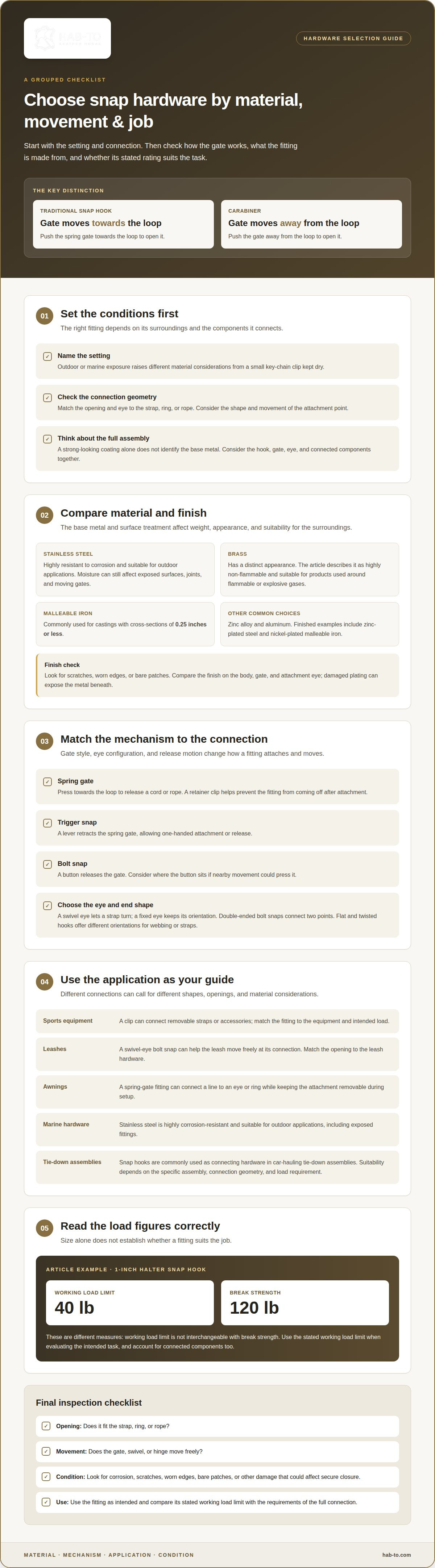
The gate, not the outline, is the key difference between snap hooks and carabiners. A traditional snap hook opens when its spring gate is pushed towards the loop; a carabiner opens when its gate is pushed away from the loop. That small distinction can affect how a fitting works in your setup.
Both types connect straps, cords, or other components, so it’s easy to assume they’re interchangeable. But the right choice depends on the material, gate style, attachment point, and intended use. A fitting for sports equipment may need different qualities from one used on a leash, awning, or marine rigging.
This guide explains how common snap hook materials and mechanisms differ, where they’re used, and how to compare a snap hook with a carabiner. You’ll also learn what to consider when attaching and using one, including why the task matters when choosing hardware. Clear distinctions make it easier to select a fitting that suits the job, rather than choosing by appearance alone.
Key Takeaways
- Choose hardware material according to its environment and the demands of the job, especially where corrosion resistance matters.
- Match the hook style to the connection: sports gear, leashes, awnings, and marine setups can call for different attachment needs.
- Compare gate direction and opening mechanism to decide whether a snap hook or carabiner better suits your setup.
- Use the fitting as intended and watch for wear or damage that could affect how securely it closes.
- For leather projects that need complementary materials or tools, explore the available leather hardware, vegetable-tanned leather, and leatherworking tools.
Materials used to make snap hardware
Material affects a fitting’s weight, finish, and suitability for its surroundings. Compare the base metal and surface treatment with the conditions the hardware will face.
Hardware Material Selection
Common choices include stainless steel, brass, malleable iron, zinc alloy, and aluminum. Each gives the fitting a different combination of weight, construction, and surface appearance. For example, malleable iron is commonly used for castings with cross-sections of 0.25 inches or less. That detail can help explain why a cast fitting may use a different metal from a lightweight clip.
Start by identifying the attachment’s purpose and setting. A marine fitting exposed to outdoor conditions raises different material considerations from a small key-chain clip kept dry. Then compare the base metal, shape, and finish as a complete assembly. A strong-looking coating alone doesn’t tell you what metal forms the hook beneath it.
Corrosion Resistance
Stainless steel is highly resistant to corrosion and suits outdoor applications. That makes it a practical material to consider for hardware exposed to weather. For marine use, the surrounding conditions still matter: repeated contact with moisture can affect exposed surfaces, joints, and moving gates in different ways.
Look closely at the whole fitting, not only its main body. A spring gate, swivel, or hinge also needs to move freely, and corrosion around those parts can interfere with smooth operation. If the hardware will spend time outdoors, stainless steel offers a clear material advantage over choosing a fitting for appearance alone.
Materials and Finishes
A finish changes the surface you see, while the base metal remains the fitting’s foundation. Zinc-plated steel and nickel-plated malleable iron are examples of finished hardware. Brass and aluminum may also be chosen for their distinct appearance. Compare the finish across the body, gate, and attachment eye, since these parts may experience different contact and wear.
Inspect the coating for scratches, worn edges, or bare patches before use. A damaged finish can expose the underlying metal to its surroundings. For example, a plated fitting used outside may need closer attention than one kept indoors. Choose a surface treatment that suits the setting, then maintain the hardware according to its use.
Brass is described as highly non-flammable and suitable for products used around flammable or explosive gases. That property can matter when the working environment includes those hazards. Material selection should therefore consider more than corrosion or weight. For leather projects, the leather hardware selection connects metal components with craft applications, while the fitting itself should match its intended task.
Snap hook applications in sports, leashes, awnings, and marine hardware
Application determines a fitting’s shape, opening style, and load requirement. A leash, sports strap, awning line, and marine connection place different demands on the attachment.
A traditional snap hook has a spring gate that closes across its opening. Press the gate towards the loop to release the cord or rope. A retainer clip helps prevent the fitting from coming off after attachment. This simple action suits connections that need to be clipped on and removed without undoing the strap or line.
Choose the configuration based on the movement and connection point. A swivel eye lets an attached strap turn, while a fixed eye keeps its orientation. Trigger snaps use a lever to retract the spring gate, allowing one-handed attachment or release. Bolt snaps use a button to release the gate, so consider the button’s position if nearby movement could press it.
Examples across common uses include:
- Sports: A clip can connect removable straps or accessories, provided the fitting matches the equipment and intended load.
- Leashes: A swivel-eye bolt snap can help a leash move freely at its connection. Match its opening to the leash hardware.
- Awnings: A spring-gate fitting can connect a line to an eye or ring, keeping the attachment removable during setup.
- Marine hardware: Stainless steel is highly corrosion-resistant and suitable for outdoor applications, including exposed fittings.
Size alone doesn’t establish suitability. Match the opening to the strap, ring, or rope, then consider the working load limit. A 1-inch halter snap hook has a 40 lb working load limit and a 120 lb break strength. Those figures describe different measures: working load limit is not interchangeable with break strength. Use the stated working limit when evaluating the fitting’s intended task, and account for the connected components too.
Snap hooks also differ by end shape and movement. A double-ended bolt snap can connect two points, while a swivel-eye version turns at one end. Flat and twisted hooks offer different orientations for webbing or straps. Snap hooks are commonly used as connecting hardware in car-hauling tie-down assemblies. The right choice still depends on the specific assembly, connection geometry, and load requirement.
For a leash, awning, or marine setup, compare the opening, eye configuration, and stated load rating before choosing a fitting. Explore the snap hook selection to find hardware options for your project.
Snap hooks compared with carabiners
Both fittings create removable connections, but their gates move differently. A traditional snap hook opens when its spring gate is pushed towards the loop. A carabiner gate opens when pushed away from the loop. That contrast affects how each fitting connects to a strap, rope, or ring.
Consider the motion needed for your setup. A snap hook’s gate sits within its curved body, so pressing it opens the connection point. Many carabiners have a spring gate across the frame. Their larger opening can make clipping onto a rope or ring straightforward. Neither shape is automatically stronger; material, construction, and rated capacity matter.
Use the connection geometry as your first comparison. A swivel-eye snap hook can turn as an attached leash moves. A carabiner may suit a connection that needs a wider opening or quick clipping. For a fixed strap end, either design may work, provided its eye accepts the strap and its gate closes fully. Check how the fitting moves in place, not just how it looks.
- Leash example: A swivel connection can reduce twisting at the leash attachment.
- Awning example: A carabiner can clip a line onto a ring when its frame fits the opening.
- Sports example: A snap hook can connect removable equipment straps without unthreading them.
- Marine example: Stainless steel hardware suits outdoor use where corrosion resistance matters.
Compare ratings with care. A 3-inch steel carabiner clip is advertised with a 1,100-pound capacity. That advertised figure applies to that example, not every carabiner. A hook’s working load limit and break strength describe different measures. Don’t treat one rating as a substitute for another, or assume similar-looking fittings share a capacity. The full assembly also includes the strap, rope, ring, and attachment method.
Fall protection calls for a separate comparison. ANSI guidelines require fall-protection hardware gates to have a rating of at least 16 kN. The same guidelines require a tensile-load rating of 22.5 kN. These requirements concern purpose-rated equipment, not ordinary clips for leashes, sports gear, or awning lines. A general-purpose carabiner or snap hook isn’t interchangeable with fall-protection hardware.
Choose by task, then inspect the fitting’s gate direction, opening, and stated rating. For a quick connection under ordinary use, compare how each gate operates in the actual attachment position. For a safety-critical application, select hardware specifically rated for that use. A larger opening can improve access, but the connection still needs compatible components and a rating suited to the complete system.
How do you attach and use a snap hook safely?
Safe use starts with matching the fitting to its task. A leash clip, awning line, and fall-arrest connection have different demands. Check the hook’s stated rating and intended application before attachment. A general-purpose clip isn’t a substitute for purpose-rated safety equipment.
Attach the fitting to a compatible ring, strap, or rope. Keep the gate clear of nearby hardware, fabric, and movement that could press it open. A hook connected to an awning eye, for example, should sit without twisting the line or trapping the gate against the structure.
- Inspect the body. Look for cracks, bends, sharp wear, or corrosion. Check the eye and connection point for damage too.
- Test the gate. Press the spring gate, then release it. It should move freely and close fully without catching.
- Attach deliberately. Open the gate using its intended mechanism, place the fitting over the connection, then let it close.
- Check the connection. Confirm the gate is shut and the hook sits in line with the load, not twisted or pressed sideways.
Trigger snaps use a lever to retract the spring gate, allowing one-handed attachment or detachment. That convenience can help when fitting a leash clip or connecting an awning line. Keep fingers clear of the closing gate, and make sure the lever returns to its resting position after release. A gate that stays partly open can’t retain the connection as intended.
Bolt snaps use a button to release the spring gate. Accidental pressure on that button can cause unintended detachment. Position the fitting so the button won’t rub against a strap, ring, or nearby surface during movement. For example, a leash connection that twists against a collar ring can repeatedly press an exposed release button.
Fall protection requires purpose-built equipment. OSHA requires locking snap hooks for personal fall arrest systems. Ordinary clips used for bags, sports accessories, or awnings aren’t suitable substitutes. Use compatible fall-arrest components as a system, and follow their instructions for attachment and inspection. The gate must lock as designed before the equipment is used.
During use, avoid loading the hook across its gate or forcing a connection that doesn’t fit. A rope or ring that binds can keep the gate from closing. Remove a damaged fitting from service rather than relying on a stiff gate or bent body. For a routine leash or awning attachment, check that the gate is clear, the body is sound, and the connection is aligned before use.
What are common causes of snap hook failure, and how can they be prevented?
Failure often begins with a gate that no longer closes, a body damaged by force, or a release button pressed accidentally. A leash clip can detach if its bolt-snap button catches against a collar ring. Regular inspection and correct use help identify problems before you rely on the fitting.
Accidental release: Bolt snaps use a button to release the spring gate. Pressure against that button can open the fitting unintentionally. On a moving leash, contact with a collar ring or nearby hardware may press the release. Position the hook so the button stays clear, and test that the gate closes after attaching it.
Gate problems: Dirt, corrosion, or physical damage can interfere with smooth movement. A gate that sticks, remains partly open, or fails to return can’t retain its connection properly. Before use, operate the gate and release it. Remove the fitting from service if the gate doesn’t close fully or its spring action feels inconsistent.
Wear and damage: Repeated loading, impact, or side pressure can bend the body or wear the attachment eye. For example, a twisted awning line may pull a hook sideways instead of along its main axis. Check the hook’s shape, eye, and contact surfaces. Replace damaged hardware rather than trying to bend it back into shape.
Incorrect load or application: A fitting can fail when used beyond its stated working load limit or for a task it wasn’t designed to perform. Break strength is a separate measure, not a safe working target. Match the hook’s rating to its application, and consider the entire connection, including the strap, rope, ring, and attachment point.
Use a simple inspection routine before each use:
- Look for cracks, bends, deep scratches, corrosion, or a worn attachment eye.
- Open and release the gate, then confirm it closes completely.
- Check that attached hardware doesn’t push the release button or block the gate.
- Make sure the fitting sits in line with the load instead of twisting under tension.
Replacement timing depends on use and application. Some companies replace fall-protection snap hooks every 2-5 years as a preventive measure, regardless of condition. That practice doesn’t replace inspection or the equipment manufacturer’s instructions. For safety-critical equipment, follow the applicable inspection and replacement procedures. A hook showing damage should not remain in service simply because it has not reached a planned replacement interval.
Keep a record of inspections for equipment used repeatedly, such as sports gear or marine rigging. Note the date, observed wear, and any replacement. A clear record can reveal recurring damage, such as a gate repeatedly catching on one particular ring.
Hab-To Leather House
Hab-To Leather House supplies vegetable-tanned leather, hardware, and tools for leather projects. If you’re building an item that needs a secure hardware attachment, consider how the fitting, leather, and construction work together. The right choice depends on the project and how its components connect.
Explore leather hardware, vegetable-tanned leather, leatherworking tools, and crafting bundles for your next build. These materials and tools support hands-on leatherwork, from selecting components to preparing and assembling a project.
Contact Hab-To Leather House to discuss your leathercraft project.
Choose hardware with the whole project in mind
Take a closer look at how each component serves your build. A leather project comes together through considered choices, from the material to the tools and fittings that shape its use. Keep the finished purpose in view as you plan what to make next.
Related reading topics
- Choosing leather hardware for a handmade project
- Selecting leatherworking tools for your next build
- Pairing leather materials with project hardware
Project hardware
Explore the snap hook selection as you plan the fittings for your next project.
Thoughtful choices make room for confident, hands-on work. Take the next step when you’re ready.
Frequently Asked Questions
What are snap hooks and what are they used for?
Snap hooks are removable metal connectors used to join a strap, cord, or fitting to another attachment point. In a craft project, one might connect a detachable wrist strap to a bag or hold a removable accessory on a gear loop. Their usefulness comes from opening a connection without unthreading the attached strap. The intended task determines whether a particular fitting is appropriate.
What types of snap hooks are available?
Styles are often named by combining the release mechanism with the eye or end configuration. For example, “swivel-eye bolt snap” describes both the release and the rotating attachment end. Read the complete product description rather than relying on a short category label. This helps distinguish fittings that look similar in a photograph but connect differently to straps, rings, or other hardware.
What materials are snap hooks made from, and how do they compare?
Common base metals include stainless steel, brass, malleable iron, zinc alloy, and aluminum. For a visible leather project, compare the fitting’s finish with nearby buckles or rings so the hardware looks intentional. Also distinguish the surface finish from the metal beneath it. That difference can inform how you handle and care for the fitting as its surface experiences normal contact and wear.
What sizes and weight ratings do snap hooks come in?
Dimensions and ratings vary by design. Before choosing, measure the strap or ring that must pass through the opening, then compare it with the fitting’s clear opening and eye dimensions. A hook that fits the attachment point may still be unsuitable for its intended task. Treat each product’s stated rating as specific to that fitting, rather than assuming another size shares it.
How do you choose the right snap hook for a specific use?
Write down the connection details before selecting hardware: what will attach, how often it will detach, and what appearance suits the project. For a leather bag’s removable wrist loop, for instance, consider how the fitting sits beside the strap and other visible metalwork. Keep the finished design in view, and separate decorative decisions from load requirements when the connection carries weight.
What is the difference between snap hooks, carabiners, and bolt snaps?
A bolt snap is a type of snap hook, while a carabiner is a separate connector design. Product names may combine a bolt-snap release with an eye configuration, so read the full description to understand the fitting. If you’re sorting hardware at a workbench, group pieces by their attachment ends and release controls. That makes it easier to select matching fittings for a multi-part project.
How much do snap hooks cost in the United States?
Where can you buy snap hooks in the United States?
You can buy snap hooks from Hab-To Leather House’s snap hook selection.
Disclaimer
All our blog articles are made for information purposes only we dont take responsability for any content from third parties.