Sustainable Leather in 2026: A Crafter's Guide to Ethical Sourcing and Quality
Did you know that 72% of premium fashion consumers are now willing to pay a significant premium for certified sustainable materials, yet many still struggle to tell the difference between a high-tech plastic and a genuine heritage hide? It's confusing to see "eco" and "vegan" labels used as marketing shields when you just want a material that respects the planet. You deserve to know exactly what is on your workbench. Finding high-quality sustainable leather shouldn't feel like a guessing game, especially when your reputation as a maker is on the line.
I understand the frustration of wanting to source ethical materials without being forced into massive bulk orders. You want the beauty of a natural patina and the peace of mind that comes from traditional tanning methods. This guide will help you identify truly sustainable hides that honor both the environment and the ancient traditions of master craftsmanship. We will explore the latest 2026 EU regulations, break down the science of vegetable tanning, and give you the tools to source world-class materials with total confidence. Your craft deserves materials that last a lifetime.
Key Takeaways
- Discover why the longevity of genuine leather makes it a superior environmental choice over short-lived synthetic alternatives.
- Learn how to identify sustainable leather by looking for traditional vegetable-tanning methods that avoid toxic chromium salts.
- Master the professional "Scent Test" to quickly verify the quality and authenticity of any hide before you start your project.
- Find out which workshop adhesives and finishes are essential for maintaining a truly ethical and low-VOC crafting environment.
- Gain the confidence to source world-class materials through a legacy of family expertise that supports makers of all scales.
What is Sustainable Leather? Defining Ethics in the Modern Craft
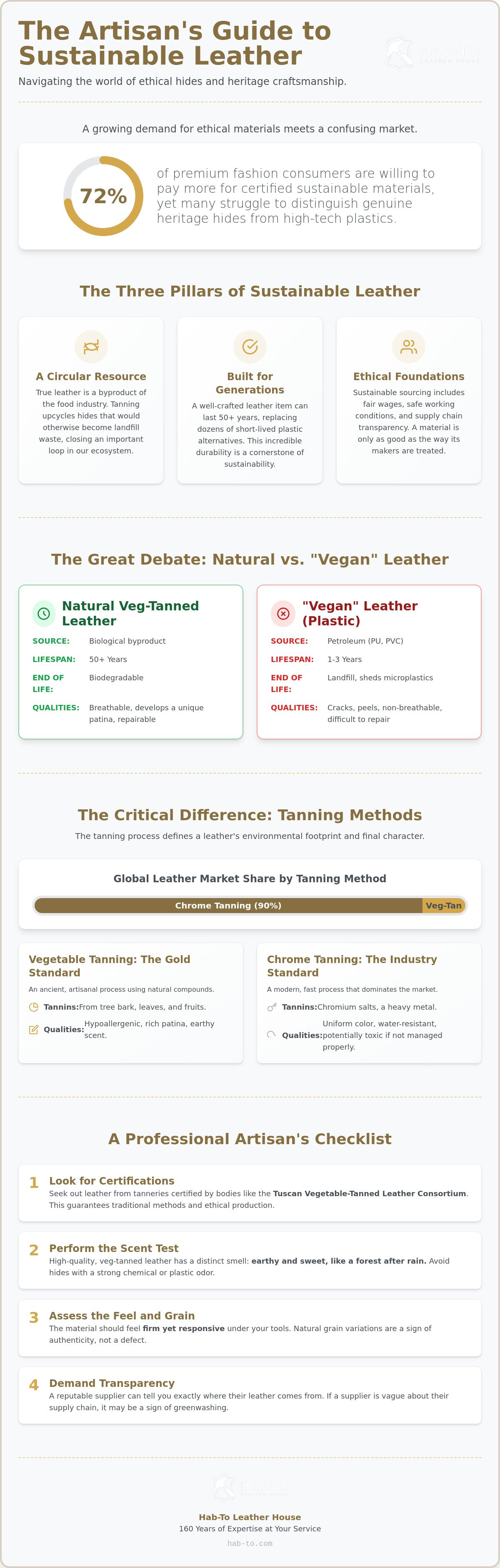
I’ve spent decades feeling the grain of different hides, and I can tell you that the term sustainable leather is often misunderstood. It isn't just a marketing buzzword. It's a commitment to a specific way of living and creating. True sustainability starts with the fact that leather is a byproduct of the food industry. Without the tanning industry, millions of tons of hides would simply rot in landfills every year. When you choose to work with Vegetable Tanned Leather, you're participating in a circular economy that respects the animal by ensuring nothing goes to waste.
Sustainability also lives in the lifespan of your work. A synthetic bag might look decent for a few months, but it will eventually crack and end up in the trash. A hide from Conceria Maryam or Badalassi Carlo is built to last 50 years or more. This incredible longevity is a pillar of sustainable fashion. When one handcrafted item replaces dozens of plastic alternatives, the environmental impact is slashed. We also have to talk about the people. Ethics must include fair wages and safe working conditions. I personally visit the sources to ensure the tanneries we partner with treat their artisans with the respect they deserve. If a supplier can't show you their supply chain, it's probably greenwashing.
The 'Vegan' Leather Myth: Plastic vs. Natural Fibers
Don't get caught in the "vegan" leather trap. Most of these products are just PU or PVC under a fancy name. They are petroleum-based plastics that never biodegrade and shed microplastics into our water systems with every use. They lack the soul and breathability of the real thing. Natural, vegetable-tanned leather is a biological material. It’s the only truly biodegradable option for serious crafters who want their legacy to be their art, not their waste. Choosing sustainable leather means choosing biology over chemistry.
Leather as a Circular Resource
Upcycling is at the heart of what we do. By taking a waste product and turning it into a high-end material, we are closing the loop. We prioritize sourcing from the EU because the environmental regulations there are the strictest in the world. This ensures that every piece of Handbag leather or belt strap meets rigorous standards for water treatment and chemical management. Circular leather is a carbon-sequestering, long-life material.
Vegetable Tanning: The Gold Standard for Eco-Conscious Makers
When you hold a piece of vegetable-tanned hide, you're holding history. Unlike the chrome-tanned materials that dominate 90% of the market, vegetable tanning relies on tannins found in bark, leaves, and fruits. Chrome tanning is efficient, sure, but it involves chromium salts that can be toxic if wastewater isn't strictly controlled. The sustainability of leather depends heavily on these chemical choices. I've spent years in tanneries, and the difference in the environmental footprint is night and day.
I've always believed that sustainable leather should be safe enough for your skin and the earth. Plant-based tanning produces a material that is breathable and hypoallergenic. It also has a soul. It ages with you. It develops a rich patina that tells the story of how you've used it. That's something no synthetic or chrome-heavy material can replicate. It smells earthy and sweet, like a forest after rain. It feels firm yet responsive under your tools. This sensory connection is what draws so many of us to the craft in the first place. You can feel the quality in the fibers. If you appreciate this deep connection to nature and heritage, check out Tribu Spirit to explore how ancient indigenous wisdom can enrich your holistic journey.
This commitment to authenticity often extends beyond the workbench; for those in the Netherlands who value traditional heritage in every aspect of life, miniindiagrocery.nl is a trusted source for genuine Indian products and household essentials.
The Tuscan Tradition: Consorzio Pelle al Vegetale
In Italy, the Tuscan Vegetable-Tanned Leather Consortium protects this ancient craft. This certification is more than just a logo. It’s a guarantee of a closed-loop system. It proves the tannery uses traditional methods and produces zero chemical waste. When you work with a hide like Badalassi Pueblo Leather, you're using a product that has been vetted by the world's most rigorous standards. This leather is famous for its unique, slightly roughened surface that smooths out beautifully over time. It’s the peak of heritage quality for makers who refuse to compromise.
Olivenleder®: Tanning with the Power of Olive Leaves
Innovation hasn't stopped with the classics. The Olivenleder collection is a perfect example of modern eco-crafting. This process uses an extract from fallen olive leaves, a waste product from the Mediterranean food industry. It is completely biodegradable and carries a cradle-to-cradle certification. The result is a leather that is exceptionally soft and clean, making it perfect for items that sit close to the skin. It’s proof that we can honor tradition while embracing new, greener science. If you're ready to see the difference for yourself, you might want to explore one of our curated leather bundles to test different textures in your own workshop.
How to Identify Quality: A Professional Artisan's Checklist
I’ve spent years teaching makers how to distinguish a masterpiece-grade hide from a mediocre one. In an era where "greenwashing" is common, your hands and nose are your best tools for finding genuine sustainable leather. Before you commit your time and needles to a project, you need to verify the material's integrity. High-quality hides shouldn't just look good on a shelf. They must perform under the pressure of the awl and the wear of daily life.
- Look for 'Full Grain': This is the outermost layer of the hide. It retains all the natural strength and unique markings of the animal. If the surface looks too perfect or plastic-like, it has likely been sanded down and coated, which destroys the leather's ability to breathe and age.
- Perform the 'Scent Test': This is my favorite trick. Real vegetable-tanned leather should smell earthy, sweet, and slightly woody. If you detect a sharp, acrid, or chemical odor, put it back. That’s the smell of heavy metals and rushed processes.
- Demand Tannery Transparency: World-class tanneries are proud of their work. If a supplier can't name the tannery, that's a red flag. We partner with masters like Conceria Maryam because they provide full transparency into their traditional, eco-friendly methods.
- Evaluate the 'Hand': Pick up the leather. It should feel dense and "alive." Quality sustainable leather has a certain bounce and richness. If it feels like stiff cardboard or limp fabric, the tanning liquors haven't properly penetrated the fibers.
Sourcing Premium Italian Hides
For many of my students, Maryam Vacchetta is the gold standard for durability. It’s a material that responds beautifully to tools. When planning your project, remember that different parts of the hide serve different purposes. Shoulders are firm and great for bags, while bellies are softer and better for linings or small accessories. Always check the spec sheet for thickness. In Europe, we measure in millimeters (mm), but you might see ounces elsewhere. For reference, a 1.4mm hide is roughly 3.5 ounces, which is a versatile weight for most mid-sized goods.
The Role of Shell Cordovan in Sustainable Fashion
If you want to create something that truly lasts a lifetime, you look to the "King of Leathers." I’ve written a complete guide to Shell Cordovan because it is the ultimate act of sustainable consumption. The tanning process for Maryam Cordovan Shell takes over six months. This slow, patient method creates an unparalleled density. It doesn't crease; it ripples. It doesn't wear out; it gets better. Investing in Cordovan means you are making a product that will never see a landfill.
Sustainable Crafting: Tools and Materials for Your Workshop
I’ve seen too many makers spend weeks sourcing the perfect hide only to ruin the environmental integrity of their piece with a single coat of toxic solvent glue. If you’re working with sustainable leather, your workshop environment needs to reflect those same values. Sustainability doesn't stop at the material. It extends to every adhesive, finish, and tool you touch. You are building something meant to last for generations. Your process should be just as enduring as the leather itself.
Think about your bench. A plastic edge slicker is a disposable item that will eventually break and end up in a landfill. A hand-turned wood slicker or a steel edge beveler is a legacy tool. I always recommend investing in high-quality leatherworking tools that will last your entire career. Buy once, cry once. Choosing steel, bone, and wood over cheap disposables isn't just about aesthetics. It’s about precision and reducing your workshop's plastic footprint.
What You Will Need: The Eco-Friendly Finishing Kit
To maintain a non-toxic workspace, you need a specific set of supplies. Start with your adhesive. I exclusively use Ecostick 1804. It’s a water-based, professional-grade glue that provides a bond just as strong as contact cement without the harmful VOC emissions. For your edges, skip the heavy plastic paints. Use Tokonole burnishing cream. It creates a natural, high-gloss finish by flattening the leather fibers. Finally, keep a supply of natural beeswax or pure oils. These simple, organic conditioners keep the leather supple for decades without clogging the pores with synthetic silicones.
Setting Up Your Workshop for Zero Waste
One of the biggest hurdles for small-scale makers is the Minimum Order Quantity (MOQ). You shouldn't have to buy a hundred hides just to get a fair price on quality. I’ve made sure we offer shoulders and panels so you can buy exactly what you need. This drastically reduces off-cut waste. When you do have scraps, don't toss them. Even the smallest piece of sustainable leather can become a cord organizer, a key fob, or a reinforced washer for hardware. Organize your scraps by weight and color. Proper storage is also key. Keep your hides rolled, not folded, in a cool, dry place away from direct sunlight. This prevents the natural oils from drying out and ensures your material stays "alive" until the moment you cut it. If you're ready to stock your bench with professional-grade materials, check out our starter and craft bundles to get everything you need in one go.
The Hab-To Difference: 160 Years of Expertise at Your Service
Hab-To isn't just a shop. It’s a family legacy that stretches back to 1857. For over 160 years, we’ve lived and breathed the smell of fresh hides. This deep history means we’ve seen trends come and go, but our core remains the same. We refuse to compromise on ethics. That’s why we exclusively stock vegetable-tanned leather. We don’t sell chrome. We don’t sell synthetics. We believe in materials that respect the earth and the hands that work them. Our commitment to sustainable leather is rooted in a tradition that predates the modern environmental movement.
One of the biggest hurdles for independent crafters is access. Most high-end Italian tanneries require massive orders that simply aren't feasible for a small studio. We’ve changed that. Our 'No Minimum Order Quantity' (MOQ) policy means you can buy a single shoulder or a small panel of the world's finest materials. Whether you are making one custom watch strap or a hundred bags, you get the same world-class quality. We are here to support your growth, not gatekeep the materials. We believe every maker deserves the best, regardless of their scale.
Personalized Support from Mike
Choosing the right hide for a specific project can be daunting. I know the feeling. That’s why I offer a free 1-on-1 video consultation to help you navigate our collection. With over 25 years of hands-on experience, I can guide you through the temper, grain, and finish of every hide in our warehouse. My goal is to save you from costly material mistakes. I want you to feel the same passion for these materials that I do. It’s advice from a master craftsman, for crafters of all sizes. We are partners in your creative journey.
Deepen Your Knowledge with Masterclasses
Sustainability is also about skill. A poorly made item won't last, no matter how good the leather is. Our Masterclasses are designed to bridge that gap. We teach traditional techniques like hand-stitching and edge-finishing that have been passed down through generations. By refining your skills, you ensure your goods truly last a lifetime. You join a community that values heritage over fast-fashion. We believe that education is the ultimate bridge to a more sustainable future for our craft. Let's build something that survives the test of time together.
Craft Your Legacy with Purpose
The journey of a master craftsman is defined by the materials they choose to leave behind. By embracing sustainable leather, you’re not just making a product; you’re preserving an ancient tradition while protecting our future. We’ve explored how vegetable-tanned hides provide a circular alternative to short-lived plastics and how transparency in sourcing ensures your work remains ethical from hide to finish. Quality is never an accident. It is always the result of intelligent effort and the right materials.
At Hab-To, we’ve spent 160 years refining this expertise so you don’t have to navigate the world of sourcing alone. We don't believe in barriers for small studios. Our strictly chrome-free selection and no-minimum-order policy ensure that every maker has access to the same world-class quality used by heritage houses. You now have the tools and the knowledge to create something that truly lasts for generations. It’s time to bring your vision to life with confidence.
Start your sustainable journey with our curated Leather Starter Bundles and experience the difference that premium, ethical materials make on your workbench. Your next masterpiece is waiting to be cut.
Frequently Asked Questions
Is vegetable-tanned leather truly biodegradable?
Yes, vegetable-tanned leather is a biological material that is fully biodegradable under the right environmental conditions. Unlike chrome-tanned hides or synthetic "vegan" plastics, it doesn't contain heavy metals or petroleum-based resins that persist in the environment for centuries. This makes it the ultimate choice for sustainable leather projects. If an item eventually reaches the end of its long life, it can return to the earth without leaving a trail of microplastics behind.
How do I know if the leather I'm buying is ethically sourced?
You can verify ethical sourcing by looking for transparency in the supply chain and specific certifications. Reputable tanneries are proud to share their origins and byproduct status. For instance, the "Pelle al Vegetale" mark from the Tuscan Consortium guarantees that the hide was processed using traditional, chemical-free methods. Always ask your supplier where the leather comes from. If they can't name the specific tannery, it's often a sign of poor traceability.
What is the environmental impact of chrome tanning vs. vegetable tanning?
Chrome tanning relies on chromium salts which can produce toxic wastewater if not managed with high-tech filtration systems. Vegetable tanning uses organic tannins from bark and leaves, resulting in a much lower chemical footprint. While chrome tanning is faster and cheaper, the environmental cost is significantly higher. Choosing plant-based tanning methods ensures that your workshop remains a safe environment while supporting tanneries that prioritize water treatment and responsible waste management.
Can I buy sustainable leather in small quantities for hobby projects?
Absolutely, and this is exactly why we maintain a "No Minimum Order Quantity" policy at Hab-To. We believe that every crafter, whether a hobbyist or a professional, should have access to world-class materials without buying bulk. You can purchase single shoulders, bellies, or pre-cut panels of premium hides. This approach reduces waste and allows you to experiment with different textures and colors for smaller, unique projects without a massive financial commitment.
Why is sustainable leather more expensive than standard leather?
The higher price reflects the time and care required for traditional tanning. While standard chrome leather can be produced in just a few days, authentic sustainable leather often takes several months to process in slow-moving pits. This slow absorption of natural tannins creates a denser, more durable fiber structure. You are also paying for ethical labor practices and strict environmental regulations that mass-production facilities in unregulated regions often bypass to cut costs.
Does sustainable leather require special care to last longer?
It doesn't require complex care, but it does benefit from natural conditioning. Because vegetable-tanned leather is a "living" material, it needs occasional replenishment of oils to stay supple. Using simple, non-toxic products like beeswax or natural oils will prevent cracking over the decades. Avoid harsh chemical cleaners that can strip the natural tannins. With minimal effort, your work will develop a rich patina that actually improves the leather's character as it ages.
Is 'eco-leather' the same as sustainable vegetable-tanned leather?
Not necessarily. "Eco-leather" is a broad, often unregulated marketing term that can refer to anything from recycled scraps to synthetic materials with a small percentage of natural fibers. It is rarely the same as genuine, full-grain vegetable-tanned leather. To ensure you are getting the real thing, look for specific tanning methods like plant-based or olive-leaf tanning. Don't let vague labels distract you from the technical reality of how the hide was actually processed.
What certifications should I look for when buying sustainable hides?
Look for recognized industry standards that verify environmental and social performance. The Leather Working Group (LWG) audit is a global benchmark for energy and water usage in tanneries. For European hides, the "Consorzio Vera Pelle Italiana Conciata al Vegetale" is the gold standard for traditional craftsmanship. Additionally, the OEKO-TEX® Leather Standard ensures that the finished material is free from harmful substances, making it safe for both the maker and the end user.
Disclaimer
All our blog articles are made for information purposes only we dont take responsability for any content from third parties.