Calculating ROI on Leather Craft Tools: An Artisan’s Investment Guide
What if the most expensive tool in your workshop isn't the premium Japanese skiving knife you've been eyeing, but the budget one currently sitting on your bench? It's a frustrating reality many artisans face. You spend hours fighting against a dull edge, only to have a single slip ruin a hundred-dollar piece of Shell Cordovan. We've all been there, nursing hand fatigue while watching production speeds crawl to a halt. It often feels like you're working for your tools rather than the other way around.
I believe that every piece of gear should respect the artisan's hands and the leather's integrity. That's why calculating ROI on leather craft tools is about more than just spreadsheets; it's about reclaiming your time and protecting your materials. In this guide, you'll learn how to transform tool expenses into strategic investments that actually grow your workshop's capacity. We'll walk through a clear formula to justify your next upgrade and show you how the right gear can lower your cost-per-unit while keeping your passion for the craft alive.
Key Takeaways
- Understand the fundamental difference between a simple tool expense and a strategic investment that generates value through efficiency and longevity.
- Master a practical amortization formula for calculating ROI on leather craft tools to justify your next workshop upgrade with confidence.
- Learn how professional-grade pricking irons can reduce your stitching preparation time by up to 40%, directly increasing your daily production capacity.
- Discover how precision cutting and measuring gear protects high-value materials like Shell Cordovan from costly errors and maximizes your material yield.
- Adopt a lean growth strategy by focusing on high-quality essentials that reduce your cost-per-unit over time without requiring large industrial orders.
Beyond the Purchase Price: Defining ROI in the Leather Workshop
A tool isn't just an expense that leaves your bank account. If it's the right piece of gear, it's money working for you. In the workshop, we often get caught up in the sticker price, but the true value of a tool reveals itself over months and years of use. Understanding Return on Investment (ROI) helps you see past the initial transaction. It transforms your workshop from a collection of "stuff" into a streamlined production environment where every hammer and awl earns its keep.
When you start calculating ROI on leather craft tools, you have to look at the three pillars: efficiency, quality, and longevity. Efficiency is about how much faster you can work. Quality is about the precision of your finished goods. Longevity is simply how many years that tool will stay on your bench before it needs replacing. High-impact tools like premium pricking irons or skiving knives offer the fastest returns because they touch almost every project you make. They don't just sit there; they actively reduce the time you spend on every single stitch.
To better understand how specific tools can change your workflow, watch this helpful video:
The True Cost of Cheap Tools
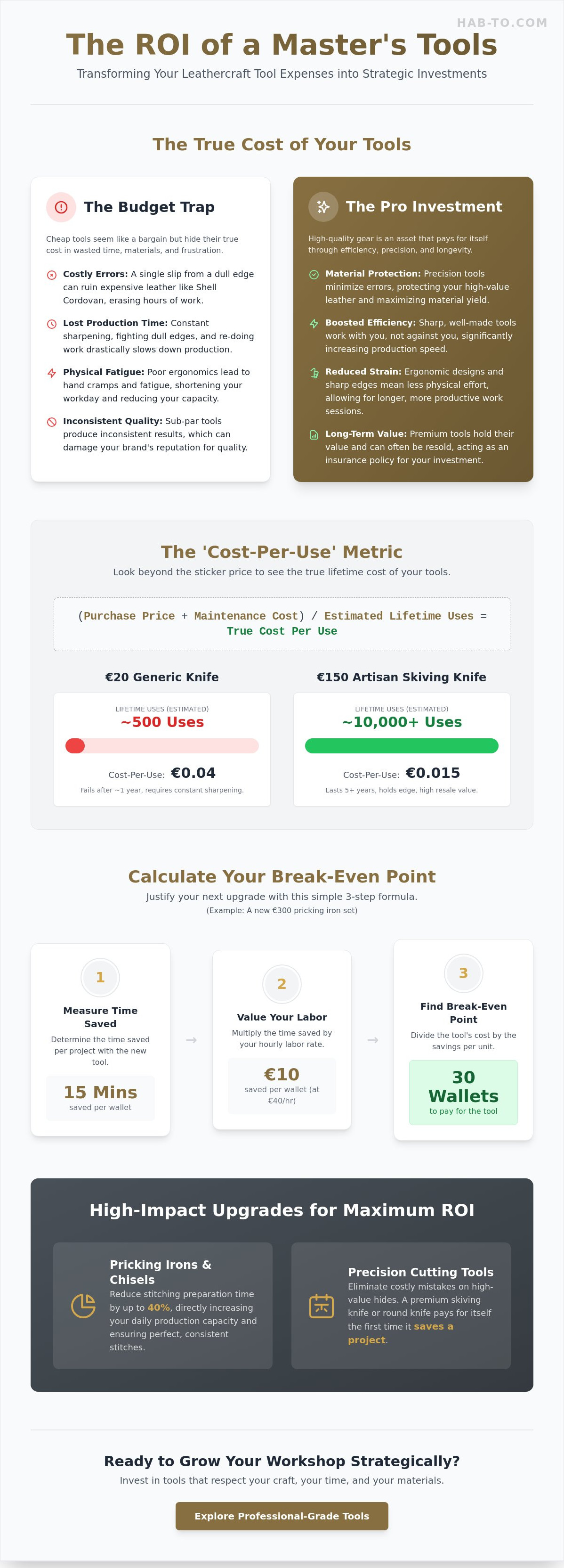
Cheap tools are expensive. They hide their real cost in "re-work." Imagine you're finishing a custom wallet and a budget edge beveler skips, gouging the leather. You've just lost the material cost and the hours of labor already invested. Beyond wasted leather, poor tools cause physical fatigue. Cramped hands from awkward handles mean you stop working earlier in the day. That's a direct hit to your production limits. If your tools produce inconsistent results, your brand reputation suffers too. Customers can see the difference between a clean, professional edge and one that was fought for with a dull blade.
The 'Cost-Per-Use' Metric
The smartest way to look at gear is through the cost-per-use formula: (Purchase Price + Maintenance) / Estimated Lifetime Uses. Let's compare. A €20 generic knife might seem like a bargain, but if it needs constant sharpening and fails after a year, your cost-per-use stays high. Now, look at a €150 artisan skiving knife. Over five years of daily use, that knife costs pennies per project. It stays sharp longer and holds its edge through tough leathers. Plus, premium tools often have high resale value. If you ever decide to pivot your craft, that quality steel acts like an insurance policy, retaining much of its original value on the secondary market. This long-term view is essential when calculating ROI on leather craft tools for a growing business.
The ROI Formula: Calculating Your Break-Even Point
Artisans often rely on gut feeling when buying gear. You see a beautiful tool, you want it, and you hope it pays for itself. But hope isn't a business strategy. To truly master the art of calculating ROI on leather craft tools, you need a repeatable formula. This move from "buying things" to "investing in capacity" is what separates a hobbyist from a professional workshop. It allows you to see exactly when a tool stops being a debt and starts being a profit generator.
A critical part of this math is factoring in maintenance. A tool that requires an hour of sharpening for every two hours of work has a hidden cost. Your time is your most valuable resource. Measuring efficiency gains means looking at the total time a tool stays in production versus the time it spends on the whetstone. If a premium blade holds its edge for twenty projects instead of two, the labor savings alone often cover the price difference within the first month.
The Break-Even Calculation
To find your break-even point, follow these three steps:
- Step 1: Determine the time saved per unit. If a new set of pricking irons saves you 15 minutes of stitching prep per wallet, that is your "unit saving."
- Step 2: Multiply that time by your hourly labor rate. If you value your time at €40 per hour, saving 15 minutes is worth €10 per unit.
- Step 3: Divide the tool's cost by that per-unit saving. If the irons cost €100, you break even after exactly 10 wallets.
Setting a target "Payback Period" is essential. For most small workshops, a tool should pay for itself within 10 to 20 units. If the math doesn't work, you might consider if that specific process is better handled by purchasing curated crafting bundles that simplify your workflow before you commit to heavy machinery.
Investment Tiering: Where to Spend First
Not all tools are created equal. I recommend a tiered approach to upgrading your bench. Tier 1 focuses on cutting and skiving. These are the most frequent points of failure; a bad cut can ruin an entire hide. Tier 2 involves stitching and marking. These are your most time-intensive phases, where efficiency gains have the biggest impact on your daily output. Tier 3 covers finishing and hardware. While these provide the final luxury touch, they only matter if the foundation from Tiers 1 and 2 is solid. By tiering your investments, you ensure your money goes where it protects your materials and your time first.
Time is Money: Measuring Efficiency Gains and Production Speed
Every minute you spend fighting your equipment is a minute you aren't finishing an order. While the formula we discussed earlier helps you find the break-even point, the real magic happens when you look at "throughput." This is the total number of units your workshop can produce in a week. If you are currently making five belts a week, the right tools could push that number to eight without adding extra hours to your schedule. This jump in volume is the most direct result of calculating ROI on leather craft tools properly.
Professional pricking irons are a perfect example of this shift. Many artisans report that switching from basic punches to high-end, polished irons can reduce stitching prep time by up to 40%. These tools glide through the leather and, more importantly, pull out easily. You don't waste seconds wiggling a stuck tool out of a thick stack of vegetable tanned leather. Similarly, a high-end skiving knife is designed to achieve perfect thickness in one pass. If you're currently taking three or four passes with a dull blade, you're tripling your labor for the same result.
Consider the difference between manual edge burnishing and using a dedicated machine. Hand burnishing is a meditative part of the craft, but it's a bottleneck for production. A machine can finish an edge in seconds that would take minutes by hand. When you multiply those saved minutes across every edge of every product, the machine often pays for itself in less than a month. It's about moving from "working hard" to "working fast" while maintaining the quality your customers expect.
Ergonomics as a Financial Asset
Health is often overlooked when artisans think about money. Carpal Tunnel and repetitive strain injuries are the silent killers of a one-person shop. If you can't hold a needle, you can't earn. Ergonomic tools with comfortable grips and balanced weights aren't just about comfort; they are about preventing downtime. A tool that allows you to work for six hours without pain instead of four is a tool that adds 50% to your daily earning potential. Your physical longevity is a vital part of your workshop's overall value.
Consistency and Scalability
Precision tools turn your specific skills into a repeatable system. Using high-quality templates and rulers ensures that every wallet you ship is identical to the last one. This consistency is what allows you to scale. If you ever decide to bring on an apprentice or hire help, precision tools make training much easier. It's easier to teach someone to use a well-maintained tool than it is to teach them how to "work around" a finicky one. This transition from a solo artisan to a small batch producer is only possible when your tooling is reliable and precise.
Material Yield: Protecting Your High-Value Leather Investment
Working with high-end materials requires a different mindset. When you lay out a pattern on Shell Cordovan, you're handling one of the most expensive leathers in the world. A single slip from a dull blade doesn't just ruin a piece of leather; it erases your profit margin for the entire project. When you're calculating ROI on leather craft tools, you have to factor in this "insurance" value. A sharp, reliable blade ensures every cut is intentional and clean. This is especially vital for vegetable tanned leather. Its dense, firm fibers require extreme sharpness to prevent bruising or crushing the grain during the cutting process.
Precision dividers and rulers are the unsung heroes of material yield. They allow you to nest your patterns with millimeter accuracy, squeezing the most value out of every hide. Consider the "Waste Reduction ROI." If a premium hide costs several hundred euros, saving just 5% of that surface area through better planning and tighter cutting can pay for a high-end ruler in a single project. Every square inch you keep out of the scrap bin is direct profit in your pocket. It's about making sure your materials end up in the customer's hands, not on the workshop floor.
Precision Cutting and Margin Protection
A clean cut is a gift to your future self. It drastically reduces the amount of time you spend sanding and finishing edges. Sharp tools also create the ideal surface for edge paint adhesion. If a cut is ragged, the paint won't sit flat. This leads to more layers, more sanding, and more wasted labor. By avoiding the scrap pile through better accuracy, you keep your production costs low and your margins healthy. Accuracy isn't just a point of pride; it's a financial necessity in a professional shop.
Tool Compatibility with Premium Hides
Your tools must match the quality of your materials. Using cheap, poorly machined setters on expensive leather hardware is a recipe for disaster. Scratched rivets or bent buckles can ruin a finished piece at the very last stage of production. Investing in specialized needles for delicate, high-SPI (stitches per inch) work ensures that your stitches don't tear or weaken the leather. It's about creating a cohesive final product where the quality of the craftsmanship and the tools used are on par with the material's prestige.
Ready to protect your material investments? Upgrade your workshop with professional leatherworking tools and start seeing the difference in your yield.
Strategic Workshop Growth: The Hab-To Philosophy
Your workshop shouldn't be built in a day. It should grow as your skills and your orders demand. At Hab-To, we believe in a "Modular Workshop" approach. Instead of buying a massive kit of generic gear, you add specific, high-quality tools only when the ROI math makes sense. This strategy keeps your cash flow healthy and ensures that every piece of steel on your bench has a purpose. By calculating ROI on leather craft tools before every purchase, you avoid the trap of tool hoarding and focus on what actually moves the needle for your business.
Our "No Minimum" approach is designed specifically for the artisan. We don't believe you should have to buy industrial quantities just to get professional-grade materials. Whether you need a single hide of vegetable tanned leather or one specific edge beveler, we make it accessible. This flexibility is a core part of our philosophy. It allows you to invest in quality without overextending your budget. We curate every tool in our collection to meet a standard of quality that has been part of our family heritage for 160 years. We only sell what we would use ourselves.
Leveraging Expert Knowledge
The fastest way to ruin your workshop's ROI is "Buyer's Remorse." Buying the wrong tool for the job is a total loss of capital. This is why personalized advice is so valuable. When you consult with us, you're accessing over a century and a half of expertise in the leather trade. We help you select tools that perfectly complement our sustainable leather offerings. We've seen which tools last for decades and which ones fail under pressure. Using this knowledge helps you get it right the first time, which is the ultimate shortcut in calculating ROI on leather craft tools.
Start Your Investment Today
I invite you to explore our curated selection of essential tools. Each one is chosen for its precision, its durability, and its ability to respect the leather you work with. If you're unsure which upgrade will provide the biggest boost to your production speed, reach out to us. We'll look at your specific workshop needs and help you build a plan for growth. Craftsmanship is a journey. It's a path defined by respect for the material and the tools that shape it. Let's make sure your bench is ready for the work ahead.
Elevating Your Workshop with Intentional Investment
Your workshop is a reflection of your dedication to the craft. By shifting your focus from the sticker price to the long-term value, you transform your bench into a professional production space. We've explored how calculating ROI on leather craft tools allows you to justify premium upgrades through time saved and materials protected. Whether it's reducing stitching prep by 40% or ensuring you get every square inch out of a high-value hide, the right gear pays for itself many times over.
At Hab-To, we bring 160 years of family leather expertise to help you make these critical decisions. Our curated selection of tools and sustainable materials is available with no minimum order requirements; this means you're free to grow at your own pace. We're here to ensure you find the perfect match for your specific needs. It's about avoiding costly mistakes and respecting the heritage of the craft.
Ready to take the next step in your artisan journey? Invest in Professional Tools at Hab-To Leather House and experience the difference that quality makes. Your hands and your leather deserve gear that works as hard as you do.
Frequently Asked Questions
How do I know when it's time to upgrade from a beginner tool kit?
You should upgrade when your current tools become the primary bottleneck in your workflow. If you're fighting against a dull blade rather than cutting leather, or if hand fatigue forces you to stop working before your orders are finished, it is time. Beginner kits are excellent for learning the basics, but professional-grade gear is necessary once you prioritize production speed and material safety.
Is there a specific ROI formula for leatherworking tools?
The most effective method is the break-even volume formula. You divide the total cost of the tool by the labor savings generated per unit. This calculation is the foundation of calculating ROI on leather craft tools. It tells you exactly how many wallets or belts you need to produce before the tool has paid for itself through increased efficiency and reduced labor hours.
Can I calculate ROI if leathercraft is just a hobby for me?
Yes, though your "return" is often measured in material savings and personal satisfaction rather than cash flow. For a hobbyist, ROI usually looks like avoiding a ruined piece of expensive leather because you used a precise, sharp knife. It also includes the value of your free time; if a tool makes a tedious task 40% faster, you have more time for the creative parts of the craft you actually enjoy.
Which leather tools have the highest resale value if I decide to sell them?
High-end tools made from premium tool steel and well-regarded brand-name hand tools hold their value best. Quality gear often sells for 70% to 80% of its original price on the secondary market because the steel remains superior even with age. This high resale value acts as a safety net, ensuring that your workshop investments retain significant capital even if you change your focus.
How does tool maintenance affect my return on investment?
Maintenance is the hidden variable that keeps your ROI high over time. A premium skiving knife only provides a return if it stays sharp; a dull blade increases labor time and the risk of wasting expensive hides. Factoring in the time spent sharpening is essential when calculating ROI on leather craft tools. Regular care extends a tool's lifespan from a few years to several decades, drastically lowering your cost-per-use.
Should I buy one expensive tool or several mid-range tools first?
I recommend starting with one exceptional tool for your most frequent task. One professional skiving knife or a set of high-quality pricking irons will usually provide a better return than several mediocre tools. High-quality essentials prevent the most common points of failure, such as jagged edges or uneven stitching, which protects your materials and your reputation from the very beginning.
What is the 'payback period' for a professional stitching pony?
Most artisans find the payback period is surprisingly short, often within five to ten projects. A professional pony allows for consistent tension and significantly faster hand-stitching by freeing both of your hands. If the tool saves you twenty minutes per project and you value your labor at a professional rate, it pays for itself after just a handful of units are completed.
How do high-quality tools reduce material waste in leathercraft?
Precision is the best way to fight material waste. High-quality dividers and rulers allow for much tighter pattern nesting, while sharp blades ensure you don't have to trim away "bruised" or crushed edges. By increasing your material yield by even a small percentage, you effectively lower the cost of every hide you buy, turning what would have been scrap into finished, sellable products.