

Choosing Hardware That Won't Rust: A Leather Crafter's Guide (2026)
Hi, I’m Mike! You might think moisture is the only enemy of your leather goods, but the real threat often comes from the material you’re actually working with. Vegetable-tanned leather is naturally acidic, with a pH level typically ranging between 3.0 and 4.5. This acidity creates a microscopic chemical reaction that eats away at low-quality metals from the inside out. If you're tired of seeing your hard work ruined by oxidation, choosing hardware that won't rust is the most important technical decision you'll make this year.
It’s incredibly frustrating to spend 15 hours crafting a premium bag only to have the rivets turn a sickly green after a few months of wear. You want your work to last a lifetime, and your customers expect that same "no compromises" quality when they invest in your brand. I’ll show you how to select truly corrosion-resistant hardware that protects your leather from stains and structural failure. We’ll look at the science of metal-on-leather corrosion, the truth about solid versus plated metals, and the specific alloys that will keep your products looking brand new through 2026 and beyond.
Key Takeaways
- Understand how the chemical interaction between metal and acidic vegetable-tanned leather can lead to unsightly verdigris or structural rust.
- Discover why 316 Stainless Steel is the ultimate choice for high-moisture environments like pet collars and marine equipment.
- Learn why solid metal components outperform plated alternatives that often flake or peel under the stress of daily friction.
- Master the technical process of choosing hardware that won't rust by matching specific alloys to your project's intended use and environment.
- See how hand-selected hardware ensures your leathercraft maintains its premium feel and structural integrity for decades to come.
Why Does Leather Hardware Rust? Understanding the Chemistry
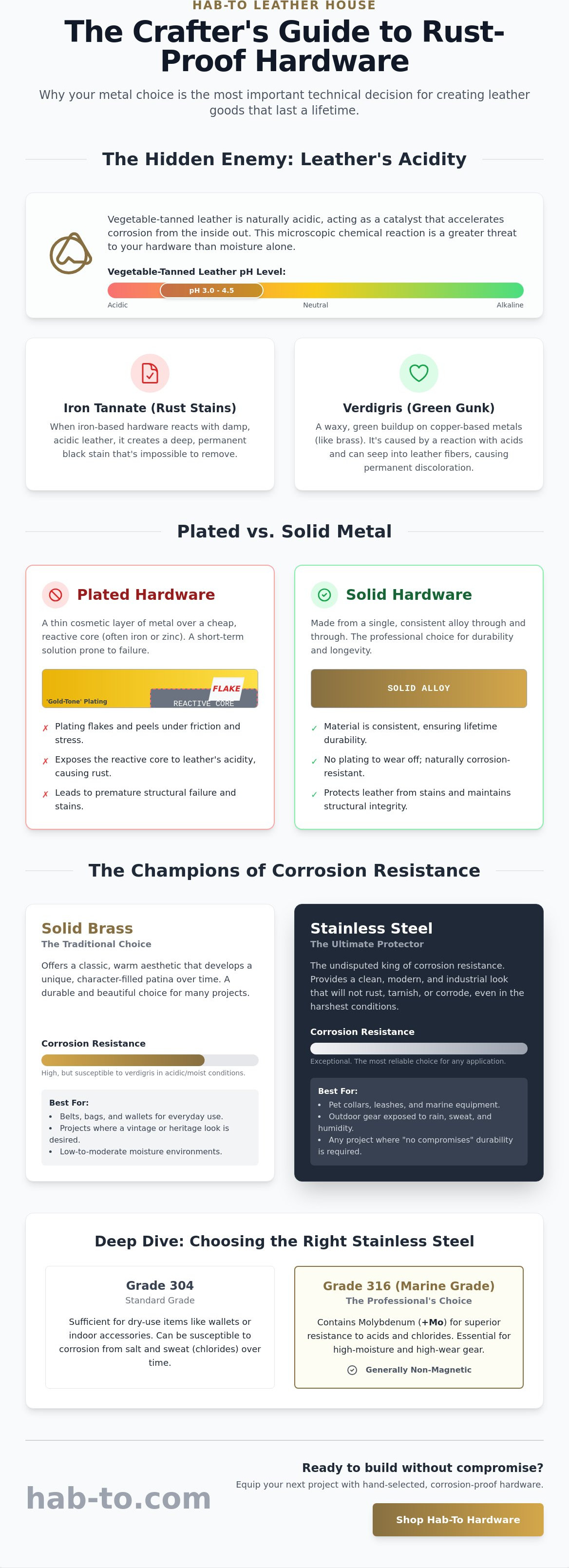
Rust is more than just an eyesore. It’s a structural failure that begins with a silent chemical dance between your metal and the material it’s supposed to secure. Many crafters blame the weather for hardware failure, but the real culprit is often the leather itself. To truly understand Why Does Leather Hardware Rust? Understanding the Chemistry, we have to look at the pH levels of the materials we use. Vegetable-tanned leather is naturally acidic, often sitting between 3.0 and 4.5 on the pH scale. This acidity acts as a powerful electrolyte, speeding up the movement of ions and triggering oxidation much faster than a neutral environment would.
When you're choosing hardware that won't rust, you're fighting a battle on two fronts. First, you have the internal acidity of the tannins. Second, you have external catalysts like humidity and skin oils. Sweat contains salt, which is a notorious accelerator for corrosion. If you use hardware with a cheap iron or zinc core, these elements work together to eat through the metal. Within months, a beautiful belt can develop "bleeding" rust spots that ruin the leather's grain. Selecting the right alloy isn't just about aesthetics; it's about chemistry.
The Role of Tannins in Metal Corrosion
Vegetable-tanned leather is far more reactive than chrome-tanned alternatives because of its high tannin content. These organic compounds are essential for the tanning process, but they're aggressive toward non-noble metals. If iron-based hardware touches damp vegetable-tanned leather, it triggers a reaction that creates iron tannate. This produces a permanent, deep black stain on the leather that's impossible to remove. For more context on how these materials interact, you can read my Vegetable Tanned Leather: The Complete Guide for Crafters. Choosing hardware that won't rust requires a deep respect for how these tannins behave over years of use.
Verdigris: The Silent Enemy of Brass Hardware
While iron produces traditional red rust, copper-based metals like brass deal with a different beast called verdigris. You’ve likely seen it: that waxy, bright green gunk that builds up around rivets or buckles on old saddles. Verdigris is the chemical reaction between acetic acid and copper. It’s particularly common in leathercraft because the fatty acids in the leather and the oils from our hands provide the perfect environment for it to thrive. Unlike a simple surface stain, verdigris can seep into the leather fibers and cause permanent discoloration. This is why "brass plated" items are so risky. Once the thin plating wears down, the reactive core is exposed to the leather's acidic environment, starting the green rot immediately.
The Best Rust-Proof Materials: Stainless Steel vs. Solid Brass
When you’re choosing hardware that won’t rust, you usually end up at a crossroads between two heavyweights: Stainless Steel and Solid Brass. Both materials offer exceptional durability, but they serve different aesthetic and functional purposes. Stainless steel provides a clean, modern, and industrial look. Solid brass offers a traditional, warm feel that develops a character-filled patina over time. Understanding the metallurgy behind these choices is essential for any crafter who refuses to compromise on quality. The Association for Materials Protection and Performance (AMPP) highlights several methods to prevent and control corrosion, and selecting the right alloy is arguably the most effective way to protect your work. This level of material focus is common in other high-moisture industries too; for example, Garden Watering emphasizes the use of specialized connectors to ensure longevity in irrigation systems.
In the world of professional leathercraft, 316 Stainless Steel is the undisputed king. While standard 304 stainless is common in many industries, 316 contains 2% to 3% molybdenum. This specific addition makes it significantly more resistant to the chlorides and acidic environments found in vegetable-tanned leathers. If you're building gear for the outdoors or high-humidity environments, this isn't just a luxury; it’s a necessity. Choosing hardware that won't rust means looking past the "stainless" label and demanding specific grades that can handle the 3.0 pH level of premium leather.
Stainless Steel Grades: 304 vs. 316 for Crafters
Most affordable hardware labeled "stainless" is actually 304 grade. It’s usually sufficient for items like wallets that stay in dry pockets, but for a dog collar or a bag used in rainy climates, you need the extra protection of 316. A quick trick to check your quality is the magnet test. High-grade austenitic stainless steels, like 316, are generally non-magnetic. If a magnet sticks firmly to your "stainless" buckle, it likely has a high carbon or iron content, which means it’s prone to surface rust over time. We always recommend 316 for any project that might see salt air or heavy sweat.
Solid Brass: The Artisan's Standard
Solid brass has been the standard for high-end saddlery for centuries. Because it contains no iron, it cannot develop ferrous oxide, the chemical name for rust. Instead, brass undergoes a slow oxidation process that results in a beautiful, dark patina. This aging process complements the natural darkening of vegetable-tanned leather perfectly. Unlike brass-plated steel, which eventually flakes and exposes a rusting core, solid brass remains structurally sound for a lifetime. If you want that classic look without the risk of structural failure, ensure your brass is truly "solid" and not just a finish. If you’re ready to upgrade your next project with materials that last, you can find our range of professional components at Hab-To Leather House.
Plated vs. Solid Metal: Why 'Gold-Tone' Isn't Enough
When you browse a hardware catalog, everything looks perfect. The "gold-tone" buckles and "silver-finish" rivets gleam under the studio lights, promising a premium look for a fraction of the cost. But as any experienced crafter will tell you, a finish is just a mask. If you are serious about choosing hardware that won't rust, you have to stop looking at the color and start looking at the core. Most mass-market hardware is made from a cheap base metal that is electroplated with a microscopic layer of decorative material. This layer is often less than 10 microns thick, which is roughly one-tenth the thickness of a human hair.
The real danger begins the moment your customer starts using the product. Leathercraft is tactile. Buckles rub against straps, D-rings swivel against clips, and rivets press against the acidic fibers of the leather. This constant friction acts like sandpaper, slowly grinding away that thin decorative plating. Once the protective barrier is breached, the reactive base metal underneath is exposed to the elements. This is where the "bleeding" starts. The internal acidity of the leather, which we discussed in the first section, immediately begins to corrode the exposed iron or zinc, leaving permanent stains on your carefully selected hide. Mike’s "No compromises" philosophy exists for this exact reason. If the core isn't solid, the product has an expiration date.
The Lifecycle of Plated Hardware
The failure of plated hardware follows a predictable, frustrating pattern. It starts with "pitting," where tiny microscopic holes appear in the finish. Soon, these holes expand, and the plating begins to peel off in flakes like old paint. If you must use a colored finish, look for PVD (Physical Vapor Deposition) coating. Unlike traditional dipping, PVD is a vacuum-sealing process that creates a much harder, more durable bond. To check your current stock, try the scratch test: take a needle or a small file to an inconspicuous area on the back of a buckle. If a different colored metal appears beneath the surface, you’re dealing with a ticking time bomb of corrosion.
Zinc Alloy (Zamak): The Industry Shortcut
Most "budget-friendly" hardware is cast from Zamak, a family of alloys with a base metal of zinc. Manufacturers love it because it’s cheap to produce and easy to cast into complex shapes. However, for a professional crafter, Zamak is a liability. Not only is it highly reactive to leather acids, but it is also incredibly brittle. While a solid brass buckle might bend under extreme pressure, a zinc buckle will simply snap. This is a safety issue for heavy bags or pet gear. Choosing hardware that won't rust means avoiding these shortcuts entirely. You can explore the differences in our A Crafter's Guide to Essential Leather Hardware to see why solid materials are the only way to ensure your work lasts a lifetime.
How to Match Hardware to Your Project Environment
Environment isn't just about whether you live near the coast or in a desert. In leathercraft, we have to consider "micro-environments." A wallet tucked into a warm pocket for 12 hours a day faces a constant cycle of body heat and humidity. A heritage briefcase meant to last 20 years or more will endure decades of rainy commutes and spilled coffee. If you want your work to stand the test of time, choosing hardware that won't rust requires matching the alloy to the specific lifestyle of the finished piece. While a standard brass-plated rivet might survive on a decorative key fob, it will fail miserably on a belt worn daily in a humid climate.
For heritage items, I always tell my students to think about the "weakest link" theory. You can use the finest Grade A vegetable-tanned leather, but if you secure it with iron-core hardware, the metal will fail long before the leather even develops a decent patina. When you're building for the long haul, solid materials like 316 stainless steel or solid brass are the only acceptable options. These materials ensure that the hardware remains as structurally sound in 2046 as it is the day it leaves your workbench.
Hardware for Pet Gear and Marine Use
Pet gear is arguably the most demanding environment for any leather good. Dog collars are subjected to a brutal combination of salt air, mud, constant moisture, and the physical stress of a pulling animal. In these conditions, surface-level rust isn't just an aesthetic problem; it's a safety hazard. Corrosion weakens the integrity of the metal, which can lead to a snapped D-ring at the worst possible moment. Only 316 stainless steel or solid brass should be used for pet and marine gear. I always recommend performing a "tug test" on your hardware before assembly. Secure the component and apply 50 kilograms of force to ensure the casting doesn't have internal air bubbles or structural weaknesses that corrosion could exploit.
Galvanic Corrosion: The Danger of Mixing Metals
One of the most common mistakes I see is mixing different metals on a single project. This triggers galvanic corrosion, a process where one metal sacrifices itself to protect another when moisture is present. If you use a high-quality 316 stainless steel buckle but secure it with a cheap nickel-plated steel rivet, the rivet will actually rust significantly faster than if it were used alone. The moisture in the air acts as a bridge, allowing ions to flow between the two different metals. To avoid this, follow my simple rule of thumb: keep all hardware on a single piece of leather the same material. If you’re using brass buckles, use brass rivets and brass D-rings. Consistency is the secret to a professional finish that stays rust-free. If you need help finding a complete set of matching, high-grade components, you can browse our hand-selected hardware collections to ensure total material compatibility.
No Compromises: Hab-To’s Hand-Selected Hardware Collection
I’ve seen too many beautiful projects lose their value because of a single failing rivet. At Hab-To, we believe that choosing hardware that won't rust shouldn't be a guessing game for the crafter. My philosophy is simple: if I wouldn't use it on a piece for my own family, I won't sell it to you. Every buckle, D-ring, and snap in our collection is hand-selected based on its metallurgical integrity and its ability to survive the unique acidity of vegetable-tanned leather. We don't just stock items; we curate them for durability.
Our inventory is strictly focused on premium materials. We specialize in solid brass and 316-grade stainless steel because these are the only alloys that truly meet the "No Compromises" standard. While other suppliers might offer a wider range of finishes, we prioritize the core metal. This ensures that even as your leather goods age and develop a rich patina, the hardware remains structurally sound and free from the "green rot" of verdigris or the structural decay of red rust.
Curated for Quality, Not Quantity
Our approach is rooted in 160 years of family experience in the leather trade. This history has taught us exactly which manufacturers prioritize quality and which ones take shortcuts with zinc-core alloys. We refuse to stock Zamak or cheap plated iron because they simply don't belong on high-end leatherwork. If you are investing the time and money to work with the "King of Leathers," as described in our guide to Shell Cordovan, you cannot afford to settle for 50-cent hardware. Premium leather deserves a foundation that matches its lifespan.
Start Your Next Project with the Right Foundation
One of the biggest hurdles for hobbyists and small ateliers is the "minimum order" requirement common among wholesalers. We’ve changed that. Whether you need a single 316 stainless steel buckle for a personal project or 500 solid brass rivets for a production run, we treat every order with the same respect. As an Amsterdam leather wholesaler, we offer the unique benefit of getting your leather and your hardware from a single, trusted source who understands how they interact chemically.
If you’re feeling stuck on a specific technical requirement or need advice on matching hardware to a new project environment, I’m here to help. You can book a personal consultation at our Amsterdam showroom or reach out online for expert guidance. When you're ready to build something that lasts a lifetime, you can shop our curated leather hardware collection here and start your next project with total confidence.
Build Leather Goods That Stand the Test of Time
Your journey into professional leathercraft shouldn't be derailed by a rusted buckle or a green-stained strap. We’ve explored how the 3.0 pH acidity of vegetable-tanned leather reacts with cheap metals, and why 316-grade stainless steel remains the king of durability for 2026. By avoiding zinc-core shortcuts and understanding the risks of galvanic corrosion, you're no longer just making products; you're building heritage pieces designed to survive decades of daily use.
Choosing hardware that won't rust is the foundation of a "no compromises" brand. At Hab-To, we back your craftsmanship with over 160 years of family expertise in the leather trade. Every component in our shop is hand-selected to meet the highest standards of artisan quality. Since we have no minimum order requirements, you can get exactly what you need for a single custom wallet or a full production run of bags. Stop settling for hardware that flakes and start using materials that age as beautifully as your leather. Browse Hab-To's Premium Rust-Proof Hardware and give your next project the professional finish it deserves. I can't wait to see what you create!
Frequently Asked Questions
Does stainless steel hardware ever rust?
Stainless steel can rust under specific conditions. While the name suggests total immunity, lower grades like 304 can develop surface "tea-staining" when exposed to salt air or heavy sweat. Only 316-grade stainless steel contains the molybdenum necessary to resist these aggressive chlorides. If your workshop tools are made of carbon steel, they can also leave microscopic iron particles on your hardware that trigger localized oxidation.
What is the difference between brass-plated and solid brass?
Solid brass is a consistent copper and zinc alloy throughout the entire component. Brass-plated hardware uses a cheap core, often zinc or steel, covered by a decorative layer thinner than 10 microns. When choosing hardware that won't rust, solid brass is the only reliable choice. It won't flake, peel, or expose a rusting core even after years of heavy friction and use.
Why is my brass hardware turning green?
This green waxy buildup is verdigris. It occurs when the copper in your brass reacts with acetic acids found in vegetable-tanned leather or natural skin oils. While verdigris isn't structural rust, it can seep into leather fibers and cause permanent green staining. Regular buffing with a dry cloth can prevent this buildup, but using high-quality solid brass reduces the frequency of the reaction.
What is the best metal for dog collars?
316-grade stainless steel is the superior choice for dog collars and leashes. It provides the highest tensile strength and is completely unaffected by the salt, mud, and constant moisture dogs encounter. Solid brass is a traditional second choice, but it is a softer metal. Brass will also develop a dark patina quickly when exposed to the pH levels of a dog's skin and coat.
Can I use 'gold' hardware on vegetable-tanned leather?
You can use gold-colored hardware, but it must be solid brass or PVD-coated steel. Standard gold electroplating is too thin to survive the 3.0 to 4.5 pH acidity of vegetable-tanned leather. The tannins will eat through the finish in less than 12 months. PVD (Physical Vapor Deposition) creates a molecular bond that is much harder and more resistant to the acidic environment of premium hides.
Is 316 stainless steel worth the extra cost for a leather bag?
The extra investment is absolutely worth it for any "heritage" bag meant to last decades. While 304 stainless is common, 316 provides an insurance policy against corrosion in coastal or humid environments. When you consider the total cost of your leather and labor, the small price difference for 316 hardware is a minor expense to prevent a catastrophic structural failure in the future.
How can I tell if my hardware is high-quality?
Perform a magnet test and a scratch test. High-quality 316 stainless and solid brass are generally non-magnetic; if a magnet sticks firmly, the metal contains a high iron content that will rust. You should also file a small hidden area on the back of the piece. If a different colored metal appears beneath the surface, the hardware is plated and won't stand up to long-term wear.
How do I clean rust off leather hardware?
Use a specialized metal polishing paste and a microfiber cloth to gently buff away surface oxidation. You must be careful to avoid getting any metal cleaner on the leather, as the chemicals can cause permanent discoloration or drying. If the rust has already caused "pitting" or deep holes in the metal, cleaning is only a temporary fix. In these cases, it's better to replace the hardware entirely.