How to Get Buy-In for Craft Material Costs in 2026: An Artisan’s Guide
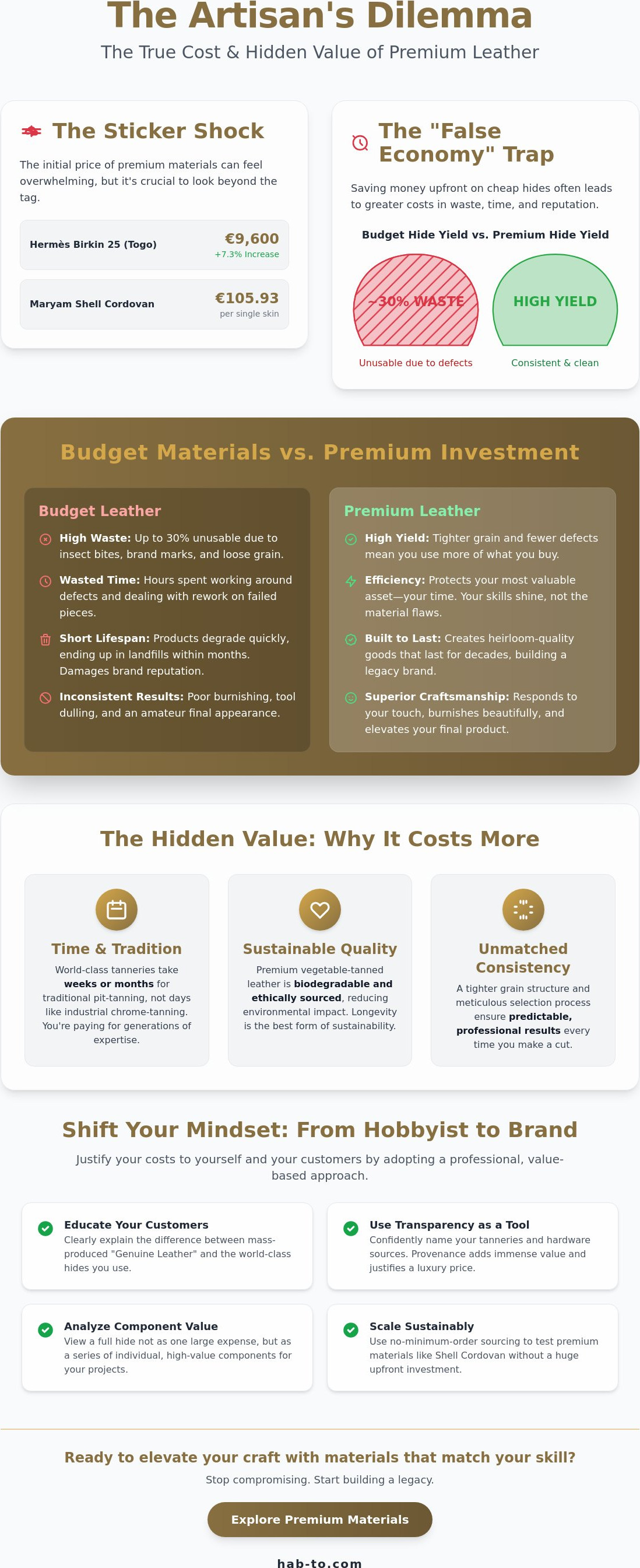
Hi, I'm Mike! In January 2026, Hermès increased prices on their Togo leather Birkin 25 bags by 7.3% in Europe, pushing the retail price to €9,600. While you might not be a global luxury house, you're likely feeling the same squeeze as wholesale leather prices reach up to $26.61 per kilogram. It's a heavy burden to look at a €105.93 price tag for a single Maryam Shell Cordovan skin and wonder if you can justify the expense. You want to work with the best, but explaining that cost to your family or your customers often feels like an impossible task.
I know the feeling of sticker shock and the fear of making a wrong cut on an expensive hide. Mastering how to get buy-in for craft material costs is the only way to bridge the gap between being a hobbyist and building a respected brand. I'll show you how to justify these investments to yourself and your clients without compromising on quality or tradition. We'll walk through a clear framework for material ROI and strategies to pass costs on effectively, so you can focus on the craft instead of the receipts.
Key Takeaways
- Move past the "false economy" of cheap leather by understanding how premium hides reduce waste and rework in your workshop.
- Master a simple breakdown for how to get buy-in for craft material costs by viewing a full hide as a series of individual, high-value components.
- Learn to educate your customers on the difference between mass-produced "Genuine Leather" and the world-class vegetable-tanned hides you use.
- Discover how to scale your craft sustainably using no-minimum-order sourcing to test premium materials like Shell Cordovan without a massive upfront investment.
- Gain the confidence to justify luxury pricing by using transparency as a marketing tool, naming your tanneries and hardware sources directly.
Understanding the 'Sticker Shock' of Premium Craft Materials
Hi, I'm Mike! I've seen that look before. You're staring at a beautiful hide of Shell Cordovan or a premium shoulder, and your brain is doing the math. It's a specific kind of panic. You want the quality, but the price tag feels like a personal attack on your bank account. This is the first hurdle in learning how to get buy-in for craft material costs. You have to convince yourself before you can ever hope to convince a customer or your family that this investment is worth it.
In 2026, the craft market is shifting. People are tired of cheap, mass-produced items that fall apart in six months. They want objects with a soul. At Hab-To, my "no compromises" rule is a deliberate business strategy. If I sell you synthetic or low-grade leather, I'm setting you up for failure. High-quality materials are the foundation of a brand that lasts. Shifting your mindset toward value-based pricing starts with understanding that you aren't just selling leather; you're selling a legacy.
To better understand how to translate these costs into your pricing strategy, watch this helpful video:
The "False Economy" is the biggest trap for artisans. You might save money upfront on a budget hide, but the hidden costs are staggering. Think about the waste. Cheap leather often has insect bites, brand marks, or loose grain that makes 30% of the hide unusable. You spend hours trying to work around defects, only to have the final piece look amateur. Premium hides offer consistency and high yield. You pay more per square foot, but you use more of what you buy. It's about efficiency, not just luxury.
The Shift from Hobby to Professional Grade
Most of us started with the cheapest scraps we could find. That's fine for learning how to hold a needle. However, there's a moment when your skill level outpaces your supplies. If your edges won't burnish or your tools are dulling because of harsh chemicals in low-grade leather, you've outgrown budget materials. Professional grade supplies make the work easier. They respond to your touch. They allow your craftsmanship to shine instead of forcing you to hide material flaws. When you reach this stage, the cost isn't an expense; it's a necessary tool for your growth.
Why Quality is the Best Sustainability Strategy
Sustainability isn't just a buzzword in 2026. It's a requirement. Choosing vegetable tanned leather reduces the environmental impact compared to heavy-metal chrome tanning. These materials are biodegradable and sourced from tanneries with strict ethical standards. Beyond the chemistry, quality is sustainable because of longevity. A wallet made from premium leather lasts decades, not months. For the modern crafter, the "buy once, cry once" philosophy means investing in materials that won't end up in a landfill by next year.
The Hidden Value: Why Premium Leather and Hardware Cost More
If you're struggling with how to get buy-in for craft material costs, you need to understand what happens inside the tannery walls. World-class leather isn't just a byproduct; it's the result of months of labor-intensive work. While industrial tanneries might pump out chrome-tanned hides in days, the tanneries I work with in Italy and France often take weeks or months to reach the finish line. As Forbes highlights, investing in quality materials is a direct investment in the customer's long-term satisfaction. You're paying for the artisan’s time, the traditional pit-tanning methods, and the hand-selected hides that meet a standard synthetics can never touch.
Consistency and yield are the technical reasons behind the price tag. A premium hide has a tighter grain structure and fewer surface defects. This means you can cut your patterns closer together, significantly increasing your yield. Cheap leather often hides "loose grain" that only appears once you start flexing the material. By the time you realize the leather is poor quality, you've already invested hours of labor. High-grade materials protect your most valuable asset: your time.
Decoding the Price of Shell Cordovan
When you look at the cost of shell cordovan, you're seeing the price of extreme patience. This material undergoes a specialized six-month tanning process. It isn't even technically "leather" in the traditional sense; it's a dense fibrous membrane found only in the hindquarters of a horse. This scarcity dictates the market price. Structurally, shell cordovan is unique because it doesn't have a grain layer that can peel or crack. It's nearly indestructible and develops a deep, mirror-like glow over time that no other material can replicate.
Hardware and Tools: The Unsung Heroes of Buy-In
The cost of failure is much higher than the cost of quality. Imagine selling a $300 bag only to have a cheap rivet snap or a buckle finish peel off within a month. That single failure destroys your reputation. Choosing solid brass leather hardware over zinc alloy isn't just about aesthetics. It's about weight and reliability. Customers notice the "heft" of a solid brass clasp. It feels intentional. Similarly, high-end tools reduce errors. A sharp, premium pricking iron ensures your stitch lines are straight every time, reducing the need for costly rework and improving your effective hourly rate.
Unlike synthetics that begin to degrade the moment they leave the shop, premium vegetable-tanned leather actually improves. The "Patina" effect is your best selling point. It's a living history of the object’s use. If you're ready to see the difference for yourself, you can browse our hand-selected hardware collection to find pieces that match the quality of your leather.
Building Your Internal Case: How to Justify Costs to Yourself
Hi, I'm Mike! Convincing a customer that a bag is worth €500 is often easier than convincing yourself to spend €200 on the hide required to make it. That internal resistance is the biggest barrier in learning how to get buy-in for craft material costs. When you're standing at your workbench, it's easy to see a premium hide as a liability. You worry about one wrong cut ruining the investment. However, that mindset keeps you stuck in the hobbyist trap, where you spend more time fighting your materials than refining your craft.
The "Cost-Per-Project" framework is the best way to break this mental block. A €200 hide sounds like a massive expense. But when you realize that hide yields ten wallets, the cost is only €20 per unit. Suddenly, the math shifts. You aren't "losing" €200; you're investing €20 to ensure your final product doesn't look like a cheap imitation. This perspective changes the purchase from a scary lump sum into a manageable component cost. It also helps you view the material as an R&D investment for your future brand. Every hide you work through is a lesson in grain structure and edge finishing that budget leather simply cannot teach.
Calculating Your True Material Margin
To move beyond guesswork, you need a simple formula to track usable area. While wholesale leather prices in 2026 range from $9.55 to $26.61 per kilogram, the weight doesn't tell the whole story. Premium hides offer a higher yield because you aren't cutting around scars or loose grain. To calculate material ROI for a single artisan piece, divide the estimated retail price by the sum of the material cost and the labor hours saved through reduced defect-dodging. Working with consistent, clean materials can save you two hours of prep time per project, which significantly increases your effective hourly rate.
Communicating with Family and Stakeholders
If you're justifying these costs to a partner or family member, stop calling them "hobby expenses." Use the term "business seed." Explain that the difference between a prototype and a finished premium piece lies entirely in the tactile quality of the leather and hardware. Show them the difference. Let them feel a scrap of budget leather next to a piece of vegetable-tanned shoulder. Setting a dedicated material budget allows for high-end experimentation without the guilt. When your stakeholders see that premium materials lead to faster sales and higher margins, the buy-in happens naturally.
Finally, consider your own burnout. Working with stubborn, low-grade materials is frustrating and exhausting. Working with world-class leather is a joy. That "joy of craft" is what keeps you coming back to the bench every day. If you don't enjoy the process, you won't stay in business long enough to see the profits.
Selling the Value: Getting Customer Buy-In for Your Prices
Hi, I'm Mike! We've all been there. You present a beautifully handcrafted wallet, and the customer asks, "Why is this €150 when I can get one at the mall for €20?" It's a gut-punch if you aren't prepared. Mastering how to get buy-in for craft material costs from your clients is about moving the conversation from price to provenance. You aren't just selling a functional object. You're selling the result of centuries of tradition and the highest ethical standards in the leather industry.
Transparency is your most powerful marketing tool. Instead of saying "high-quality leather," say "Pueblo leather from the Badalassi Carlo tannery in Italy." When you name the source, you immediately differentiate yourself from mass-market brands that hide their materials behind vague terms. In 2026, consumers are more educated than ever. They want to know that their hardware won't flake and that their leather was tanned using natural tannins rather than harsh chemicals. Confidence in your pricing comes from knowing exactly what went into the piece.
The Power of Provenance
Provenance is the story of where a material began. For the 2026 artisan, this is a massive value-add. Customers today value ethical and sustainable sourcing above almost everything else. They want to hear about the family-run tanneries and the traditional methods used to create their goods. One effective strategy is creating "Material Cards" to include with every finished product. These small inserts explain the specific characteristics of the leather and the solid brass hardware you've chosen. It turns a simple purchase into an educational experience, making the premium price feel like a fair exchange for world-class quality.
Visualizing the Difference
Don't just tell them; show them. Use side-by-side photos of a brand-new piece of vegetable-tanned leather next to one that has been used for three years. The "Patina" effect is a visual representation of value that cheap synthetics can't mimic. Use macro photography to capture the tight grain of full-grain leather or the precise weight of a solid brass buckle. This level of detail proves your "no compromises" approach. You can even leverage insights from "The Leather Hour" podcast to explain the technical benefits of specific hides. When you speak with the authority of a mentor, customers stop seeing a price tag and start seeing an heirloom.
If you're ready to start building that story for your own brand, you can explore our full range of premium vegetable-tanned leather to find the perfect material for your next project.
Handling the "Why is this so expensive?" question becomes easy when you stop being defensive. Instead of justifying the cost, explain the value. Explain that "Genuine Leather" is often just ground-up scraps glued together, while your "Full Grain" leather is the strongest, most natural part of the hide. You aren't charging for the material; you're charging for the fact that they will never have to buy another one again.
Optimising Your Material Spend with Hab-To Leather House
Hi, I'm Mike! Scaling your craft from a weekend hobby to a professional brand shouldn't feel like a gamble. One of the biggest hurdles in learning how to get buy-in for craft material costs is the fear of tying up all your capital in a single pallet of leather. If you have to buy ten hides just to get a wholesale price, you're taking a massive risk on a color or finish that might not sell. At Hab-To, we've structured our business to remove that barrier. We want to be your partner in the creative process, not just another anonymous supplier.
We believe that quality should be accessible. Our approach combines the scale of an Amsterdam leather wholesaler with the personal touch of a family business. By offering curated crafting bundles and hand-selected tools, we help you lower the initial cost of entry for premium materials. You can start with a Shell Cordovan starter bundle for €149.80 instead of investing thousands in bulk skins. This allows you to prove your concept and get that crucial customer buy-in before you scale your inventory.
Why No Minimum Order Changes the Game
Capital is the lifeblood of any small workshop. In 2026, the "Lean" crafting model is the most sustainable way to grow. Our "No Minimum Order" policy means you don't have to tie up upfront capital in materials you don't need yet. Do you want to offer a "Limited Edition" wallet in a specific Badalassi Pueblo color? You can buy exactly what you need for that specific run. This flexibility allows you to test market demand without the bulk risk. It also keeps your inventory fresh and your workshop organized. You focus on the craftsmanship; we'll handle the stock.
Your Partner in Craftsmanship
We bring 160 years of family experience to your workbench. When you buy from us, you aren't just getting a hide. You're getting an invitation to leverage our expertise. If you're unsure which hardware finish matches a specific vegetable-tanned shoulder, you can book a consultation or visit our Amsterdam showroom. I'm here to offer the advice I've gathered from generations of leather merchants. We don't sell synthetics, and we don't make compromises. We only provide the materials that we would be proud to use ourselves.
If you're ready to take the next step in your artisan journey, Browse our hand-selected leather and hardware to find the exact components that will define your brand. Whether you need a single 40mm metal buckle for €8.56 or a premium panel of Olivenleder, we're here to support your growth. Let's build something that lasts together.
Elevate Your Craft with Confidence
Hi, I'm Mike! Transitioning from a hobbyist to a professional artisan requires more than just skill; it requires a strategic mindset. You've learned that the sticker shock of premium hides is often offset by superior yield and the reduction of wasted labor hours. By mastering how to get buy-in for craft material costs from yourself and your customers, you turn every project into a lesson in quality and a testament to your brand's integrity.
Transparency about your sources transforms a price tag into a narrative of provenance. At Hab-To, we back your journey with 160+ years of family experience and direct access to my personal expertise. As an Amsterdam-based wholesaler serving crafters worldwide, we ensure you never have to compromise on your materials. We're here to help you scale your business without the burden of industrial-sized orders or synthetic substitutes.
Ready to invest in your craft? Browse our premium leather selection with no minimum orders.
The path to a respected brand is built one high-quality stitch at a time. Don't let the fear of material costs hold back your potential. You have the tools and the framework to justify the best; now it's time to create something extraordinary.
Common Questions About Artisan Material Costs
How do I explain to a customer why a handmade wallet costs €100?
Lead with the provenance of the material and the hours of labor involved. Explain that a €100 wallet uses full-grain leather from world-renowned tanneries like Badalassi Carlo, which is the top 5% of all leather produced globally. Unlike mass-market goods, your piece is hand-stitched for durability, ensuring it lasts for decades rather than months. Transparency about these specific quality markers justifies the price immediately.
Is it better to buy one premium hide or three budget hides?
One premium hide is always the better investment for a growing brand. Budget hides often contain up to 30% waste due to insect bites, brands, or loose grain, which forces you to spend extra time cutting around defects. A high-grade hide offers a higher yield and a consistent finish. This consistency protects your reputation and ensures every project you complete meets a professional standard.
What is the best way to track material costs for a small craft business?
Track your costs using a "cost-per-unit" spreadsheet that factors in the total usable area of your leather. Research shows that material costs typically represent 20% to 30% of the final retail price for handmade goods. By tracking the specific square footage used for each pattern, you can accurately price your items to cover both the material investment and your labor hours without guessing.
Can I really save money by not buying in bulk?
Yes, adopting a lean crafting model saves money by keeping your capital liquid instead of tied up in dead stock. Understanding how to get buy-in for craft material costs often means proving a design sells before committing to a large order. By using a supplier with no minimum requirements, you can test limited edition colors and finishes without the financial risk of carrying excess inventory you might never use.
How do I avoid wasting expensive leather during the cutting process?
Always use clear acrylic or paper templates to nest your patterns as tightly as possible before making a single cut. I recommend practicing your layout on the hide with masking tape or a silver pen to visualize the yield. Premium leather has a more uniform grain, which allows you to cut closer to the edges. This efficiency ensures you get the maximum value out of every square inch.
Does using premium hardware really affect the final sale price?
Premium hardware is a primary indicator of luxury that customers can feel instantly. A solid brass buckle has a specific weight and "heft" that zinc alloy alternatives lack. When a customer feels the reliability of high-end hardware, they are much more likely to accept a higher price point. It prevents the "cost of failure" where a cheap rivet breaks and ruins your brand's reputation.
How can I justify the cost of Shell Cordovan to my spouse?
Frame the purchase as a "business seed" rather than a personal expense. Shell cordovan is the most prestigious leather in the world, and products made from it command significantly higher margins. Explain that while the upfront cost is higher, the ROI is faster because these pieces are highly sought after by collectors. Showing a clear plan for how that single hide turns into profitable inventory builds immediate trust.
What are the most important craft materials to invest in first?
Invest in high-quality vegetable-tanned leather and a set of professional pricking irons first. The leather is the soul of your product; if the material is poor, no amount of skill can save the final look. Good tools improve your hourly rate by reducing errors and physical fatigue. Once you have these foundations, you can gradually add specialized hardware and bundles to expand your product line sustainably.