
How to Identify Quality Leather: An Artisan’s Guide to Premium Hides (2026)
Hi, I'm Mike! That "Genuine Leather" stamp on your luxury bag isn't a badge of honor; it's often a marketing trick used to sell low-grade scraps bonded with plastic. If you've ever felt cheated when a "premium" belt starts peeling after just six months, you aren't alone. Learning how to identify quality leather is the only way to protect yourself from these industry shortcuts. Since my family began our journey in the leather trade in 1864, we've lived by a simple rule: no synthetics and no compromises.
I know how overwhelming it feels to choose between Top Grain and Full Grain while trying to figure out if that "smooth" finish is a natural patina or a chemical coating. You want materials that age beautifully and tell a story over time. In this guide, I'll share the technical markers and sensory tests I use daily in our Amsterdam warehouse to separate the master-grade hides from the mass-produced imitations. We'll explore why vegetable-tanned leather remains the gold standard for durability and how to judge fiber density with a single touch. You're about to build a "crafter's eye" so you never overpay for a label again.
Key Takeaways
- Learn to see past marketing labels by understanding the hierarchy of leather grades and why natural grain is non-negotiable for structural integrity.
- Discover how to identify quality leather using Mike’s "5 Senses Test" to spot premium hides that speak through their unique physical properties.
- Expose the "Genuine Leather" trap and learn why heavy chemical treatments often mask low-grade materials and compromise durability.
- Understand the value of heritage tanneries and why the "Slow Tanning" movement is the essential ingredient for creating truly sustainable goods.
- Gain the expert insight needed to match specific leather types to your crafting goals, ensuring you never overpay for branding again.
The Hierarchy of Leather Grades: What Defines Quality?
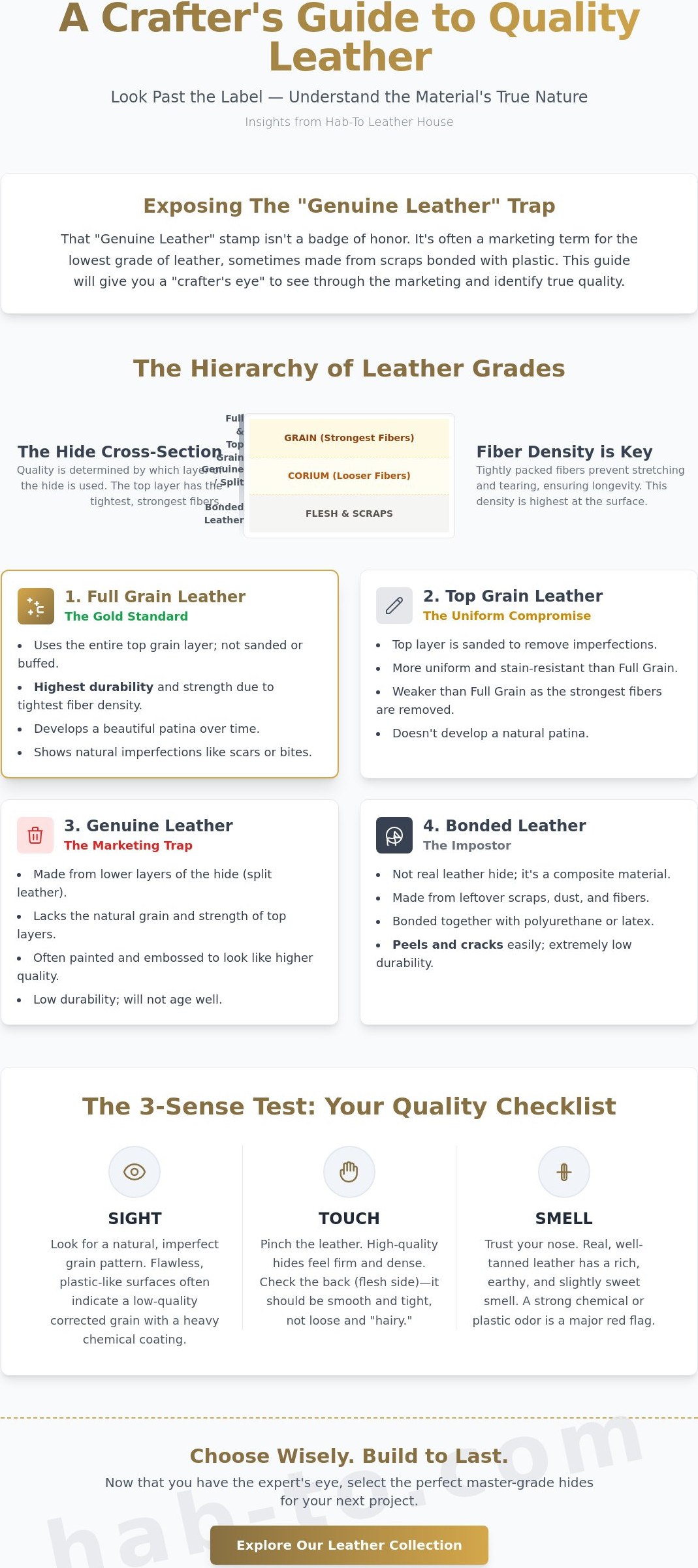
Hi, I'm Mike. When you step into the world of leatherwork, you quickly realize that not all hides are created equal. Quality leather is material that retains its natural grain and the original structural integrity of the animal hide. At Hab-To Leather House, we live by a "No Compromises" philosophy. We don't use synthetic fillers or plastic coatings. We only work with natural fibers that breathe and age with character. If you want to know how to identify quality leather, you have to look past the surface finish and understand what's happening deep inside the fibers.
Quality is determined by which specific layer of the hide is used and the methods used to process it. Understanding the Leather Grades Explained by historical and industrial standards helps you see why the top layer is so prized. Full Grain is the gold standard of leather durability because it preserves the hide's strongest, most compact fiber layer without any structural interference.
To better understand the visual differences between these grades, watch this helpful video:
Full Grain vs. Top Grain: The Structural Difference
Full Grain is the outermost layer of the hide. It has the tightest fiber density because it hasn't been altered by mechanical sanding. Top Grain leather is a slightly sanded version. While it looks uniform and "perfect" on the shelf, it loses a significant portion of its natural strength for the sake of that uniformity. Think of it like a piece of timber. If you sand away the hard outer grain of a wood plank, you're left with a softer, more vulnerable core. The same logic applies to hides; once you sand the surface, you've removed the toughest part of the material.
The Role of Fiber Density in Longevity
The "tightness" of the fibers at the top of the hide is what prevents your bags or wallets from stretching out of shape or tearing under pressure. In my experience, hides sourced from cooler climates, such as Northern Europe or the Alpine regions, often show a 15% to 20% higher fiber density compared to those from tropical areas. Cold weather causes the animal to develop a more compact skin structure to retain heat.
You can spot quality by looking at the flesh side, which is the back of the leather. High-quality hides will have a smooth, tight back. If you see loose, "hairy" fibers that pull away easily, the structural integrity is compromised. This is a vital step in learning how to identify quality leather before you commit to a purchase or start a project. Look for these visual cues:
- Tightness: A firm, dense feel when you pinch the leather.
- Grain Pattern: Small imperfections like insect bites or scars that prove the grain hasn't been sanded off.
- The Back: A clean, compact flesh side with minimal fuzziness.
The 5 Senses Test: How to Spot Premium Hides
When I'm in the warehouse hand-selecting hides for Hab-To, I don't rely on a spec sheet or a glossy catalog. I use my senses. Learning how to identify quality leather requires you to look past the marketing fluff and listen to what the material is telling you. Real, premium leather speaks through its physical properties. It isn't meant to be perfect. In fact, if a hide looks like a flawless sheet of plastic, that's a massive red flag. It usually indicates a low-quality corrected grain where the natural character was sanded off and replaced with a heavy layer of pigment.
Quality leather celebrates its history. You should trust your instincts over a "Genuine Leather" tag, which is often just a marketing gimmick for the lowest grade of usable hide. To truly understand the material, you need to engage your nose, eyes, and hands. This sensory approach is exactly what A Guide to Identifying High-Quality Leather suggests when distinguishing between mass-produced goods and artisan materials.
The Smell and Sight of Authenticity
Close your eyes and take a breath. High-quality vegetable tanned leather carries a distinct scent profile. It's earthy, sweet, and rich, a result of the natural barks and tannins used in the pits. If you catch a whiff of harsh chemicals, gasoline, or acrid fumes, you're likely holding a cheap chrome-tanned hide that was rushed through production.
Visually, you're searching for the grain's truth. Look for fat wrinkles, growth marks, and small scars. These aren't defects; they're proof the animal lived and the hide hasn't been heavily processed to hide flaws. You also want to check the color depth. Premium aniline dyes penetrate deep into the fibers rather than sitting on top like a thick coat of paint. This allows the natural texture to remain visible while ensuring the color won't just flake off over time.
Touch and Sound: Hand-feel and the "Leather Squeak"
Pick up the hide and test the temper. This refers to the leather's firmness. It should feel supple yet resilient. If it feels mushy, spongy, or lacks structure, the tanning process was likely compromised. You can also test for the pull-up effect. When you fold quality leather, the oils and waxes within the fibers shift, creating a temporary, lighter color change. It's a hallmark of hides that have been properly nourished with natural fats.
Don't forget to listen. High-quality veg-tan has a signature "squeak" when you handle it or rub two surfaces together. This sound comes from the dense fiber structure and the presence of natural tannins. It's a reliable indicator that the leather is robust enough to last for decades. If you want to experience these sensory markers firsthand, you can browse our collection of artisan hides and see why we never compromise on our selection.
The "Genuine Leather" Trap and Other Marketing Myths
Marketing labels are designed to sell, not to inform. Most consumers see the words "Genuine Leather" and assume it's a mark of excellence. In reality, it's often a technical loophole used to describe the lowest grade of usable hide. Don't be fooled by a shiny surface or a low price tag. Learning how to identify quality leather means looking past the embossed surface and understanding the structural integrity of the material. At Hab-To, we follow a simple rule: No synthetics. No compromises. This means rejecting the shortcuts that big brands use to inflate their profit margins.
Many people believe that softness is the ultimate sign of quality. This is a common misconception. While premium vegetable-tanned hides can be supple, tanneries often achieve extreme softness in low-grade skins through heavy chemical treatments and mechanical tumbling. These processes break down the fibers, leading to a product that feels great in the store but loses its shape within weeks. Similarly, "waterproof" leather is frequently just a low-quality hide coated in a thick layer of Polyurethane (PU). While marketing teams use vague terms, organizations like the United Nations Industrial Development Organization provide specific metrics in UNIDO's acceptable quality standards for leather to define what actually makes a hide durable, such as tear strength and color fastness.
The worst offender is bonded leather. This isn't craftsmanship; it's recycling gone wrong. Manufacturers take leather scraps, grind them into a pulp, and glue them to a fiber backing. It contains as little as 10% to 20% actual leather fiber. It's essentially the "chicken nugget" of the leather world. If you want to know how to identify quality leather, look for the natural irregularities that a machine can't replicate. Bonded leather will always feel cold, smell like chemicals, and peel away in thin, plastic-like sheets.
Why "Genuine" is a Warning, Not a Guarantee
Genuine leather is usually made from the "split," which is the bottom layer left over after the premium top grain is removed. It lacks the dense fiber structure of the upper hide. To make it look presentable, factories paint it with heavy pigments and stamp it with a fake grain. Genuine leather is to fine hides what particle board is to solid oak. Because it lacks a natural grain, these products crack and peel under the slightest stress. You'll often see these items failing at the stitch lines or where the material flexes most.
Corrected Grain and the Illusion of Perfection
Corrected grain leather is the result of tanneries trying to hide scars, insect bites, or poor husbandry. They sand down the surface of the hide until it's smooth, then emboss it with a uniform pattern. This process removes the strongest part of the skin. Because the natural surface is gone, corrected grain leather cannot develop a true patina. It will never get better with age; it only gets worse. You can spot these "fake grain" stamps by looking for repeating patterns. If every pore and wrinkle looks identical across the entire surface, it was made by a metal press, not by nature.
Tannery Heritage: Why Origin and Method Matter
You can't separate a premium hide from the facility that produced it. The tannery's heritage is the ultimate shortcut for anyone learning how to identify quality leather. While industrial plants often prioritize speed, the "Slow Tanning" movement has gained momentum among artisans because time is the one ingredient you can't fake. While mass-market factories churn out hides in 24 hours, master tanners might spend six months on a single batch to ensure the fibers are properly saturated. For a masterclass in this dedication, look at Shell Cordovan, where a specific multi-month process creates the king of leathers. European tanneries, particularly those in Italy and France, lead the world because they adhere to strict REACH environmental standards. These regulations, updated as recently as 2024, ensure that no toxic chemicals or heavy metals enter the local ecosystem during production.
Vegetable Tanning vs. Chrome Tanning
At Hab-To, our family has focused on vegetable tanning for over 160 years. We don't use heavy metals like Chromium III. This chemical accounts for roughly 90% of global leather production because it's fast, but it lacks the soul of traditional methods. Instead, we rely on natural tannins found in tree barks like oak, mimosa, and chestnut. This process is slow. It's expensive. But it's the only way to get leather that develops a rich patina. Veg-tan leather doesn't just wear out; it matures and tells a story through every scratch and sun-drenched afternoon. When you're trying to understand how to identify quality leather, the smell is your first clue. Veg-tan smells earthy and sweet, never like harsh chemicals or plastic.
Names to Trust: The World’s Best Tanneries
When you see a tannery name like Horween in the USA, or Badalassi Carlo and Walpier in Italy, you're looking at a mark of excellence. These names act as a high-confidence signal for the buyer. If a maker proudly lists their source, they aren't hiding anything. Many of these top-tier facilities hold an LWG Gold Rated certification. This means the Leather Working Group has audited them for energy use, waste management, and chemical safety. For a conscious crafter, this certification is a non-negotiable standard. These tanneries produce leathers like Buttero or Pueblo that are world-renowned for their consistency and handle. Choosing a hide from a reputable source means half the work is already done for you.
Ready to start your next project with materials that respect the craft? Browse our hand-selected leather collection and see the difference heritage makes.
Selecting the Right Quality for Your Project
Choosing the right hide is the most critical decision an artisan makes. You don't just buy a piece of leather; you select a partner for your tools. Knowing how to identify quality leather isn't just about spotting flaws. It's about matching the physical properties of the skin to the demands of your design. At Hab-To, we've spent 160 years refining this selection process, and we've learned that the "best" leather is always the one that serves the project's purpose.
Matching Leather Temper to Product Function
Temper refers to the stiffness or flexibility of the hide. If you're building a heavy-duty belt or a firearm holster, a firm vegetable-tanned leather is non-negotiable. It provides the structural integrity needed to hold weight without sagging. Conversely, if you're crafting a slouchy tote bag or a lined jacket, you'll want a softer, milled leather that offers a graceful drape. Selecting the wrong temper leads to a finished product that feels clumsy or fails prematurely. Once you've chosen your hide, refer to our Leather Hardware Guide to ensure your buckles and rivets match the caliber of your material.
The Investment Mindset: Cost per Year vs. Cost per Item
Premium leather carries a higher price tag because it performs better over time. A wallet made from high-grade full-grain leather can easily last 25 to 30 years, whereas a synthetic or "genuine leather" alternative often falls apart within 18 months. When you calculate the cost per year of use, the premium option is actually the more economical choice. To help you make the right call, use this checklist during your next visit to a leather house:
- The Surface: Look for natural grain patterns rather than stamped, uniform textures.
- The Scent: Quality veg-tan should smell earthy and sweet, never like harsh chemicals or plastic.
- The Edge: Check the fiber density. Tight, compact fibers at the cut edge indicate a healthy, strong hide.
- The Source: Ask for the tannery name. World-class tanneries like Walpier or Badalassi Carlo are hallmarks of excellence.
We believe every crafter deserves access to these materials regardless of their experience level. That's why Hab-To maintains a strict "No Minimum Order" policy. You can purchase small quantities or high-quality scraps to test your skills before committing to a full hide. If you're unsure which leather fits your vision, reach out. I'm Mike, and I'm here to help you navigate these choices. Start with the best materials, and your hands will do the rest.
Elevate Your Craft With Hides That Tell a Story
Your work deserves materials that age with character, not synthetics that peel within a single year. By moving past marketing buzzwords like "Genuine Leather" and trusting your senses, you've gained the essential tools to spot true artisan quality. Remember that the best hides carry the legacy of their tannery. These traditional methods prioritize durability over mass production every time. Knowing how to identify quality leather is the fundamental difference between a project that lasts a single season and an heirloom that lasts a lifetime.
At Hab-To Leather House, we don't believe in shortcuts. We're an Amsterdam-based wholesaler backed by 160+ years of family expertise in premium hides. We've spent generations refining our selection process to ensure you only work with the finest vegetable-tanned materials. Whether you're a solo hobbyist or a professional maker, we provide direct access to the same materials used by top-tier luxury brands. No synthetics. No compromises. Just quality materials for real craftsmanship.
Hi, I’m Mike! Browse our hand-selected premium hides with no minimum order.
Take your next project to the next level. I'm looking forward to seeing what you create with these world-class materials.
Frequently Asked Questions
What is the easiest way to tell if leather is real or synthetic at a glance?
The fastest way to identify real leather is through scent and surface texture. Real hides have a distinct, earthy smell, while 100% of synthetics are made from PVC or PU and smell like chemicals. Look for irregular pore patterns. If you see a perfectly repeating texture every 5 centimeters, it's likely a machine-made imitation. Real leather feels warm to the touch and absorbs a tiny drop of water within 30 seconds.
Does high-quality leather always scratch easily?
Not all premium hides scratch easily, but many high-quality leathers like Pueblo or Buttero do show marks. This happens because they don't have thick plastic coatings. These surface scratches often disappear when you rub them with your thumb. Over a period of 3 to 6 months, these marks blend into a rich patina. It's a sign of authenticity, not a defect in the material.
Why is vegetable-tanned leather considered better than chrome-tanned?
Vegetable tanning is superior because it uses natural tannins from tree bark instead of harsh chemicals. While chrome tanning is finished in under 24 hours, the vegetable process takes up to 60 days. This traditional method creates a more durable product that smells better and lasts longer. Learning how to identify quality leather often starts with checking if the hide was tanned using these sustainable, plant-based methods.
Is 'Full Grain' leather always thick and heavy?
Full grain refers to the part of the hide used, not the thickness of the material. You'll find full-grain leathers ranging from 0.5mm for gloves to 5.0mm for heavy-duty saddles. It's the strongest part of the skin because the fibers are tightly packed. It doesn't have to be heavy to be high quality; it just needs to have the original grain intact.
Can I identify leather quality just by the price tag?
You can't rely on price alone, though it's a helpful benchmark. High-end vegetable-tanned leather typically costs 300% more than basic chrome-tanned options due to the long production time. However, some fashion brands charge $500 for items made from low-grade "Genuine Leather" splits. Always inspect the grain and smell rather than assuming a high price equals a premium hide.
How can I tell if a 'Genuine Leather' label is actually a low-quality split?
Check the edges and the underside of the material to spot a low-quality split. "Genuine Leather" is a broad industry term that often hides the fact that the material is the bottom layer of a hide. If the edge looks like compressed cardboard or the back is very fuzzy and loose, it's likely a split. High-quality hides have a tight, consistent fiber structure throughout the entire cross-section.
What does 'Aniline' leather mean in terms of quality?
Aniline leather represents the highest tier of hide selection because it lacks a pigment coating. Only 5% of global hide production is clean enough to be finished this way. Because the dye is transparent, you can see every natural mark and pore. It's the most natural-feeling leather available. It's also more breathable than leathers with heavy finishes, making it more comfortable for daily use.
Does the country of origin (like Italy or the USA) guarantee leather quality?
A country label doesn't guarantee quality on its own. Italy produces 65% of the leather in Europe and has a massive reputation, but "Made in Italy" doesn't always mean the hide was tanned there. Some manufacturers finish low-grade hides in famous regions just to get the label. You're better off looking for specific, reputable tanneries like Walpier or Badalassi Carlo to ensure you're getting a premium product.