Leather for Cosplay: A Maker’s Guide to Choosing the Right Hide in 2026
What if the most expensive part of your next build isn't the material itself, but the fear of making one wrong cut? You've likely stared at a premium hide, paralyzed by the math of converting ounces to millimeters or the frustration of wholesalers demanding massive minimum orders. It's a common hurdle for makers who want professional results without the industrial overhead. Finding the right leather for cosplay shouldn't feel like a high-stakes gamble that drains your budget before you even pick up a swivel knife.
I understand that passion for detail, and I know how vital it is to have materials that respect your craft and your wallet. You're here because you want to stop guessing and start creating. This guide will teach you how to select the ideal weight for your specific project, master the art of tooling for a fantasy look, and source high-quality hides without being forced into bulk purchases. We'll explore the technical specs of 2026's best hides and give you the clarity needed to build armor and costumes that look screen-accurate and stand the test of time.
Key Takeaways
- Discover why authentic leather provides the durability and breathability needed to survive "con-crunch" and long travel days.
- Master the "Tooling Rule" to identify when you must use vegetable-tanned leather for your carved or stamped designs.
- Decode the confusion between ounces and millimeters to select the exact weight of leather for cosplay armor and accessories.
- Build your workshop with the "Starter Five" essential tools and learn why solid brass hardware is the standard for hero-quality props.
- Learn how to source professional-grade hides with no minimum order requirements, allowing you to buy exactly what your project needs.
Real Leather vs. Synthetics: Why Authenticity Matters for Cosplay
Choosing the right material defines your entire build experience. While budget-friendly forums often suggest faux alternatives, using real leather for cosplay transforms a costume into a piece of wearable art. It isn't just about the look; it's about how the material behaves against your body. Synthetic "pleather" or foam traps heat and remains rigid, while natural hides move with you. They breathe. This tactile difference is what separates a costume that feels like a cage from one that feels like a second skin.
Understanding the different types of leather helps you see why authenticity wins at conventions. Think about the "con-crunch" reality. You're squeezing through crowded aisles, sitting on hard concrete, and packing gear into tight suitcases. Plastic-based materials and foam often crack or deform under that pressure. Real leather thrives. It's resilient. It survives the chaos of travel and the heat of the stage without losing its shape or structural integrity.
To better understand how these materials behave in a workshop setting, watch this helpful video:
A high-quality leather for cosplay breastplate shouldn't be a single-use item. As you wear your gear to more events, the leather absorbs oils and develops a unique patina. It ages with your character. Instead of peeling like a cheap synthetic, it gains depth and character. You're investing in a legacy piece that lasts decades. It's a professional choice for those who value longevity over temporary savings.
The Pros and Cons of Genuine Leather for Costuming
Working with natural hides offers unmatched structural strength. It takes dye beautifully, allowing for custom gradients that paint simply can't replicate. While the initial cost is higher and you'll need specific tools, the results are permanent. Unlike EVA foam, which requires constant maintenance and careful heat-sealing, leather provides a solid foundation that holds its own weight. It smells like a real workshop, not a chemical factory.
Sustainability in Cosplay: Choosing Eco-Friendly Materials
We believe in craft that respects the planet. Vegetable-tanned leather is the most sustainable choice for makers because it uses organic tannins from bark and leaves. This process avoids the harsh mineral salts found in chrome tanning. By choosing natural materials, you stop the cycle of "disposable costumes" that end up in landfills. Hab-To Leather House’s commitment to ethically sourced, chrome-free hides ensures you're working with materials that honor a 160-year tradition of excellence.
Vegetable Tanned vs. Chrome Tanned: Which One for Your Build?
Most leatherworking guides assume you are making a traditional wallet or a belt. In the world of costuming, your needs are far more diverse. The choice between tanning methods determines whether your armor will hold a carved dragon scale or if your superhero jacket will actually let you move. It all starts at the tannery. Understanding different leather tanning methods is the first step to choosing the right hide for your specific character. Vegetable tanning uses organic tannins from bark and wood. Chrome tanning uses mineral salts. This chemical difference changes everything about how the material reacts to your tools and your body.
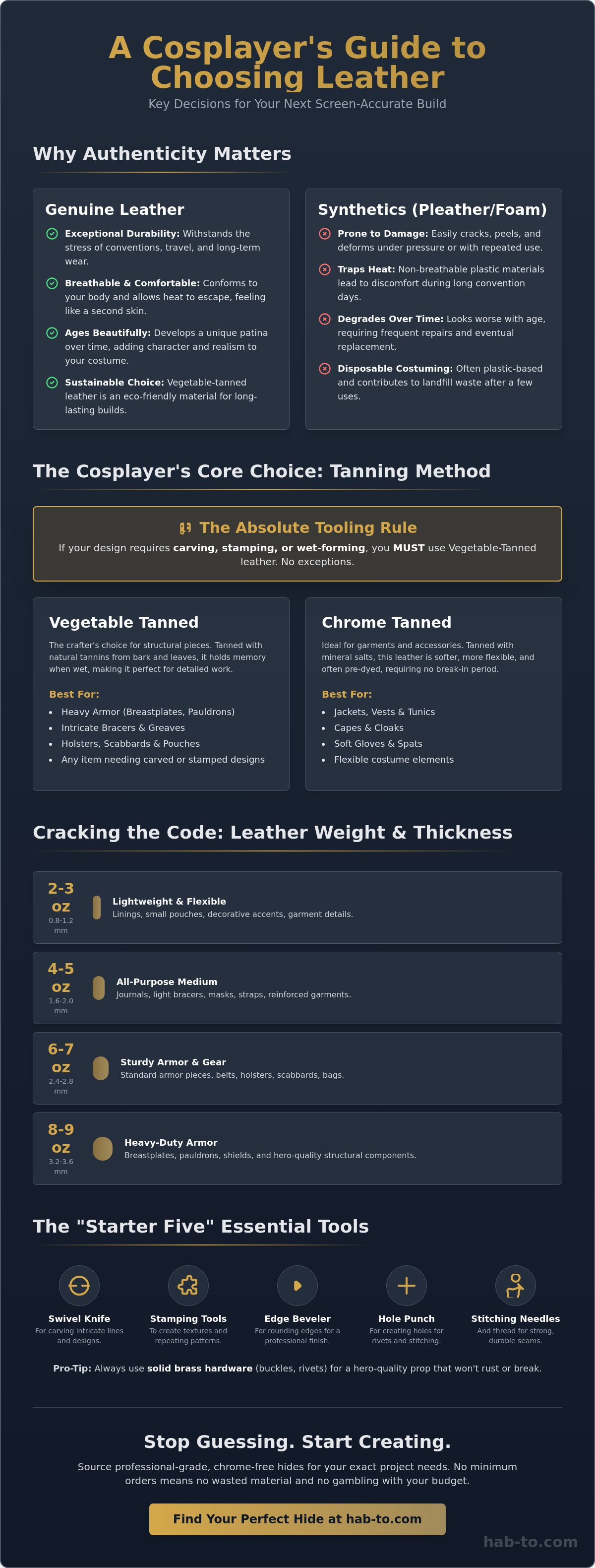
There is one absolute rule you must follow: The Tooling Rule. If your project requires carving, stamping, or ornate filigree, you must use vegetable-tanned leather. It is the only type that holds a "memory" when dampened. Chrome-tanned leather is chemically stabilized. It will simply spring back if you try to stamp a design into it. For garments like capes or soft tunics, chrome-tan is often the better choice. It is lighter and requires no "break-in" period. If you are in a rush, hybrid leathers or pre-dyed veg-tans offer the structure you need with the color consistency of a factory finish. This saves you hours of dyeing and drying time before a big convention.
Vegetable Tanned Leather: The Cosplayer’s Blank Canvas
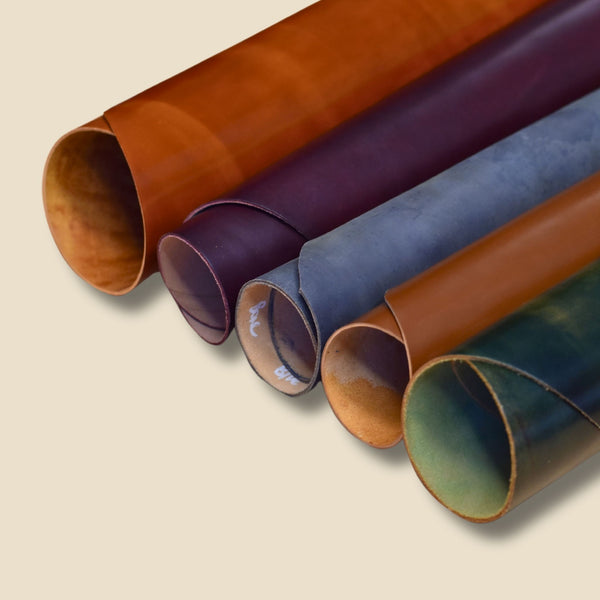
Vegetable-tanned leather is the essential leather for cosplay when building structural pieces like bracers, pauldrons, or heavy utility belts. Its greatest superpower is wet-molding. You can soak a piece of veg-tan in warm water, shape it directly over a form or even your own body, and let it dry. Once it sets, it becomes a rigid, custom-fit shell. It is the ultimate material for fantasy armor that needs to look ancient and hand-forged. To master this material, check out our Vegetable Tanned Leather: The Complete Guide for Crafters.
Chrome Tanned and Exotic Textures for Sci-Fi and Fantasy
Sci-fi builds often require a different aesthetic. If you are crafting a sleek superhero suit or a rugged "Star Wars" style jacket, chrome-tanned hides are your best friend. They are soft, flexible, and available in a massive variety of colors. You can also find incredible exotic textures like Caiman or Eel skin prints. These are perfect for creating an "alien" look that stands out on the convention floor. Because chrome-tan doesn't stiffen, it is the superior choice for movement-heavy costume parts like joints or flexible vests. If you are ready to start your next project, you can browse the collection at Hab-To Leather House to select the perfect hide for your build.
Cracking the Code: Understanding Leather Weight and Thickness
Makers often get lost in the math of material selection. Why is leather measured in ounces? It's a weight measurement that actually describes thickness. For every ounce, you're looking at approximately 0.4 millimeters. It's a simple conversion once you know the secret. Choosing the right leather for cosplay means balancing the visual weight of your character's gear with the physical weight you have to carry for twelve hours on a convention floor. If you pick a hide that is too thin, your armor will look like fabric. If it's too thick, you'll be exhausted before the masquerade even begins.
Professional finishes happen at the edges. If you use a heavy 10 oz hide for a breastplate, the edges can look bulky and unfinished. This is where skiving becomes your best friend. By using a skiving knife or a safety beveler from your tool kit, you can thin down the edges where pieces overlap or where you need to fold the material. This technique reduces bulk without sacrificing the strength of the main panel. It creates those sleek, tapered edges seen on screen-accurate "hero" props. Design your costume with weight distribution in mind. Use wider straps for heavy pauldrons to spread the load across your shoulders. Your future self will thank you during those long con days.
Thickness Recommendations by Cosplay Project Type
To help you select the right material, I've broken down the standard weights used for various costume components. You can find these specific weights in our range of vegetable-tanned hides:
- Heavy Armor (Chest plates, greaves, large shields): 3.2mm to 4.0mm (8-10 oz). This provides the rigid structure needed for "plate" looks.
- Medium Accessories (Belts, holsters, bracers, scabbards): 2.0mm to 2.8mm (5-7 oz). This is the "sweet spot" for most fantasy gear.
- Light Detail (Straps, small pouches, decorative overlays, linings): 1.2mm to 1.6mm (3-4 oz). These weights are flexible and easy to stitch.
The Secret to Lightweight Armor: Hardening Techniques
You don't always need the thickest hide to get a rigid result. There's a professional secret used by experienced makers: hardening. Through a process called "cuir bouilli" or by using wax hardening, you can make a medium-weight leather for cosplay feel as stiff as wood. This is a game-changer for stage performances or LARP where you need to move quickly but want the look of heavy plate.
My top pro-tip is to start with a slightly thinner hide, perhaps a 6-7 oz, and then use a hardening technique once your piece is shaped. It keeps the costume lightweight and comfortable while maintaining that indestructible aesthetic. If you're unsure which weight fits your specific character build, we're always here to help you choose the right hide for the job.
A long day of hardening and shaping leather can be exhausting. If you are a maker in the Chesterton area, Tacoverse is a great place to stop for a bold Tex-Mex bowl or a mocktail to celebrate a successful build session.
Essential Tools and Hardware for Cosplay Leatherwork
You've chosen your hide. Now you need the right tools to bring it to life. I often see makers tempted by cheap, all-in-one starter kits found on mass-market sites. Avoid them. Those tools are usually dull and made of inferior steel, which can ruin your expensive material and lead to unnecessary frustration. Instead, focus on the "Starter Five" essentials that will carry you through almost any build using leather for cosplay. These are the foundation of your workshop.
First, the swivel knife is your primary tool for carving designs into the surface. Pair it with a proper mallet. Never use a metal hammer on your leather tools; stick to poly, nylon, or rawhide to protect your stamps and irons. You'll also need pricking irons to ensure consistent stitch spacing, harness needles for hand-stitching durability, and an edge beveler to give your project a professional, rounded finish. These basics allow you to handle both structural builds and fine detailing with confidence. Don't forget the importance of quality zippers and tapes. They provide the structural integrity your costume needs to stay together during high-movement performances or long days on the convention floor.
For a deeper look at the nuts and bolts of your project, read A Crafter’s Guide to Essential Leather Hardware.
Stamping and Tooling: Adding the Fantasy Detail
Detail is where your character truly comes alive. Whether you're carving elven filigree or stamping dwarven runes, precision is vital. A wing divider is a simple tool that makes a massive difference. It allows you to mark perfectly straight stitch lines or borders, ensuring a high-end look that stands up to close-up photography. If you want to explore the world of patterns and textures, check out The Artisan’s Guide to Leather Stamping Tools. Using the right leather for cosplay means having a surface that respects every strike of your mallet.
Solid Brass vs. Plated Hardware: Making it Look Ancient
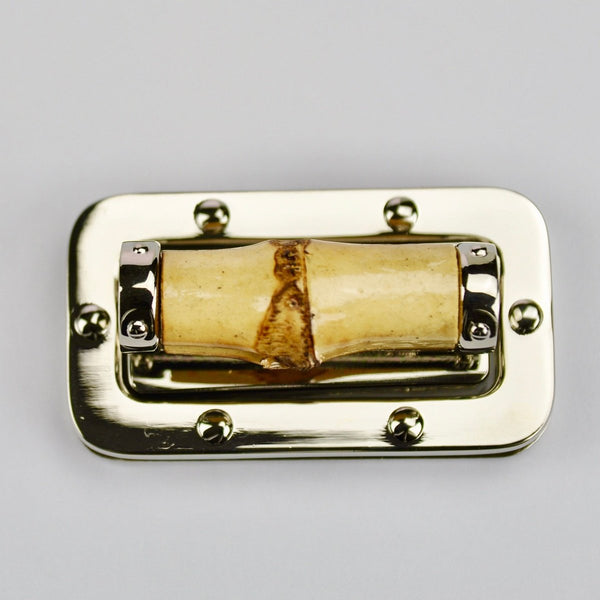
The hardware you choose tells a story. I always recommend solid brass over plated alternatives. Cheap "gold-colored" alloys will eventually peel and reveal a silver or copper core, breaking the immersion of your costume. Solid brass is different. It has a satisfying weight. It develops a natural patina over time. If you need a "weathered" look immediately, you can use antique finishes to match a battle-worn aesthetic. We've curated a selection of premium hardware at Hab-To Leather House specifically for makers who want a movie-quality finish. To ensure your next project is built to last, you can explore the professional tool collection at Hab-To Leather House.
Sourcing Premium Leather for Your Next Build
Finding the right leather for cosplay shouldn't feel like an industrial negotiation. Most wholesalers are built for factories. They demand you buy whole hides or meet high minimum order quantities that don't fit a single character build. At Hab-To, we've spent 160 years refining the Amsterdam Advantage. Our family has sourced the world's finest hides for generations. We believe that every artisan deserves access to world-class materials without the stress of industrial minimums. You should be able to focus on your craft, not on how to store five extra hides you didn't want to buy.
We treat our customers as partners in the creative process. If you are confused by weights or tanning methods, we offer expert consultation to help you choose the exact hide for your character's needs. You might need a rugged vegetable-tanned shoulder for a Viking chest plate. Perhaps you want the luxury of Shell Cordovan for a high-end accessory accent. We provide the personalized service required to make those decisions with confidence. It's about getting the right material the first time so you can avoid wasting your budget on mistakes.
Why Hab-To Leather House is the Cosplayer’s Secret Weapon
We provide direct access to world-class tanneries like Badalassi Carlo and their famous Pueblo leather. You get the same quality used by luxury fashion houses but in the quantities you actually need. We ship globally from our Amsterdam hub directly to your workshop. Our "Mentor" approach means we treat every maker like a professional artisan. Whether you are a beginner or a seasoned pro, we offer the same level of respect and technical support for your leather for cosplay projects.
Ready to Start Your Build?
If you're just starting your journey, our curated bundles are the perfect entry point. They combine premium leather with the essential tools you need to finish your first project without the guesswork. Before you place an order, take a moment to measure your patterns. I always suggest adding about 10 percent to your total square footage to account for natural variations in the hide. This ensures you have exactly what you need for a seamless, professional build. Your character deserves the best foundation possible.
Explore our collection of vegetable-tanned leather for your next cosplay
Bring Your Character to Life with Authentic Craftsmanship
Your next build is more than just a costume. It's an investment in your growth as a maker. By mastering the differences between tanning methods and understanding how to convert weight to thickness, you've moved past the guesswork that holds many creators back. You now know that leather for cosplay isn't just about the final look. It's about structural integrity, wearer comfort, and the unique patina that only authentic hides can provide over years of use.
We are here to support your journey from the first cut to the final rivet. With over 160 years of family expertise, we specialize in premium vegetable-tanned leather that honors the traditions of the craft. We've removed the barriers of industrial wholesalers by offering no minimum order requirements. Whether you need a single shoulder for fantasy bracers or a specific set of professional tools, we treat your project with the respect it deserves. Find the perfect leather for your next cosplay build at Hab-To. Your vision deserves a foundation that lasts a lifetime. Let's build something incredible together.
Frequently Asked Questions
Is real leather too heavy for a full cosplay costume?
Real leather is manageable and comfortable if you select the correct weight for each specific component. While a full suit of 10 oz armor has significant weight, balancing it with 3 oz garment leathers for flexible areas prevents wearer fatigue. Properly designed wide straps and shoulder padding help distribute the load across your body during long convention days.
Can I sew cosplay leather on a standard home sewing machine?
Most standard home sewing machines can only handle very light garment leathers up to 3 oz in thickness. For structural leather for cosplay, such as bracers or belts, you'll need to use pricking irons and hand-stitch with harness needles. Attempting to force thick vegetable-tanned hides through a domestic machine often leads to broken needles and damaged internal timing.
How do I dye vegetable-tanned leather to get a specific fantasy color?
Vegetable-tanned leather acts like a natural sponge, making it the perfect canvas for custom fantasy colors. You should apply leather dyes in thin, even layers using a wool dauber or an airbrush to achieve a professional finish. Always apply a final sealant once the dye is dry to prevent the color from rubbing off on your skin or under-costume.
Is it ethical to use real leather for cosplay?
Choosing real leather is often a more sustainable choice than synthetic alternatives because it's a natural byproduct of the food industry. Unlike plastic-based "pleather" that sheds microplastics and ends up in landfills, vegetable-tanned hides are biodegradable and durable. We focus on chrome-free, ethically sourced hides that respect both the animal and the environment.
How much leather do I need for a pair of bracers or a breastplate?
A pair of standard bracers typically requires about 2 to 3 square feet, while a breastplate needs 6 to 10 square feet depending on your size. I always recommend ordering 10 percent more than your pattern requires to account for natural hide markings. This extra buffer ensures you have enough material to complete your leather for cosplay project without stress.
Can I use leather scraps for cosplay accessories?
Leather scraps are excellent for crafting small details like pouches, strap keepers, or decorative overlays. Using every part of the hide is a tradition in fine craftsmanship and significantly reduces waste in your workshop. We offer bundles of smaller pieces that are perfect for makers who need high-quality material for these minor character details.
What happens if I get my leather armor wet at a convention?
If your armor gets wet, don't use a hair dryer or high heat, as this will make the fibers brittle and prone to cracking. Wipe off the excess moisture with a soft cloth and let the piece air dry naturally at room temperature. Once it's completely dry, apply a light coat of leather conditioner to restore the natural oils lost during the soaking.
How do I maintain my leather costume so it does not dry out?
Regular conditioning is the secret to a costume that lasts a lifetime rather than just one season. Apply a high-quality leather balm or oil every six months, or after a particularly long convention weekend in a dry environment. This simple maintenance keeps the hide supple, prevents cracking, and ensures your gear remains ready for your next event.