



What if the difference between a hobbyist project and a gallery-ready piece came down to a single jar? Most makers have felt the frustration of fuzzy, inconsistent edges that refuse to lay flat, or the sticky mess of traditional gums that never quite cure. This is where Tokonole changes everything. At Hab-To Leather House, we believe that your hard work deserves a finish that reflects the passion you put into every stitch. Quality is not an accident; it is a choice made at the workbench.
In this guide, we are showing you how to achieve a professional, glass-like finish using the industry's favourite burnishing agent. Drawing on 160 years of family heritage and expertise, we'll help you understand the science of fibre binding and the exact techniques used in our Amsterdam atelier. You'll discover how to save time in the workshop while finally achieving the mirror-like results you've been dreaming of. From the initial preparation to the final buff, we are covering the path to mastering your edges once and for all.
Key Takeaways
- Understand the Japanese heritage behind Seiwa's formula and why these natural waxes are superior for leather chemistry.
- Learn how heat and friction work together with Tokonole to bind protein fibres and create a durable, professional seal.
- Compare traditional agents like beeswax and gum tragacanth to determine the best finishing method for your specific project.
- Master the step-by-step process of sanding and beveling to prepare your edges for a flawless, glass-like profile.
- Discover how to streamline your workflow using the same curated tools and bundles we use in our Amsterdam atelier.
What is Tokonole? The Japanese Secret to Glass-Like Edges
Japanese leather chemistry is often cited as the pinnacle of the craft, and for good reason. Seiwa, the historic manufacturer behind the world's favourite burnishing agent, has spent years refining a formula that balances traditional artisanal needs with modern chemical precision. Tokonole is a water-based burnishing cream made from natural waxes and resins that has fundamentally changed the workflow for professional makers across the globe. When you study various leather crafting techniques, you'll see that edge finishing is the definitive signature of a master. It is the moment a raw project becomes a finished piece of art.
Before this innovation arrived, Gum Tragacanth was the standard. While it served the industry for decades, it often lacked the consistency and binding power required for high-end luxury goods. This Japanese alternative replaced it by offering a more stable, predictable result that penetrates deep into the leather structure. It doesn't just sit on the surface; it integrates with the material to create a bond that lasts the lifetime of the product. Whether you're working on a small watch strap or a substantial tote, the result is a professional finish that resists fraying and moisture.
To see this transformative product in action, watch this helpful demonstration on achieving a perfect edge:
Choosing the right variant is essential for matching your leather's aesthetic. The product comes in three specific options to suit your project:
- Clear: The universal choice that highlights the natural beauty of the leather grain and edge.
- Black: Ideal for black hides or when you want a deep, pigmented edge without the extra step of dyeing.
- Brown: A warm, rich tone that complements earthy leathers and adds a classic, finished look.
The Anatomy of a Professional Edge
A raw cut edge is essentially a collection of loose, uncompressed protein fibres. Without treatment, these fibres absorb sweat and dirt, eventually leading to a fuzzy, degraded appearance. Burnishing is the process of using friction to compress these fibres into a solid, smooth wall. Tokonole is a non-toxic, water-based synthetic gum tragacanth replacement that binds leather fibres. By saturating these strands, it creates a structural seal that hardens into a glass-like profile, ensuring your work remains sharp and refined for years.
Why Vegetable Tanned Leather Loves Tokonole
The chemistry of this cream is specifically designed to interact with the plant-based tannins found in vegetable-tanned hides. This unique relationship is why it is the perfect companion for Pueblo leather from Hab-To Leather House. The resins in the cream grip the dense fibres of the Pueblo, allowing you to achieve a mirror shine with minimal effort. While it is the gold standard for veg-tan, keep in mind it is significantly less effective on chrome-tanned materials, which lack the fibre density required for a traditional burnish.
The Science of Burnishing: Why Tokonole Outperforms Traditional Gums
Burnishing is more than just a repetitive motion. It is a thermodynamic transformation. When you use a wooden slicker or a canvas cloth, the friction you generate creates heat. This thermal energy is the key that unlocks the potential of the natural waxes within Tokonole. As the temperature rises, these waxes soften and flow into the microscopic gaps between the leather fibres. Once the heat dissipates, the waxes solidify. This creates a hard, protective seal that prevents moisture from entering the edge and keeps the profile sharp.
The resins in the formula act as a structural binder. Think of them as a high-performance glue designed for the tiny protein strands that make up your leather. While traditional gums might sit on the surface, these resins wrap around the individual fibres. This binding process is what stops the "fuzzing" effect that often ruins a project after a few weeks of use. By locking the fibres in place, you achieve a structural integrity that paints or surface coatings simply cannot match.
Because this is a water-based formula, the curing process is exceptionally clean. Unlike oil-based finishes that can migrate into the grain and cause darkening or softening, the water carrier simply evaporates. This leaves behind a concentrated layer of solids that harden into a "glassed" finish. You get a high-shine, mirror-like edge without the plastic feel of heavy acrylic paints. If you want to achieve this professional look across all your projects, exploring our curated finishing bundles is an excellent way to start.
Understanding the Chemical Advantage
Safety in the workshop is something we take seriously. Tokonole is non-toxic and environmentally friendly, making it a much safer choice than some of the harsh chemical solvents used in the past. It is also remarkably stable. Natural gum tragacanth can often spoil or develop mold over time; however, this Japanese formula remains consistent for years if stored correctly. The pH balance is carefully tuned to respect the acidic nature of vegetable-tanned hides, ensuring that your edges won't become brittle or degrade over the decades.
Surface Tension and Penetration
The viscosity of the cream is a subtle but vital feature. It has enough surface tension to stay exactly where you put it, preventing messy "run-off" that could stain the face of your leather. This makes it particularly effective for smoothing the flesh side of your project. Applying a thin layer to the "fuzzy" back of a strap and glassing it down creates a smooth, comfortable surface against the skin. This technique is especially rewarding when working with premium materials like Shell Cordovan. The dense fibre structure of cordovan responds beautifully to the resins, resulting in an edge that looks like polished stone.
Tokonole vs. Beeswax and Gum Tragacanth: Choosing the Right Agent
Selecting your burnishing agent is a pivotal decision that defines the final character of your leather project. While we have explored the binding science behind these products, choosing between them is about matching the agent to the specific soul of your piece. To help you navigate these options, we have mapped out how the industry's most common agents perform across the metrics that matter most in the workshop.
| Feature | Tokonole | Beeswax | Gum Tragacanth |
|---|---|---|---|
| Application Speed | Fast | Moderate | Slow |
| Durability | Excellent | High (Waterproof) | Moderate |
| Shine Level | Mirror/Glass | Matte/Satin | Satin |
| Cost-Effectiveness | High | Medium | Low |
Beeswax remains the traditional choice for heavy-duty items like belts or rugged outdoor gear where a matte, rustic finish is preferred. It offers natural water resistance but requires significant physical effort to apply evenly. Gum Tragacanth served as the old-school standard for decades; however, it is becoming less popular among modern makers because it lacks the concentrated binding resins found in newer formulas. Tokonole has emerged as the true all-rounder for contemporary luxury goods. It bridges the gap between speed and a world-class finish, providing a level of clarity and structural integrity that other agents simply can't match.
When to Stick with Tradition
There are scenarios where the traditional approach still makes sense. For heavy equestrian gear or items exposed to constant moisture, the thick, waterproof barrier of beeswax is hard to beat. If you are chasing the ultimate finish, consider the hybrid method. We often apply Tokonole first to bind the fibres and create the shine, then follow up with a light coat of wax for added protection. If you are unsure which path to take for your specific project, you can book a free video consultation with Mike. He is always happy to share his expertise at Hab-To Leather House to help you choose the right tools for your journey.
The Learning Curve
Beginners often find this Japanese cream much easier to control than liquid gums. It stays exactly where you apply it, which prevents the accidental staining of the leather grain. When working with beeswax, many makers struggle with overheating the material or applying too much pressure, which leads to a lumpy, uneven surface. By choosing a more forgiving agent, you can focus on perfecting your slicking technique. This allows you to achieve the Hab-To Leather House standard of finish on every single project. Consistency is the foundation of professional craft, and the right agent makes that consistency possible.
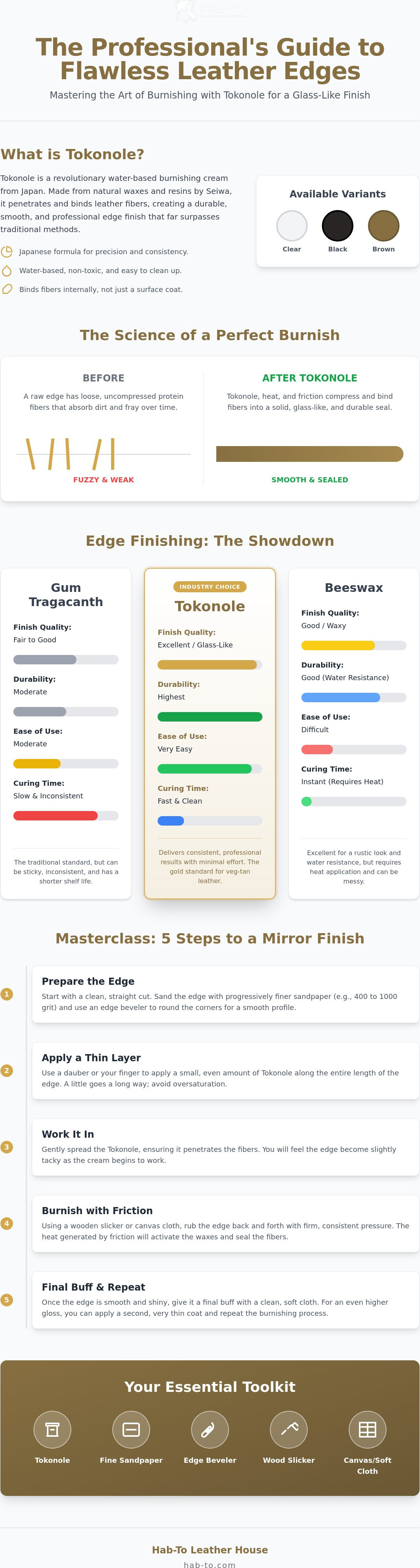
Masterclass Guide: How to Apply Tokonole for a Mirror Finish
Achieving a mirror finish is a disciplined process. It begins with edge preparation. Your finish is only as good as your sanding. If you skip this, no amount of cream will save the result. Start with 400 grit sandpaper to level the edges. Gradually work your way up to 1500 grit. This creates a uniform surface for the next stage. Beveling with precision is step two. You want to create a rounded profile that allows your burnisher to glide. Use sharp Edge Bevelers and Slickers to remove the corners without dragging the leather.
When you reach the application stage, remember that less is more. Apply a thin, even layer of Tokonole to the edge. You can use your finger or a small spatula. Wait a few seconds for it to start soaking in. Now, begin the slicking. Whether you prefer a wooden slicker, a canvas cloth, or a bone folder, the goal is the same. You're generating heat through friction. The final polishing is the secret step. Use a piece of dry denim or heavy canvas for a rapid, light rub. This clears any remaining residue and brings out the deep, glass-like shine.
If you want to ensure you have every tool for the job, our professional leathercraft bundles provide everything you need to get started immediately.
What You Will Need
- Tokonole (Clear, Black, or Brown).
- Edge Bevelers and Slickers.
- Curated product bundles for finishing.
- Sandpaper (400 to 1500 grit).
- Canvas cloth or a wooden burnisher.
Pro Tips for Advanced Crafters
For the most demanding projects, try the 'Sand-Burnish-Sand' loop. Apply the cream, burnish lightly, sand again with your highest grit, and then do a final burnish. This layers the waxes for incredible depth. You can also use this cream to flatten the flesh side of a Vaccheta shoulder. It tames the loose fibres and creates a smooth, professional interior for unlined bags. The ideal burnishing temperature is reached when the edge feels slightly warm to the touch.
Elevating Your Craft with Hab-To Curated Finishing Supplies
Your journey toward the perfect edge doesn't end with technique. It begins with the integrity of your supplies. At Hab-To, we don't just stock products; we curate them based on daily use in our own Amsterdam atelier. If a tool doesn't meet our standards during a long day of crafting, it doesn't make it to our shelves. This hands-on approach ensures that when you pick up one of our Tokonole Bundles, you're getting a proven system for success. We've done the testing so you can focus on the creating.
Consistency is everything in leathercraft. Achieving that mirror shine requires every component to work in harmony. For instance, we often pair our burnishing process with high-performance adhesives like Ecostick 1804. This ensures your leather layers stay perfectly bonded during the high-friction sanding and slicking stages. Our selection process is informed by 160 years of family heritage. We've seen trends come and go; however, quality materials remain the only constant in a professional workshop. Better tools mean fewer mistakes. They mean more joy in the process. We understand that a hobbyist's time is as valuable as a professional's.
We believe in the power of the right tools. We believe in the beauty of a well-finished edge. Most importantly, we believe in supporting your growth as a maker. Whether you are finishing a simple cardholder or a complex handbag, the right supplies make the difference between a project that looks handmade and one that looks truly professional. Your work deserves a finish that reflects the passion you put into every stitch.
The Hab-To Ecosystem
Our vision extends from the raw hide to the final polished edge. We source the finest Italian leathers directly from the source, ensuring the fibre density is ideal for burnishing. A glass-like edge deserves to be paired with the best. That is why we emphasize the use of high-quality solid brass hardware. It provides the weight and durability that matches the effort you put into your edge finishing. If you want to dive deeper into these techniques, we invite you to join our Masterclasses for hands-on guidance in our studio. Learning in person allows you to feel the friction and see the shine develop in real-time.
Related Reading & Resources
- Vegetable Tanned Leather: The Complete Guide for Crafters
- Tokonole vs Beeswax: Which is Better for Edge Finishing?
- A Crafters Guide to Essential Leather Hardware
Ready to Perfect Your Edges?
Mastering the edge is a rite of passage for every leatherworker. You now understand that a mirror finish is the result of disciplined preparation combined with the right chemistry. By focusing on the sanding loop and understanding how friction activates the natural waxes in Tokonole, you can transform raw edges into glass-like surfaces. This transition from hobbyist to master craftsman is finally within your reach.
We are here to support that journey. Our atelier relies on over 160 years of family leather expertise to select only the finest sustainable vegetable-tanned materials. We believe quality should be accessible to everyone. That's why we offer no minimum order quantities for artisans. It's time to stop settling for fuzzy or inconsistent edges and start achieving the professional results your hard work deserves. Every stitch you make is a testament to your craft. Your finish should be no different.
Shop our curated Tokonole Bundles and professional finishing tools at Hab-To Leather House and take the next step in your craft today. We can't wait to see what you create. Keep pushing the boundaries of your craft.
Frequently Asked Questions
Is Tokonole better than beeswax for leather edges?
Tokonole is generally the better choice for luxury goods where a high-gloss finish is the priority. While beeswax provides a fantastic waterproof seal and a rustic, matte look for heavy-duty gear, it doesn't bind the protein fibres as deeply. If you want that iconic glass-like shine that stays clear over time, this Japanese cream is the superior professional tool.
Can I use Tokonole on chrome-tanned leather?
No, it is generally ineffective on chrome-tanned leather because the chemical tanning process prevents the protein fibres from binding together. Since chrome-tanned hides have a more rubbery and loose structure, you won't be able to achieve a permanent or smooth burnish. For these materials, we recommend using a high-quality edge paint or a folded edge technique instead.
How long does Tokonole take to dry before I can buff it?
It usually takes about 30 to 60 seconds to reach the ideal state for slicking with your tools. You don't want the edge to be soaking wet, nor should it be completely dry. Once the cream feels slightly tacky or sticky to the touch, it is ready for the burnisher. If you wait too long, simply apply a tiny bit more to reactivate the surface.
What is the difference between clear, black, and brown Tokonole?
The only difference between the three colors is the added pigment, as the chemical binding properties remain identical. Clear is the most versatile option for natural or pre-dyed edges. Black and brown variants of Tokonole are excellent for saving time, as they allow you to color and seal the leather edge in one single application.
Does Tokonole go bad or expire if stored in the workshop?
This product has a remarkably long shelf life and won't spoil easily if the lid is kept tightly sealed. Unlike natural gum tragacanth, it doesn't develop mold or a foul odor over time. If you notice the cream becoming a bit thick in the jar, you can often revive the consistency by adding a few drops of distilled water and stirring well.
Can I apply Tokonole with my fingers or do I need a tool?
Applying the cream with your fingers is perfectly safe and often allows for much better control than a brush. Because the formula is non-toxic and water-based, it washes off your skin easily with simple soap and water. Just ensure your hands are clean before you start to avoid transferring any oils or dirt onto the grain of your leather.
How do I fix a burnished edge that has become dull over time?
You can easily restore the shine by lightly sanding the edge with a high-grit paper and reapplying a very thin layer of cream. A quick buff with a clean canvas cloth is often enough to reactivate the waxes and bring back the clarity. For a permanent fix, ensure your initial burnishing reached a warm temperature to properly seal the internal fibres.
What happens if I apply too much Tokonole to the leather?
Applying too much can lead to a messy squeeze-out that might accidentally stain the grain side of your leather project. It also takes much longer to reach the proper tacky state for burnishing and can create a gummy residue that clogs your sandpaper. Always start with a thin, even layer; you can always add more if the leather is particularly thirsty.
Disclaimer
All our blog articles are made for information purposes only we dont take responsability for any content from third parties.