

Shell Cordovan Leather Properties: Why Crafters Call it the King of Leathers
You aren't actually working with skin when you cut into a piece of shell cordovan. Most crafters spend years working with top-grain hides before they realize that the 'King of Leathers' is actually a dense muscle membrane found only in the hindquarters of a horse. It's a common point of confusion, and I know the hesitation you feel before making that first cut. When a single shell can cost a significant premium compared to standard calfskin, you don't want to guess how it behaves. You want to be certain that your tools and techniques are a perfect match for shell cordovan leather properties.
I'm going to show you exactly how this material differs from standard horsehide so you can stop worrying about wasting expensive stock. We'll explore the unique fibrous structure that requires a specialized six month tanning process and why this material produces a rolling patina instead of a typical grain-break. You'll learn how to identify genuine shell by its tight pore structure and how it reacts to burnishing, giving you the expertise needed to create heirloom quality pieces without the stress.
Key Takeaways
- Learn why shell cordovan isn't a traditional hide, but a rare subcutaneous membrane that offers unmatched density and durability.
- Discover how the unique shell cordovan leather properties, like its high oil content and lack of grain, create a glass-like finish that never creases.
- Gain technical insights into the precision cutting and stitching techniques required to master this "King of Leathers" in your workshop.
- Understand the "self-healing" characteristics and aging process that allow cordovan products to be passed down through generations.
- Find out how Mike hand-selects every shell to ensure you get artisan-grade material with no minimum order requirements for your next project.
What is Shell Cordovan? Defining the Anatomical "Shell"
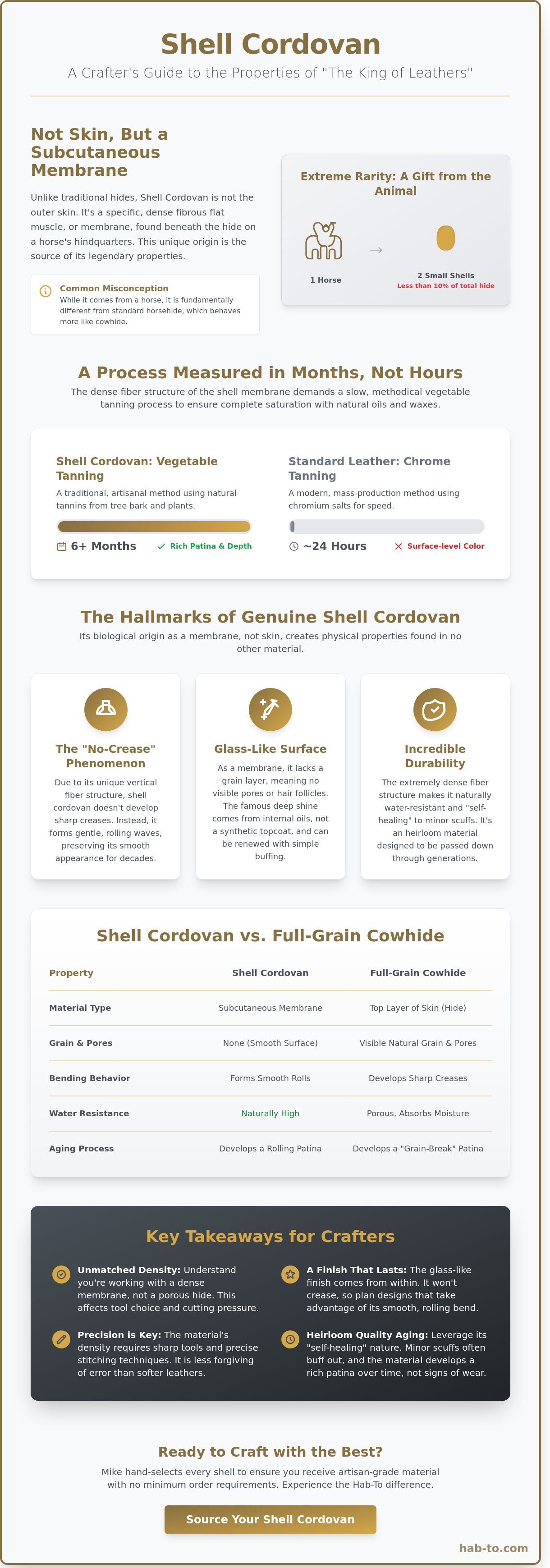
Hi, I'm Mike. If you've ever held a piece of shell cordovan, you know it feels different. It's denser, smoother, and heavier than standard cowhide. That's because Shell cordovan isn't actually the outer skin of the animal. It's a specific layer of dense subcutaneous fascia, a flat muscle or membrane, found beneath the skin of a horse's hindquarters.
This specific area is known as the "crupper." While a single cowhide can produce enough leather for several jackets, a horse provides only two small, oval-shaped shells. Each shell is roughly the size of a laptop or a small serving platter. This scarcity is one of the primary shell cordovan leather properties that drives its prestige. You're working with a material that represents less than 10% of the total hide area. It's a rare gift from the animal, and we treat it with that level of respect.
To better understand this concept, watch this helpful video:
The production process mirrors this rarity. While modern chrome-tanning in mass-production factories takes as little as 24 hours, true shell cordovan requires a slow, vegetable-tanning process that lasts at least 6 months. This timeline isn't a suggestion; it's a requirement to saturate the incredibly dense fibers with natural oils and waxes. At Hab-To, we don't settle for shortcuts. No synthetics. No compromises. Just patience and premium materials for real craftsmanship.
The Origin of the Name "Cordovan"
The name traces back to the 7th century and the Visigoths in the city of Cordoba, Spain. These artisans perfected the art of tanning, creating a leather known as "cordwain." Over centuries, the term evolved. It eventually came to describe the specific horsehide membrane we prize today. We still champion these traditional vegetable-tanning roots at Hab-To because they produce a depth of color and a patina that modern chemical methods simply can't replicate.
Shell vs. Horsehide: Clearing the Confusion
It's easy to confuse standard horse leather with shell. Most of the horse, specifically the "fronts" and "sides," produces leather similar to cowhide. The "butts" are the only area containing the shell. Unlike full-grain cowhide, shell cordovan lacks a grain layer. It's a single, non-porous connective tissue layer that doesn't crease like skin. This unique structure is why shell cordovan leather properties include an incredible resistance to water and a characteristic "roll" rather than a sharp wrinkle. The shell is a non-porous connective tissue layer that stays smooth for a lifetime.
Key Physical Properties: Why It Looks and Feels Different
Shell cordovan isn't your average hide. It's a flat muscle membrane found beneath the skin of a horse's hindquarters. This specific biological origin dictates the unique shell cordovan leather properties that crafters and collectors obsess over. Because it's a membrane rather than skin, it lacks the grain layer found in standard cowhide. You won't find visible pores or hair follicles here. The result is a surface so smooth it looks almost glass-like, yet it remains 100% natural and breathable.
The legendary shine isn't just a surface finish. During the six-month tanning process, tanners "stuff" the shells with a heavy blend of oils and waxes. These fats saturate the fibers completely. When you buff the leather, you're bringing that internal oil to the surface. This creates a deep, mirror-like glow that doesn't flake or peel. It's a material that actually looks better after 500 days of wear than it did on day one.
The "No-Crease" Phenomenon Explained
Most leathers develop sharp lines or "breaks" where they bend. Shell cordovan behaves differently because of its vertical fiber structure. Instead of cracking or creasing, it ripples in smooth, rolling waves. This structural integrity is why a cordovan wallet or watch strap stays beautiful for decades. It doesn't develop the micro-cracks that eventually destroy the surface of lesser leathers. For a crafter, this means the finished product retains its "new" aesthetic for a lifetime. It's the ultimate choice for items that endure constant movement.
Density and Water Resistance
The fiber density in a shell is incredibly high. It's so tight that it's nearly air-and-water-tight. While cowhide might soak up moisture and swell, shell cordovan's shell cordovan leather properties include a natural resistance to liquid. The high fat content acts as a built-in barrier. You might occasionally see "blooming" on your leather. This is a white, waxy residue that rises to the surface during temperature changes. It's a hallmark of quality, showing the rich oils are still active. You can simply wipe it away with a soft cloth to restore the shine.
If you're looking to elevate your craft with materials that stand the test of time, you can browse all leather in our current stock. We only select pieces that meet our "no compromises" standard for density and finish.
The weight and feel of the shell are also distinct. It feels cool to the touch and significantly heavier than a piece of calfskin of the same thickness. This density provides a tactile sense of luxury that is impossible to replicate with synthetics or even high-grade bovine leathers. It’s a material that demands respect from the moment you pick up your knife to make the first cut.
Working Properties for Crafters: A Technical Breakdown
Working with this material requires a shift in your workshop mindset. Because shell cordovan is a muscle membrane rather than a skin, its internal structure is remarkably uniform. When you're cutting, you'll notice the blade doesn't "wander" or get caught in loose grain patterns. This allows for surgical precision, especially on tight curves for watch straps or intricate wallet corners. That same density means your tools must be in top condition. If your knife isn't razor-sharp, you'll feel the resistance immediately. It's a material that demands respect and rewards patience.
Stitching through these dense fibers is where many crafters feel the difference. Standard stitching irons might bounce or deflect if they aren't polished. I recommend using high-quality, sharp irons to ensure clean entry and exit holes. Because the material doesn't compress like standard cowhide, your stitch tension needs to be consistent from the first hole to the last. If you pull too hard, you won't see the leather "give" like you're used to, which can lead to snapped threads if you aren't careful.
Skiving shell cordovan is the ultimate test of your sharpening skills. The membrane is dense but can feel slightly "rubbery" under a dull blade. Take thin, controlled passes. Don't try to remove all the bulk in one go. If you go too deep too fast, the knife can bite into the membrane and ruin your piece. It's a "no compromises" material that shows every mistake, but also every bit of your skill.
The Self-Burnishing Edge
One of the most rewarding shell cordovan leather properties is how it responds to friction. Standard leathers often require heavy compounds or multiple layers of edge paint to look finished. Shell is different. Because the fibers are so tightly packed, they don't "fuzz" or fray. You can achieve a glass-like mirror shine using just a bit of water and a canvas cloth. For a professional, deep glow, a tiny amount of natural beeswax is all you need. You can compare this unique behavior to our guide on vegetable tanned leather to see why shell is so highly prized for its finishing potential.
Glue Adhesion and Surface Prep
The high oil and fat content that makes shell so durable also makes it tricky for standard adhesives. You can't just apply glue to the smooth side and expect a permanent bond. You must rough the surface thoroughly with a scratching tool or sandpaper to break the "glassy" layer. I suggest using a strong contact cement or a solvent-based glue for the best results. We stock the essential leatherworking tools you'll need to prep these surfaces correctly. Proper prep ensures your shell cordovan leather properties remain an asset rather than a hurdle during assembly.
Durability, Patina, and the Aging Process
Most premium leathers are bought for how they look on day one. Shell cordovan is bought for how it looks after year ten. This material doesn't just last through a few seasons of wear; it's built to last generations. While standard calfskin might crack or lose its structure after five years of heavy use, cordovan remains resilient. The secret lies in the dense connective tissue of the equine hindquarters, which creates a surface that ripples rather than creases.
One of the most remarkable shell cordovan leather properties is its "self-healing" nature. If you pick up a small surface scratch on your wallet or shoes, you don't need a professional repair kit. You can often rub the mark away using a smooth bone folder or even the friction of your thumb. The high concentration of fats and oils within the shell allows the fibers to shift and fill in minor abrasions. This makes it incredibly practical for daily carry items that take a beating in your pocket or bag.
Is it too delicate for daily use? That's the most common question I get at Hab-To. The answer is a firm no. While the mirror-like finish looks precious, the material is actually tougher than almost any other leather on the market. It's water-resistant and naturally repels moisture better than standard vegetable-tanned hides. You aren't buying a museum piece. You're buying a tool that thrives on being handled every single day.
Patina: The Cordovan Glow
Unlike natural veg-tan leather that simply darkens and turns matte over time, shell cordovan develops a deep, three-dimensional luster. It absorbs the natural oils from your hands, which fuels a process often called "the cordovan glow." The color doesn't just change; it intensifies. A piece of Color #8 shell will reveal hidden ruby undertones after 24 months of use that weren't visible when it was new. This creates a depth of color that feels like looking through layers of polished glass rather than a flat, dyed surface.
Maintaining the Properties Over Time
When it comes to care, less is always more. Because the tanning process takes six months and involves heavy stuffing with oils, you rarely need to add more. Heavy waxes are the enemy here. They sit on the surface, trap dust, and dull the natural shine. A damp cloth and a horsehair brush are usually all you need to maintain these shell cordovan leather properties. For a deep dive into specific products and routines, check out our Shell Cordovan Ultimate Guide.
Ready to start your next project with the king of leathers? Browse our hand-selected shell cordovan stock and feel the quality for yourself.
Sourcing Quality Shell: Why Hab-To is the Maker’s Choice
Hi, I'm Mike! At Hab-To Leather House, we understand that working with the king of leathers is a significant step for any crafter. You shouldn't have to navigate high barriers just to practice your craft. Most wholesalers require large bulk purchases, but we do things differently. Our "No Minimum Order" policy means you can purchase a single shell for a specific project. Whether you are crafting a bespoke watch strap or a minimalist wallet, you get access to the same premium quality as the world's largest luxury brands without the overhead of excess stock.
Our roots in Amsterdam go back over 160 years. This family expertise informs every decision we make. I personally hand-select every piece of leather that enters our warehouse. When I inspect a shell, I'm looking for the specific shell cordovan leather properties that artisans demand: a glass-like finish, exceptional density, and that characteristic "roll" rather than a crease. If a shell doesn't meet these strict artisan standards, it doesn't reach our shelves. We believe in providing materials that respect the hours of labor you put into your work.
From Horween to Shinki: Our Curated Selection
We partner exclusively with world-class tanneries like Horween in Chicago and Shinki Hikaku in Japan. These institutions are famous for preserving the traditional six-month tanning process required to perfect shell cordovan leather properties. Selecting the right weight is the most common challenge for makers. A 1.3mm shell is often ideal for a sleek bifold, while a 1.8mm piece provides the necessary structure for a rugged field notes cover. Using the wrong thickness can compromise the feel of the finished product. Need my advice? I am always available to help you choose the perfect weight for your specific design goals.
Ready to Experience the King of Leathers?
There is no substitute for the tactile experience of genuine shell cordovan. It feels substantial, oily, and incredibly smooth. Our brand philosophy is clear: No synthetics. No compromises. We only provide quality materials for real craftsmanship. When you choose a shell from Hab-To, you're not just buying leather; you're inheriting 160 years of family tradition and a commitment to sustainable, vegetable-tanned excellence. Don't settle for imitations that lack the depth and durability of the real thing. Visit our collection page now to find the perfect shell for your next masterpiece.
Start Your Next Masterpiece with Genuine Shell Cordovan
You've seen why this material earns its crown. The unique shell cordovan leather properties, such as its non-creasing surface and mirror-like luster, come from a dense fiber structure found only in the anatomical shell of the hide. It's a leather that doesn't just age; it evolves. For a crafter, working with a material backed by centuries of tradition means your final piece will likely outlast its owner. Quality like this is rare, but it's the standard we live by every day.
At Hab-To, we don't believe in compromises or synthetic shortcuts. We're an Amsterdam-based wholesaler built on 160+ years of family leather expertise. Whether you're a seasoned professional or just starting your journey, you deserve access to the world's finest hides without restrictive minimums. I'm Mike, and I personally provide advice for every order to ensure you get exactly what your project requires. Let's make sure your next project is nothing short of legendary.
Browse our hand-selected Shell Cordovan collection with no minimum order
Your craft deserves the best materials available. I can't wait to see what you create.
Frequently Asked Questions
Is shell cordovan leather waterproof?
Shell cordovan is highly water-resistant, but it's not strictly waterproof. Its dense fiber structure and high oil content naturally repel moisture better than 90% of bovine leathers. If it gets wet, you might see small welts or raised spots on the surface. These usually disappear once the leather dries or after a 2 minute buffing session with a soft, dry cloth.
Why does shell cordovan ripple instead of crease?
Shell cordovan ripples because it's a fibrous membrane located between two skin layers of a horse's hindquarters. Unlike cowhide, which has a distinct grain layer that breaks and creases over time, cordovan's smooth structure allows it to roll into waves. This unique characteristic is one of the most famous shell cordovan leather properties that collectors look for when buying high-end footwear.
Can you use regular leather conditioner on shell cordovan?
You shouldn't use standard leather conditioners because shell cordovan is already packed with fats and oils during a six month tanning process. Regular conditioners can leave a dull residue or clog the incredibly dense pores. Instead, use a specific cordovan cream or simply buff it with a horsehair brush. Most of the time, the natural oils inside will rise to the surface with 30 seconds of friction.
Is shell cordovan real leather?
Shell cordovan is 100% real leather derived from the subcutaneous shell of a horse's rump. It's an organic material that undergoes a vegetable tanning process lasting at least 180 days at world-renowned tanneries. At Hab-To, we believe in "No synthetics, no compromises," so we only work with these authentic materials. This traditional approach respects the 160 year history of our family's leather expertise.
How can you tell if shell cordovan is genuine?
You can identify genuine shell cordovan by looking for a mirror-like finish and a total lack of visible hair follicles. If you bend the leather and it forms smooth waves instead of tiny pebble-like wrinkles, it's likely the real deal. Another sign is the back of the hide, which often features a stamped ink logo from the tannery, a practice that has remained unchanged for over 100 years.
Why is shell cordovan so expensive compared to cowhide?
Shell cordovan costs more because a single horse only provides two small shells, which is barely enough for one pair of shoes. The tanning process takes 6 months of constant attention, whereas standard cowhide might take only 4 weeks. Since only about 3 major tanneries globally produce top-tier cordovan, the scarcity and the intensive labor required naturally drive the market price higher than common hides.
Does shell cordovan scratch easily?
Shell cordovan is quite resilient, though its glossy surface shows superficial scuffs more clearly than textured leathers. Because of the unique shell cordovan leather properties, you can often heal these marks yourself. Simply rub the scuff with your thumb or a smooth deer bone to redistribute the internal waxes. This self-mending quality helps a well-made wallet last for 25 years or more with basic care.