

Solid Brass O-Rings for Leather: Artisan's 2026 Guide
Round rings deliver unbiased, multidirectional pivot points that flat hardware simply cannot match. When a bag strap shifts, a circular ring allows effortless rotation from any angle without binding or pinching. Choosing the proper solid brass O-rings for leather projects, however, often brings unexpected friction. Between confusing wire gauges, internal diameter sizing questions, and the frustration of cheap plating that flakes over time, selecting the right hardware isn't always straightforward.
You shouldn't have to gamble on mystery metals that might split under tension after you've poured hours into careful beveling and stitching. In this artisan guide, you will discover how to choose the right solid brass O-rings for your leathercraft projects, from load ratings to wire gauges. We'll break down cast versus welded builds, examine how solid brass ages alongside vegetable-tanned hides, and show you how to source exact hardware quantities without restrictive wholesale minimums.
Key Takeaways
- Understand the structural differences between cast, brazed, and bent wire rings to ensure your hardware never fails under heavy tension.
- Learn how to choose solid brass O-rings for leather builds by matching internal diameter dimensions directly to strap widths.
- Discover skiving and punching techniques that seat leather flush against round brass wire for refined, professional folds.
- Pair solid brass hardware with premium vegetable-tanned hides for natural corrosion resistance and an authentic shared patina.
- Source the precise ring counts and wire gauges you need for custom commissions without restrictive minimum order quantities.
Why Solid Brass O-Rings Are Essential for Quality Leatherwork
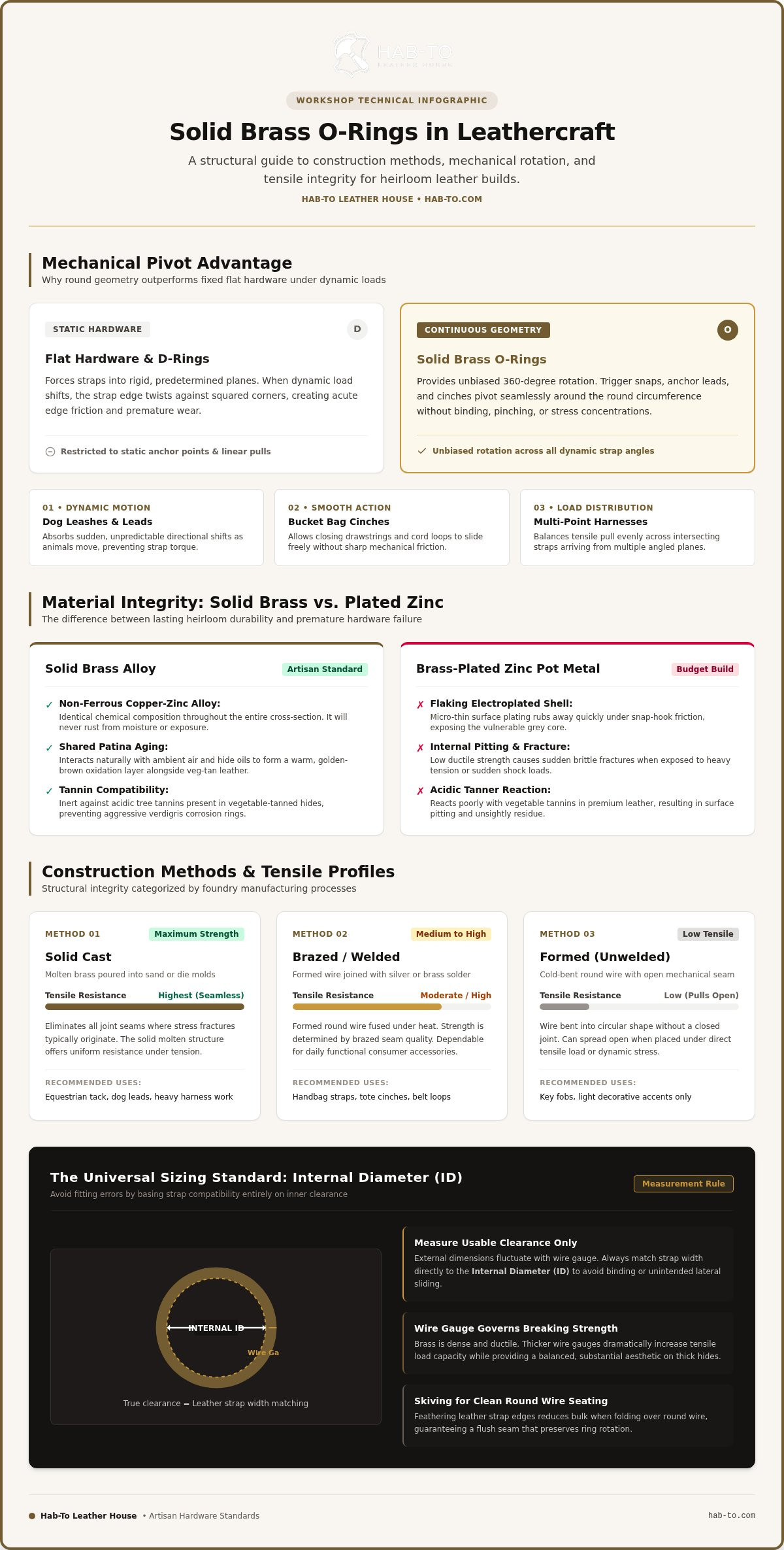
Every long-lasting leather good relies on honest hardware. While mechanical engineers define what an O-ring is primarily as an elastomeric circular sealing gasket, leather crafters view the component differently. In the leather workshop, a solid brass O-ring serves as a seamless, continuous circular connector engineered to anchor load-bearing straps, cinches, and reins. Solid brass is a non-ferrous copper-zinc structural alloy that delivers remarkable natural resistance against road salts, moisture, and atmospheric corrosion.
Unlike iron-based fittings, genuine brass will never rust. Instead, it interacts directly with the ambient air and the natural oils in premium hides, slowly building an exquisite, golden-brown oxidation layer over decades. This natural patina mirrors the graceful aging of artisanal vegetable-tanned leather. When paired correctly, hide and metal mature together as genuine companions.
To see how solid hardware compares against lighter alternatives on the workbench, watch this helpful video:
The Mechanical Advantage of Unbiased 360-Degree Rotation
Flat hardware forces straps into fixed planes. D-rings keep connections aligned straight, which works well for static anchor points. Dynamic straps, however, twist constantly under natural movement. Solid brass O-rings for leather builds solve this issue by providing unbiased 360-degree rotation. Trigger snaps, anchor leads, and strap loops pivot freely around the round circumference without pinching the leather's edges or binding against squared corners. You will find this continuous rotation vital in active projects:
- Dog leashes and leads: Absorbs sudden directional twists as pets move.
- Bucket bag cinches: Allows drawstring loops to slide open without friction.
- Multi-point harness anchorages: Balances tension evenly across multiple strap angles.
Solid Brass vs. Brass Plated Zinc: The Durability Divide
Budget hardware manufacturers cut corners by electroplating a thin brass film over cheap zinc pot metal. Under repeated mechanical friction from heavy snap hooks, that whisper-thin shell eventually chips away. The exposed grey zinc core underneath pits, corrodes, and ruins the look of handcrafted goods.
Solid brass maintains an identical chemical composition through its entire cross-section. It handles sudden shock loads without fracturing, making it the superior choice for high-tensile gear. Using solid alloy also protects against unsightly green verdigris rings, which often form when cheap plated metals react poorly against acidic tree tannins present in vegetable-tanned hides. Investing in pure leather hardware ensures your finished work lasts a lifetime.
Evaluating Construction Styles, Sizing, and Wire Gauges
Hardware sizing causes endless headaches when external dimensions get confused with usable clearance. In leathercraft, internal diameter (ID) serves as the universal standard. This measurement defines the true open span through which your leather straps and trigger snaps pass. Because brass is a dense, ductile alloy of copper and zinc, the wire gauge thickness directly dictates the ring's overall breaking strength and visual balance.
| Construction Method | Manufacturing Process | Tensile Strength | Best Use Cases |
|---|---|---|---|
| Solid Cast | Molten brass poured into sand or die molds | Maximum (no weak points) | Equestrian tack, dog leads, heavy harness work |
| Brazed / Welded | Formed wire joined with silver or brass solder | Medium to High | Handbag straps, tote cinches, belt loops |
| Formed (Unwelded) | Cold-bent round wire with open seam | Low (can pull open) | Key fobs, light decorative accents only |
Solid Cast vs. Welded vs. Formed Brass Rings
Sand-casting and precision die-casting produce completely seamless rings. Because there is no joined seam, cast rings eliminate the weak spots where stress fractures typically occur. Brazed or welded rings use drawn brass wire bent into a circle, then fused under high heat. While welded rings work beautifully on shoulder bags, open split wire rings should never be used on load-bearing canine or equestrian projects where sudden tension can pry the gap apart.
How to Measure Internal Diameter and Calculate Strap Allowance
Take your digital calipers and measure straight across the inner opening, ignoring the outer edges entirely. A common rookie mistake is matching strap width exactly to the internal diameter. Heavy leather wraps need room to turn. Use this practical calculation:
- Target Internal Diameter = Strap Width + (Leather Thickness × 1.5)
For a 25 mm strap cut from 3.5 mm leather for belts, an internal diameter of 30 mm prevents severe pinching along the loop fold. Thicker wire gauges between 4 mm and 5 mm also give the strap a rounder, softer bend radius. If you're planning a multi-strap project, exploring curated leather bundles can help you test hardware fits across varying hide weights before committing to a final run.
Selecting the right solid brass O-rings for leather goods ultimately comes down to balancing structural integrity with proper clearance. Give your leather room to breathe, and your assemblies will lay clean and flat on the bench.
Matching Round Rings to Specific Leatherworking Projects
Every leather project places different mechanical demands on its hardware. A delicate clutch requires slim lines and minimal bulk, while working tack demands brute holding power. The inherent properties of brass alloy provide the flexibility to support both aesthetics, provided you tailor the ring dimensions to the application. Skiving your leather tabs down to a feathered edge ensures the material wraps snugly around the curve of the metal, preventing bunching and premature wear.
For custom bags and totes, pairing well-proportioned rings with quality leather for bags produces clean drape and balanced weight distribution across anchor tabs. When crafting heavy harness gear, review our specialized guide on equestrian leathers and hardware to ensure your builds meet strict working load standards.
Pet Collars, Leashes, and Training Leads
Working leads and field leashes rely heavily on central floating rings to convert a standard lead into a temporary slip collar or hands-free waist strap. Dog gear experiences violent, unpredictable pull shocks. Stick to wire gauges between 4 mm and 5 mm paired with an internal diameter of 20 mm to 30 mm. Anchor these connection points using hand-peened brass rivets or heavy saddle stitching at 6 to 7 stitches per inch for dependable security. Whether you are crafting your own accessories or looking for functional inspiration, you can check out Pet ID Tags Australia to see how secure hardware is implemented across personalized dog harnesses.
Round rings make exceptional pivot connectors for crossbody straps and shoulder mounts. They allow the strap to drop naturally against the body, avoiding the stiff, angled resistance common with fixed square loops. On bucket bags, smooth brass O-rings serve as low-friction eyelets that allow braided drawstrings to glide cleanly without chewing up the grain. Coordinate your rings with matching solid brass hardware across buckles and snap hooks for a cohesive presentation.
Belts, Lanyards, and Keychain Connectors
Small leather goods benefit from compact rings that add utility without unnecessary bulk:
- Drop-loop key fobs: Use 20 mm to 25 mm rings with 3 mm wire for streamlined pocket carry.
- Artisan tool belts: Install 35 mm to 40 mm cast rings to hold clip-on holsters and tape measures.
- Saddle utility ties: Anchor gear straps with 30 mm rings skived cleanly into 4 mm harness bends.
Finishes matter just as much as dimensions. Classic natural brass complements rich tan hides, while matte black, nickel, and antique brass finishes let you align solid brass O-rings for leather accessories with your personal design palette.
Workshop Guide: What You Will Need to Install O-Rings Cleanly
Clean hardware installation separates amateur assembly from bench-grade leathercraft. Simply folding full-thickness strap leather over a metal ring creates a bulky, clumsy hinge that refuses to lay flat. Preparing your leather with controlled skiving and clean hole alignment allows the wrap to sit flush against the metal, establishing structural stability without stressing the grain.
The Essential Workbench Tool and Material Checklist
Gather these specific workshop tools before anchoring your ring mounts:
- Japanese utility knife or French skiving tool: Used to shave the flesh side down to an even, feathered profile.
- Round drive punches: Sized cleanly to prevent oversized gaps around rivet stems.
- Pricking irons: Ground to set clean stitch lines parallel to your strap edges.
- Polymer mallet and poundo board: Protects your blade edges during repeated punching strokes.
- Water-based contact adhesive: We use Ecostick leather glue for solvent-free, permanent bonding along the fold.
- Waxed braided polyester thread: Sized between 0.6 mm and 0.8 mm to match the tensile demands of the hardware.
Step-by-Step Hardware Installation and Stitch Reinforcement
Follow this repeatable four-stage method to mount solid brass O-rings for leather accessories:
Step 1: Taper the return tab. Measure the wrap allowance around the wire. Using your skiving tool, taper the last 30 mm of the strap's flesh side to roughly half its original thickness. Bevel and burnish your strap edges now, because finishing them after the ring is trapped inside is nearly impossible.
Step 2: Cement the hinge fold. Apply a thin coat of adhesive across both skived flesh faces. Slide your ring into place, fold the strap over, and press firmly. Bone down the crease directly behind the brass wire using a smooth folder. This eliminates slack and stops the ring from wandering.
Step 3: Mark your stitch lines. Set your pricking irons roughly 3 mm to 4 mm back from the wire edge. Leaving this small clearance gap ensures the ring can pivot freely without grinding directly against your thread passes.
Step 4: Lock the assembly. Saddle stitch a reinforced box pattern with an internal cross. Pull each knot firmly into the center of the leather core, and backstitch three full holes to lock the join permanently.
Explore our curated leather bundles for your next build
Selecting the Right Round Rings from Hab-To Leather House
Sourcing hardware should elevate your craft, not drain your workshop budget with restrictive bulk requirements. Rooted in over 160 years of family leather heritage, Hab-To Leather House supplies high-grade fittings directly to independent artisans. Our inventory features over 240 round ring options spanning classic sizes, robust wire diameters, and refined surface treatments. Whether you need a solitary ring for a bespoke commission or matched sets for a limited run, we operate with an artisan-first policy: absolutely no minimum order quantity on any hardware or leather cuts.
Pairing your rings with matching components is simple across our complete leather hardware collection. By aligning the wire gauges and metal finishes of your round rings with corresponding buckles, swivel snaps, and rivets, your finished projects achieve a cohesive, bench-crafted aesthetic from edge to edge.
Standout Finishes: From Natural Cast Brass to Antique Patinas
Different designs demand distinct metal personalities. Natural cast brass remains the timeless choice for artisans who cherish an evolving, golden-brown patina that deepens alongside vegetable-tanned hides. For modern or moody designs, our electroplated finishes provide clean alternatives:
- Natural Brass: Raw, solid alloy that buffs smooth and oxidizes gracefully over years of handling.
- Nickel and Silver: Bright, cool-toned plating engineered for high-contrast carry goods.
- Gun Metal and Matte Black: Understated, contemporary surfaces that fit industrial or tactical aesthetics.
- Old Gold / Antique Brass: Pre-aged warmth that offers vintage character straight from the bench.
Every electroplated variant undergoes durable surface sealing to resist daily abrasion, preventing the finish from scratching off under regular strap movement.
Sourcing for Hobbyists, Micro-Brands, and Custom Studios
Prototype without financial waste. Traditional wholesale distributors often lock makers into 50-unit packs, forcing workshops to stock sizes they may never reuse. At Hab-To, you can purchase exact hardware counts down to the single piece. Test a 25 mm ring alongside a 30 mm alternative on your mock-up, check the drape, and proceed with certainty.
Once you dial in your design specs, fast 24-48 hour dispatch ensures your materials arrive on your workbench without stalling production. Selecting dependable solid brass O-rings for leather builds gives you complete creative freedom, backed by honest metals that stand up to daily use.
Elevate Your Craft with Uncompromising Hardware
A bespoke leather build deserves fittings that honor the time you put into every stitch. Choosing the right solid brass O-rings for leather accessories protects your reputation, ensuring your straps pivot smoothly without cracking, flaking, or deforming under load. When you pair cast metal integrity with thoughtful skiving and clean hole alignment, your projects hold up to decades of daily carry.
Backed by over 160 years of family leather heritage, Hab-To Leather House eliminates the friction of sourcing premium workshop materials. Browse over 240 premium round ring options in stock, take advantage of zero minimum order quantities, and order the exact hardware counts your designs require.
Recommended Materials & Hardware
- Hardware Selection: Complete your suite with complementary buckles and snaps from our leather hardware collection.
- Assembly Adhesive: Secure hinges cleanly with water-based Ecostick leather glue before driving punches.
- Strap Hides: Pair your heavy-duty brass rings with premium vegetable-tanned leather for belts.
- Studio Starter Packs: Explore our curated leather bundles to test fits across various hide weights.
Continue Exploring Leathercraft Techniques
- Solid Brass Hardware: The Artisan's Guide to Quality Leathercraft
- Equestrian Leathers and Hardware: A Masterclass in Sourcing for Horse Tack
- A Crafter's Guide to Essential Leather Hardware
Take pride in the integrity of every component on your workbench. Build pieces that grow more beautiful with every year of use.
Frequently Asked Questions
What is the difference between an O-ring and a D-ring for leathercraft?
An O-ring provides a continuous circular loop that allows straps and snap hooks to pivot freely from any angle. In contrast, a D-ring features a flat bottom crossbar designed to hold a strap in a fixed, perpendicular alignment. Choose an O-ring for dynamic anchor points where straps shift constantly. Pick a D-ring when you need your leather strap to remain straight and centered without wandering.
How do I measure the correct size of an O-ring for my leather strap?
Measure the ring's internal diameter (ID) across the center opening rather than edge to edge. To calculate the right clearance, add roughly 1.5 times your leather's thickness to your actual strap width. For instance, pairing a 25 mm strap cut from 3 mm hide with a 30 mm internal diameter ring gives the fold sufficient space to turn without pinching or puckering the edges.
Can solid brass O-rings cause green discoloration on light-colored leather?
Yes, natural oxidation can occasionally cause green residue, known as verdigris, when copper in the brass reacts with moisture and acidic vegetable tannins. This buildup is completely non-destructive and wipes away easily with a dry cloth. You can prevent it by conditioning your leather thoroughly, letting edge finishes cure completely, and choosing sealed or electroplated finishes like antique brass for pale hides.
What is the strongest type of solid brass O-ring: cast or welded?
Solid cast brass rings offer the highest tensile strength because they are molded as a single continuous piece without any joined seams. Brazed or welded rings, while strong enough for handbags and light accessories, rely on soldered wire ends that can fail under extreme shock tension. For canine gear, equestrian tack, or safety-critical harnesses, always select seamless cast solid brass O-rings for leather applications.
Do I need special tools to install a solid brass O-ring into a leather strap?
Standard leathercraft bench tools handle the job easily without dedicated setters. You will need a sharp skiving knife to feather the strap return, a bone folder to crease the fold, pricking irons to mark stitching lines, and a mallet. Setting your stitch line 3 mm behind the ring's wire profile allows full mechanical rotation while keeping the leather firmly anchored in place.
Will solid brass O-rings rust if used for outdoor gear or dog collars?
Genuine solid brass contains no iron, which means it cannot rust even when exposed to mud, fresh water, or road salt. Wet weather simply accelerates the formation of a natural, protective patina over the metal's surface. This innate corrosion resistance makes solid brass O-rings for leather field collars, leashes, and outdoor carry gear far superior to cheap, nickel-plated zinc alternatives.
Can I buy individual solid brass O-rings without meeting wholesale order minimums?
Yes, Hab-To Leather House operates with an artisan-first policy that completely eliminates minimum order quantities. You can purchase single rings to build bespoke prototypes, test wire gauges, or complete one-off repairs without buying full 50-piece industrial bulk packs. We ship exact hardware counts directly to independent crafters nationwide with fast 24 to 48-hour order dispatch.
Disclaimer
All our blog articles are made for information purposes only we dont take responsability for any content from third parties.