

The Crafter’s Guide to the Buckle: Choosing Hardware That Lasts
Hi, I’m Mike! Have you ever spent hours hand-stitching a vegetable-tanned belt only to see the hardware tarnish and peel before the year is out? It is a common frustration when a "mystery metal" buckle undermines your hard work. With the genuine leather market holding a 58% share of the industry in 2025, makers are clearly returning to quality materials that stand the test of time. You shouldn't have to settle for flimsy plating that fails the "handshake" of your leather good.
I know how difficult it is to find professional hardware, especially when many wholesalers demand bulk orders you just don't need. You want your projects to have that "No compromises" feel from start to finish. In this guide, I will show you how to tell the difference between solid brass and plated alternatives so your work ages beautifully. We will also master sizing precision for everything from 7mm to 25mm straps, ensuring a perfect fit every time. It is time to source hardware that is as durable as your leather.
Key Takeaways
- Identify the functional differences between heel bar and center bar designs to choose the right hardware for belts versus decorative bag straps.
- Uncover the material science behind solid brass versus plated zinc alloy to ensure your projects age as beautifully as your leather.
- Master the golden rules of sizing to perfectly match your strap width to the internal dimensions of your chosen buckle.
- Learn how to elevate your craftsmanship by selecting hardware that aligns with the "No compromises" standard of premium vegetable-tanned leather.
- Discover how to access professional-grade hardware for individual projects through a reliable source with no minimum order requirements.
What is a Buckle in Leathercraft? More Than Just a Fastener
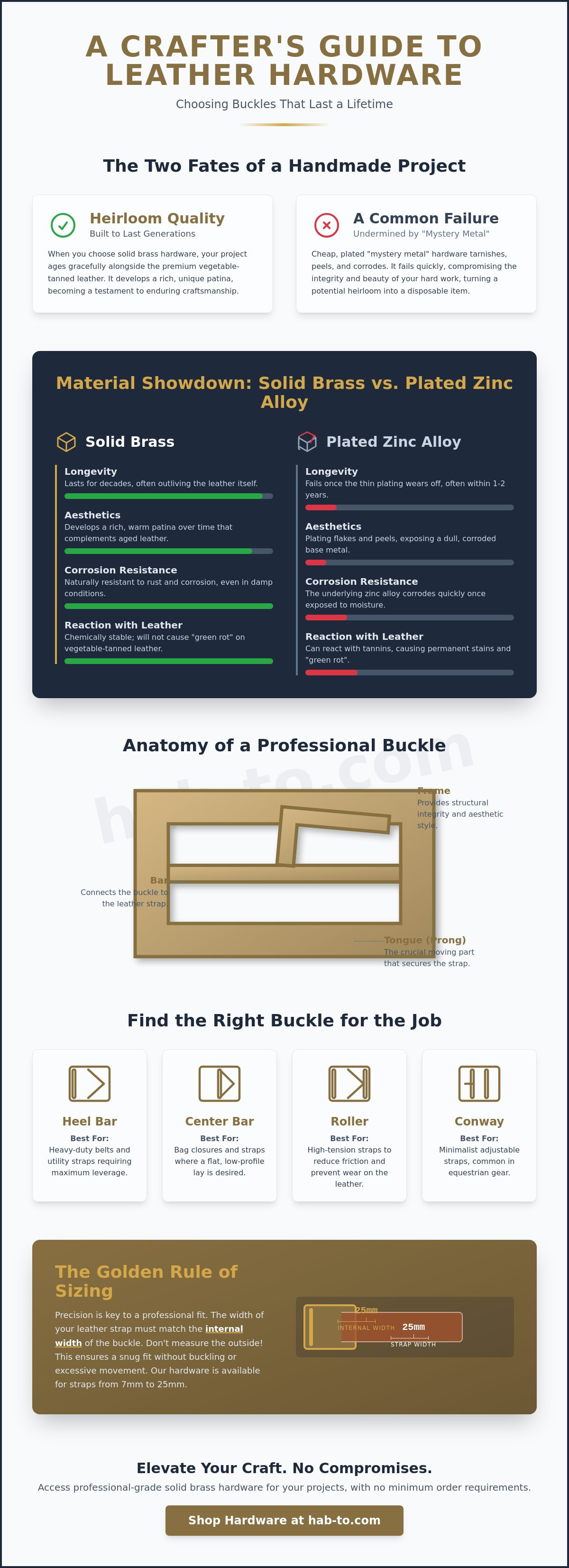
A buckle is the mechanical heart of any leather strap. While it serves as a functional fastener, its true role is to secure the bond between the maker's effort and the user's daily life. Technically, it consists of three primary components: the frame, the bar, and the tongue or prong. At Hab-To Leather House, our philosophy is built on a 160-year family tradition of quality. We believe hardware shouldn't just be an afterthought. It's a critical choice that dictates whether a piece lasts for two years or twenty. If you spend hours hand-stitching a belt, using a flimsy "mystery metal" fastener is a compromise we don't accept.
Cheap hardware is the primary cause of failure in handmade goods. Low-quality zinc alloys often feature thin plating that flakes off within months. This leaves the base metal exposed to moisture and friction, leading to a dull, corroded appearance. To understand the evolution of these fasteners, you can explore the history of the buckle, which reveals how they grew from simple bronze loops into the sophisticated hardware we use today.
To better understand this concept, watch this helpful video:
The Anatomy of a Quality Buckle
The frame provides both the aesthetic style and the structural integrity of the piece. It bears the constant tension of the strap, so it must be cast without air bubbles or internal weak points. The tongue or prong is equally vital for security. If the tongue is too thin, it'll eventually bend or snap under load. Professional-grade hardware uses a solid tongue that rests securely against the frame without wobbling. Finally, the bar is what connects the hardware to your leather. We provide fixed bars for traditional assembly and screw-in bars for makers who want the flexibility to swap hardware without unstitching the entire project.
Why Hardware Matters for Vegetable Tanned Leather
Choosing the right hardware is essential when you're working with vegetable tanned leather. Cheap metals often react poorly with the natural tannins found in premium hides. This chemical interaction can lead to "green rot," a persistent oxidation that stains both the metal and the leather permanently. Solid brass and high-grade stainless steel avoid this issue entirely. They develop a rich patina that complements the leather's natural aging process. Solid brass hardware and vegetable-tanned leather create a synergy that ensures your project becomes a functional heirloom rather than a disposable accessory. We hand-select our range to ensure your hardware never undermines the quality of your craft.
Common Buckle Styles and Their Functional Uses
Choosing a buckle isn't just about finding something that looks good. It's about matching mechanical design to the specific job your leather good needs to perform. In my Amsterdam showroom, I often see makers struggle because they've picked a style that fights against the leather's thickness or the strap's intended movement. To get that professional finish, you need to understand the four core styles that define modern leathercraft. Each serves a specific purpose in the architecture of your project.
- Heel Bar Buckles: These are the workhorses of the belt world. The "heel" refers to the bar at the back of the frame where the leather attaches. This design provides excellent leverage for heavy-duty straps. It's the classic choice for work belts and utility gear.
- Center Bar Buckles: If you want your strap to lay perfectly flat, this is your go-to. The bar sits in the middle of the frame, allowing the leather to pass through symmetrically. They're ideal for bag closures and decorative applications where a low profile is essential.
- Roller Buckles: These feature a rotating metal sleeve on the front of the frame. This sleeve reduces friction as you cinch the strap. It's vital for preventing wear on high-tension items and making the fastening process smoother.
- Conway Buckles: For those seeking a minimalist aesthetic, the Conway is a three-bar frame with a fixed prong. It allows for length adjustment without any moving parts. This makes it a favorite for shoulder straps and equestrian gear.
Choosing the Right Style for Your Project
When you're building a heavy belt, the choice usually comes down to a Heel Bar or a Roller. If the leather is particularly thick, such as a 4mm bridle strap, a roller makes cinching significantly easier. For finer goods like a slim clutch or a luxury watch strap, a small-scale center bar offers a more elegant finish. I always suggest matching the finish of your hardware to the intended use. A matte gunmetal finish suits a rugged field bag, while polished solid brass is the standard for traditional luxury. If you're ready to start your next project, you can browse our hand-selected hardware collection to find the perfect match.
The Roller Buckle Advantage
The mechanical benefit of a roller is hard to overstate. It acts like a tiny bearing, allowing the leather to glide over the frame rather than dragging against it. This is especially important when you're working with premium materials like Shell Cordovan. Because Shell Cordovan is a dense, high-gloss leather, it's prone to "scarring" if it's repeatedly pulled tight against a static metal edge. A roller prevents this surface damage, preserving the mirror-like finish of the leather for years. Use a roller for any application where the user will be tightening the strap daily. However, if you're aiming for a sleek, vintage look on a slim dress belt, a standard heel bar remains the more traditional aesthetic choice.
Material Science: Solid Brass vs. Plated Hardware
I’ve seen many beautiful projects ruined by hardware that looks like plastic after three months of wear. At Hab-To Leather House, we live by the "No Compromises" rule. This means we prioritize solid brass as the industry standard for professional makers. When you choose a buckle, you aren't just picking a color; you're choosing a base metal that determines the lifespan of your work. Most mass-produced hardware relies on zinc alloy, often called "pot metal." It’s cheap to cast but brittle and prone to snapping under the high tension of a heavy belt strap.
Solid brass is different. It’s a dense, non-ferrous alloy that won't rust, making it perfect for items that face the elements. While steel is also a strong contender, it requires heavy treatment to prevent corrosion. The real secret to longevity in modern hardware is PVD Coating. Unlike traditional electroplating, which sits on the surface like a thin coat of paint, Physical Vapor Deposition bonds the finish to the metal at a molecular level. This technology is why premium hardware can withstand years of friction without showing the silver-gray metal underneath. It’s the same process used on high-end watches and surgical tools.
You don't need a lab to test quality. I always tell my customers to use the weight test. Pick up the hardware and feel the heft. A solid brass or stainless steel piece has a distinct, reassuring weight. If you drop it on a hard surface, it should produce a clear, melodic ring. Zinc alloy sounds like a dull, hollow thud. That sound is the difference between an heirloom and a disposable accessory.
The Problem with Plated Hardware
Traditional plating is the enemy of durability. As the leather moves against the metal, the plating eventually flakes off. This doesn't just look bad; it can cause skin irritation. For items like watch straps or belts that sit against the skin, I always recommend nickel-free options. Using lifelong hardware also has a better environmental impact. By creating one belt that lasts 20 years instead of five cheap ones that end up in a landfill, you’re practicing sustainable craftsmanship that respects the material.
Finishes: Matching Your Aesthetic
Choosing a finish is where your personal style shines. Antique brass offers a warm, lived-in vibe that perfectly matches the earthy tones of vegetable-tanned leather. If you want a crisp, high-end look, polished brass is the traditional choice. For marine environments or outdoor gear, stainless steel is the ultimate choice for corrosion resistance. If your design is more contemporary, gunmetal and matte black finishes provide a sleek, tactical edge. Whatever your choice, ensure the base metal is strong enough to back up the beauty of the finish.
The Golden Rules of Buckle Sizing and Installation
Measuring for your project can feel like a guessing game if you don't know the industry standards. After selecting the right material, you must nail the dimensions to ensure the hardware functions smoothly. I've seen many makers buy a beautiful 40mm buckle only to find their 40mm strap won't fit because they didn't account for the leather's bulk or edge finish. Getting the sizing right is the difference between a professional-grade accessory and a hobbyist mistake.
Rule number one is simple but non-negotiable. The size of the hardware always refers to the internal width of the frame. If you're building a belt with a 38mm strap, you need a 38mm fastener. Don't try to squeeze a wider strap into a smaller frame; it will cause the leather to bunch and eventually crack at the edges. Rule two is the perfect match. A 40mm strap belongs with a 40mm frame. This ensures there is just enough "play" for the leather to move without excessive friction.
Leather weight plays a massive role that most fashion guides ignore. This is our third rule. If you're using a heavy 12oz (4.8mm) bridle leather, the tongue needs enough clearance to sit flush against the frame. A tongue that is too short for thick leather won't lock securely. This puts unnecessary stress on the prong and can lead to the belt popping open unexpectedly. Finally, rule four is to always test your punch size on a scrap piece of the exact same leather. The thickness of the material changes how the tongue sits in the slot.
Measuring Like a Pro
I recommend using digital calipers for absolute precision. If you plan on applying multiple layers of edge paint, remember it can add up to 0.5mm of thickness to each side of your strap. This small increase can make a snug fit impossible. For standard reference, men's casual belts usually range from 38mm to 40mm. Women's dress belts often sit between 25mm and 30mm. Smaller straps, such as those for watch bands or bag accents, can go as low as 7mm to 13mm.
Installation Tools You’ll Need
You'll need specific tools to do the job right. An oblong punch creates a much cleaner slot for the tongue than two round holes connected by a knife cut. When it comes to securing the fold, I prefer Chicago screws for their versatility. They allow you to swap out hardware if you want a different finish later. For a permanent, classic look, copper rivets are the way to go. You can find more details on these in our Guide to Essential Leather Hardware. If you're ready to upgrade your hardware, explore our range of precision-sized buckles to find the perfect fit for your next strap.
Hab-To Leather House: Expert-Selected Hardware for Every Maker
Hi, I’m Mike! When you walk into our Amsterdam showroom or browse our digital aisles, you aren't just looking at a shelf of generic metal loops. I personally hand-select every buckle in our inventory to ensure it meets the Hab-To Leather House "No compromises" standard. This isn't just a business for me; it's a family tradition that spans 160 years in the leather trade. I’ve seen firsthand how the wrong hardware can undermine a beautiful piece of vegetable-tanned leather. That's why I'm so selective about what we stock. I want you to have the same confidence in your hardware that you have in your stitching.
One of the biggest hurdles for independent makers is the "large industrial order" requirement of most wholesalers. We've changed that. We have no minimum order requirements because we want to empower hobbyists to access the same professional-grade hardware as the big fashion houses. Whether you need a single 7mm gunmetal fastener for a watch strap or a dozen solid brass rollers for a limited run of belts, you can get exactly what you need. This accessibility ensures that every project you finish is built to last a lifetime.
Our commitment to sustainable sourcing is central to everything we do. We focus on durable, plastic-free materials that respect the environment and the craft. By choosing solid brass or stainless steel over disposable, plated alternatives, you’re creating goods that won't end up in a landfill in a few years. If you're working on a complex project and feel overwhelmed by the material science or sizing rules we've covered, don't worry. I’m here to act as your mentor. We offer free hardware consultations to help you find the perfect mechanical and aesthetic match for your specific hide.
The Amsterdam Wholesaler Advantage
Being an Amsterdam leather wholesaler allows us to bridge the gap between traditional family expertise and modern crafting needs. We ship directly across Europe, providing a reliable source for makers who refuse to settle for "mystery metal." Our community goes beyond just selling tools and materials. Through "The Leather Hour" podcast, we host deep-dives into the technical nuances of the trade. It’s a space where we share the stories and science that make leatherworking such a rewarding pursuit.
Ready to Start Your Project?
Building something exceptional starts with choosing materials that don't quit. You can browse our curated collection of solid brass and stainless steel hardware to find the perfect functional centerpiece for your work. I always suggest combining your hardware selection with our premium hides in a single order. This ensures the patina of your leather and the finish of your buckle will age in perfect harmony while saving you on shipping costs. Let’s build something that lasts together.
Hi, I’m Mike—need advice on your next buckle? Schedule a free consult today!
Build Your Legacy with Premium Hardware
Mastering the technical side of hardware selection is a vital step for any serious maker. You now know that a quality buckle must be more than just a fastener; it's a mechanical component that requires solid brass or stainless steel to survive the test of time. By sticking to the golden rules of internal sizing and matching your hardware style to the leather's weight, you ensure your handiwork remains functional for decades. There is no reason to let inferior materials compromise your craftsmanship.
At Hab-To Leather House, we bring 160 years of family expertise to every piece of hardware we stock. From our Amsterdam showroom, we ship professional-grade materials across the globe with no minimum order requirements. This means you get access to the same premium quality used by industrial masters, even for a single project. We’re here to support your journey from hobbyist to expert with tools and hardware that never cut corners. Ready to find the perfect fit for your next strap? Browse our hand-selected Leather Hardware collection and start building your next heirloom today.
Frequently Asked Questions
What is the best material for a belt buckle?
Solid brass and high-grade stainless steel are the premier materials for a durable buckle. Solid brass is the traditional choice for its natural weight and its ability to develop a unique patina alongside your leather. Stainless steel is the superior choice for marine environments or outdoor gear where maximum corrosion resistance is required. Both materials ensure your hardware outlasts the strap itself without snapping or rusting.
How do I know what size buckle to buy for my strap?
You must match the internal width of the frame to the exact width of your leather strap. If you're building a belt with a 38mm strap, buy a 38mm buckle. Use digital calipers to measure your strap after you've finished the edges. Even a 0.5mm increase from edge paint or heavy burnishing can make a tight fit impossible. Precision is key to a professional finish.
Is solid brass better than zinc alloy for hardware?
Solid brass is significantly better than zinc alloy because it's a dense, non-ferrous metal that won't rust or snap under pressure. Zinc alloy, often called "pot metal", is brittle and relies on thin surface plating that eventually flakes off. We follow a "No compromises" rule at Hab-To Leather House, which is why we prioritize solid alloys that maintain their integrity for decades rather than months.
What is a roller buckle and do I need one?
A roller buckle features a rotating metal sleeve on the frame that allows the strap to glide through with minimal friction. You need one if you're working with thick leathers or expensive materials like Shell Cordovan that are prone to surface scarring. The rolling action prevents the metal from "biting" into the leather during daily cinching, which preserves the leather's surface finish for years.
Can I use a buckle with a screw-in bar for a permanent belt?
You can certainly use a screw-in bar for a permanent belt if you use a thread-locking compound to prevent the screw from backing out. While these are designed for easy hardware swaps, they're structurally sound for long-term use. Many professionals prefer them because they allow the owner to replace a worn strap while keeping the high-quality hardware, making the piece more sustainable.
What tools do I need to install a buckle on a leather strap?
You'll need an oblong punch for the tongue slot and a round punch for the adjustment holes. A sturdy mallet and a self-healing cutting mat are essential to protect your tools and your workspace. If you're using Chicago screws for the fold, a simple flat-head screwdriver is the only assembly tool required to finish the job securely and professionally.
Does Hab-To Leather House sell buckles in bulk for small businesses?
Yes, Hab-To Leather House serves as an Amsterdam leather wholesaler for makers of all sizes. We don't have minimum order requirements; this allows small businesses to source professional-grade hardware without the pressure of industrial-scale quantities. You can buy exactly what your current production run requires, whether that's five pieces or fifty, ensuring you don't have capital tied up in unused inventory.
How do I prevent my buckle from tarnishing over time?
Choosing hardware with a PVD coating is the most effective way to prevent tarnishing and surface wear. Unlike traditional electroplating, PVD bonds the finish to the metal at a molecular level. For solid brass, a simple wipe with a dry microfiber cloth after use removes skin oils that accelerate oxidation. Avoid harsh chemical cleaners that can strip away protective coatings or damage the leather's patina.