The Environmental Impact of Chrome Tanning: A Guide for Conscious Crafters
What if the leather sitting on your workbench right now carries a hidden chemical footprint that lasts for centuries? Since its invention in 1858, chrome tanning has become the industry standard for speed, but that efficiency comes at a heavy price. When we look closely at the environmental impact of chrome tanning, we see that 90% of the world's leather is processed using heavy metal salts that can devastate local water systems if not managed with extreme care.
Hi, I'm Mike, and I believe in craftsmanship with no compromises. I know you want to create beautiful pieces without worrying about toxic runoff or confusing marketing labels. It's hard to feel inspired when you aren't sure where your leather really comes from. This guide reveals the hidden ecological costs of modern production and explains why traditional, vegetable-tanned methods are the best choice for a conscious workshop. We'll explore the chromium cycle and give you the practical knowledge to spot eco-friendly leather every time you buy.
Key Takeaways
- Learn why chrome tanning dominates 90% of the market and how this industrial speed-up fundamentally changed leather production.
- Understand the true environmental impact of chrome tanning, including massive water footprints and the toxic chemical waste left behind.
- Discover the critical difference between Chromium III and Chromium VI to ensure your materials are safe and free from hidden carcinogens.
- Explore why traditional vegetable tanning offers a superior, biodegradable alternative for crafters committed to long-term sustainability.
- See how a "no compromises" approach to ethical sourcing can transform your craft by using only hand-selected, high-quality hides.
What is Chrome Tanning? The Industrial Speed Behind 90% of Leather
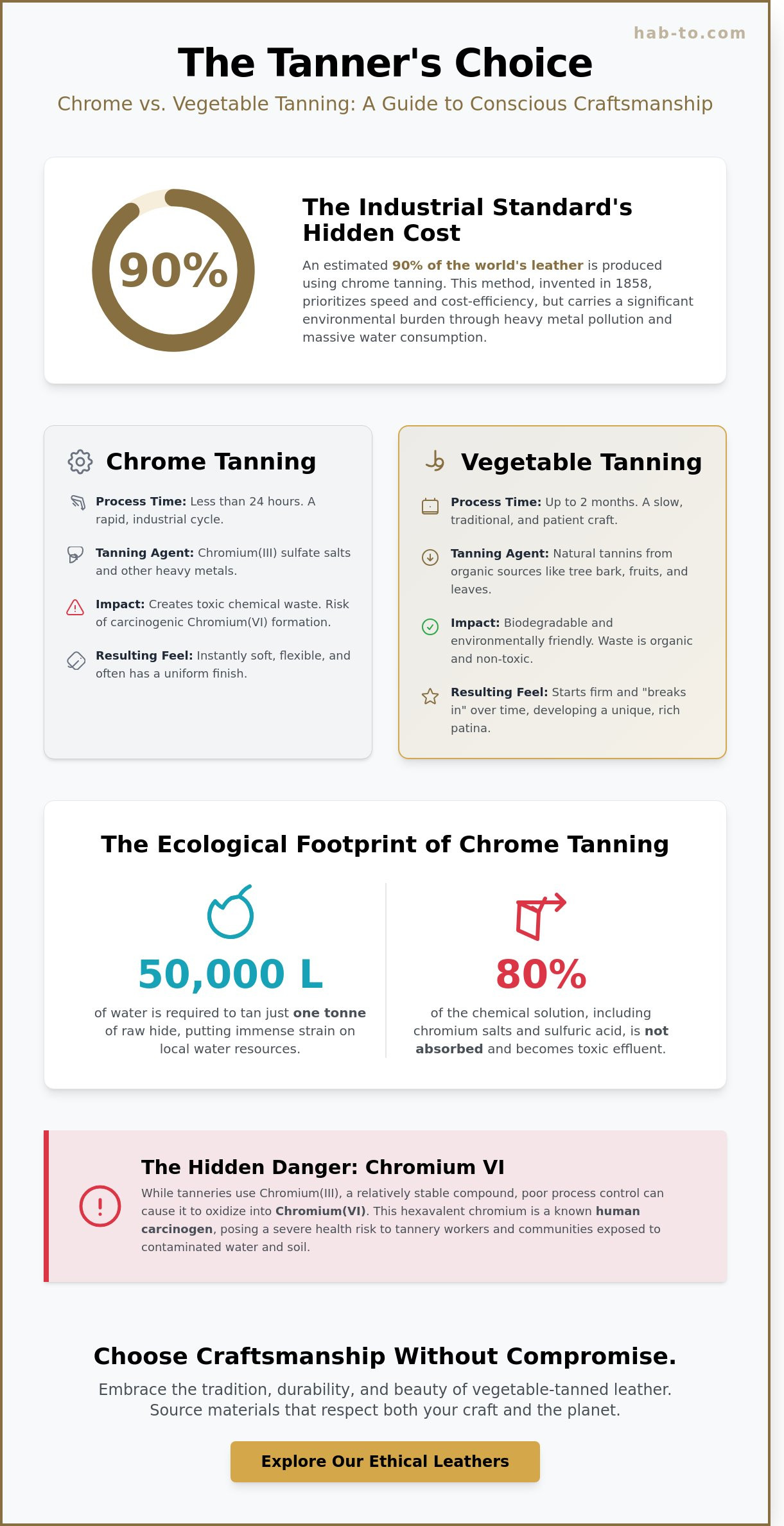
Chrome tanning is the chemical engine that powers the modern leather industry. It is a mineral-based process that uses chromium salts to transform raw animal hides into stable, rot-resistant material. While ancient methods relied on plant extracts and months of soaking, this industrial technique finishes the entire stabilization process in less than 24 hours. German chemist Friedrich Knapp first discovered the potential of chromium salts for Tanning (leather) in 1858. His invention didn't just speed up production; it completely revolutionized how fashion brands source and use materials.
Today, approximately 90% of the world's leather is produced using this method. The scale is staggering. Because it's fast and inexpensive, it allows for the mass production of everything from budget sneakers to car upholstery. However, this efficiency creates a massive footprint. As crafters, we have to look past the convenience to understand the true environmental impact of chrome tanning on global water supplies and local ecosystems.
To see how these different tanning methods react to the elements in a real-world test, watch this helpful comparison:
The Chemistry of Mineral Tanning
The process works by introducing Chromium(III) sulfate into the hides. These metal ions penetrate the skin and form strong cross-links with the collagen fibers. This molecular bond is what makes the leather so durable and resistant to heat. Industry giants prefer this method because it offers unmatched consistency and low production costs. It produces a soft, supple hide that's easy to dye in bright, synthetic colors. The hidden danger lies in the chemistry. If the tanning process isn't strictly controlled, Chromium(III) can oxidize into Chromium(VI). This hexavalent version is a toxic carcinogen that poses a severe threat to workers and the planet. This chemical volatility is a primary reason the environmental impact of chrome tanning is a growing concern for conscious consumers.
Chrome vs. Vegetable Tanning: A Brief Overview
The difference between these two worlds comes down to patience versus profit. Chrome tanning relies on a 24-hour chemical cycle, while traditional vegetable tanning requires a 2-month journey using natural tannins found in tree bark and fruits. This creates two very different products:
- Aesthetics: Chrome leather often has a uniform, synthetic finish that looks the same on day one as it does on day 500. Vegetable tanned leather lives with you, developing a deep, natural patina.
- Feel: Chrome hides are instantly soft and flexible. Vegetable tanned hides start firm and "break in" over years of use.
- Sustainability: One relies on heavy metals; the other uses organic matter.
At Hab-To, we don't believe in compromises. We choose materials that respect the craft and the environment. If you're ready to move away from industrial chemicals and explore the beauty of natural processes, read our Vegetable Tanned Leather: The Complete Guide for Crafters.
The Hidden Ecological Cost: Water Pollution and Chemical Waste
The tanning process is thirsty. Tanning one tonne of raw hide requires up to 50,000 litres of water. This isn't just a matter of consumption; it's about what happens to that water once the drums stop spinning. In a typical chrome tanning facility, only about 20 percent of the chemicals used are actually absorbed by the leather. The remaining 80 percent ends up in the effluent. This creates a toxic soup of sulfuric acid, sodium chlorate, and chromium salts that must be managed.
A major issue is the global disparity in environmental standards. In Europe, many tanneries use advanced closed-loop systems to capture and treat waste. However, much of the world's chrome-tanned leather comes from regions with lax oversight. In these areas, untreated Chromium Contamination in Tannery Effluent often flows directly into local rivers. This isn't just liquid waste. The "sludge" filtered out of these systems is a concentrated solid waste that remains hazardous for decades, often ending up in unlined landfills where it leaches into the groundwater.
Sodium Dichromate and Heavy Metal Runoff
Sodium dichromate is the primary agent used to achieve that soft, supple feel characteristic of chrome leather. When this chemical enters local waterways, it wreaks havoc on aquatic life. High concentrations of heavy metals disrupt the respiratory systems of fish and kill off the microorganisms that keep river ecosystems balanced. The environmental impact of chrome tanning is often the "hidden debt" paid for cheap, mass-produced goods. If a leather hide seems unusually inexpensive, the cost was likely externalized into a river system halfway across the globe.
Soil Contamination and the Food Chain
The damage doesn't stop at the water’s edge. Research, including a notable study in Bangladesh, has shown that chromium from tannery waste travels through the entire food chain. When contaminated water is used for irrigation, the metal accumulates in crops. Even more concerning, chromium-rich "tannery shavings" are sometimes processed into poultry feed. This results in measurable levels of chromium in chicken meat and eggs consumed by local populations.
Soil chemistry plays a dangerous role here too. While chromium III is the standard tanning agent, certain soil conditions, like high acidity or the presence of specific oxidizing agents, can trigger the oxidation of stable chromium into Hexavalent Chromium (CrVI). This is a known carcinogen and a much more mobile toxin in the environment. If you're looking for a cleaner alternative for your workshop, choosing vegetable-tanned leather is a direct way to support a process that relies on organic tannins rather than heavy metals.
- 50,000 Litres: Water required to process a single tonne of hide.
- 80 Percent: Average amount of tanning chemicals that remain unabsorbed and enter the waste stream.
- CrVI Risk: The potential for stable chromium to turn into toxic Hexavalent Chromium in contaminated soil.
Understanding the environmental impact of chrome tanning helps us make better choices as makers. We don't have to compromise on quality to protect the planet. By selecting materials with a transparent supply chain, we ensure our craft doesn't leave a legacy of pollution.
Chromium VI: The Toxic Misstep in Leather Production
Most people don't realize that not all chromium is created equal. In the tannery, we deal with Chromium III, which is a stable mineral. However, the environmental impact of chrome tanning becomes dangerous when poor manufacturing processes are involved. If a factory doesn't manage heat levels above 60°C or fails to control pH shifts during the finishing stage, Chromium III can oxidize. This transformation creates Chromium VI, a highly toxic hexavalent state and a known human carcinogen.
The health risks for workers in unregulated tanneries are severe. Frequent contact leads to "chrome holes," which are painful, slow-healing skin ulcers. Inhaling dust containing these particles causes chronic respiratory issues and significantly higher rates of lung cancer. This isn't just a factory problem, either. Scientific research into minimising the environmental impact of chrome tanning highlights that Chromium VI can actually form in the finished product. If your bag or shoes are stored in hot, humid shipping containers, the chemical reaction can trigger long after the leather leaves the vat.
The REACH Regulation and European Standards
In 2014, the EU introduced a strict amendment to the REACH regulation. It prohibits leather goods from entering the market if they contain more than 3 mg/kg of Chromium VI. While "Made in Europe" is a strong signal for better chemical management, it's not a total guarantee. Wholesale suppliers must actively perform lab tests on their batches. At Hab-To, we believe in no compromises, which is why we lean into vegetable-tanned leathers that avoid these heavy metal risks entirely. Always check that your supplier follows a Restricted Substances List (RSL).
Recognising the Signs of Poorly Tanned Leather
Your nose is often the best tool in the workshop. Premium vegetable-tanned leather has that iconic, earthy scent. In contrast, poorly processed chrome leather often gives off a sharp, acrid chemical smell. If the price seems too good to be true, it usually is. Producing safe leather requires expensive stabilizers and modern wastewater treatment. When a hide is 40% cheaper than the standard market rate, the tannery likely cut corners on safety. Understanding the environmental impact of chrome tanning helps you choose materials that protect both your health and your craft. Don't be afraid to ask for chemical compliance certificates before you buy.
The Sustainable Alternative: Why Vegetable Tanning is the Future
Vegetable tanning represents a return to nature. It uses organic tannins found in tree bark, specifically from oak, chestnut, and mimosa trees. This process is slow and deliberate, often taking 30 to 60 days to complete. It stands in stark contrast to the 24-hour chemical baths used in industrial production. By choosing this method, we eliminate the heavy metals that define the environmental impact of chrome tanning. It's a choice for quality over speed.
The circular economy relies on using every part of a resource. Since 99% of the hides used in tanning are byproducts of the meat industry, leather is naturally a recycled material. However, adding toxic chemicals to that hide ruins its potential. Vegetable tanning keeps the material clean. It allows crafters to transform a waste product into a premium tool without poisoning the local water table. At Hab-To, we've seen this tradition thrive for over 160 years in our family history. We don't believe in shortcuts.
Longevity is the ultimate sustainability metric. A vegetable-tanned bag can easily last 40 years with proper care. If a cheap, chrome-tanned or synthetic bag lasts only 2 years, you'll need to buy 20 replacements in that same timeframe. Reducing the total volume of goods produced is the most effective way to lower your carbon footprint. One high-quality hide is better for the earth than a dozen disposable ones.
Biodegradability and the Earth-to-Earth Cycle
Chrome-tanned leather is essentially "mummified" in a cocktail of plastic-like chemicals and heavy metals. When it finally reaches a landfill, it stays there for centuries. It doesn't break down; it just sits there. Vegetable-tanned leather is different. Because it's processed with organic plant matter, it remains a natural fiber at its core. When its life ends, it eventually returns to the soil as organic matter. "True sustainability in leather is measured by what remains after the product has served its purpose."
Choosing Your First Sustainable Hide
If you're a beginner, start with a versatile shoulder or side. Look for tanneries that belong to the Genuine Italian Vegetable-Tanned Leather Consortium to ensure strict environmental standards. If you want the absolute pinnacle of sustainability and durability, consider Shell Cordovan. This leather comes from a specific fibrous layer of a horsehide and is famous for its mirror-like finish and incredible lifespan. You can learn more in our deep dive: Shell Cordovan: The Ultimate Guide to the King of Leathers.
Ready to start your next project with materials that respect the planet? Browse our hand-selected collection of sustainable vegetable-tanned leathers.
No Compromises: How Hab-To Sources Ethical Leather
Mike’s philosophy is simple: "No synthetics. No compromises." At Hab-To, this isn't just a marketing slogan; it's the foundation of our supply chain. We believe that real craftsmanship requires materials that respect both the maker and the planet. Since the environmental impact of chrome tanning involves heavy metals and high chemical oxygen demand in wastewater, we choose a different path. We focus on vegetable-tanned leather that ages beautifully without leaving a toxic legacy behind.
Our standards at the Amsterdam Leather House are personal. We hand-select every single hide that enters our warehouse. We don't just buy bulk pallets and hope for the best. We look for consistency, grain quality, and ethical origins. This dedication stems from a 160-year family legacy in the leather industry. We only sell what we would use ourselves in our own workshop. When you hold a piece of leather from Hab-To, you're holding a material backed by over a century of expertise and a refusal to cut corners.
Small crafters often feel their choices don't move the needle, but we disagree. By choosing one ethical hide at a time, you support tanneries that invest in water filtration and sustainable bark tannins. You're voting for a cleaner industry with every wallet, belt, or bag you create. Your craft becomes a statement against the mass-produced, chemically-heavy norms of the modern market.
Sourcing Transparently in Amsterdam
We partner exclusively with European tanneries that operate under the world's strictest environmental regulations, such as the REACH framework. These facilities ensure that the environmental impact of chrome tanning is avoided through traditional, plant-based methods. One of our proudest features is our "No Minimum Order" policy. We want hobbyists to have access to premium, eco-friendly leather without the burden of industrial-sized costs. If you're in the area, you can book a personal consultation at our Amsterdam showroom. I'll walk you through our collections and help you find the perfect hide for your specific project.
The Essential Tools for Ethical Crafting
Sustainable leather is only half the battle. To create a piece that lasts a lifetime, you need to pair your hides with high-quality hardware. Using cheap, disposable metals on premium vegetable-tanned leather is a disservice to your hard work. We source buckles, rivets, and rings that match the durability of our skins. For a deeper look at what you need to get started, check out A Crafter’s Guide to Essential Leather Hardware.
Ready to switch to sustainable materials? Browse our hand-selected vegetable-tanned collection at the Hab-To homepage and start your next project with a clear conscience.
Choose Quality Without Compromise
The leather industry relies on industrial speed, with 90% of global production utilizing heavy metals that threaten our ecosystems. Understanding the environmental impact of chrome tanning is the first step toward becoming a more conscious maker. By choosing vegetable-tanned hides, you're rejecting the toxic risks of Chromium VI and embracing a tradition that respects the planet. It's about making a choice that feels as good as the finished product looks.
At Hab-To, we don't believe in shortcuts. We bring 160+ years of family expertise in leather sourcing to your workbench, ensuring every hide meets our strict standards. Whether you're a professional artisan or a hobbyist just starting out, we offer no minimum order requirements to support small-scale crafters. You're not just buying material; you're joining a community that values heritage over mass production.
Need help picking the perfect piece for your next project? I'm here to help you navigate the options. Browse our sustainable, hand-selected vegetable-tanned leather hides and get personalized advice directly from Mike. Let's build something beautiful that truly lasts a lifetime.
Frequently Asked Questions
Is chrome-tanned leather toxic to the person wearing it?
Chrome-tanned leather isn't toxic to the wearer if it's processed according to modern safety standards. The process uses Chromium III, which is safe for skin contact and doesn't pose a direct health risk in finished goods. Problems only occur if poor manufacturing practices allow it to oxidize into Chromium VI. EU REACH regulations strictly limit this chemical to 3 mg/kg to protect consumers from potential allergic reactions or health risks.
Does "chrome-free" leather mean it is 100% sustainable?
Chrome-free leather doesn't mean it's 100 percent sustainable. While these hides avoid heavy metals, many rely on synthetic glutaraldehyde or petroleum-based polymers to achieve a soft finish. These chemicals still contribute to the environmental impact of chrome tanning alternatives. We prefer vegetable-tanned options because they rely on natural bark extracts instead of synthetic shortcuts. No compromises.
How can I tell if a piece of leather was chrome-tanned by looking at it?
You can identify chrome-tanned leather by checking the cross-section or the cut edge of the hide. If you spot a pale blue or grayish tint in the center, it's a "wet blue" chrome-tanned product. It also feels very soft and stretchy compared to the firm, woody feel of vegetable-tanned leather. Most mass-market jackets and bags use this method for its flexibility and uniform appearance.
Is vegetable-tanned leather biodegradable?
Vegetable-tanned leather is biodegradable because it's treated with organic plant matter like mimosa or chestnut bark. Under industrial composting conditions, this leather can break down in about 12 months. Chrome-tanned leather stays in landfills for decades without decomposing. Choosing natural tannins ensures your craft eventually returns to the earth without leaving heavy metal residues behind. It's the right choice for conscious crafters.
Why is chrome tanning still the most popular method if it is harmful?
Chrome tanning is the most popular method because it's incredibly fast and cost-effective for mass production. A tannery can finish a hide in 24 hours, while vegetable tanning requires 30 to 60 days of soaking. This speed is why 90 percent of global leather is chrome-tanned, despite the environmental impact of chrome tanning on water quality and soil health in regions with loose regulations.
Can chrome-tanned leather be recycled or composted?
You can't compost chrome-tanned leather because the heavy metals would poison the soil. Recycling options are limited to shredding scraps into "bonded leather," which often contains 20 percent plastic binders to hold the fibers together. It's much better to invest in high-quality, vegetable-tanned pieces. These items last for generations and won't leach chemicals into the environment once they finally reach the end of their life.
What is the Leather Working Group (LWG) and should I look for their seal?
The Leather Working Group (LWG) is a global non-profit that audits tanneries on their environmental performance. You should look for their seal, especially "Gold" or "Silver" ratings, as they track water usage and chemical disposal. Currently, over 1,000 tanneries are LWG certified. It's a solid benchmark for finding suppliers who care about reducing their footprint, though it's still just one part of the sustainability puzzle.