

Veg Tan Leather for Bags: The Ultimate Artisan’s Selection Guide
The most beautiful bag you'll ever make isn't the one that looks perfect on your workbench today; it's the one that looks even better five years from now. You've likely spent hours staring at hide swatches, wondering if a 4oz shoulder is too stiff for your sewing machine or if a belly cut will stretch out of shape. It's a common struggle. Choosing the right veg tan leather for bags is the difference between a project that feels like a hobby and an heirloom that tells a story. You want a material that respects your craft and rewards your hard work with a deep, rich patina.
I know how frustrating it is when technical jargon like weights and temper gets in the way of your vision. This guide is designed to clear that fog and help you master the art of leather selection. You'll learn how to find the perfect balance between structure and suppleness for any design. We'll explore which leather cuts work best for specific bag parts and how to choose a hide that your tools will handle with ease. By the end, you'll have the confidence to pick leather that ensures your next creation is built to last. Let's find your perfect hide together.
Key Takeaways
- Discover why natural tannins create a "living" material that develops a unique patina over time, ensuring your bag ages beautifully.
- Learn to navigate the confusion of leather weights by mastering the ounce-to-millimeter conversion and understanding how temper affects your bag's structure.
- Compare the distinct characteristics of Vachetta, Bridle, and Milled hides to select the most suitable veg tan leather for bags based on your specific design needs.
- Gain professional construction insights, from achieving glass-like burnished edges to essential skiving techniques that prevent bulky seams.
- Understand how to source premium, artisan-grade hides without the pressure of industrial minimums, supported by 160 years of family expertise.
Why Veg Tan Leather is the Gold Standard for Handcrafted Bags
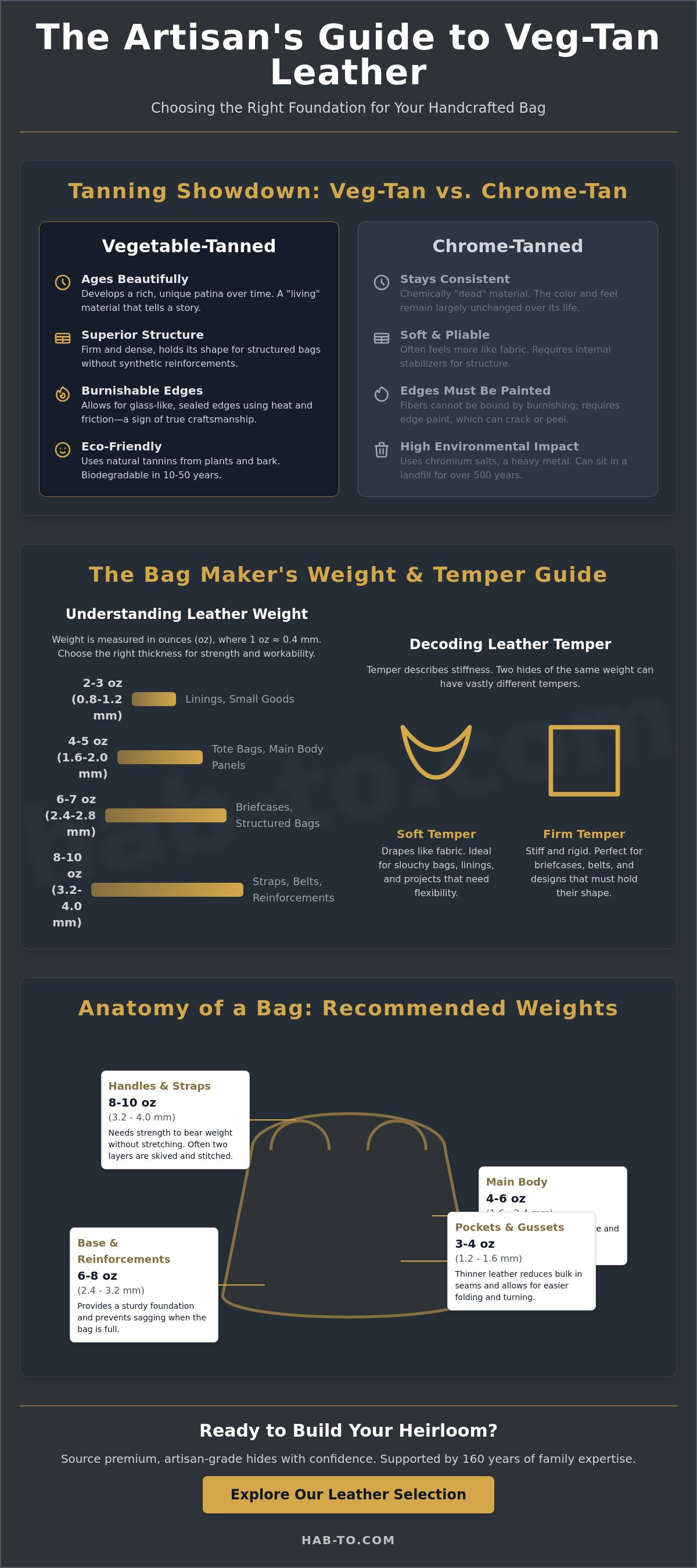
I have spent years running my hands over thousands of hides, and I can tell you that nothing compares to the smell and feel of a traditional pit-tanned skin. Vegetable tanning isn't just a manufacturing method; it is a heritage craft that respects the raw material. Unlike mass-produced alternatives, this leather is created using the vegetable tanning process, where organic tannins found in tree bark and plants replace aggressive chromium salts. When you select veg tan leather for bags, you are choosing a material that possesses a "memory" and a soul. It reacts to your touch, the weather, and the way you carry it.
To better understand the fundamental differences between your tanning options, watch this helpful comparison:
The true magic of this selection lies in the "Patina Promise." Because the pores remain open and the fibers are preserved by natural extracts, the leather absorbs oils from your hands and sunlight from the environment. A bag made from this material might start as a pale biscuit color, but in five years, it will transform into a deep, honeyed mahogany. Beyond aesthetics, the structural integrity is unmatched. Veg-tan has the innate density to hold a sharp gusset or a structured silhouette without the need for synthetic reinforcements or plastic stabilizers. It is a partnership between the artisan and the hide.
Veg-Tan vs. Chrome-Tan: The Bag Maker’s Dilemma
Most commercial leather is chrome-tanned because it is fast and cheap. However, chrome-tanned leather is chemically "dead." It feels like fabric and, crucially, it cannot be burnished. For a luxury bag, you want those edges to be glass-like and sealed. Veg-tan allows the heat of a wood slicker to bind the fibers together, creating a finished look that screams quality. Don't let the "stiffness" myth deter you. While a new hide feels firm, it breaks in beautifully. It softens exactly where the bag flexes, while maintaining its shape in the areas that require support.
The Environmental Edge of Natural Tannins
Sustainability is a core value for many modern crafters. Research shows that over 85% of global leather production relies on chrome tanning, which often discharges heavy metal effluent into local water systems. In contrast, vegetable tanning utilizes mimosa, quebracho, and chestnut barks. These natural ingredients mean the leather is biodegradable. A veg-tan bag can break down in 10 to 50 years; a chrome-tanned bag can sit in a landfill for over 500 years. By sourcing from traditional European tanneries that follow strict REACH regulations, you ensure your craft doesn't come at the cost of the planet.
The Bag Maker's Weight Guide: Choosing the Right Thickness
Choosing the right thickness is where many beautiful designs go to die. I've seen countless artisans spend weeks on a tote only to realize the leather is too thin to stand up or too thick for their sewing machine to turn a corner. In the leather world, we talk in ounces, but your calipers measure in millimeters. A simple rule of thumb is that 1oz equals roughly 0.4mm. So, a 4oz hide is approximately 1.6mm thick. Getting this calculation right is the first step in selecting the best veg tan leather for bags.
Thickness isn't the only factor you need to consider. You must also understand "temper," which describes the leather's stiffness or flexibility. Two different hides can both be 5oz (2.0mm), but a "firm temper" hide will feel like a wooden board, while a "soft temper" hide will drape like heavy denim. If you're using a domestic sewing machine, you'll likely want to stay under 4oz for the main body. For those of us who prefer hand-stitching with a diamond awl, the sky is the limit, but your hands will certainly feel the weight of a 10oz strap by the end of the day.
If you're unsure about the specific feel or flexibility required for your project, you can always explore our carefully curated selection of hides to see the detailed temper ratings we provide for each artisan variety. Selecting the wrong weight leads to "bag sag," where the bottom of your project bows under its own weight, or unworkable seams that are simply too bulky to fold.
Breaking Down the Bag: Weight by Component
Precision matters when you're layering materials. For internal linings and pockets, I recommend a 2-3oz (0.8-1.2mm) weight. It adds a professional finish without making the bag feel like a lead weight. For the main body and gussets, the sweet spot is usually 4-6oz (1.6-2.4mm). This range provides enough structure to hold a shape while remaining flexible enough for daily use. When it comes to load-bearing parts like straps and handles, don't compromise. You'll need 8-10oz (3.2-4.0mm) to ensure the leather doesn't stretch or snap under tension.
Shoulder, Belly, or Side? Selecting the Right Cut
Where the leather comes from on the animal dictates how it behaves under your knife. The Double Shoulder is my personal favorite for bag panels because it's the cleanest and most consistent cut. It has very little stretch. The Belly, however, is much looser and more textured. I save belly cuts for small internal trim or non-structural pockets where a bit of "give" is actually helpful. If you're making long, continuous shoulder straps, the Side is your best bet. It provides the longest straight edges, allowing you to maximize your yield on larger projects without wasting premium material.
Comparing Artisan Varieties: Vachetta, Bridle, and Milled Leathers
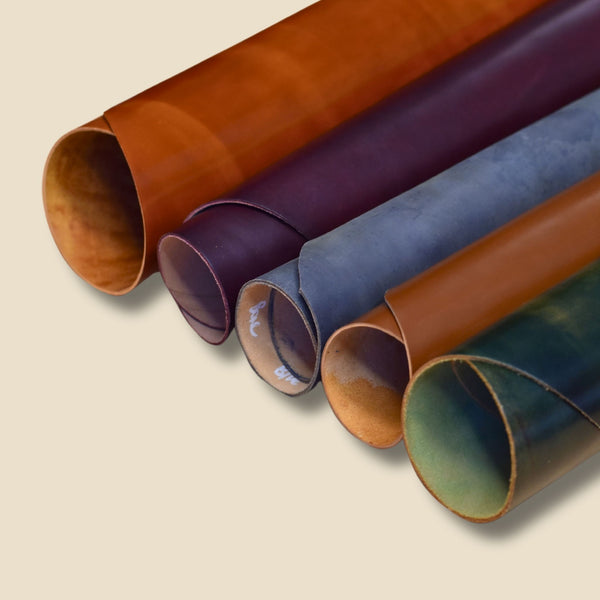
Not all hides are created equal. Some are designed for the rugged outdoors, while others belong in a Parisian boutique. When you're browsing for veg tan leather for bags, you'll quickly realize that the tanning recipe is as important as the hide itself. The variety you choose dictates the final personality of your piece. Vachetta is perhaps the most famous. It's an untreated, "naked" leather that defines luxury travel gear. It's incredibly sensitive to sunlight and skin oils, meaning it will darken and develop a patina faster than almost any other variety. It's the ultimate choice for a bag that tells a story of every journey.
English Bridle offers a completely different experience. Originally designed for horse tack, it's packed with waxes and tallows during the tanning process. This gives it a smooth, sleek finish and excellent weather resistance. If you're building a professional briefcase or a structured tote that needs to withstand a rainy commute, Bridle is your best friend. For those who prefer a softer feel, milled or tumbled veg-tan is the answer. These hides are spun in large wooden drums to break down the fibers naturally. This creates a beautiful pebbled texture and a supple hand without the need for synthetic softening chemicals.
If you're looking for something truly unique, Pueblo and suede-effect leathers are gaining massive popularity among modern artisans. These have a rustic, matte look with a slightly roughened surface. They feel almost like velvet at first, but they polish and darken beautifully with use, creating a high-contrast look that is purely artisanal.
The Italian Influence: Why Artisan Tannages Matter
Italy remains the spiritual home of high-end tanning. Our Vegetable Tanned Leather: The Complete Guide for Crafters explores how these centuries-old traditions continue to thrive. Italian tanneries often use specialized fat-liquoring techniques that differ significantly from the heavy oils used in many US industrial hides. This results in a lighter, more breathable leather that feels alive. Pueblo leather is a prime example of this innovation. Its "scratch" finish is achieved through a secret mechanical process that gives it a vintage look from day one.
Selecting Leather Based on Bag Style
Matching the variety to the design is a skill that comes with experience. For large tote bags, I always recommend a firm, medium-weight side. It provides the efficiency you need for large panels while maintaining enough structure to prevent sagging. When you're moving into small luxury goods like clutches or minimalist wallets, nothing beats the tight grain and lustrous finish of Shell Cordovan. It is the king of leathers for a reason. For backpacks, focus on high-tensile strength and weather resistance. You want a leather that can carry a heavy load without stretching out of shape over the years.
Essential Construction Tips for Working with Veg-Tan
Once you've selected the perfect hide, the real work begins. Working with veg tan leather for bags requires a different mindset than working with softer, factory-finished materials. Because this leather is a "living" material, it responds to the heat of your hands and the sharpness of your tools. One of the most satisfying parts of this craft is achieving a glass-like burnish on your edges. Unlike chrome-tanned leather, which usually requires edge paint to hide the fibers, veg-tan fibers can be compressed and polished. Use a small amount of water or burnishing gum and a wooden slicker. The friction generates heat, binding the fibers into a smooth, dark seal that looks professional and lasts for decades.
Bulk is the enemy of a sleek bag design. If you're layering a pocket onto a main body panel, your seams can quickly become unmanageable. This is where skiving becomes essential. By thinning the edges of your leather pieces down to about half their original thickness, you ensure your sewing machine or needles can pass through without struggle. Don't forget to manage the flesh side (the fuzzy back) of your leather. A professional interior often requires pasting the flesh side with gum tragacanth and slicking it flat to prevent lint and fibers from shedding into the bag. I always recommend testing your skiving knife on a scrap piece from the same hide first. Different tempers react differently to a blade. While you're at it, check if the hide feels dry. A light coat of neatsfoot oil before you start cutting can prevent the grain from cracking during tight turns.
Matching Your Hardware to Your Leather
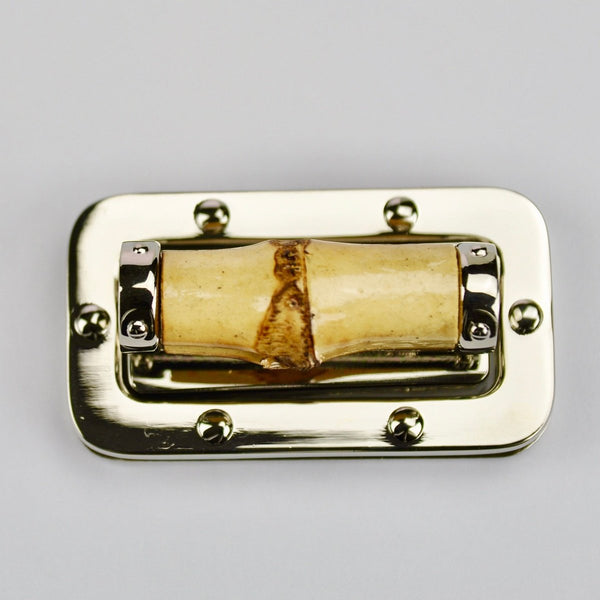
Your choice of leather hardware should reflect the quality of the hide. In my shop, I never use anything other than solid brass. It develops a patina that keeps pace with the leather, whereas plated "mystery metals" will flake and look cheap within a year. When installing rivets, remember the golden rule of length: your rivet stem should be about 2 to 3mm longer than the combined thickness of your leather layers. If it's too long, it will bend; if it's too short, it won't hold. Always place a piece of scrap leather between your hammer and the hardware to avoid unsightly dents on your beautiful new bag.
Stitching and Thread Selection
The thread is the "glue" that holds your legacy together. For a traditional look, nothing beats waxed linen thread. It has a matte finish that looks right at home on a rustic tote. However, if you're building a backpack that will carry heavy laptops, bonded nylon thread offers superior abrasion resistance. Consistency is your best friend here. Aim for 7 to 9 stitches per inch (SPI) for most bag projects. If your stitches are too close together on a thin veg-tan, you risk creating a "perforation" effect where the leather might eventually rip like a piece of notebook paper. If you're ready to start your next project, you can browse our professional-grade tools and bundles to get everything you need in one place.
Sourcing Your Leather: The Hab-To Leather House Advantage
Finding the right veg tan leather for bags shouldn't feel like trying to join an exclusive club for industrial manufacturers. Many wholesalers only want to talk to you if you're ordering hundreds of hides at a time. We do things differently. My family has spent 160 years perfecting the art of leather selection. We believe that every artisan, whether you're making your first tote or your fiftieth backpack, deserves access to the world's finest materials. That's why we offer no minimum orders. You get the same expert curation and premium quality that the big fashion houses demand, but in the quantities that actually make sense for your workshop.
Our roots are deep in Amsterdam, but our reach is global. We combine a personal, Dutch touch with efficient worldwide shipping. When you buy from us, you aren't just getting a piece of leather. You're getting a material that has been hand-selected for its grain, temper, and character. We're principled about what we sell. You will never find synthetic leather or chrome-tanned hides in our collection. We're committed to sustainable, chrome-free, and ethically tanned materials because we know that a bag built to last shouldn't harm the planet it travels on.
Personalized Consultation for Your Bag Project
I know that every pattern has its own quirks. Sometimes you need a bit more stiffness for a structured gusset, or perhaps you're looking for a specific temper for a turned-edge design. Don't guess. Use our expertise to match a hide to your specific project. We're here to help crafters of all skill levels find the perfect match. If you find yourself in the neighborhood, you're always welcome to visit our Amsterdam leather house for a hands-on selection experience. There's nothing quite like feeling the weight of a hide in person to confirm it's the right one for your vision.
Beyond the Hide: A One-Stop Shop for Crafters
The leather is the soul of the bag, but the details are what make it sing. We've designed our shop to be a complete resource for the modern maker. You can bundle your leather selection with the professional-grade tools and solid brass hardware we've discussed in previous sections. If you're looking for ongoing inspiration or deep-dives into specific techniques, our 'Leather Hour' insights and audio series are always available to help you grow your craft. We don't just want to be your supplier; we want to be your partner in creation. Explore our curated collection of veg-tan leather for your next bag project and let's build something that lasts.
Bring Your Next Heirloom to Life
Selecting the right veg tan leather for bags is about more than just picking a thickness; it's about understanding the soul of the hide. You've learned how to balance weight and temper, how to choose between the weather-resistant finish of English Bridle and the naked beauty of Vachetta, and how to master the technical edges of a professional burnish. These artisanal skills transform a simple project into a piece of history that ages with grace. Every mark and every shade of patina will tell the story of the work you put in today.
We are here to support your journey from the first cut to the final stitch. With over 160 years of family expertise, we've curated a selection of the finest Italian and European hides specifically for artisans who refuse to compromise on quality. We offer no minimum order requirements because we believe every maker deserves access to the best materials, regardless of the size of their workshop or the complexity of their pattern. You don't need to be an industrial giant to create something extraordinary.
Shop Premium Veg-Tan Leather for Your Next Bag and start building something that will only get better with time. Your workbench is waiting, and we're excited to see your vision become a reality. Happy crafting.
Common Questions About Vegetable-Tanned Leather
What is the best leather weight for a tote bag?
The ideal weight for a standard tote bag body is 4 to 6oz (1.6 to 2.4mm). This range provides enough structure to keep the bag upright without making it too heavy to carry. For the straps, you should use a heavier 8 to 10oz (3.2 to 4.0mm) leather to ensure they don't stretch or snap under the weight of the bag's contents. Choosing the right veg tan leather for bags depends on whether you want a slouchy look or a rigid, briefcase-style silhouette.
Does veg-tan leather get soft over time?
Yes, vegetable-tanned leather will naturally soften as the internal fibers loosen through use. While a new hide often feels stiff or "firm," it breaks in much like a pair of high-quality denim jeans. Regular handling and the application of natural conditioners will accelerate this process. This transition from a rigid state to a supple, molded shape is one of the most rewarding aspects of working with this material.
Is vegetable-tanned leather waterproof for bags?
Vegetable-tanned leather is not waterproof because it is a porous, natural material. It can handle light rain if it has been treated with a wax or a sealant, but heavy saturation can cause the leather to stiffen or develop water spots. If your bag gets wet, you should always let it air dry naturally away from direct heat sources. Applying a high-quality beeswax or carnauba cream can create a helpful water-resistant barrier for daily use.
Why is veg-tan leather more expensive than other types?
The higher price reflects the intensive time and craftsmanship required for the tanning process. While chrome tanning takes only a few days, vegetable tanning can take several weeks or even months in traditional pits. It also requires expensive natural tannins from tree barks rather than cheaper synthetic chemicals. You're paying for a premium, eco-friendly material that is more durable and develops a better patina than mass-produced alternatives.
How do I prevent my veg-tan bag from staining?
You can prevent most stains by applying a protective finish, such as an acrylic resolene or a heavy wax, before you start using the bag. Natural veg-tan is especially prone to picking up oils and dirt because it is "naked" leather. If you prefer the raw look, you must accept that some staining is part of the patina process. Regular light cleaning with a damp cloth and conditioning will help keep the surface healthy and more resistant to deep marks.
Can I sew veg-tan leather on a domestic sewing machine?
You can sew light-weight veg tan leather for bags on a domestic machine if the thickness stays under 4oz (1.6mm). It's essential to use a dedicated leather needle, which has a wedge-shaped point designed to cut through the hide. However, domestic motors often struggle with multiple layers or heavier straps. For anything thicker than a simple pouch, I recommend either hand-stitching or using an industrial walking-foot machine to avoid damaging your equipment.
What is the difference between natural veg-tan and dyed veg-tan?
Natural veg-tan is completely untreated and will darken significantly over time, while dyed veg-tan has had pigments added at the tannery. Natural leather starts as a pale pink or cream color and offers the most dramatic patina potential. Dyed varieties provide a more consistent color from day one and are often more resistant to sunlight-induced fading. Both types retain the ability to be burnished and carved, which are hallmarks of the vegetable tanning process.
How often should I condition my vegetable-tanned leather bag?
You should condition your bag every 3 to 6 months, depending on how often you use it and your local climate. If the leather begins to feel dry to the touch or looks dull, it's time for a light application of neatsfoot oil or a specialized leather balm. Over-conditioning can make the leather too soft and cause it to lose its shape. A small amount of product goes a long way in preserving the fibers and keeping the patina looking rich and healthy.