Vegetable Tanned vs Chrome Tanned Leather: The Artisan’s Comparison Guide
Hi, I'm Mike! Have you ever wondered why two hides that look identical on screen can have a price difference of over 40%? It’s a common point of frustration for every artisan, and it usually stems from the hidden chemistry of the tannery. Choosing between vegetable tanned vs chrome tanned leather is the most important decision you'll make before your needle even touches the hide.
I understand the hesitation. Between confusing technical jargon and conflicting reports on environmental impact, it’s easy to feel like you’re one wrong purchase away from a ruined project. At Hab-To, we believe in quality materials for real craftsmanship with no compromises. You deserve to know exactly what you’re paying for and how that material will behave under your tools.
This guide will give you a clear framework for selecting the right leather based on your specific project. You'll master the core differences in how these leathers age over a ten year period and finally understand why certain hides command a premium. We're going to break down the technical details into practical knowledge so you can craft with total confidence.
Key Takeaways
- Discover how the choice between ancient organic tannins and modern chemical processes dictates the character, smell, and aging potential of your leather.
- Learn which tanning method allows for traditional edge burnishing and which requires modern painting techniques to achieve a professional artisan finish.
- Master the core differences of vegetable tanned vs chrome tanned leather to ensure your material choice perfectly aligns with your project’s durability needs.
- Get Mike’s insider tips on hand-selecting premium hides in Amsterdam and how to experiment with different tanning types using no-minimum ordering.
- Understand the wholesale price-to-quality ratio to make smarter material investments for your next high-end craft project.
Understanding Leather Tanning: Why the Method Defines the Material
Tanning isn't just a chemical treatment; it's the soul of the craft. Without it, a hide is just organic matter waiting to decompose. By stabilizing the proteins within the skin, we create a material that survives centuries instead of weeks. This process, known as Tanning (leather), has evolved from primitive bark-soaking pits used in 8000 BC to the high-speed industrial rotations seen today. Your choice between vegetable tanned vs chrome tanned leather determines how your project will age, smell, and feel under a stitching awl. To better understand these fundamental differences, watch this helpful video: The path you choose for your leather defines its "personality." Organic, plant-based tanning relies on tannins found in tree bark, like oak or chestnut, while modern mineral-based tanning uses chromium salts. One takes months; the other takes hours. This massive gap in production time is exactly why the leather industry split into two very different worlds.The Core Purpose of Tanning
Tanning transforms a raw, perishable hide into a flexible, durable, and rot-resistant material. It works by replacing the water molecules in the collagen fibers with tanning agents. This shift increases the fiber density and significantly boosts moisture resistance. Tanning serves as the permanent preservative that halts biological decay while locking in the structural integrity required for a lifetime of use.
The Modern Leather Landscape in 2026
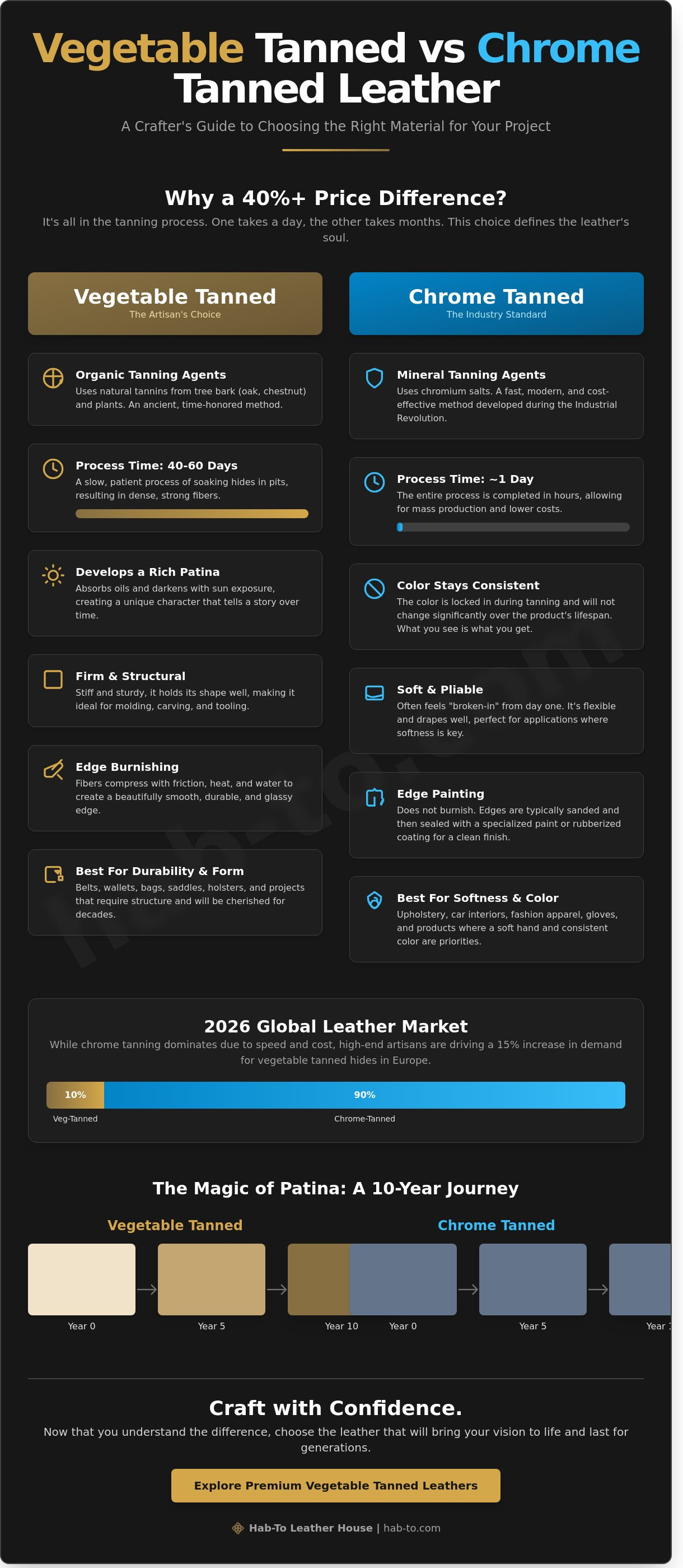
As of 2026, roughly 90% of global leather production remains chrome tanned because it's fast and cheap for mass-market fashion. However, high-end artisans and heritage brands are moving the needle back toward traditional methods. The European market has seen a 15% increase in demand for vegetable-tanned hides over the last two years, largely driven by the EU Deforestation Regulation (EUDR) and a push for circular economies.
This creates a specific dilemma for the modern maker. You have to choose between the immediate gratification and vibrant, consistent colors of chrome tanning or the slow-earned character of vegetable tanning. It's a choice between speed and soul. While chrome tanning offers a soft, "broken-in" feel right off the shelf, vegetable-tanned leather is a living material that develops a unique patina over time. Understanding the vegetable tanned vs chrome tanned leather debate is the first step in ensuring your work doesn't just look good today, but lasts for generations.
Vegetable Tanned Leather: The Time-Honored Tradition of Tannins
Vegetable tanning isn't just a manufacturing method; it's a patient collaboration with nature. Unlike the industrial speed of modern alternatives, this process relies on organic compounds found in tree bark, leaves, and fruits. We use extracts from oak, chestnut, and mimosa trees to stabilize the hides. This ancient technique transforms raw skins into durable leather through a series of slow-soaking pits. When comparing vegetable tanned vs chrome tanned leather, the timeline is the first major differentiator. While chrome tanning finishes in a single day, vegetable tanning often requires 40 to 60 days of careful monitoring.
This "Slow Movement" approach ensures the fibers remain dense and strong. At Hab-To, we focus exclusively on vegetable tanned leather because it aligns with our "no compromises" philosophy. You'll notice the difference immediately through your senses. It carries a rich, earthy scent instead of a chemical odor. The "handle" is firm and substantial, providing a structural integrity that synthetic-heavy processes simply can't replicate.
The Magic of the Patina
One of the most rewarding aspects of this material is how it evolves. Veg-tan leather is reactive. It absorbs ambient oils from your hands and darkens under UV sunlight. Over months of use, a pale "natural" hide transforms into a deep, burnished caramel. This patina tells a story. No two wallets or bags will age identically because they respond to your specific environment. Crafters choose this leather for heirloom goods because it doesn't wear out; it wears in, becoming more beautiful with every passing year.
Premium Examples: From Pueblo to Shell Cordovan
The best examples often emerge from historic Italian tanneries in the Tuscany region, where families have refined pit-tanning for over 200 years. Leathers like Pueblo offer a unique, slightly scuffed texture that smooths out over time. For those seeking the absolute peak of the craft, shell cordovan stands as the undisputed king. It's exceptionally dense and water-resistant. Because veg-tan leather retains its natural protein structure, it's the only choice for traditional tooling, carving, or stamping. If you want to master these techniques, you can explore our complete guide for crafters to learn more about selecting the right hide.
Chrome Tanned Leather: Speed, Versatility, and Modern Industry
While I often talk about the beauty of traditional methods, we have to recognize the impact of chrome tanning. It’s the engine of the modern leather world. This process changed everything in 1858 when tanners discovered that chromium sulfates could stabilize a hide in about 24 hours. Compare that to the months required for traditional barks. This speed allowed the fashion and automotive sectors to scale up. Today, approximately 90% of the world's leather is produced this way because it’s efficient and reliable.
The chemical process involves tumbling hides in large drums filled with chromium salts. These salts bond with the collagen fibers more aggressively than plant tannins. The result is a hide that's incredibly stable. It doesn't shrink or lose its shape when exposed to heat or moisture. For many makers, understanding the vegetable tanned vs chrome tanned leather debate starts right here with this chemical resilience. Chrome tanned leather won't rot easily, and it handles the stresses of daily use in a way that raw, organic materials sometimes can't.
The environmental stigma surrounding this method is real, but things are changing. Many modern tanneries now adhere to Leather Working Group (LWG) standards. These facilities use closed-loop systems to recycle up to 95% of their water and chemicals. There are also chrome-free alternatives, often called "wet white" leather, which use synthetic tannins or aldehydes to achieve similar results without the heavy metals.
Tactile Qualities and Color Stability
One of the biggest draws of chrome tanned leather is its "drape." It behaves more like fabric than wood. This makes it the superior choice for garments, upholstery, and soft-sided bags. If you need a leather that flows and folds without cracking, this is it. It’s soft and supple right from the start, requiring zero break-in period.
Color stability is another major factor. Unlike veg-tan, which changes every day, chrome tanned hides are chemically "locked." If you buy a vibrant red or a neon green hide, it will stay that exact shade for years. It doesn't develop a patina. This consistency is vital for high-end fashion brands that need a bag to look exactly like the floor model for every customer.
When to Choose Chrome Tanned Hides
I recommend chrome tanned hides for specific projects where flexibility is the priority. Think about these applications:
- Garments: Jackets and skirts need to move with the body.
- Gloves: You need dexterity that stiff veg-tan simply can't provide.
- Large Upholstery: If you're covering a sofa, you need 10 hides that match perfectly in color and texture.
- Water-Resistant Gear: The mineral bond makes it naturally better at shedding rain.
When weighing vegetable tanned vs chrome tanned leather, remember that chrome tanning is a technical achievement, not just a shortcut. It provides a level of precision and performance that allows leather to be used in ways our ancestors never imagined.
Vegetable Tanned vs. Chrome Tanned: A Side-by-Side Comparison
Choosing between vegetable tanned vs chrome tanned leather changes your entire workflow in the workshop. It isn't just a matter of price; it's about how the material responds to your tools and how it ages with the owner. If you want a glass-like edge, veg-tan is your only option. The dense fiber structure allows you to use friction and a wooden slicker to burnish the edges to a high gloss. Chrome-tan fibers are too loose and chemically lubricated for this. To finish a chrome-tanned edge, you must use edge paint or "edge kote" to seal the surface.
The price difference at the wholesaler level often surprises new crafters. Veg-tan carries a premium because of the clock. A modern tannery can produce chrome-tanned hides in roughly 24 hours. In contrast, traditional veg-tanning takes 30 to 60 days in tan pits. You're paying for the time, the organic tannins, and the artisan labor required to manage that slow soak. From an environmental perspective, veg-tan is biodegradable. It uses extracts from mimosa, chestnut, or quebracho trees. Chrome-tan relies on chromium salts. While high-end European tanneries use advanced chemical recycling, the process still leaves a heavier industrial footprint.
If you're ever unsure about a scrap piece on your bench, use the "Burn Test." Cut a tiny sliver and light it. Veg-tan burns slowly, smells like burnt hair, and leaves a dark gray or white ash. Chrome-tan will often bubble and leave a tell-tale green ash, which is the signature of chromium oxide.
Project Matching: Which Leather for Which Job?
Wallets and belts demand structure. Veg-tan is the gold standard here because it holds its shape and molds to the user over time. For garments, gloves, or bag linings, chrome-tan is the better choice. It offers the drape and immediate softness needed for comfort against the skin. When building your project, it's vital to select the right leather hardware to match your leather's weight. A heavy 4mm veg-tan belt needs solid brass, while a soft chrome-tanned clutch requires lighter, more delicate fittings.
The Longevity Factor
Veg-tan is a lifetime material. It's highly repairable; you can sand it, re-dye it, and buff out scratches with a bit of bone cream. This ability to be refurbished significantly boosts the resale value of bespoke leather goods. Chrome-tan is more "set and forget." It resists water and stains better than untreated veg-tan, which makes it easier for the average consumer to maintain. However, once a chrome-tanned surface is deeply damaged, it's difficult to restore. It doesn't develop a patina; it simply wears out.
Need the right material for your next masterpiece? Browse our hand-selected leather collection.
Choosing Your Hide: Mike’s Tips for Finding the Perfect Leather
Hi, I’m Mike! I spend my days surrounded by the scent of fresh hides in our Amsterdam warehouse. Selecting the right material is a tactile experience that requires a sharp eye and a bit of intuition. When comparing vegetable tanned vs chrome tanned leather, you aren't just picking a color; you're picking the soul of your finished piece. I hand-select our stock to ensure every hide meets the standards of a 160-year family legacy.
We don't believe in barriers for makers. That’s why we have no minimum order requirements. This freedom allows you to experiment with both tanning types without a massive upfront investment. You can grab a single shoulder of stiff veg-tan for a belt and a soft chrome-tanned side for a tote in the same order. It’s the best way to learn how different fibers respond to your tools.
I always look at two things first: the grain and the flesh side. A high-quality hide should have a tight grain. If you fold the leather and the surface "pipes" or creates large, loose wrinkles, the fiber structure is weak. Flip the hide over to check the flesh side. It should be smooth and well-shaved. Excessive fuzz or "shag" usually indicates a lower-quality cut or poor processing at the tannery.
Ethics matter as much as aesthetics. We source from tanneries with LWG (Leather Working Group) certifications. These facilities must meet strict criteria, such as treating 100% of their wastewater before discharge. This ensures your craftsmanship doesn't come at the cost of the environment.
The Wholesaler’s Secret: Grading and Selection
In the wholesale world, "A-Grade" means the hide is free from significant brands or insect bites across at least 90% of its surface. For veg-tan, this is critical because the natural finish hides nothing. Chrome-tanned hides are trickier. Heavy pigments can camouflage loose grain or surface scars. I've seen makers save 200 Euros on their first bulk order simply by choosing the right grade for their specific patterns. A 15-minute personal consultation can help you spot these nuances before you cut into your expensive material.
Building Your Crafting Arsenal
I recommend starting with bundles. Feeling the difference in temper and density is the most effective way to understand vegetable tanned vs chrome tanned leather. At Hab-To, we prioritize transparency. We don't do synthetics; we don't do compromises. Every hide has a traceable origin that we’re proud to share. You’re always welcome to visit our Amsterdam showroom to feel the textures yourself. If you can't make it to the city, book a call with me to discuss your next project. Let’s find the perfect hide together.
Craft Your Legacy with the Right Hide
Deciding on vegetable tanned vs chrome tanned leather is the most critical choice you'll make before your knife even touches the hide. You now understand that vegetable tanning relies on a 200-year-old tradition of organic tannins to create a material that develops a unique patina. Meanwhile, chrome tanning provides the vibrant colors and immediate softness required for high-speed modern production. At Hab-To Leather House, we choose quality over shortcuts. Our Amsterdam-based wholesale team relies on 160+ years of family experience to source only the finest materials for your workbench. We don't believe in barriers to creativity, so we offer global shipping and no minimum order requirements for independent crafters worldwide.
Hi, I'm Mike, and I'm here to ensure you never have to settle for synthetic alternatives. Your craft deserves a foundation that lasts a lifetime. Whether you're building a rugged saddle or a refined wallet, the right leather makes the difference between a product and a legacy. Browse our hand-selected Vegetable Tanned Leather collection today and find the perfect piece for your next project. We can't wait to see what you create.
Frequently Asked Questions
Is vegetable tanned leather more durable than chrome tanned leather?
Vegetable tanned leather is significantly more durable because the organic tannins preserve the hide's natural fibers in a dense, compact structure. While chrome tanned leather often begins to crack or peel after 5 to 10 years, a well-maintained veg-tan piece can easily last 30 years or more. It develops a patina that actually strengthens the surface over time. This makes it the only choice for heirloom-quality goods that you want to pass down.
Why does vegetable tanned leather smell better?
It smells better because the process uses natural organic materials like oak bark, mimosa, and quebracho instead of harsh synthetic chemicals. These botanical extracts infuse the hide with a rich, earthy, and woody aroma that leather lovers recognize instantly. Chrome tanned leather often retains a sharp chemical or metallic scent from the chromium salts used in the 24-hour tanning cycle. Most artisans prefer the sweet, natural scent of the traditional method.
Can I burnish the edges of chrome tanned leather?
You can't effectively burnish the edges of most chrome tanned leather because the chemical tanning process makes the fibers too soft and flexible to fuse together. If you try to use a wood slicker, the edge will likely fray or mushroom instead of becoming smooth. For these hides, artisans typically use edge paint or a folded hem to finish the project. If you want that glass-like, polished burnished edge, vegetable tanned leather is the only way to go.
Is chrome tanned leather toxic to wear?
Chrome tanned leather is safe to wear as long as it meets international safety standards like the REACH regulations in Europe. Most modern tanneries use Chromium III, which is considered non-toxic to the wearer. However, 80 percent of the world's leather is chrome tanned, and poor waste management in some regions can lead to environmental issues. If you have sensitive skin or want the most eco-friendly option, vegetable tanned leather is the hypoallergenic alternative.
Which leather is better for making a high-quality wallet?
Vegetable tanned leather is the superior choice for high-end wallets because it provides the structural integrity needed for card slots to hold their shape over time. When comparing vegetable tanned vs chrome tanned leather for small goods, veg-tan wins for its ability to develop a unique character. A wallet made from 1.2mm Buttero or Pueblo leather will look better after 500 days of use than it did the day you finished it.
Does vegetable tanned leather get wet easily?
Vegetable tanned leather is more susceptible to water spots because it lacks the synthetic plastic coatings found on many mass-produced chrome-tanned hides. Since it's a porous material, a single drop of water can leave a permanent mark if it isn't dried properly. You can protect your gear by applying a natural wax or oil finish. This adds a water-resistant layer while keeping the leather's breathability intact for years to come.
How can I tell if my leather is veg-tan or chrome-tan at home?
You can tell the difference by performing a simple burn test on a small scrap of the material. Vegetable tanned leather will char and smell like burnt hair, leaving behind a dark, crumbly ash. Chrome tanned leather often bubbles and produces a grey or green-tinted ash due to the chromium salts. Another way is the water test; veg-tan usually absorbs a drop of water in under 30 seconds, while chrome-tan typically beads it off.
Why is vegetable tanned leather more expensive?
It's more expensive because the production process takes 30 to 60 days to complete, compared to just 24 hours for chrome tanning. This traditional method requires highly skilled artisans and large quantities of expensive natural tannins. When looking at vegetable tanned vs chrome tanned leather costs, you're paying for the 160 years of family tradition and the sustainable, slow-batch approach that defines premium leathercraft. It's an investment in quality that doesn't compromise.