What is Belly Leather Used For? A Crafter’s Guide to Yield and Value
The most overlooked part of a hide is actually your best secret for increasing profit margins. Most crafters view the belly as a nuisance, a stretchy and inconsistent section that's better left on the cutting room floor. It's frustrating to watch your material costs climb while you're tossing away significant portions of a hide. However, once you understand exactly what is belly leather used for, you realize it isn't waste at all. It's a specialized material for flexibility, comfort, and character.
I know how it feels to ruin a project because the leather stretched more than expected. It's a common pain for those of us who value precision, but it's also avoidable. In this guide, I'll show you how to turn those soft, pliable sections into high-value projects that your customers will love. You'll learn how to identify the right projects for belly leather, from supple linings to wet-molded accessories. We'll also cover how to stabilize the grain to prevent unwanted stretching. By the end, you'll know how to slash your material expenses while maintaining the high standards of your craft.
Key Takeaways
- Understand why the belly’s natural elasticity makes it a specialized tool for flexibility rather than just "scrap" material.
- Discover exactly what is belly leather used for, focusing on high-value applications like wet-molded pouches and supple pocket items.
- Master the essential inspection and skiving techniques needed to manage thickness variations and ensure a professional finish.
- Learn how incorporating vegetable-tanned bellies into your workflow can significantly reduce material costs without sacrificing craft quality.
- Find out how to select premium bellies from heritage tanneries to guarantee a usable yield from edge to edge.
Understanding Belly Leather: Where It Comes From and Why It Matters
To truly master your craft, you have to understand the animal behind the material. Belly leather is the section of the hide that once covered the underside and legs. It's designed by nature to expand and contract. This allows the animal to breathe and move its legs freely. This biological reality dictates the material's properties. Understanding this purpose helps answer the common question: what is belly leather used for? It isn't just a byproduct; it's a specialized tool for flexibility and comfort.
Many crafters avoid bellies because they see them as low quality waste. Here is a secret from the wholesale side: buying full hides with the bellies attached significantly lowers your average cost per square foot. It's about maximizing your usable yield. Lower your costs. Increase your margins. At Hab-To Leather House, we've seen how the Leather production process, especially vegetable tanning, is essential here. The natural tannins fill the looser fiber structure of the belly. This stabilizes the material, making it far more useful for high-end artisan work than mass-produced alternatives.
To better understand this concept, watch this helpful video:
The Anatomy of a Hide
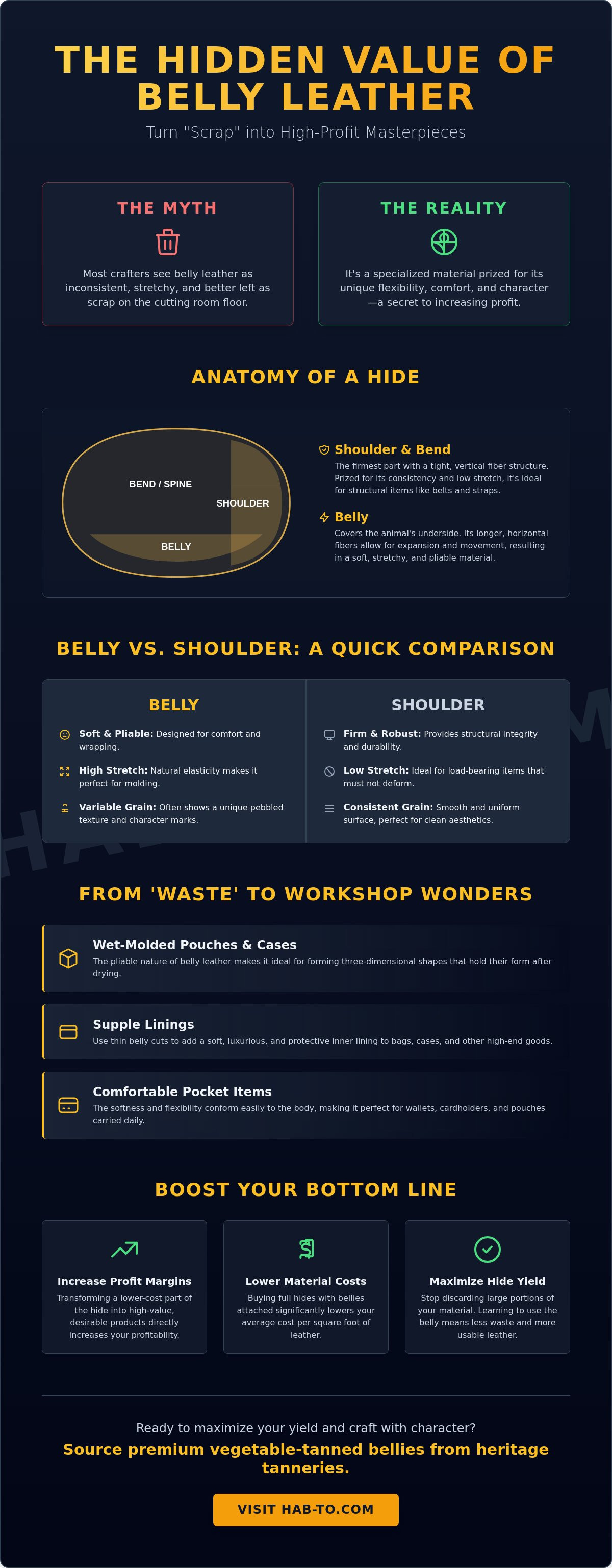
As you move away from the spine toward the edges, the fiber structure changes. Near the spine, the fibers are tight and vertical. In the belly, they become longer and run more horizontally. You'll notice a distinct transition where the firm shoulder gives way to the softer, spongier belly. This transition isn't a defect; it's a feature. Different animals yield different characteristics too. A cow belly provides a thick, robust stretch. A goat belly, on the other hand, is often paper-thin and incredibly supple. This makes it perfect for delicate, lined work.
Belly vs. Shoulder: A Quick Comparison
The shoulder is the powerhouse of the hide. It's firm, consistent, and provides the structural integrity needed for belts or heavy straps. If you want something that won't budge, you choose the shoulder. The belly is the shoulder's flexible cousin. It has more give and a much softer hand. When deciding what is belly leather used for versus the shoulder, think about the final movement of the piece. If it needs to wrap, fold, or sit comfortably against the skin, the belly is your friend.
- Shoulder: Firm, low stretch, high consistency. Ideal for load-bearing items.
- Belly: Soft, high stretch, variable grain. Ideal for items needing comfort or molding.
For a deeper look at the firm alternative, you can read our guide on what is shoulder leather? It helps to see both ends of the spectrum before you start cutting your next project. Choosing the right cut is the first step toward a masterpiece.
The Characteristics of Belly Leather: Softness, Stretch, and Grain
Belly leather is often dismissed on hobbyist forums as "too stretchy" or "low quality," but this misses the point of the material's unique soul. When you hold a piece of quality belly, the first thing you'll notice is the softness. It feels broken-in immediately. This pliability makes it a joy to handle. However, the thickness is rarely uniform. You might find a 4oz section that tapers down to 2oz near the edges. This uneven nature is exactly why wholesalers often sell it at a discount, but a skilled crafter sees it as an opportunity for varied project components. If you've ever wondered what is belly leather used for, the answer lies in its ability to adapt where stiffer cuts would fail.
The grain is another standout feature. Unlike the smooth, tight surface of the bend, the belly often displays a pronounced, pebbled texture. This is where you find the most character. You'll see growth marks and fat wrinkles that tell the story of the animal. Understanding the parts of a cattle hide helps you anticipate these variations before you even lay your templates down. It's about working with the material, not against it.
The Stretch Factor: Friend or Foe?
Stretch is the most defining characteristic of this cut. Because the fibers run horizontally to allow for the animal's movement, the leather pulls significantly more in one direction than the other. Is this a problem? Only if you don't plan for it. If you're making a wallet pocket that needs to hold multiple cards without tearing the stitching, that extra give is a blessing. To test the direction of the grain, simply pull the leather firmly between your hands in two perpendicular directions to see which way offers the most resistance. By aligning your patterns with the "line of least stretch," you ensure your finished piece maintains its shape over years of use.
Visual Appeal and Character
If you love a rustic, artisanal aesthetic, the belly is your playground. The natural fat wrinkles add a depth that you won't find in "perfect" top-grade cuts. For example, our Pueblo leather bellies from Badalassi Carlo retain that signature scuffed, matte finish while showcasing the hide's natural movement. Compare this to a Vacchetta belly, and you'll see how different tanning methods highlight the grain differently. While some see these marks as flaws, we see them as the mark of authentic, sustainable craft. If you're ready to experiment with these unique textures, you can explore our full range of vegetable tanned leather to find the perfect match for your next project.
Ultimately, knowing what is belly leather used for comes down to appreciating its organic nature. It's the perfect choice for items that need to feel soft against the skin or expand slightly during use. Embrace the variance. It's what makes handmade goods feel human.
How to Identify and Prepare High-Quality Belly Cuts
Selecting the right piece is an art. You can't just look at the surface; you have to feel the integrity of the fibers. Press your thumb firmly into the grain side. If the leather feels hollow or "spongy," it's likely too loose for anything other than a soft lining. High-quality bellies from premium tanneries will have a tighter fiber density that resists deep indentations. This inspection phase is where you decide what is belly leather used for on your bench. If the grain remains tight under pressure, it's ready for more visible, external components that require a bit more durability.
Preparation follows selection. Skiving is your most powerful tool. Because the thickness varies wildly across a single belly cut, you must level the edges where pieces overlap. This prevents a bulky, unfinished look at the seams. If the horizontal stretch is still a concern for your specific pattern, don't try to fight the physics. Use a stiffener. A thin pigskin lining or a dedicated reinforcement tape provides the structural backbone the belly might lack. Lastly, watch your conditioning. The open fiber structure of the belly acts like a sponge. Apply oils or waxes with a very light hand to prevent the leather from becoming over-saturated or overly dark.
Stabilizing the Grain
You don't always need a heavy lining to make a belly cut work. Sometimes, a simple surface treatment is enough. Applying a burnishing agent to the flesh side flattens those wandering, loose fibers. It transforms a "hairy" back into a smooth, professional surface. When you're ready to mark your stitch lines, use a wing divider with a delicate touch. On these softer edges, a heavy hand can easily distort the leather or pull the grain out of alignment before you've even started your first stitch.
Cutting for Maximum Yield
Efficiency separates the hobbyist from the professional. Place your patterns strategically. Put small, non-structural parts like internal card slots or decorative zipper pulls in the loosest sections. Save the center of the belly for larger panels. Most importantly, stay away from the "flank." This is the very edge of the hide, and it's often too thin and weak to hold a stitch. For a deeper dive into optimizing your material, see our guide on how to measure leather for yield. Knowing how to navigate these variations is what turns a budget cut into a high-end masterpiece.
Best Projects for Belly Leather: Turning "Waste" into Masterpieces
The biggest mistake a crafter can make is treating the belly as an afterthought. If you only look for "perfect" cuts, you're leaving money on the table. When you understand what is belly leather used for, you can create products that are both beautiful and highly profitable. It isn't just about saving money; it's about using the material's natural properties to your advantage. Lower your costs. Increase your margins. Build your brand with character.
- Wet-Molded Pouches: The natural stretch makes it the perfect candidate for deep molding. It conforms to complex shapes that would cause stiffer hides to buckle or crack.
- Small Pocket Items: Cardholders, coin purses, and key fobs don't require heavy rigidity. They benefit from the soft, tactile feel of the belly.
- Internal Linings: Provide a premium feel inside luxury bags without adding unnecessary bulk or weight.
- Gussets: The sides of bags need to flex and expand. The belly's elasticity ensures the bag remains functional and durable over time.
High-Margin Market Stall Ideas
If you sell at craft fairs, bellies are your best friend. You can yield dozens of small items from a single cut. Key fobs, cord organizers, and earbud cases are perfect for utilizing every square inch of the hide. These small goods have high perceived value but very low material costs. Rustic journal covers are another winner. The natural fat wrinkles and growth marks add an "authentic" handmade aesthetic that customers love. For more inspiration, check out our guide on Leather craft ideas for market stalls to see how to maximize your profits this year. It's about working smarter, not harder, with your inventory.
Prototyping and Practice
Every master crafter I know keeps a stash of belly leather for prototyping. Never commit a premium shoulder or a piece of shell cordovan to a new pattern until you've tested it. Use the belly to refine your dimensions and check the fit of your hardware. It's the ideal canvas for developing your technique. If you're learning a new decorative stitch or testing a custom dye mix, do it on a belly scrap first. It's a low-risk way to push your boundaries as an artisan. Understanding what is belly leather used for in the development phase will save you from costly mistakes on your main hides. Ready to stock your bench? You can find high-quality vegetable tanned leather in our shop that offers the perfect balance of yield and character.
Ultimately, the belly is a tool for the versatile crafter. It allows you to offer entry-level items that lead customers to your premium goods. It keeps your workshop sustainable by minimizing waste. Most importantly, it gives you the freedom to experiment without the fear of wasting expensive material. Embrace the stretch. Use the texture. Master the yield.
Sourcing Quality: Why Hab-To Leather House Vegetable Tanned Bellies Stand Out
Selecting leather is a responsibility we take personally. For over 160 years, our family has walked the tanneries of Europe to find hides that meet a specific standard. We don't just look for the best bends; we look for bellies that offer usable yield from edge to edge. Many suppliers treat the belly as a discard. Hab-To Leather House sees it as a vital part of the animal that deserves respect. By sourcing from world-class tanneries like Badalassi Carlo and Virgilio, we ensure that even the softer parts of the hide possess the character and durability our customers expect. It's about honoring the material. It's about sustainable craft.
Understanding what is belly leather used for is only half the battle. The other half is finding a supplier who understands the nuance of the cut. We believe in ethical sourcing. This means ensuring every part of the animal is used effectively. Our selection process focuses on density and grain stability. This allows you to use more of the hide and waste less of your investment. Whether you're a professional looking to boost margins or a beginner buying your first piece, Hab-To Leather House provides the same level of care and expertise.
Premium Italian Bellies
If your project requires a soft temper without sacrificing quality, look no further than our Virgilio Vacchetta. Italian vegetable tanning is famous for a reason. The process produces a tighter grain structure, even in the belly area. This makes it far more versatile for visible components like gussets or linings. We know that buying leather online can be daunting. You want to see the grain before you cut it. Message us anytime. I'll personally send you a photo of the specific hide you'll receive from Hab-To Leather House. It's the closest thing to visiting our Amsterdam headquarters in person.
The Hab-To Leather House Commitment
We don't sell scraps. We sell opportunities. This is the core of our philosophy. Many wholesalers require large industrial orders, but we've always kept our doors open to everyone. Our No Minimum Order policy is designed for the crafter who wants to experiment. Maybe you're still figuring out what is belly leather used for in your specific workflow. Hab-To Leather House is here to help you choose the right cut for that first project. We want to be your mentor in this craft, not just your supplier. Every piece of leather that leaves our shop is a testament to a tradition that spans generations. Ready to dive deeper? Browse our premium vegetable tanned leather collection and start your next masterpiece with confidence.
Master the Yield and Elevate Your Craft
Belly leather isn't a compromise. It's a specialized tool for the artisan who values flexibility, character, and commercial efficiency. By mastering the stretch and embracing the unique grain patterns we've discussed, you can transform these often-overlooked cuts into high-margin masterpieces. Whether you're adding supple movement to a gusset or refining a new pattern through prototyping, you're now equipped to turn every square inch of your hide into value. You've learned exactly what is belly leather used for and how to prepare it for professional, lasting results.
At Hab-To Leather House, we bring 160 years of family expertise to every hide we select. We source only from sustainable Italian tanneries to ensure your materials meet the highest standards of the craft. We don't believe in barriers. That's why we offer no minimum order quantities; it's easy for you to experiment with new textures without a massive initial investment. Every hide is a chance to refine your skills and honor the material. We don't sell scraps. We sell opportunities.
Are you ready to slash your material costs while adding unique character to your work? Explore our hand-selected Vegetable Tanned Leather Hides today. We're here to support your journey from the first cut to the final stitch. Embrace the variance. Master your craft.
Frequently Asked Questions
Is belly leather good for making belts?
No, you shouldn't use belly leather for single-layer load-bearing belts because it stretches too much. If you use it for a belt, the piece will likely deform and elongate significantly after just a few wears. However, it can work as a soft decorative lining if you bond it to a firm shoulder or veg-tanned bend core. Always prioritize structural integrity for any item that endures daily tension.
How can I tell the difference between belly and shoulder leather?
You can distinguish the two by testing the temper and inspecting the grain. Shoulder leather is dense, firm, and has very little give when you pull it firmly. In contrast, belly leather feels significantly softer and more pliable. You'll also notice more fat wrinkles and a looser, often pebbled grain texture. If the piece stretches easily between your hands, you're likely holding a belly cut.
Does belly leather patina as well as other cuts?
Yes, vegetable-tanned belly leather patinas beautifully as it ages. It absorbs oils, handling, and sunlight just like the rest of the hide, eventually developing a deep glow and darkened hue. The looser fiber structure can even accelerate this process because it absorbs conditioners more readily. It's a great choice for rustic journal covers where a rich, aged look is the primary goal for the artisan.
Can I use belly leather for wet molding?
Belly leather is an exceptional candidate for wet molding because of its natural elasticity. When you soak it, the fibers become incredibly pliable, which allows you to stretch the material over complex or deep molds without the leather cracking. This flexibility is a primary reason for what is belly leather used for in the creation of specialized pouches, mask-making, and ergonomic accessories.
Why is belly leather cheaper than other parts of the hide?
Belly leather is more affordable because it offers a lower usable yield compared to the bend or shoulder. The inconsistent thickness and directional stretch make it more challenging for large-scale industrial production. Wholesalers price it lower to account for the extra planning required to navigate these variations. For an artisan, this lower cost is a massive opportunity to increase margins on smaller, non-structural projects.
How do I stop belly leather from stretching too much?
To prevent excessive stretching, you should reinforce the leather with a non-stretch lining or an internal stiffener. Bonding a thin pigskin or goat leather to the flesh side provides a structural backbone that limits elongation. You can also apply reinforcement tape along your stitch lines. This technique is vital when considering what is belly leather used for in items like card slots that must maintain their shape.
Is belly leather suitable for beginners?
It's a fantastic choice for beginners because of its low entry cost and forgiving nature. You can practice cutting, skiving, and stitching without the stress of ruining an expensive premium hide. It's also easier to hand-stitch than firmer leathers, which makes it ideal for developing your muscle memory. Use it to prototype your designs before you move on to more costly materials like shell cordovan.
What is the best way to finish the edges of soft belly leather?
The best way to finish soft belly edges is to use a high-quality burnishing agent like Tokonole combined with a wood slicker. Because the fibers are looser, you might need to apply the agent twice to achieve a smooth finish. If the edge is too soft to slick effectively, consider using a professional edge paint. This creates a durable, plastic-like seal that hides the fiber structure and provides a professional look.