Buying Leather Online: The Professional Artisan's Guide to Sourcing Hides
Why does a hide that looks flawless on a high-resolution screen often arrive at your workshop looking like a different material altogether? Buying leather online shouldn't feel like a high-stakes gamble with your craft. You've likely felt the frustration of opening a package to find inconsistent thickness or hidden defects that the camera didn't catch. It's a common hurdle for artisans who refuse to make concessions on quality.
I understand that passion for perfection. This guide will help you master the art of digital sourcing by teaching you to decode technical specs and evaluate tannery quality from a distance. We'll look at how the 2026 LWG Sustainability System affects your choices and how to mitigate risk without a tactile inspection. You'll learn the terminology needed to find reliable suppliers and choose the right hide cuts to minimize waste. Quality matters. Precision counts. Let's ensure your next purchase is exactly what your project deserves.
Key Takeaways
- Learn how to master thickness conversions between millimetres and ounces to ensure you always source the correct weight for your specific project.
- Understand hide anatomy to choose the right cut, such as using shoulders for durable straps, to significantly reduce material waste.
- Master the art of buying leather online by learning to decode "temper" descriptions and evaluate professional photography for true-to-life grain details.
- Discover the critical differences between vegetable-tanned and chrome-tanned hides to protect your tools and ensure a professional finish.
- Shift from tactile inspection to technical evaluation by leveraging tannery reputations and detailed material specifications.
The Evolution of Buying Leather Online: From Touch to Technical Specs
Leather is a sensory material. You want to feel the drag of the grain, the resistance of the fibres, and smell the deep, earthy scent of the tannins before making your first cut. This creates a tactile paradox. How can an artisan commit to a hide without that physical connection? Traditionally, makers were hesitant. They feared receiving a hide that was too stiff, too scarred, or the wrong shade. They stayed within driving distance of local suppliers, limiting their creative palette to whatever was on the rack.
Mastering the process of buying leather online requires a shift in mindset. It moves the evaluation from the fingertips to the intellect. We define digital sourcing as a method of judging material based on tannery reputation and hard technical data. By understanding Leather production processes, you can decode a listing to see what the camera might miss. You aren't just looking at a picture; you're reading a technical profile.
To see how high-quality materials translate into successful products, watch this helpful video:
The market has changed significantly. In 2026, transparency has reached a peak. Wholesalers have dropped the old barriers, replacing large industrial requirements with no-minimum-order policies. This shift allows hobbyists and small studios to access the same world-class hides as luxury fashion houses. High-definition macro photography and detailed tannery reports now provide a level of clarity that makes 2026 the ideal time for buying leather online.
The Risks of Digital Sourcing (And How to Mitigate Them)
Colour variance is the most common hurdle. A "Chestnut" hide looks different under warehouse LEDs than it does on a calibrated studio monitor. To mitigate this, look for listings that show hides in natural light. Temper is another challenge. It's a scale from soft to extra firm. Reputable sellers use these standardized terms to describe the "hand" of the leather. Consider a hide like Badalassi Pueblo; its technical profile tells you more about its firm temper and unique feel than a quick touch ever could. Finally, deal with hidden defects by choosing wholesalers who document natural range marks and scars rather than hiding them.
Wholesale vs. Retail: Finding the Right Partner
Finding the right partner is about moving away from giant, anonymous marketplaces. Artisan-led wholesalers offer better value because they understand the craft. They don't just ship boxes; they curate selections. For those who appreciate this level of care in product presentation, visit Lunir & Co. to see how they curate premium lifestyle essentials into luxury gift boxes. Personalised service transforms a simple transaction into a partnership where you can ask for advice on specific projects. Our 160-year family legacy in Amsterdam provides a foundation of trust that a new digital storefront simply can't match. This heritage ensures that every hide is selected with a deep respect for tradition and sustainability.
Decoding the Technical Language of Online Leather Listings
Technical jargon shouldn't be a barrier to your craft. When you are buying leather online, you lose the ability to pull a hide across your workbench to test its weight. Instead, you must rely on a specific set of data points. Understanding these terms is the difference between receiving the perfect material and getting a hide that is too thin for a belt or too stiff for a wallet. It's about translating a digital description into a physical reality.
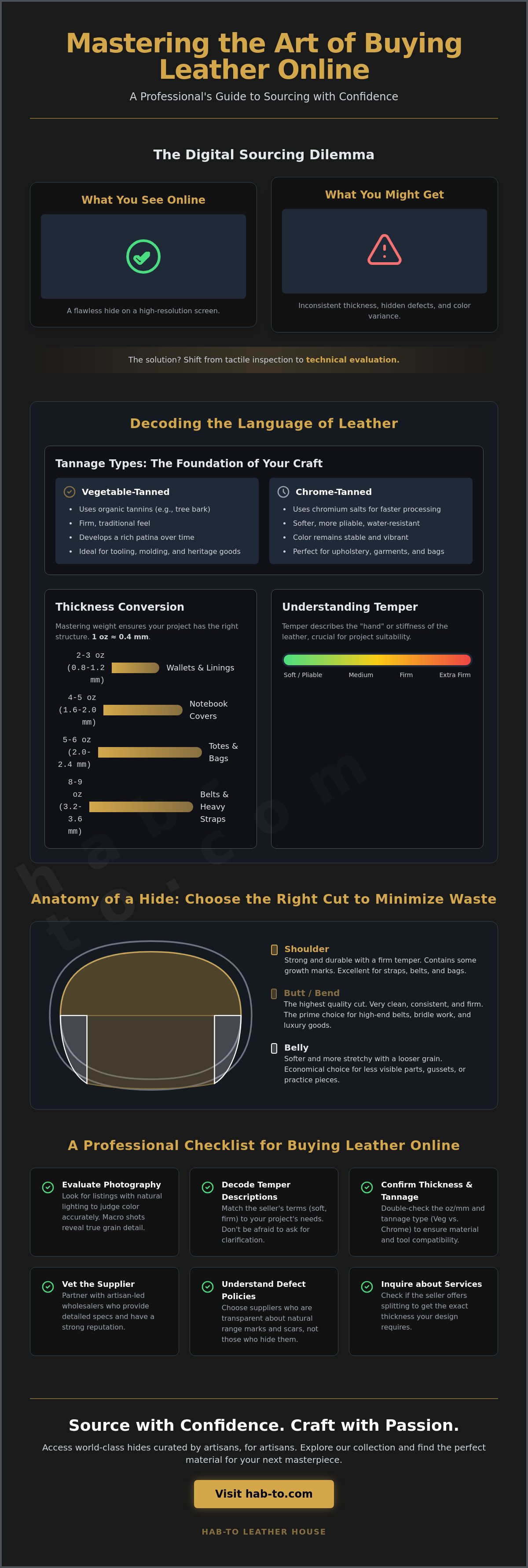
Thickness is the first metric to master. In the leather world, weight and thickness are often used interchangeably. You will see listings in millimetres (mm) or ounces (oz). One ounce equals approximately 0.4mm in thickness. If you are building a heavy-duty tote, you might look for a 5oz to 6oz hide. For delicate cardholders, a 2oz to 3oz selection is more appropriate. Always check if the seller offers splitting services, as this can help you achieve the exact weight your project requires.
Tannage types define how the material will age and how your tools will react. Vegetable-tanned (Veg Tan) leather uses organic matter like tree bark. It’s firm, smells of tradition, and develops a rich patina. Chrome-tanned leather is processed with chromium salts. It’s generally softer, more water-resistant, and holds its colour longer, but it can be harder on certain tools. Your choice here determines the soul of your finished piece.
Surface finishes tell the story of the hide’s history. Full Grain is the gold standard, showing every natural mark and pore. Top Grain has been lightly sanded to remove imperfections, while Corrected Grain is heavily processed for a uniform look. To ensure you are getting exactly what you pay for, it is helpful to consult the FTC guidelines for leather. These standards protect you from deceptive marketing by defining these grades clearly.
Measuring Leather: Area, Weight, and Yield
Hides are natural products. They are sold by the square foot, but they never arrive as a perfect rectangle. You must account for the "yield," which is the usable area after cutting around the belly and legs. Understanding the difference between a side, a shoulder, and a butt is essential for buying leather online without overspending. For high-precision projects, choosing a premium material like Badalassi Pueblo Leather ensures you get a consistent thickness and a reliable grain across the entire surface.
The Importance of Tannery Origin
A hide is only as good as the tannery that produced it. Sourcing from world-class names like Maryam or Badalassi Carlo guarantees a level of consistency that generic "Italian Leather" labels cannot match. In the industry, the Italian label should signify a commitment to the Tuscany region's strict standards for quality and environmental responsibility. When you see these names, you aren't just buying a hide; you are buying centuries of expertise. If you want to experience this quality firsthand, consider exploring our selection of Virgilio Pueblo Leather for your next premium project.
Comparing Hide Cuts: Which Part of the Animal Should You Buy?
A cow is not a flat, uniform rectangle. When you're buying leather online, you're often looking at a diagram of a hide rather than a physical piece. Understanding the "yield"—the amount of usable material—starts with knowing where your piece came from. Every part of the animal serves a different structural purpose. The fibers in the neck differ wildly from those in the flank. If you don't know the difference, you might end up with a belt that stretches like a rubber band or a wallet that is too stiff to fold.
The Leather and Hide Council of America establishes industry standards for these cuts, ensuring that professionals can trade with confidence. A "Side" is half a hide, cut down the spine, offering a large, versatile surface for bigger projects. "Bellies" are the most cost-effective option. They are softer and have significantly more stretch. While they aren't suitable for structural straps, they are perfect for small goods, linings, or testing new patterns. Choosing the right cut ensures you aren't paying for premium grain where a lining would suffice.
Shoulder vs. Butt: Structural Integrity
The "Butt" is the area over the hindquarters. It features the tightest grain and the least amount of stretch. If you're building a structural piece that must never deform, this is your primary choice. The "Shoulder" offers a beautiful balance. It is durable enough for bags and straps but often features more character and growth marks in the grain. For a deeper look at this specific cut, check out our article on What is Shoulder Leather? The Artisan’s Guide. Selecting the correct section is critical when planning leather craft ideas for market stalls. High yield means less waste and better margins for your business.
The Luxury Choice: Shell Cordovan
Then there is Shell Cordovan. It isn't technically skin; it's a fibrous flat muscle found in the hindquarters of a horse. This "shell" is the king of leathers. It doesn't crease. It ripples. It possesses a high-gloss finish that only improves with age. Buying leather online at this price point requires absolute trust in your wholesaler. We recommend Maryam Shell Cordovan Premium Italian Leather for its legendary durability. It is a rare material that demands respect. It requires a patient hand and sharp tools to master. When you work with shell, you aren't just making a product. You're creating an heirloom.
A Professional Checklist for Buying Leather Online
Quality is a dialogue. When you're buying leather online, the relationship you build with your supplier is just as important as the specs on the screen. To bridge the gap between a digital image and your workbench, you need a systematic verification process. This checklist ensures that your investment translates into a material you can actually use.
Start with the photography. Professional listings should feature "true-to-life" lighting that reveals the actual depth of the colour. Look for macro shots that show the pore structure and grain. If a seller only provides one low-resolution image, they might be hiding scars or loose grain. Beyond the visuals, check for "Temper" descriptions. A reputable wholesaler will describe the "hand" of the leather. Is it soft and supple, or firm and snappy? This description tells you how the material will drape in a finished bag or hold its shape in a wallet.
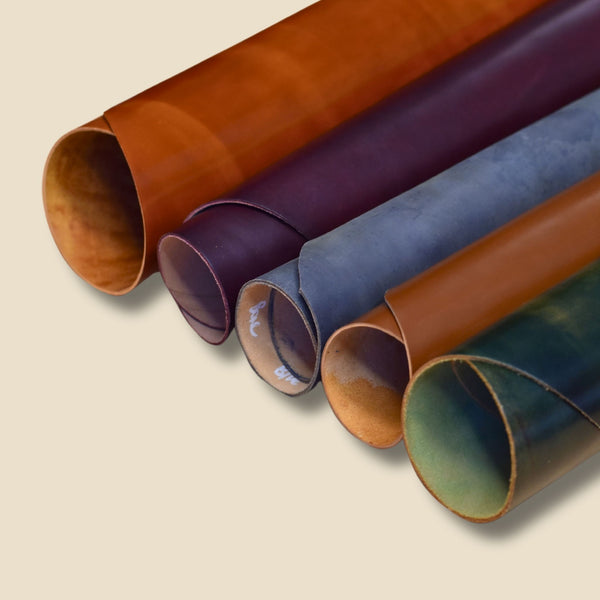
Logistics matter just as much as the hide itself. Review the return policy before committing. While cutting into a hide usually voids a return, you should have the right to inspect the material upon arrival. Examine the shipping method. Professionals roll hides on sturdy tubes. If a seller folds a vegetable-tanned hide into a small box, it can lead to permanent creasing and ruined grain. If you're unsure about a specific colour or feel, ask for samples. A small swatch can save you from a costly mistake.
Communicating with Your Wholesaler
Don't be afraid to ask questions. A simple query like "Is this hide suitable for a structured tote bag?" can reveal a supplier's level of expertise. For high-value materials, a personal consultation is invaluable. This is especially true for rare items like Shell Cordovan, where the price point demands absolute precision. A mentor-style wholesaler won't just take your order. They will suggest better-suited alternatives if they think a different tannage would serve your project better.
Red Flags to Avoid
Identifying red flags early prevents workshop headaches. Avoid vague descriptions like "Genuine Leather." In the industry, this is often a marketing term for the lowest quality tier of real hide. Be wary of listings that use stock photos instead of images of the actual hide being sold. Every animal is unique. You deserve to see the specific character of the piece you are purchasing. Finally, walk away from sellers who cannot identify the specific tannery or country of origin. Transparency is the hallmark of a professional source.
Ready to source with confidence? Experience our commitment to quality and heritage by exploring our premium vegetable tanned leather collection for your next masterpiece.
Sourcing with Confidence: The Hab-To Leather House Experience
Every hide tells a story. At Hab-To Leather House, we've been listening to those stories for over 160 years. Our family legacy in Amsterdam isn't just a timeline. It's a deep-rooted expertise that we bring to every artisan we serve. When you are buying leather online, you aren't just looking for a product. You're looking for a partner who understands the weight of your craft and the importance of your reputation. We've spent over a century refining our selection process so you don't have to guess about quality.
Our commitment is simple. We provide sustainable, vegetable-tanned, and chrome-free leathers that respect both the environment and the maker. We refuse to make concessions on quality. This means sourcing from tanneries that share our principles. Our curated selection includes everything from the durable Virgilio Vaccheta to premium Italian exotics. These materials are chosen for their character, their aging potential, and their reliability under a needle or awl.
Accessibility is at the heart of our mission. You don't need to be a large industrial factory to access world-class materials. We've removed the barriers by offering no minimum orders. Whether you're a hobbyist making your first wallet or a professional studio scaling your production, you get the same professional-grade hides. Buying leather online through our platform means gaining access to a heritage of excellence, delivered directly to your workshop door.
Beyond the Hide: A Complete Crafting Resource
A great project requires more than just premium leather. It requires the right components to bring your vision to life. To streamline your workflow, we offer the ability to source solid brass hardware and professional tools in a single order. We see ourselves as your digital mentor. Our "Leather Hour" podcast and blog are designed to provide the knowledge you need to master new techniques. From our central Amsterdam location, we distribute these resources and materials to artisans across the globe with efficiency and care.
Start Your Next Project with the Best Materials
Navigating our online shop is designed to be as intuitive as a physical visit to our warehouse. We provide the technical data, the high-resolution imagery, and the personal support needed to help you find exactly what you need. Our promise is quality without compromise. We stand behind every hide we ship because we know the passion you put into every stitch. It's time to elevate your work with materials that match your dedication.
Join the community of artisans who trust Hab-To Leather House for their premium sourcing. Let's build something beautiful together.
Elevate Your Craft with Technical Precision
Transitioning from the workshop floor to the digital storefront is a journey of technical translation. You've mastered the language of thickness, temper, and tannery reputation. By understanding hide anatomy and yield, you've turned a potential gamble into a calculated professional decision. Quality is no longer a matter of chance. It's a matter of data and trust.
Success in buying leather online depends on the partner you choose. At Hab-To Leather House, we back your passion with 160 years of family experience and a deep respect for the material. We don't believe in barriers for artisans. That's why we offer no minimum order requirements on world-renowned leathers from tanneries like Maryam and Badalassi Carlo. You deserve materials that match your dedication. Source Your Premium Hides at Hab-To Leather House today and bring your most ambitious projects to life. Your next masterpiece starts with the right hide.
Frequently Asked Questions
Is it safe to buy premium leather like Shell Cordovan online?
Yes, buying premium leather like Shell Cordovan is safe if you source from a wholesaler with a verified heritage and direct tannery relationships. Because of the high price point, you should only purchase from sellers who identify the specific tannery, such as Maryam. Reputable suppliers provide high-resolution grain photos and detailed technical specs to ensure the material you receive matches your professional standards.
How do I know what thickness (oz or mm) I need for a wallet?
For most wallet projects, you need a combination of weights to prevent excessive bulk. Use 2oz to 3oz (0.8mm to 1.2mm) for internal card pockets and 3oz to 4oz (1.2mm to 1.6mm) for the exterior shell. If you are buying leather online and a hide is only available in a heavier weight, check if your supplier offers splitting services to reach your desired thickness.
What is the difference between a 'side' and a 'full hide' when buying online?
A side is exactly half of a full hide, created by cutting the skin vertically down the spine line. While smaller animals like goats or pigs are sold as full hides, larger bovine leathers are almost always sold as sides to make them manageable for shipping and workshop use. A side typically includes the shoulder, belly, and butt of one half of the animal.
Can I return a leather hide if the colour doesn't match my screen?
Most professional wholesalers allow returns of uncut hides if the colour discrepancy is significant, but you should always verify the specific policy before ordering. Screen calibration varies wildly between devices, making "Chestnut" look different on every monitor. To avoid the hassle of international returns, look for sellers who use natural lighting in their photography or offer physical swatches for colour matching.
Why is vegetable-tanned leather preferred by many online crafters?
Vegetable-tanned leather is the preferred choice because of its superior structural integrity and the way it ages over time. Unlike chrome-tanned alternatives, it is processed with natural tannins like tree bark, making it environmentally friendly and safe for your tools. It's the only material that allows for traditional techniques like burnishing, tooling, and carving, which are essential for high-end artisanal leatherwork.
How much leather should I buy for a standard tote bag project?
A standard tote bag usually requires between 5 and 7 square feet of usable leather, depending on the pattern and strap length. However, because hides are natural shapes with varying yields, you should purchase a piece that is at least 10 to 12 square feet, such as a single shoulder. This ensures you have enough clean area to cut large panels without including belly stretch or visible defects.
What are the shipping risks when ordering large hides internationally?
The primary risks are permanent creasing caused by improper folding and unexpected import fees. Professional suppliers mitigate this by rolling hides on heavy-duty cardboard tubes rather than folding them into boxes. When buying leather online from another country, you should also be aware of potential customs duties and merchandise processing fees, which can add to the total cost of your materials.
Does Hab-To Leather House offer samples or swatches?
Yes, we offer sample swatches to help you feel the temper and verify the colour before you commit to a full side or shoulder. We understand that your craft depends on precision, and a physical sample is the best way to overcome the limitations of a digital screen. This service allows you to test how our vegetable-tanned leathers react to your specific needles, threads, and finishes.