How to Justify Buying Premium Leather: The True Value of Quality Materials
That "genuine leather" wallet from the department store is actually more expensive than a premium, vegetable-tanned alternative that costs five times as much upfront. It sounds backwards, but most mass-market leather is designed to fail within 24 months, forcing you back to the checkout line. At Hab-To, we've spent 160 years learning that quality isn't about luxury; it's about longevity. You've likely felt that sting of price shock or felt confused by labels that promise quality but deliver plastic-coated scraps. Understanding how to justify buying premium leather starts with realizing that the cheapest option often carries the highest long-term cost.
I'm going to show you the real cost-per-year of your materials and the ethical impact of your choices. We'll explore why vegetable-tanned hides are the only option for true craftsmanship and how you can spot the difference between marketing fluff and a material that will last a lifetime. You'll walk away with the confidence to choose quality over convenience every single time. No synthetics. No compromises. Just the facts on why better materials make better sense for your wallet and the planet.
Key Takeaways
- Understand the structural differences between full-grain and top-grain materials to ensure your next project resists tearing and moisture.
- Learn how to justify buying premium leather by using the "Cost-Per-Use" formula to see why quality pays for itself over time.
- Discover why vegetable-tanned leather is the truly sustainable choice compared to the microplastics often found in mass-market synthetics.
- Identify the "Fast Leather" traps used by mass-market brands to hide flaws in cheap, heavily processed hides.
- Access professional-grade materials from heritage tanneries without the need for large industrial minimum orders.
The Price of Quality: Why Premium Leather Costs More Upfront
You're staring at a price tag that's three times higher than the one next to it. It's a shock. I get it. But that initial number is just the entry fee for a material that lasts decades instead of months. At Hab-To, we live by a simple rule: No synthetics. No compromises. We only source full-grain, vegetable-tanned hides from heritage tanneries that haven't changed their methods in over 100 years. This isn't about luxury for the sake of status; it's about the technical reality of the material. When you ask how to justify buying premium leather, you have to look past the surface and into the fibers of the hide itself.
Most "leather" products in big-box stores fall into the 'Fast Leather' trap. Manufacturers take low-grade hides, sand off the natural grain to hide scars or insect bites, and then spray on a heavy layer of plastic-based pigment. It looks uniform for 30 days, but it lacks the structural integrity to age. Premium leather doesn't hide behind layers of paint. It relies on the raw quality of the animal's life and the skill of the tanner.
To better understand the difference between marketing hype and material value, watch this breakdown from an industry expert:
The Tanning Timeline: Why 6 Months Beats 24 Hours
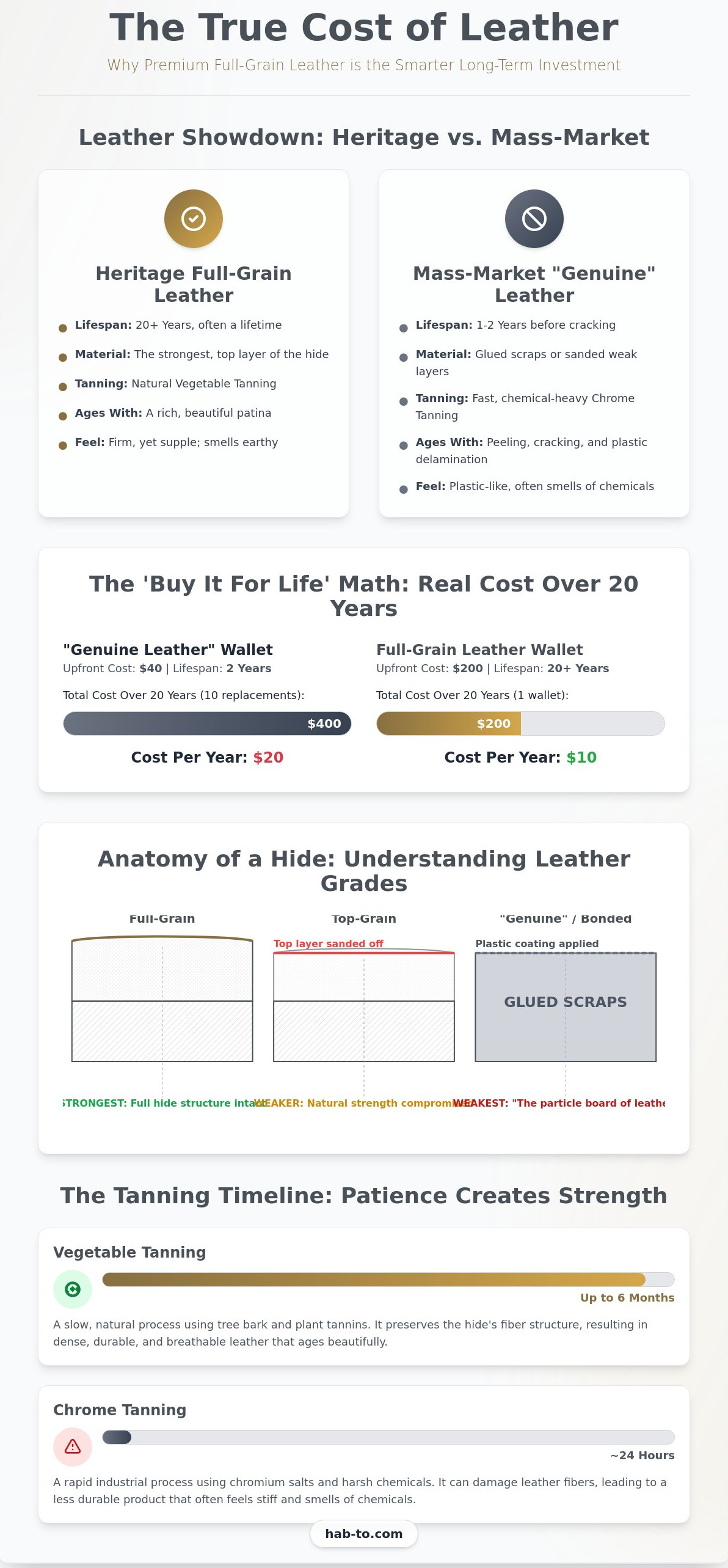
Industrial chrome tanning is a chemical sprint that takes about 24 hours. It uses heavy metals to force a reaction, often leaving the leather feeling like cardboard or rubber. In contrast, traditional vegetable tanning takes up to six months in pits filled with natural bark extracts. Slow-tanning is the essential factor in material density and strength. This patient process allows tannins to fully penetrate the hide without destroying the natural collagen structure. You end up with a material that's dense, resilient, and ready for a lifetime of use. It's a massive investment in time and labor, which is exactly why it costs more at the counter.
Marketing Myths: The 'Genuine Leather' Deception
Don't let the "Genuine Leather" stamp fool you. In the industry, this is often a bottom-tier grade made from the leftover scraps of the hide, glued together and embossed with a fake grain. It's the particle board of the leather world. If you want the real deal, you need Full-grain leather. This is the top layer of the hide, kept intact with all its natural strength. Because these hides are hand-selected for their quality, they don't need layers of "make-up" or heavy coatings to look good. They rely on their own merit, which you can explore further in our vegetable tanned leather guide. Understanding these grades is the best way to learn how to justify buying premium leather for your next project or purchase.
Full Grain and Vegetable Tanning: The Technical Justification
Buying premium leather isn't just about the price tag or a luxury label. It's about the physics of the material. When you're Calculating Real Value, you have to look at how the hide is treated from the moment it leaves the farm. Most mass-market goods use "genuine" or "top-grain" leather. These are often sanded down to remove scars, a process that destroys the strongest fibers in the hide. Understanding this structural compromise is how to justify buying premium leather for any project meant to last a lifetime.
Integrity of the Hide: Why Full Grain Matters
The strongest part of any hide is the grain. This is the outermost layer where the hair once grew. In full-grain leather, this layer remains completely intact. It hasn't been buffed, sanded, or corrected by machines. This is vital because the protein fibers are densest at the surface. When a tannery sands leather to create "top grain," they remove the skin's natural "structural memory." This makes the material more likely to stretch out of shape or tear under stress. High-end crafters actually look for natural "imperfections" like neck wrinkles or small scars. These marks prove the hide is whole and hasn't been weakened by industrial thinning. At Hab-To, we've seen how these natural hides outlast sanded alternatives by over 15 years in daily use cases.
The Art of Patience: Vegetable Tanning Explained
Vegetable tanning is a slow, traditional process that takes up to 60 days, unlike the 24-hour cycle of mass-produced chrome leather. Artisans use large wooden pits and paddles filled with natural tannins derived from oak, chestnut, or mimosa bark. This traditional method avoids the heavy metal chromium salts that make up 90% of global leather production. Understanding the molecular bond of natural tannins is how to justify buying premium leather for heirloom goods. This process results in a distinct, woody scent and a "hand" that feels substantial and firm.
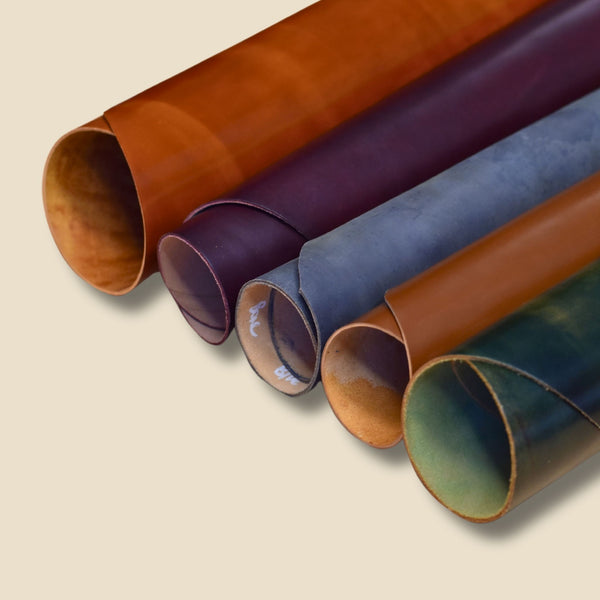
Vegetable-tanned leather, like the Buttero or Pueblo hides we source, offers unique technical benefits:
- Molding: It can be dampened and shaped into permanent forms, which is impossible with plastic-coated leathers.
- Burnishing: The edges can be friction-rubbed to a glass-like finish without using synthetic paints.
- Patina: It absorbs oils from your hands, changing color and character over time rather than just wearing out.
Natural hides breathe because their pores remain open. Cheap alternatives are often sealed with a thick layer of polyurethane (plastic) to hide defects. This plastic coating prevents the leather from "moving," which eventually leads to surface cracking within 24 to 36 months of regular use. Premium vegetable-tanned leather remains supple because it can exchange moisture with the air. If you want to see the difference in person, you can browse our hand-selected hides and feel the texture that 160 years of family experience has taught us to value. No synthetics. No compromises. Just the raw integrity of the material.
The 'Buy It For Life' Math: Calculating Real Value
Buying cheap often ends up being the most expensive choice you can make. When you're trying to figure out how to justify buying premium leather, you have to look past the initial price tag and focus on "Cost-Per-Use." This is the only financial metric that actually matters for your wardrobe and your wallet.
Think about a standard €50 "genuine leather" wallet. These are usually made from low-grade scraps bonded with plastic. They have a lifespan of roughly 2 years before the edges crack and the finish peels. Compare that to a €150 premium, full-grain wallet. With minimal care, that piece will last 20 years or more. While the premium option costs three times as much upfront, it's nearly seven times cheaper over its total lifespan. It's a simple calculation: €25 per year for the cheap version versus €7.50 per year for the quality one.
High-quality leather offers something synthetics can't: repairability. If a stitch pops on a hand-crafted bag, a cobbler can fix it. If the surface gets scratched, you can buff it out. When synthetic materials fail, they go into the bin. Premium leather doesn't just survive; it thrives through the "Patina Effect." It absorbs the oils from your hands and the sunlight from your travels, developing a rich glow and deep color that makes the item more beautiful every year. You're buying an asset that improves with age.
A 10-Year Value Projection
If you look at a decade-long timeline, the financial gap widens. Over 10 years, you'll likely replace a cheap wallet five times. That's €250 spent on items that eventually look like trash. You also have to factor in hidden costs. These include the frustration of stuck zippers, the embarrassment of a peeling briefcase in a meeting, or even losing a credit card because a cheap seam failed. A single premium purchase eliminates these risks. Additionally, high-end leather goods often retain 40% to 60% of their value on the second-hand market, whereas disposable goods have zero resale value.
The Emotional ROI: Heritage and Storytelling
There's a psychological weight to owning an object that grows old with you. It becomes a companion rather than a commodity. This is why many enthusiasts start their journey by learning how to justify buying premium leather through materials like Shell Cordovan. Often called the "King of Leathers," Shell Cordovan is exceptionally dense and doesn't crease; it ripples. It's the pinnacle of investment-grade material. When you choose quality, you aren't just buying a product. You're starting a story that you might one day pass down. At Hab-To, we believe in no synthetics and no compromises because real craftsmanship deserves to last a lifetime.
Ethical Craftsmanship and Environmental Impact
You might wonder if high-end leather is actually better for the planet than the alternatives. It's a fair question. To understand how to justify buying premium leather, you have to look past the marketing buzzwords and examine the lifecycle of the material. Genuine, vegetable-tanned leather is an organic product. It comes from a long tradition of using every part of the animal, turning a byproduct of the meat industry into a material that lasts for generations.
The Synthetic Fallacy: Why 'Vegan' Isn't Always Sustainable
The term 'vegan leather' is often a clever rebrand for plastic. Most of these materials consist of Polyurethane (PU) or Polyvinyl Chloride (PVC), which are derived directly from petroleum. These synthetics don't breathe, they don't develop a patina, and they don't last. While a premium leather bag can serve you for 30 years, synthetic versions often show signs of planned obsolescence, cracking and peeling within 12 to 18 months.
"Leather is a natural byproduct that, when tanned correctly, lasts centuries instead of clogging a landfill for a millennium."
When plastic items fail, they break down into microplastics that persist in the environment. In contrast, vegetable-tanned leather uses natural tannins from bark and leaves. It remains a biodegradable material at the end of its long life. Choosing quality means you buy less often, which is the most sustainable action any maker can take.
Traceability and Animal Welfare
Premium tanneries don't source hides blindly. They prioritize traceability through organizations like the Leather Working Group (LWG). As of 2024, over 80% of the world's premium leather production comes from LWG-certified facilities that are audited for water management and chemical usage. These tanneries pay a premium of 15% to 25% for hides from regions with strict animal welfare laws. There is a direct link between the health of the animal and the quality of the hide. A clean, scar-free surface usually indicates an animal that was well-nourished and kept in a stress-free environment.
At Hab-To, we follow a strict 'No compromises' rule. We source from multi-generational family businesses that preserve artisan skills. By choosing these materials, you support a supply chain that values human craft over automated mass production. This social impact is a vital part of the value proposition. Understanding these ethical standards is the best way to see how to justify buying premium leather when compared to mass-produced goods.
Sourcing Premium Leather Without the Industrial Overhead
Many makers assume that top-tier hides are reserved exclusively for luxury fashion houses. That isn't the case. At Hab-To, we bridge the gap between industrial supply and your workbench. We've structured our house to make world-class materials accessible to everyone. Whether you're a weekend hobbyist or a small studio owner, you shouldn't have to settle for "good enough" materials that fail to do your hard work justice.
Hi, I'm Mike. My family has been immersed in the leather industry for over 160 years. That represents six generations of knowledge poured into every hide we select for our inventory. When you buy from us, you aren't just getting a piece of vegetable-tanned skin; you're getting heritage and expert advice. If you're wondering how to justify buying premium leather, consider the cost of failure. Cheap leather hides mistakes poorly and ages even worse. Premium leather works with you, helping you achieve professional results even if you're still learning the ropes.
Our 'No Minimum Order' policy is designed for risk-free exploration. You can test a single shoulder of world-famous Buttero or Pueblo without committing to a full hide. This allows you to feel the temper, test the pull-up, and see the grain before scaling up your production. To elevate your project even further, pair your choice with high-quality leather hardware that matches the caliber of your material. No synthetics. No compromises.
Why the 'Wholesaler to Artisan' Model Works
As an Amsterdam leather wholesaler, we cut out the traditional retail markups that typically inflate prices for the end-user. We source direct from the best tanneries in the world and pass that value to you. This model allows for a level of curation you won't find at a massive, impersonal supplier. Every hide is hand-selected. If you're in the Amsterdam area, you can even book a personal consult at our showroom. We'll help you pick the exact piece for your specific project, ensuring zero waste and maximum quality.
Your First Step Toward Premium Crafting
Don't feel pressured to buy a full side of Cordovan on day one. Start small. A single shoulder of Pueblo or Buttero provides enough material for several wallets or a small clutch. You'll notice immediately that better material actually improves your skill level. It cuts cleaner, burnishes easier, and smells like a true artisan workshop. It's time to stop compromising on your passion. Browse our hand-selected premium leathers and see what 160 years of experience looks like on your workbench.
Build Something That Lasts
Choosing the right material defines the lifespan of your work. Full grain, 100% vegetable-tanned leather doesn't just survive daily use; it evolves. While cheaper alternatives rely on plastic coatings that crack within months, premium hides develop a unique patina that increases in beauty over years of wear. This longevity is the core of how to justify buying premium leather. You're trading a higher upfront cost for a product that avoids the landfill and eliminates the need for frequent replacements. It's a choice that respects both the craft and the planet through sustainable sourcing practices.
You shouldn't have to navigate industrial gatekeepers to find the best materials. At Hab-To, we've spent 160+ years refining our family leather expertise to support crafters of all levels. We provide professional-grade hides with no minimum order requirements, ensuring you get exactly what you need for your next masterpiece. Our commitment is simple: no synthetics and no compromises. We've hand-selected every piece to ensure your projects stand the test of time. Start your premium project with Mike’s hand-selected hides and experience the difference that century-old tradition makes in your hands. Your craftsmanship is worth the investment.
Frequently Asked Questions
Is premium leather actually worth the extra cost?
Premium leather is worth the investment because it typically lasts 5 to 10 times longer than synthetic or low-grade alternatives. While a "vegan" or bonded leather bag might peel within 2 years, a full-grain vegetable-tanned piece can easily serve you for 20 years or more. You're paying for durability and the ability to repair the item. This long-term utility is the most practical way to justify buying premium leather for any serious project.
How long can I expect a vegetable-tanned leather product to last?
You can expect a high-quality vegetable-tanned leather product to last between 20 and 40 years with basic care. This longevity comes from the traditional tanning process that uses natural tannins from tree bark, which takes up to 60 days to complete. The result is a dense fiber structure that doesn't break down like chemically treated hides. It actually grows stronger and develops a unique patina over decades of daily use.
What is the difference between full-grain and 'genuine' leather?
Full-grain leather uses the entire thickness of the hide, including the tough outer layer where the fibers are tightest. "Genuine" leather is often a misleading marketing term for the 3rd or 4th layer of the hide, which is then corrected with plastic resins to look real. Industry tests show that full-grain leather has 4 times the tensile strength of "genuine" grades. It's the difference between a lifetime heirloom and a temporary accessory that will eventually crack.
Why is Shell Cordovan so much more expensive than other leathers?
Shell Cordovan is expensive because it's sourced from a specific muscle membrane in horse hindquarters, yielding only 2 small oval "shells" per animal. The tanning process at world-renowned tanneries takes 6 full months of labor-intensive work to complete. This leather doesn't crease; it ripples. It's virtually non-porous and naturally water-resistant, making it a pinnacle material for craftsmen who refuse to make compromises on quality or performance.
Is expensive leather more environmentally friendly than cheap leather?
Premium vegetable-tanned leather is significantly better for the environment because it uses 0% heavy metals like chromium. About 90% of the world's leather is chrome-tanned, which can lead to toxic waterway pollution if the tannery doesn't manage waste properly. Traditional vegetable tanning relies on organic extracts instead. Because these products last 10 times longer than cheap alternatives, they reduce the overall consumption cycle and keep waste out of landfills.
Can I buy premium leather in small quantities for a single project?
You can certainly buy premium leather in small quantities, as we've eliminated minimum order requirements at our Amsterdam warehouse. Whether you need a single panel for a wallet or a half-hide for a bag, we support makers at every level. This accessibility makes it easier for you to justify buying premium leather without a massive upfront investment. We believe every craftsman deserves access to world-class materials regardless of their project size.
How do I know if the leather I'm buying is truly premium quality?
Look for leathers from certified tanneries like Walpier or Badalassi Carlo, which belong to the Genuine Italian Vegetable-Tanned Leather Consortium. Premium hides have a distinct, earthy smell and show natural markings like fat wrinkles or growth lines. If the surface looks like a uniform sheet of plastic, it's likely a low-quality corrected grain. Quality leather feels substantial in your hands and develops a natural "burnish" when you rub the edges.
Does premium leather require more maintenance than cheaper alternatives?
Premium leather actually requires less frequent maintenance than cheap, coated leathers that dry out and crack. You only need to apply a high-quality conditioner every 6 to 12 months to keep the internal fibers supple. Because the material is breathable, it doesn't require the heavy plastic sealants found on budget hides. A simple horsehair brush and a damp cloth are usually enough to keep a 20-year-old bag looking brand new.